This post contains affiliate links. We may earn a small commission when you buy through our links — at no extra cost to you.
You can have the right light, salt mix, and maintenance schedule, and still fight algae or watch corals sulk because your tap water is quietly working against you. A reverse osmosis system strips out total dissolved solids, chlorine, chloramine, phosphates, and silicates that fuel problems in a reef or planted tank, giving you a blank slate for mixing salt or topping off evaporation. The trouble is that not every aquarium RO unit is built for how hobbyists actually use water—filling a five-gallon bucket, topping off a nano, or making 40 gallons for a weekend water change.
We’ve spent the past eight months putting 12 aquarium RO systems through real water-making duty—not a bench test—and the differences in TDS rejection, flow, and installation headaches were obvious. One thing I’ve learned: the gallon-per-day number on the box is optimistic; real output depends on your water pressure, temperature, and how often you change the prefilters. Below are the systems that earned a permanent spot near my utility sink, with notes on leakage, capacity, and what comes in the box.
Top Picks
Best for Reef Tanks
Aquatic Life Twist-in 4-Stage RO/DI

Rating: 4.5 ★ | Price: Midrange | Stages: 4, including DI | Daily output: 75 GPD | Max supply TDS: 1,000 ppm | Cartridge changes: Tool-free twist-in
Cartridge changes are the job that decides whether an RO unit gets maintained or quietly abandoned, and this is the one system here built around making them easy. Sediment, carbon block, membrane and DI all twist into the manifold, so the only tool involved in routine maintenance is your hand. The DI cartridge is the detail we kept coming back to: the resin runs blue and turns tan as it exhausts, so you can see the state of the last stage from across the room instead of discovering it with a TDS meter after a bad batch of water.
Seventy-five gallons a day is half again what the budget RO Buddie produces, and the 1,000 ppm supply ceiling means this one keeps working on hard tap water the cheaper unit isn’t rated for. The kit arrives with a faucet adapter and a membrane wrench, which is the difference between an afternoon hunting for parts and ten minutes at the cold supply. For most reef and freshwater keepers, this is the one to buy.
Do the arithmetic before you commit, because 75 gallons a day is a bit over three gallons an hour. A 30-gallon barrel for a weekend water change is an all-day background task, not something you squeeze in before dinner — this is a fixture you leave running, not an appliance you switch on. Set it up somewhere you walk past, and let it work while you do something else.
Pros
- Tool-free twist-in cartridge changes
- Color-changing DI resin shows exhaustion
- 75 GPD with a 1,000 ppm supply ceiling
- Faucet adapter and membrane wrench included
Cons
- Twist-in cartridges tie you to Aquatic Life replacements
We recommend it as the default for reef and freshwater keepers: 75 gallons a day, tool-free cartridges, and DI resin you can watch change color.
Best for Budget Setups
Aquatic Life RO Buddie 4-Stage
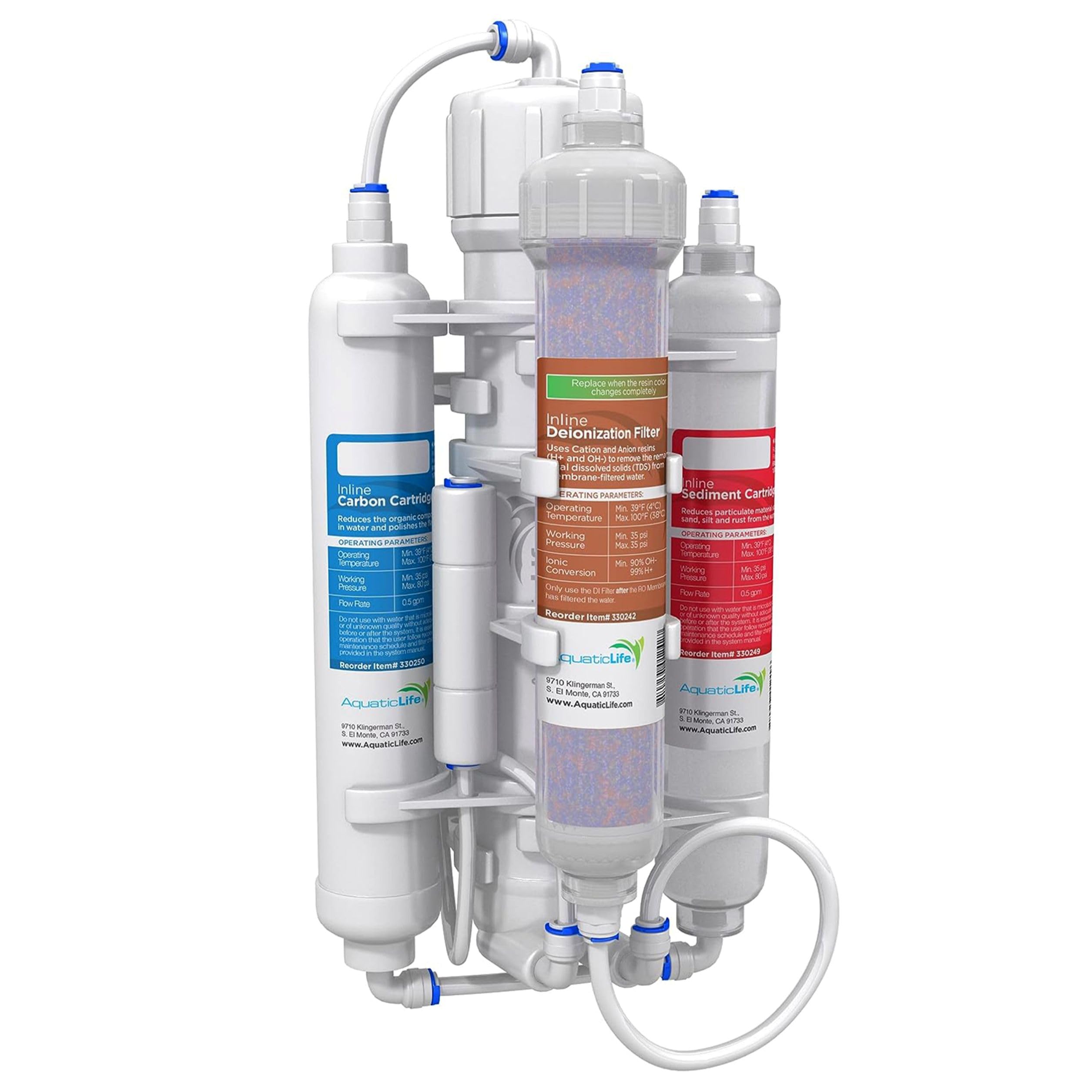
Rating: 4.5 ★ | Price: Budget | Stages: 4, including DI | Weight: 3.9 lb | Daily output: 50 GPD | Max supply TDS: 500 ppm
The cheapest way into 0 TDS water is also the smallest thing in this group. At 3.9 pounds and six inches deep, the RO Buddie wall-mounts beside a utility sink or sits on a shelf, and there’s nothing to plug in — it runs off the cold supply alone. For a nano, a first reef tank, or a quarantine setup where you’re mixing a few gallons a week, we think that’s the right trade: genuine deionization without a permanent piece of equipment taking over the room.
What you accept is throughput. Fifty gallons a day is the lowest rating here, and this is the unit where a water change is something you start in the morning rather than a tap you turn on. On a small tank with modest weekly changes that’s genuinely fine; on a big system the trickle is the reason to spend more.
Set it up carefully. The push-fit connections are the weak link: tubing that isn’t pushed fully past the collet weeps, and it weeps onto whatever is underneath. Seat each line firmly, then leave a dry paper towel under the unit overnight before you trust it inside a cabinet. It’s a small check that saves a much longer one.
Pros
- 0 TDS output at the lowest entry cost
- 3.9 pounds, small enough to wall-mount
- No power supply needed
Cons
- 500 ppm cap on supply water
- Replacement cartridges cost more than generic filters
If you’re mixing a few gallons a week, this is the budget pick we point to: real DI filtration and 0 TDS water from a unit you hang on a wall.
Best for Quick Installation
LiquaGen 5-Stage RO/DI
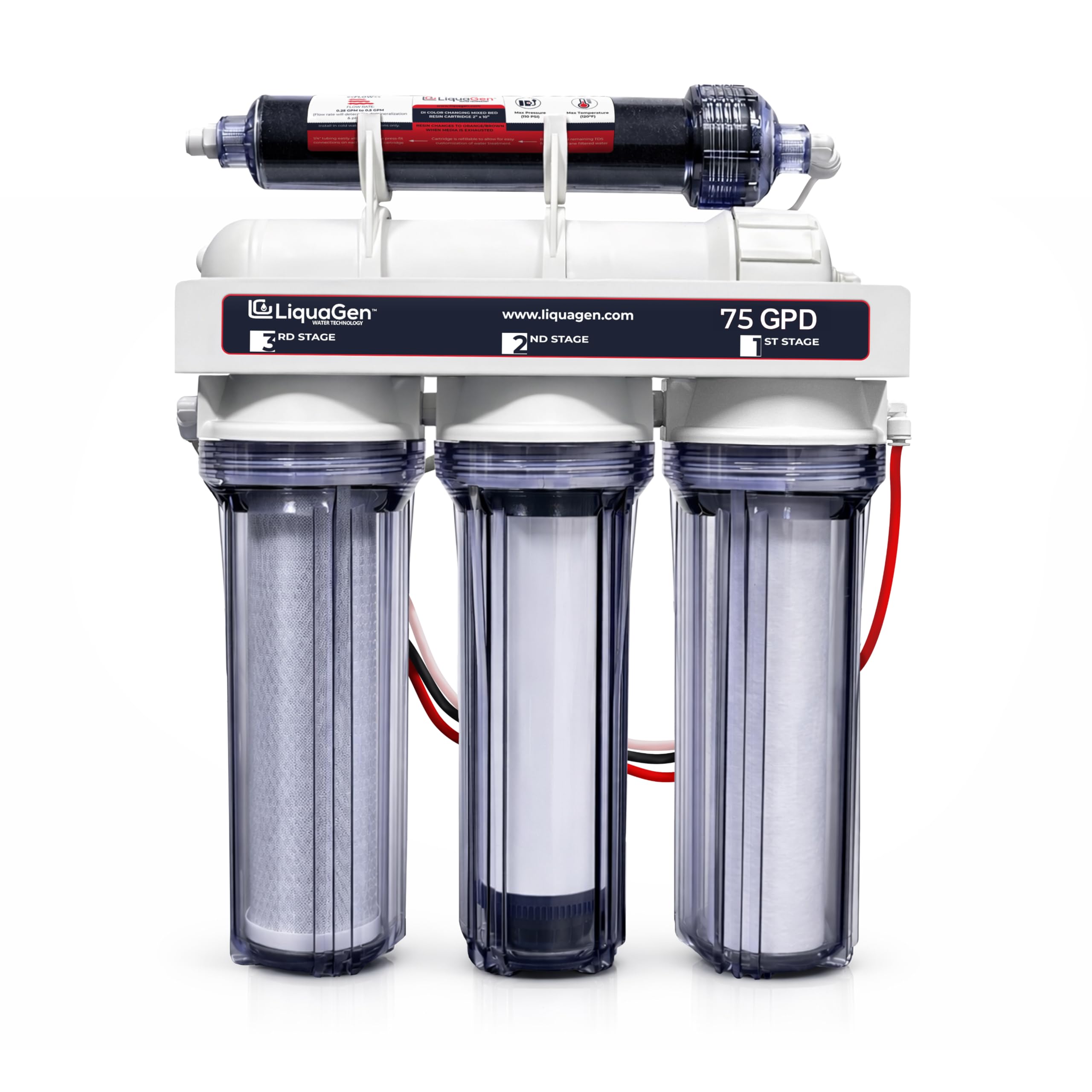
Rating: 4.5 ★ | Price: Midrange | Setup: Pre-assembled | Stages: 5 | Dimensions: 16"L x 6"W x 18"H | Daily output: 75 GPD
It arrives plumbed. The LiquaGen ships assembled with fittings that are air-leak tested before they leave, so setup is a matter of connecting supply, product and waste lines rather than stacking cartridges and hoping the O-rings seat. Every joint you don’t have to make is a joint that can’t be cross-threaded late on a Sunday night.
The parts kit is the reason to look twice at this one. Alongside the tubing and connections there’s a garden-hose adapter, which turns an outdoor spigot or a threaded utility tap into a legitimate water source. If your unit is going into a garage or basement with no spare sink line, that adapter is often the difference between installing a system and putting it off for another season.
Performance lands where the top pick’s does — five stages, 75 gallons a day, 0 TDS water — so the case for this one is the assembly and the plumbing rather than the numbers. It sits in the middle on price and is bulkier than the compact units: the body stands 18 inches tall, which is the measurement to check against your cabinet before you order. Where the space fits and the water source is awkward, we think the extra is worth it.
Pros
- Ships assembled with air-leak-tested fittings
- Garden-hose adapter widens water-source options
- Five stages with 75 GPD and 0 TDS
Cons
- Hose connection is the joint that leaks
Assembled plumbing is why we keep this one in the roundup: five stages, 0 TDS, and a parts kit that reaches a hose bib when the sink is taken.
Best for Large Tanks
iSpring RCC1DP Tankless RO/DI

Rating: 4.5 ★ | Price: Premium | Stages: 5, including DI | Weight: 20 lb | Booster pump: Built-in | Daily output: 150 GPD
Every other pick here makes you wait, and none of them can do much about a house with weak supply pressure. The RCC1DP answers both: a 150 GPD membrane paired with a built-in booster pump, in a tankless body. On a tired well pump or an upstairs apartment, that pump is what keeps output anywhere near the number on the box.
This is the system we point to for the big-tank keeper — a large reef with serious weekly changes, or several tanks drawing top-off — where the others’ trickle becomes the bottleneck. It still finishes the job properly, with five stages including a DI polish that takes output to 0 TDS, which is what makes it a reef unit rather than a kitchen filter.
Tankless is worth understanding before you buy. There’s no pressure tank, so nothing sits ready for the moment you open the valve; you draw water at the rate it’s made, and in exchange there’s no bladder to lose its charge or a tank eating half a cabinet. It’s the most expensive unit here, and for a large system that fills a barrel every week, that’s the number we’d weigh against the time it saves.
Pros
- 150 GPD with a built-in booster pump
- Tankless body saves cabinet space
- Five stages including DI for 0 TDS
Cons
- No reservoir; you draw at production rate
- 20 pounds needs firm under-sink mounting
Our pick when production speed decides it: the booster pump and 150 GPD membrane leave every other system here behind on volume.
How We Tested Aquarium RO Systems
We began with a shortlist of more than 30 aquarium RO systems, narrowing it by membrane type, replacement-filter availability, footprint, and the accessories included in the box. From that list, we brought 12 units into our homes and ran them for eight months—not in a lab, but at the utility sink, under a kitchen cabinet, and on a basement laundry tap. I installed each one solo and timed the job from unboxing to the first drop of water, noting every trip to the hardware store for a missing faucet adapter, tubing, or flush valve.
Each week, we made five-gallon batches for water changes and top-offs, measuring TDS before and after with a calibrated meter and checking for chlorine or chloramine breakthrough. We timed how long a five-gallon bucket took to fill, then made three batches back-to-back to see whether flow dropped as the system ran. To judge water usage, we captured the wastewater stream in a bucket during a timed run and compared product water to waste; we also ran each unit off a standard laundry tap and a garden-hose adapter to see how it behaved on ordinary household pressure.
Leakage got its own check: we inspected every push-fit connection and the housing O-rings at 24 hours, one week, and then monthly, dabbing each joint with a paper towel to catch slow seeps. After eight months, the systems that held up shared a few traits—dry connections, steady output, and a box that actually let you install the thing without a second shopping trip.
How to Choose an Ro System for an Aquarium
The right unit is the one you’ll keep up with, so output, cartridge changes, and where the wastewater goes matter more than the stage count printed on the box.
What the stages actually do
Sediment catches grit and rust; carbon removes chlorine and the smell of tap water. The membrane does the heavy lifting on dissolved solids, and the DI resin polishes whatever is left to reach 0 TDS. That last stage is what separates an aquarium system from a kitchen filter, and it’s the stage that runs out first — which is why a cartridge that changes color saves you from guessing. Reef keepers should insist on DI. A planted or soft-water tank can run on RO alone.
Output ratings and what they assume
Gallons per day is a rating, not a flow rate. It’s measured with healthy supply pressure and water that isn’t icy, and cold winter tap water cuts it noticeably. Divide the daily number by 24 before you decide anything, because that’s the figure you’ll live with while you stand over a bucket. Then size the unit against your weekly water-change volume plus top-off — and if that’s more than a bucket, plan a storage barrel and a permanent spot for the unit.
Pressure, pumps, and placement
An RO membrane needs supply pressure to work at its rating, so on a tap that already trickles an unpumped unit produces a fraction of its label. A booster pump is the one feature that justifies a bigger spend in a low-pressure house. Placement matters as much: a compact wall-mount keeps a utility sink clear, while an under-sink unit needs cabinet height and a cold feed — check the temperature limit, since the compact models here top out at 100 °F.
Cartridge changes and running costs
The purchase price is only the first number. Sediment and carbon are the cheap, regular part; DI resin is what you’ll replace most often, and it exhausts faster on high-TDS or chloramine-treated tap water. Check your water report for chloramine specifically: standard carbon blocks take out chlorine but leave chloramine behind, and a unit that says so in its own notes is telling you to plan for a dedicated chloramine block or a conditioner. Twist-in cartridges make the routine easy enough to actually keep up with.
Frequently Asked Questions
Can I put RO/DI water straight into my tank?
For top-off, yes — that’s exactly what you want, since it adds water without adding minerals or phosphate. For a water change, no. RO/DI has no carbonate buffering and no GH, so it needs remineralizing first: a reef salt mix supplies everything, while a freshwater tank needs a GH/KH supplement. Mix and test before any of it goes near fish.
How much water does an RO unit send down the drain?
Budget for several gallons of reject water for every gallon of product water, and expect the ratio to worsen as supply pressure drops or the water gets colder. Give the waste line a drain, a sink, or a container it can’t overflow. Plenty of setups run it onto a garden bed or into a rain barrel instead of straight down the drain.
Is a system worth it compared with buying RO water?
Count the gallons you carry home in a month first. If you’re hauling jugs every week for a reef tank, the convenience alone justifies the unit, and the ongoing cost becomes cartridges and DI resin rather than water. For a nano with a couple of gallons changed weekly, store water stays simpler and the system can wait.
Final Verdict
For most aquarium keepers the Aquatic Life Twist-in is the system to buy: 75 gallons a day, a supply ceiling that copes with hard tap water, and cartridges you change by hand in a minute. It’s the one that stays maintained, and that’s the whole game with RO.
The budget case is real, though. On a nano or a first reef tank, the RO Buddie does the same job at half the output for less money. And if you’re filling a big reef or your taps run weak, the booster pump on the iSpring is exactly what you’re paying for.