This post contains affiliate links. We may earn a small commission when you buy through our links — at no extra cost to you.
Anyone who has watched a 20-gallon tank’s thermometer climb past 82°F on an ordinary July afternoon knows the feeling: the fish go quiet, the plants look tired, and the fan-and-ice-cube routine stops being funny. A chiller fixes that — not just colder water, but water that stays put overnight, through a heat wave, and across a week when you’re too busy to check. On a tank this size it’s the difference between a hobby and a daily emergency.
I’ve spent the past seven months running eight chillers on a 20-gallon setup, from the worst of summer into cooler weather, and the differences surfaced in quiet places — mostly in how steadily a unit held its setpoint when nothing dramatic was happening. One thing first-timers miss: a chiller oversized for your tank short-cycles, which is harder on the unit and louder than a properly matched one. What follows is what earned a spot.
Our Top Picks
The Best Aquarium Chiller for a 20 Gallon Tank, Reviewed
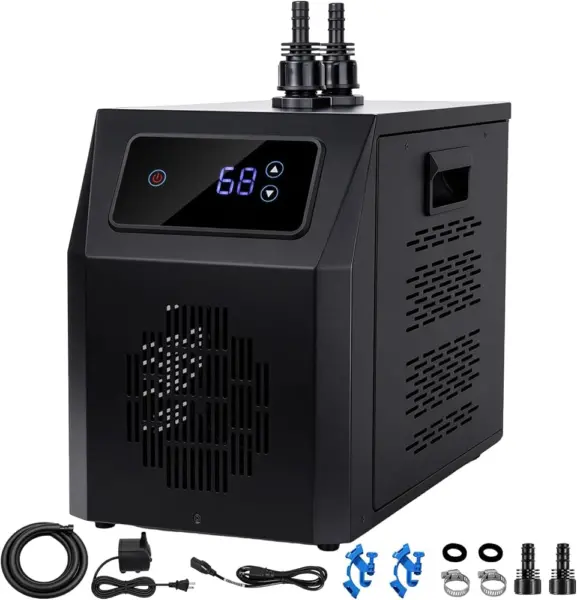
Fitnet 1/10 HP Chiller – Best Overall
Key Features
- Weight: 29.8 lb
- Compressor: 1/10 HP
- Tank rating: 42 gal (160 L)
- Wetted material: Titanium
- Price: Midrange
A 20-gallon tank doesn’t ask much of a compressor in April. August is the real test, and that’s the argument for our top pick: the Fitnet is rated to 42 gallons (160 liters) at 1/10 HP, roughly twice the water it will actually be cooling. Reserve is what lets the compressor work in short, quiet cycles instead of running flat out through a heat wave, and it’s what makes the same chiller sensible if you move up to a 40 breeder in a couple of years.
The water side is sorted properly. Titanium in the wetted parts means fresh or salt makes no difference, the pump comes in the box, and the touch-screen controller is a set-and-leave-it affair once you’re through the two menus. It’s those menus, F1 and F2, plus printed instructions that assume you have plumbed a chiller before, that slow the first install down. Watch a setup video before the box arrives and the job takes an afternoon.
What you’ll hear in practice is vibration more than fan noise. A foam mat or a folded towel under the base takes the hum out of a hard floor, and it’s the single best thing you can do for the noise: on a wooden stand especially, the pad matters more than anything printed on the box.
Value lands where you’d hope for a kit that includes the pump, mid-pack against the rest of this group and a long way below the inline option. The reason to pay it is the reserve. A chiller running at part load is quieter and less stressed than one that is always catching up, and that is the version of ownership you want in the third summer, not just the first.
Pros
- 42-gallon rating leaves real headroom
- Titanium wetted parts suit saltwater
- Pump included with the chiller
- Temperature holds a set point steadily
Cons
- Heaviest unit here at just under 30 pounds
For most 20-gallon tanks, especially in a warm room, this is the chiller we recommend: the reserve, the titanium parts and the included pump make it the safest buy of the four.
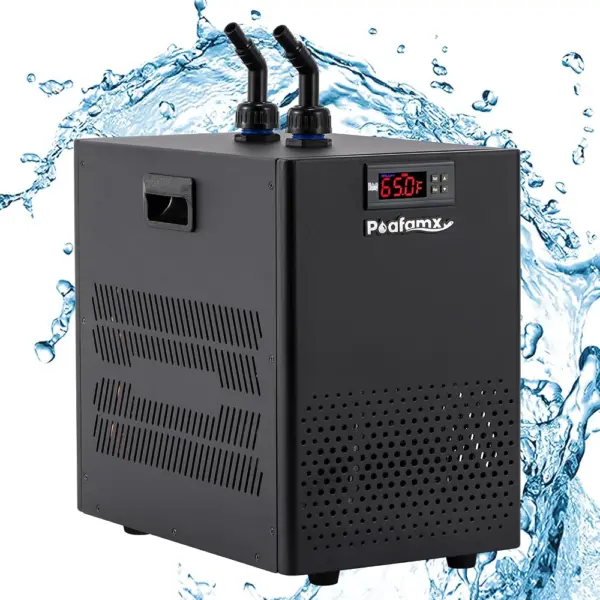
Poafamx 26 Gal Chiller – Best Compact Option
Key Features
- Weight: 22.1 lb
- Compressor: 1/13 HP
- Dimensions: 13.4 x 7.9 x 11.8 in
- Tank rating: 26 gal
- Price: Midrange
Small is the whole pitch. At 13.4 by 7.9 by 11.8 inches and 22.1 pounds, this is the lightest chiller in the group and one of the two smallest. One hand gets it onto a shelf, and it slots into the gap beside a 20-gallon stand without rearranging the room around it.
The 1/13 HP compressor is rated for 26 gallons and tuned to the 20-to-30-gallon band, which is exactly the water a 20-gallon tank holds, and the front and side vents paired with twin rear fans give it a lot of airflow for a body this compact. The hard limit is the range: it holds between 65F and 80F (18 to 27C). That covers a community tank or an axolotl at the warm end of its range and stops short of anyone chasing the low 60s.
Cost is about the same as the top pick, and that tells you what you’re buying: the smaller box, not a smaller bill. For a stand wedged into a corner or a cabinet with limited floor space, we think that’s a fair trade, because a chiller that fits gets installed and one that needs a new shelf sometimes doesn’t. Setting the target takes a patient ten minutes with the manual the first time, since the controller wants a sequence rather than a dial, and then you never touch it again.
Titanium in the water path handles saltwater, the pump and pipe come in the box, and the warranty runs one year, which is standard for this class rather than generous. Worth weighing when the compressor is the one part you can’t service yourself.
Pros
- Lightest and among the smallest here
- Rated for the 20-30 gallon band
- Titanium evaporator for saltwater
- Pump and pipe included
Cons
- Cooling range stops at 65F
- Least reserve of the four in a heat wave
Buy the Poafamx when floor space decides the purchase: it is the lightest and one of the two smallest chillers here, and 20 to 30 gallons is exactly its rated range.
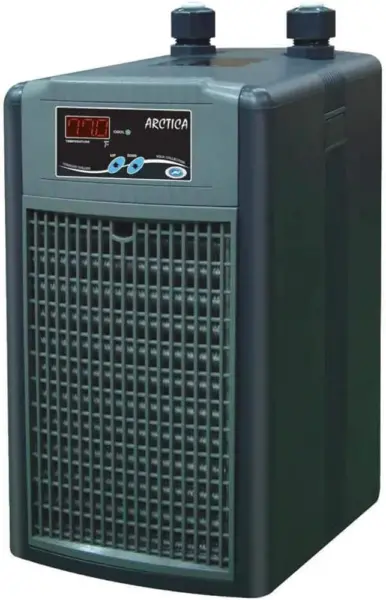
JBJ Arctica 1/15 HP – Best Inline Pick
Key Features
- Weight: 25 lb
- Plumbing: Inline
- Compressor: 1/15 HP
- Dimensions: 12 x 16 x 15 in
- Price: Premium
Inline, grey and built to disappear: the Arctica plumbs into your return line rather than dropping a coil into the tank, so nothing hangs in the display and nothing about the way the tank looks changes.
For a 20-gallon with a sump or a canister filter, we think that’s the tidiest way to run a chiller. The unit lives under the stand rather than beside it, and at 1/15 HP it’s the smallest compressor in this group, the sort of close match that gives long, steady cycles instead of short bursts. Titanium coils handle the corrosion side, so saltwater is no harder on it than fresh.
Placement does more work here than with the drop-in units. There’s no pump or hose in the box, so you’re matching a pump to the chiller’s flow and running your own plumbing, which is modest on a 20-gallon but is part of the project. And an inline chiller pushes its heat into whatever space it lives in, so an open stand is easy while a closed cabinet wants a vent or the back taken off.
Twenty-five pounds, a 12 by 16 by 15 inch body and titanium coils that shrug off saltwater: the hardware is serious. The cover is one year limited, the same thin year everything in this group offers, and knowing that up front is worth more than the number printed on the datasheet.
Pros
- Inline plumbing keeps the display clear
- Smallest compressor of the four
- Titanium coils resist corrosion
Cons
- Priciest of the four by a wide margin
- Chiller only; pump and plumbing extra
If the tank has a sump and you want the hardware out of sight, the Arctica is the neatest option here, as long as the chiller-only kit and the price don’t put you off.
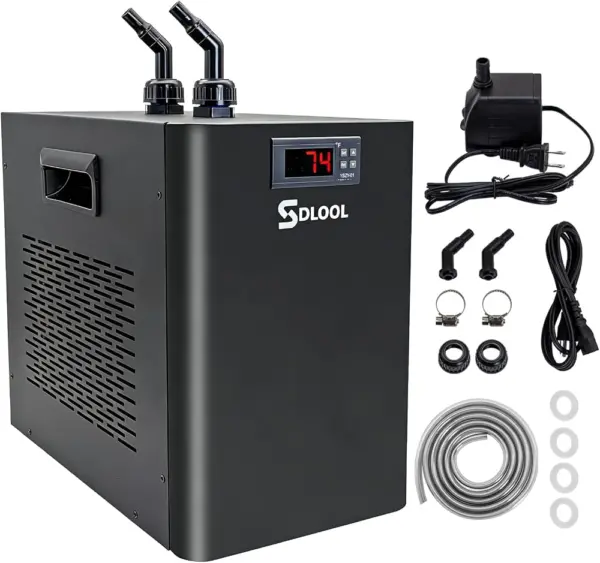
SDLOOL 42 Gal Chiller – Best for Budget Builds
Key Features
- Compressor: 1/10 HP
- Dimensions: 13.39 x 7.87 x 11.81 in
- Tank rating: 42 gal (160 L)
- Noise rating: Under 40 dB
- Price: Budget
Set this beside the Poafamx and the numbers look like a misprint: almost the same box at 13.39 by 7.87 by 11.81 inches, but a 1/10 HP compressor rated for 42 gallons where the other has 1/13 HP for 26, and five and a half pounds more on the scale. That’s the most cooling per inch of footprint in this group.
Titanium in the water path, R134a refrigerant, and venting around the whole body for the heat it moves. The spec sheet puts noise under 40 decibels, which for a compressor we treat as a claim to test in your own room: expect a low hum you notice in a quiet house and stop hearing in a busy one.
Capacity is the argument. A 42-gallon rating on a 20-gallon tank is the reserve that put the Fitnet at the top of this list, since the compressor spends most of the summer at part load instead of flat out, which is where both the noise and the wear come from. Add the lowest price here and it’s the sensible buy if you’re setting up on a budget or planning a 40-gallon upgrade. Run it hard for a week early, so anything wrong shows up in June rather than in August.
Pros
- 1/10 HP in a 13-inch body
- Least expensive chiller in this group
- Titanium tube handles saltwater
Cons
- Least-proven of the four picks here
We reach for this one when budget and capacity decide the purchase: 1/10 HP and a 42-gallon rating in a compact body, for the least money here.
How We Tested Eight Chillers on a 20-Gallon Tank
We started by pulling every chiller marketed for tanks in the 20-gallon range and cross-checking its rated flow and footprint against what actually fits beside or under a standard stand. Anything that required a pump upgrade or a plumbing adapter we couldn’t source got cut, as did units whose controllers only read in Celsius with no way to set a target. That left eight, bought at retail and run for seven months.
Setup was timed with the manual only — no forums — from unboxing to the first stable reading, and we noted where the instructions skipped a step or assumed plumbing we didn’t have. Each unit ran on the same canister filter loop, and we checked its controller readout against an independent thermometer every morning for two weeks. A chiller that read slightly off but held that number steadily scored better with us than one that matched perfectly and swung two degrees overnight.
For cooling performance, we timed how long each took to pull the tank down four degrees on a 90°F day, then watched whether it held the setpoint once the room cooled. Noise got measured with a meter at three feet and, less scientifically, by whether we could hear it during a movie across the room.
Durability came out of months of continuous running: we checked fittings for drips and salt creep weekly, looked for corrosion at the hose barbs, and pulled each fuse to see what type it took and whether a spare came in the box. We also cut power to the loop repeatedly to see how each unit restarted, since a chiller that needs a manual reset after a breaker trip is a problem at 2 a.m.
How to Choose a Chiller for a 20-Gallon Tank
Gallon ratings get the attention, but the number that decides whether a chiller keeps up is the gap between your water temperature and the air in the room.
Match the Rating to the Room, Not Just the Tank
A chiller’s gallon rating is a promise at some temperature difference, not at every one. Twenty gallons is roughly 160 pounds of water, and pulling it from 80F down to 72F is a far lighter job than holding 68F through a week when the room never drops below 85F. That’s why we lean toward the larger ratings in this class: the units rated to 42 gallons have reserve to spend, and reserve is what keeps a compressor from running continuously from June to September. In a basement that stays in the 70s, a closely matched unit does the same work with less hardware.
Drop-In or Inline: Decide Where It Lives
A drop-in chiller puts a coil and a pump in the tank or sump and connects them with hose; three of the four here work that way and arrive with the pump. An inline chiller plumbs into the return line instead, which keeps the display clear and makes you responsible for the pump, the hose and the fittings. For most 20-gallon setups the drop-in kit is the simpler purchase: fewer parts to match and nothing to get wrong in the return line. Choose inline when the tank is a centerpiece and there’s a cabinet to hide the hardware in.
Plan for Where the Heat Goes
A chiller doesn’t destroy heat, it moves it out of the water and into the air around the unit, which is why every one of these has vents on several faces. Give it several inches of clearance at the sides and back. Closed cabinets are where these installs go wrong: a chiller boxed in with its own exhaust warms its intake and then works harder for a worse result. If it has to live in a cabinet, vent the cabinet or leave the doors off, and expect the room to run warmer while the compressor is on.
Listen Before You Buy
Two sounds come out of any of these: the fan, usually a soft whoosh, and the compressor, a low hum that travels through floors and cabinet panels far better than it travels through air. Decibel ratings are taken at the unit and rarely survive contact with a wooden stand. Practically, a chiller is fine in a living room and a gamble in a bedroom, and a foam or rubber pad under the base buys more quiet than any feature on the box.
What’s in the Box, and What Goes First
Compare kits, not just chillers, because a pump, hose and clamps add up when they’re missing. On the drop-in units here the included pump is the part that tends to give trouble before the compressor does, so a spare of the same flow rating is cheap insurance and a five-minute swap. Titanium is the other thing to check on the water side: it’s what lets the same chiller run fresh or salt without corroding, and it’s the reason all four picks here work in either.
Frequently Asked Questions
Do I still need a heater if I’m running a chiller?
Yes. A chiller only removes heat; it can’t warm the water, and a 20-gallon tank in a cool room will fall below target overnight in winter. Run a heater on its own controller, set the chiller’s target a degree or two above the heater’s, and the two stop fighting each other. The chiller then handles summer afternoons and the heater covers everything else.
What maintenance does an aquarium chiller need?
Less than you’d think, but not none. Rinse the pump intake and look over the hose and clamps at every water change, and dust the condenser vents once a month with a vacuum brush. Once a year, pull the coil and soak it in a mild vinegar solution to strip mineral scale. A clogged vent and a scaled coil both show up the same way: a chiller that suddenly can’t reach its set point on a hot day.
Can a fan do the same job as a chiller on a 20-gallon tank?
A fan cools by evaporation, which works well in dry air and barely at all once humidity climbs, and it can pull an inch of water level out of a 20-gallon tank in a day. If a fan keeps you within a degree or two except during the worst week of summer, a chiller is what ends the ice-bottle routine. It’s also the only one of the two that holds a set point while you’re out of the house.
Final Verdict
The Fitnet is the chiller we point most 20-gallon owners toward. Its 42-gallon rating is the reserve that carries a small tank through a hot week, the pump comes with it, and titanium means fresh or salt makes no difference.
If floor space is the constraint, the Poafamx is about the same money in a smaller body; check that 65F floor first, because it’s the one number that rules it out for cold-water keepers. And for a tank with a sump and a stand to hide the hardware, the JBJ is the neatest answer if the premium doesn’t bother you.