This post contains affiliate links. We may earn a small commission when you buy through our links — at no extra cost to you.
The first time my tank crept past 83 degrees, nothing dramatic happened — no alarm, no crash, just a torch coral that stayed closed for four days and a thermometer I started checking hourly. A chiller solves that slow, quiet problem: it holds a 40-gallon tank at a steady temperature when the room, the lights, or the return pump push it past what the livestock will tolerate. It also lives in your house, not a garage, which is why the good ones have to be quiet as well as cold.
My team has now spent eight months living with six chillers sized for 40-gallon systems — in a living room, a basement fish room, and one setup against a bedroom wall where noise decided everything. Here’s what nobody tells a first-time buyer: the gallon rating on the box is measured under conditions your tank will never see, so a unit rated for 40 gallons is usually working at its ceiling, not its sweet spot. Every pick below was chosen with that headroom in mind.
Our Top Picks
The Best Aquarium Chiller for a 40 Gallon Tank, Reviewed
Poafamx 42 Gal Chiller – Best Overall
Key Features
- Weight: 19 lb
- Dimensions: 13.4" x 7.9" x 11.8"
- Horsepower: 1/10 HP
- Rated tank size: 42 gallons
- Price: Midrange
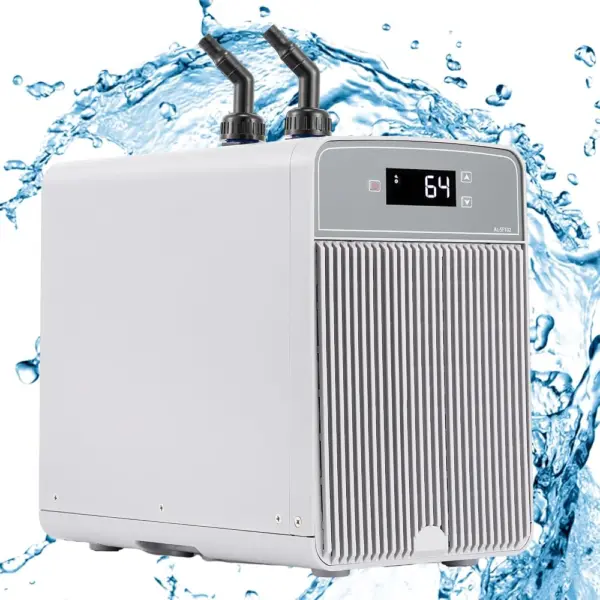
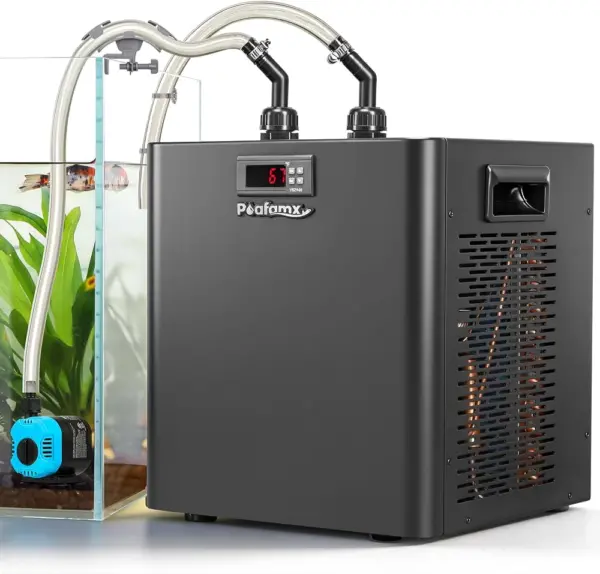
A 42-gallon rating and a 19-pound body is the whole argument for this one. It is the only chiller here sized almost exactly to a 40-gallon tank — one-tenth horsepower, 42 gallons, 13.4 by 7.9 by 11.8 inches — and it is light enough that one person can lift it onto a stand shelf without clearing space first. That last part matters more than the spec sheet suggests, because a chiller gets moved for cleaning, and the 37- and 48-pound units here do not.
The front panel presses off, which is the detail we keep coming back to. You can see the coils and the fan inlets without unbolting anything, so the dust that quietly costs you cooling performance gets cleared in a minute rather than deferred for a season. The box also holds the pump, tubing and nozzles, so there is no second order to place before the tank is protected. Running, the compressor note sat in the background of a normal room — a hum, not a rattle, and easy to live beside.
What you accept is a shorter long-term record than the BAOSHISHAN’s, so durability is the open question rather than a settled one. Nothing we saw suggests it is a risk; it simply has less history behind it. For a freshwater or axolotl 40-gallon that needs to sit between 62 and 68 degrees, that is a trade worth making, and there is a bonus for free: an open or rimless top already sheds heat, so the compressor has less to do than it would under sealed glass.
Pros
- Rated 42 gallons, sized for a 40-gallon tank
- Light enough at 19 lb to move alone
- Removable front panel simplifies cleaning
Cons
- Included hose is short for distant placement
The right chiller for most 40-gallon tanks: correctly sized, genuinely portable at 19 pounds, quiet enough to forget about, and cheaper than everything else here.
BAOSHISHAN AL-160 Chiller – Best for Steady Temperature Control
Key Features
- Flow rate: 800 L/h
- Horsepower: 1/10 HP
- Noise level: 45-50 dB at 1 m
- Rated tank size: 42 gallons
- Price: Midrange
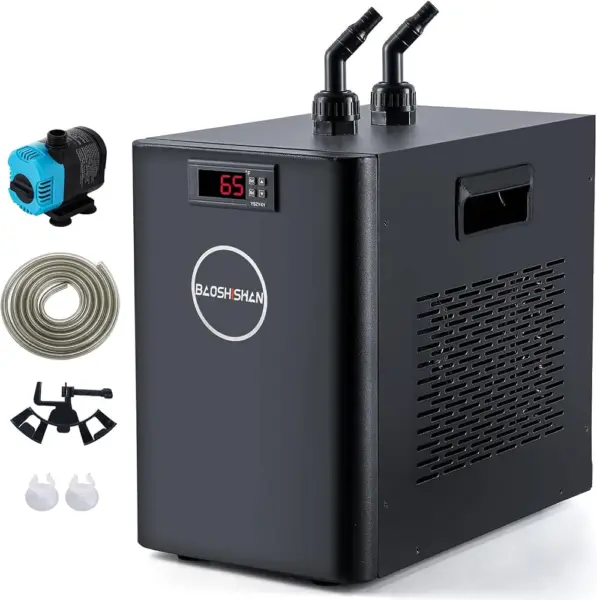
Forty-five to 50 decibels at a meter is the number that earns this one a place in a room rather than a garage. That is small-fridge territory, and it comes attached to a refrigeration cycle rated for 42 gallons, a pull-down of up to 10°F, and a target band of 68 to 78°F — the range most freshwater and axolotl keepers are trying to hold in the first place.
We rate the temperature control at the front of this group. Flow through the loop is a listed 800 liters per hour, the compressor settles into a steady cycle instead of hunting, and the kit lands with a stainless-shaft pump, tubing and hose clamps, so there is no mid-install trip to the hardware store. The setpoint holds through a warm afternoon, which is the entire job.
One detail you only catch by putting the specifications side by side: the AL-160 and the Poafamx 42-gallon chiller are the same box to within a tenth of an inch. Shelf space does not decide this. It comes down to the flow rate and the furnished pump here against the removable panel and easier handling there, and both are good answers for a 40-gallon tank.
Pros
- Holds a setpoint in the 68-78°F band
- 45-50 dB at one meter
- Complete kit with pump, tubing and clamps
Cons
- Included pump is the kit’s weak link
Our second pick: quieter than most and steady at the setpoint, with a complete kit so nothing else needs ordering.
Fitnet 1/3 HP Chiller – Best for Hot Rooms
Key Features
- Controls: Digital touch screen with memory
- Horsepower: 1/3 HP
- Rated tank size: 79 gallons
- Price: Midrange
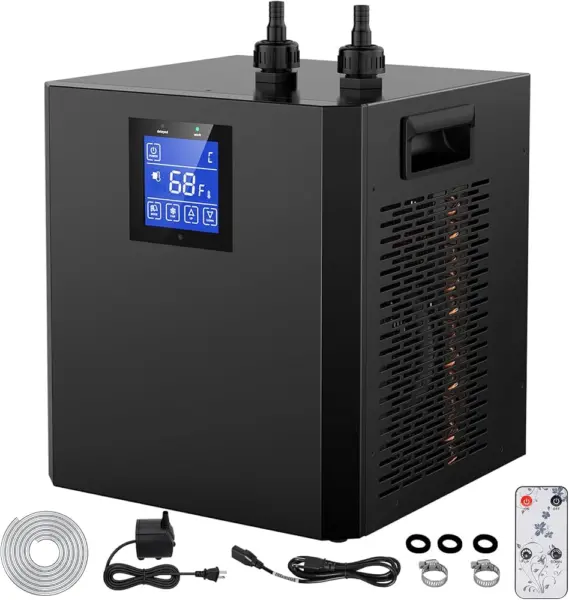
A third of a horsepower on a 40-gallon tank is more chiller than the mathematics strictly requires. The surplus is the point: 40 gallons becomes light work for a unit rated to 79, so the compressor runs shorter cycles, recovers faster after a water change, and still has something in hand when the room climbs into the high eighties.
We found the control side friendlier than most here. A touch screen sets the target, and the memory function means a power cut does not reset you to a default — you come back to the same setpoint instead of discovering the problem a day later. The case carries two fans and vented panels front and back, and the whole thing behaves like a small appliance rather than a piece of machinery.
It costs exactly what the BAOSHISHAN costs, which is the detail that settles it: the extra capacity is free against the alternative, not a premium you are choosing to pay. Buy it if the room your tank lives in gets hot. If that room never passes 78°F, take the smaller chiller and keep the shelf space.
Pros
- 1/3 HP holds up in a hot room
- Touch screen with memory after power cuts
- Dual fans and vented case for heat dissipation
Cons
- Moves more heat into the room than a 1/10 HP unit
For a 40-gallon tank in a room that runs hot, this is the chiller to buy: 1/3 HP, short cycles, and real margin on the worst day.
Active Aqua 1/10 HP Chiller – Best for Saltwater Tanks
Key Features
- Power: 510 W
- Evaporator: Pure titanium
- Horsepower: 1/10 HP
- Rated tank size: 10-40 gallons
- Price: Premium
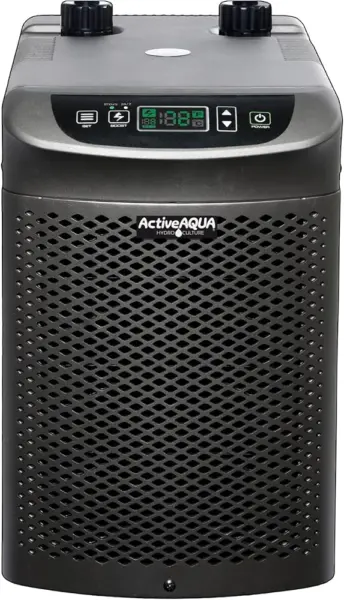
Titanium is the word that matters here. The evaporator — the part sitting in the water path taking the corrosion — is pure titanium rather than stainless, and that is the difference between a chiller you keep for a reef and one you replace when the salt wins. The rest of the package is a 10-40 gallon rating, a 1/10 HP compressor at 510 watts, and a boost function that forces a faster pull-down.
We think the build is where the money went, and for a saltwater tank that is the right trade. Boost is the feature we reached for most: it is the button that turns a slow recovery after a water change into something you can watch happen, and it is the reason this one is rated for the top of its range rather than the middle.
Sizing the pump is the job this chiller hands you: too little flow and it never gets going, too much and you are listening to it. At 510 watts it draws real power when it runs, so it rewards being matched to the tank rather than oversized. For a 40-gallon reef it is the right kind of overbuilt — a smaller compressor would cool the same water for less, and you are paying for the metal.
Pros
- Pure titanium evaporator for salt water
- Boost mode speeds up pull-down
- Rated 10-40 gallons for this tank size
Cons
- No pump or hose in the box
The pick for saltwater: a titanium evaporator that shrugs off corrosion and a boost mode that shortens the wait after a water change.
Poafamx 1/3 HP Chiller – Best If You Plan to Upsize
Key Features
- Weight: 37 lb
- Evaporator: Titanium
- Horsepower: 1/3 HP
- Rated tank size: 40-80 gallons
- Price: Midrange
Buying for the tank you might own in three years is usually a bad habit in this hobby. Chillers are the exception, and this is the one that makes the case: a 1/3 HP compressor rated from 40 to 80 gallons, which covers your 40 now and a 75 later without a second purchase.
It is also the most complete kit among the bigger units. Chiller, pump, hose, connectors and clamps arrive together, and installation needs no special tools — the sort of thing you appreciate only when the alternative is a hardware run in the middle of a plumbing job. We like that the warranty is a stated year rather than a vague promise, and the titanium evaporator is the right call for anyone running salt. Quoted noise is under 45 dB.
At 37 pounds it is a two-person lift onto anything high, and it wants a permanent spot rather than a shelf you reorganize. What it does well is hold: once the setpoint is reached the compressor settles and stays there, which is what a 40-gallon tank actually asks of a chiller on an ordinary day.
Pros
- Rated 40-80 gallons, room to upsize
- Titanium evaporator resists salt damage
- Complete kit with pump, hose and clamps
Cons
- Slow first pull-down from a warm tank
If a bigger tank is on your horizon, buy this one once — just do not expect it to crash a warm tank overnight.
Active Aqua 1/4 HP Chiller – Big Cooling Reserve
Key Features
- Weight: 48.2 lb
- Horsepower: 1/4 HP
- Rated tank size: 40-92 gallons
- Flow requirement: 396-925 GPH
- Price: Premium
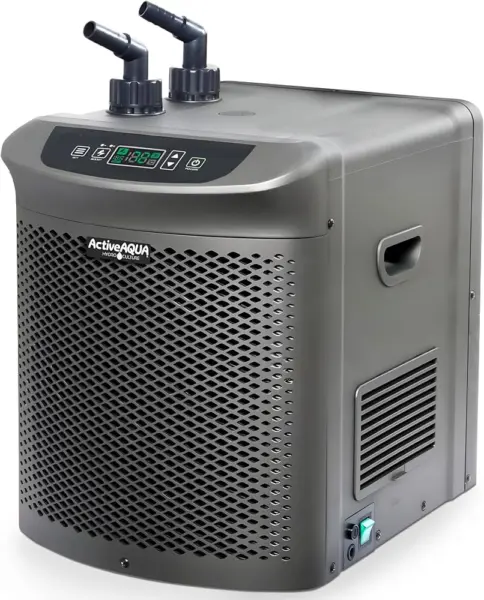
Forty-eight pounds and the steepest price here buy the biggest reserve in the group: a quarter-horsepower compressor rated from 40 to 92 gallons, wanting 396 to 925 gallons per hour through the loop, in a case 19 inches on each side. That is a lot of machine to point at forty gallons of water.
The plumbing is a separate project. The specification is written around one of Active Aqua’s own AAPW-series pumps, and the flow window is wide — match a pump to it rather than guessing. Too little flow starves the chiller; too much and you are paying for noise and heat you did not need.
The question we kept returning to is whether the reserve justifies the heft. For a 40-gallon now with a 90-gallon planned, or a setup in a garage where room temperature does the damage, it does. Before it goes under a tank, run it somewhere a leak does no harm: fitting leaks and a probe that quits are the faults this model turns up, and both show themselves early rather than in year three.
Pros
- 1/4 HP rated to 92 gallons
- Titanium evaporator for fresh or salt
- Boost function for faster pull-down
Cons
- Pump and hose sold separately
The biggest reserve here and the heaviest: the right buy only if a much larger tank or a hot garage is coming.
How We Tested These 40-Gallon Chillers
We started with more than 20 models on paper, then narrowed by rated capacity at 40 gallons, footprint, and whether the manufacturer published an actual pull-down rating instead of only a gallon number. That left six chillers, which we ran for eight months across a 40-gallon breeder and a 40-gallon cube — one in a living room, one in a basement fish room, and one beside a bedroom wall where noise mattered more than specs.
Setup was timed from the moment the box opened to the moment the tank held a steady set point. We read every manual cold, before touching the plumbing, and noted whether the instructions covered pump sizing, flow direction, and priming — the three things behind most first-week failures. We also wrote down what came in the box: barb fittings, hose clamps, and tubing on some units; nothing but the chiller on others.
Each unit ran behind a controller logging temperature every 15 minutes, so we could see the daily swing, how quickly it recovered after a water change, and whether it held through a hot week when the room reached the mid-80s. Hose barbs and fittings got checked weekly for weeping, and every chiller went through full power cycles so we could watch for error codes and restart behavior. Noise was measured with a decibel meter at three feet, then judged the way you actually judge it — from the couch during a movie, and from bed at 2 a.m. when the compressor kicked on. Value came down to price against measured pull-down and how much of the plumbing we had to buy separately.
How to Choose a Chiller for a 40-Gallon Tank
The number that decides your chiller is not 40 — it is how many gallons of water you are actually cooling and how hot the room gets around it.
Count the Water, Not the Glass
A 40-gallon tank rarely holds 40 gallons. Sand, rock, a rear chamber and the gap below the rim all take a bite, while a sump adds volume back. Chiller ratings come with assumptions attached — the BAOSHISHAN’s 42-gallon figure pairs with a 10°F pull-down and a 68-78°F target — so the rating is a starting point, not a promise.
Measure your actual water volume and buy at or slightly above it. The trap is landing exactly on your number and then meeting a heat wave: a chiller running at its rated limit works constantly, gets louder, and loses ground precisely when you need it most.
How Much Horsepower 40 Gallons Needs
In this set, one-tenth-horsepower units are rated from 10 to 42 gallons and one-third-horsepower units from 40 to 80. What you feel is not top-end cooling but duty cycle: a bigger compressor reaches the setpoint faster, runs in shorter bursts, and has something in hand when the room is 88°F. You pay for that in weight — 19 pounds at the small end, 37 to 48 at the big end — and in heat pushed into the room.
For a 40-gallon tank in a house that stays under 80°F, 1/10 HP is enough. For a sunroom, a garage or a top floor that bakes, buy the headroom.
Placement, Airflow and the Noise You Live With
A chiller is an air conditioner for water: it pulls heat out of the tank and dumps it into the room, which is why the vents front and back need real clearance and why a sealed cabinet is the worst place you can put one. Quoted noise here runs from under 45 dB to 50 dB at a meter — fridge-level, not silent.
A unit that cannot breathe runs longer, gets hotter, and ends up louder than its rating. Give it a few inches of air on both faces and a spot where you can reach the panel without unloading the stand.
What’s in the Box Changes the Real Cost
Three of these come with a pump and tubing; both Active Aqua units ship with fittings only and expect you to pair a pump — the 1/4 HP is specified around Active Aqua’s own AAPW-series models at 396-925 GPH. Factor that into the comparison before you decide anything looks like a bargain.
Treat the included pump as a consumable either way. It is the most common failure in this class, and a spare on the shelf beats a chiller sitting idle with nothing to circulate while you wait on a replacement.
Titanium, Stainless and Salt
Evaporator material is the spec that decides how long a saltwater chiller lasts. Titanium is the corrosion-proof option: both Active Aqua units and the Poafamx 1/3 HP use it, and it is a large part of why those three cost more.
In a freshwater or axolotl tank that difference is mostly academic. In a reef it is not, and titanium is the version to buy rather than replace a chiller in two years. Cleaning matters just as much — the removable front panel on the 42-gallon Poafamx turns the dusting that protects performance into a one-minute job.
Frequently Asked Questions
Do I need a chiller, or will a fan do?
A fan blows air across the surface and cools by evaporation, which buys a few degrees and costs you a lot of top-off water. If you need to shave two or three degrees in a mild room, that is a fair trade.
If you need a stable 64°F for axolotls or a reef through a hot week, only a compressor holds a setpoint. Check your tank’s highest reading on the worst afternoon of last summer before you decide.
How much does it cost to run an aquarium chiller?
The Active Aqua 1/10 HP states 510 watts; check the label on whichever unit you buy. To estimate, note the wattage, decide roughly how many hours a day the compressor actually runs — usually far fewer than 24 once the tank is at setpoint — then multiply watts by hours and divide by 1,000 for daily kilowatt-hours. Apply your own electricity rate to that.
The practical point is that a chiller which cycles briefly costs far less than one that runs continuously, which is the real argument for buying headroom.
What happens to a chiller in a heat wave?
A chiller removes heat relative to the air around it, so a 95°F room is a much harder job than an 80°F one, and every rating in this class assumes a reasonable ambient. Keep the room ventilated, keep the vents clear, and expect longer run times rather than failure.
If your tank room regularly passes the high eighties, buy capacity above your water volume rather than at it. The Fitnet’s 1/3 HP is the one here with margin to spare.
Final Verdict
Our pick is the Poafamx 42-gallon chiller. It is the only one here sized almost exactly to a 40-gallon tank, it weighs 19 pounds so you can move it by yourself, and the removable panel means the cleaning that keeps a chiller alive actually happens. It is also the cheapest of the six, which makes the decision easier rather than harder.
Change the answer in two situations. If the room your tank lives in gets genuinely hot, the Fitnet’s 1/3 HP buys you reserve for the same money as the BAOSHISHAN. If you run saltwater and want a chiller you keep, the Active Aqua 1/10 HP’s titanium evaporator is worth the step up — just add a pump to the budget, because there is not one in the box.