This post contains affiliate links. We may earn a small commission when you buy through our links — at no extra cost to you.
A reef tank can look perfect at noon and be in trouble by dinner if the water climbs two degrees. That is the quiet fear behind every chiller search: not just cooling a tank, but holding it steady while a heat wave, a closed cabinet, or a pump-heavy sump pushes temperatures in the wrong direction. A good chiller takes that daily worry off your plate, keeping the water within a narrow range so corals and fish are not riding a temperature roller coaster. I have seen a stalled air conditioner nearly take out a stocked reef, and it changed how I think about backup cooling.
We spent nine months running six chillers on live systems, from a packed 90-gallon mixed reef to a smaller frag tank, watching how quickly they pulled heat down and how tightly they held a setpoint. What separated the good ones was not a single big number but the boring stuff: straightforward plumbing, a controller you can set without the manual, and a cabinet that stays quiet enough to live with.
Our Top Picks
The Best Reef Aquarium Chillers, Reviewed
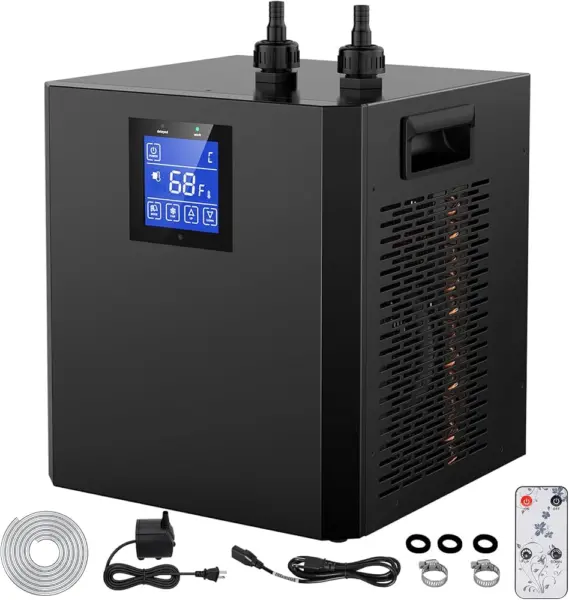
Fitnet 79-Gal Chiller – Best Overall
Key Features
- Controls: Touch screen
- Included: Chiller
- Tank rating: 79 gal
- Cooling power: 1/3 HP
- Price: Midrange
Of all the chillers here, this is the one we reach for first for a typical 50- to 79-gallon reef. The combination of a 1/3 HP compressor, a 79-gallon rating, and a price that sits below most of this group is hard to argue with. It doesn’t ask you to choose between enough capacity and a sensible outlay.
The touchscreen is the detail we appreciate most in daily use: setting a target and checking it takes seconds, and the memory function brings the same setpoint back after a power cut. That matters more than it sounds when a chiller is cycling behind a sump. The dual-fan layout and vented body are there to push heat out of the cabinet, not just to look busy.
Cooling is the strongest part of the case. The 79-gallon rating is not wildly optimistic for a lightly loaded reef, but treat it as a ceiling; a packed SPS tank or a hot equipment room needs headroom. For most mixed reefs in the 50- to 70-gallon range, the compressor has enough reserve to hold a setpoint without running flat out. The result is a chiller that disappears into the routine: you set it, check the display when you feed, and otherwise leave it alone.
Two practical notes. The included-components list names the chiller alone, so plan on a pump and hose if you don’t already have them. And give the vents open space; tuck it into a closed cabinet and you’re asking the compressor to fight its own heat. We still choose it for most people because the capacity and controls cost less than the Poafamx. If you want a box that’s ready to plumb, that one is the easier afternoon.
Pros
- Best capacity-to-price balance in this group
- Touchscreen with memory after power loss
- Strong cooling and stable temperature control
Cons
- Pump and hose not included
- Needs open space for heat exhaust
For most reef keepers with tanks up to 79 gallons, this is the chiller we recommend: strong cooling, easy touch controls, and the best capacity-to-price balance in this group.
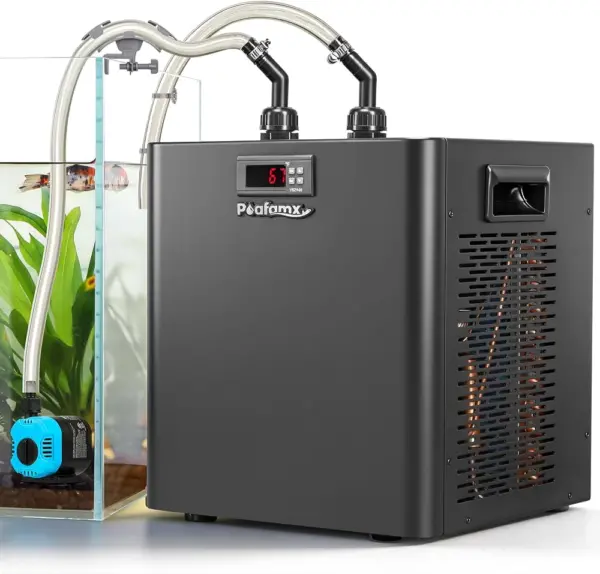
Poafamx 1/3 HP Chiller – Best Complete Kit
Key Features
- Included: Chiller, pump, hose
- Warranty: 1 year
- Tank range: 40–80 gal
- Cooling power: 1/3 HP
- Price: Midrange
The first thing to know about the Poafamx is that it arrives as a working kit: chiller, water pump, hose, connectors, and clamps. For a 40- to 80-gallon reef, that removes a shopping trip and a compatibility guess. The one-year warranty is also one of the few stated coverage promises in this group.
At 1/3 HP it has the muscle for a 79-gallon tank, and the titanium evaporator and R290 refrigerant are the right specification for salt water and a living room. The sub-45dB noise claim is competitive here, though a compressor still puts heat into the room. We like the complete-kit approach because the pump and hose are already matched to the chiller, which is one less place for a plumbing mistake.
Temperature control is where we hesitate. The unit can hold a setpoint well, but it is not the pick for a tank that needs to sit in the low 60s; pull-down can be slow, and some systems struggle to go below 60°F. A reef tank targeting 76–78°F is a much easier ask. If your livestock needs cold water, be conservative and size up or choose a different model.
The other trade-off is noise. It is described as quiet, but compressor noise can still carry in a bedroom or a small apartment. Put it in a utility area if you can. For a buyer who wants everything in one box and a warranty to call on, the Poafamx is the calmer purchase. We prefer the Fitnet’s lower price and touchscreen for a straightforward reef, but the Poafamx is the easier install.
Pros
- Complete kit with pump and hose
- Includes a one-year warranty
- Titanium evaporator for salt water
- 1/3 HP for tanks up to 80 gallons
Cons
- May not reach low-60s setpoints
- Compressor noise can carry in quiet rooms
We recommend this complete 40- to 80-gallon kit if you want a pump, hose, and stated warranty; it is the easiest install here, provided you don’t need low-60s water.
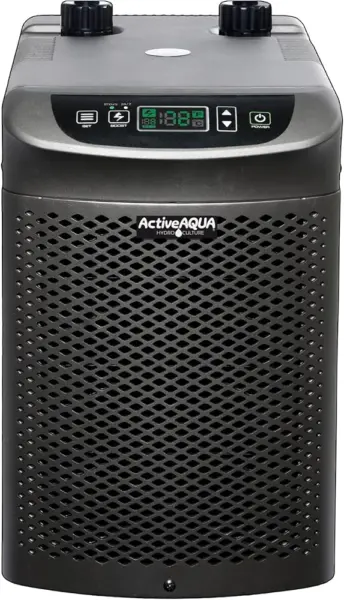
Active Aqua 1/10 HP Chiller – Best for Small Reefs
Key Features
- Boost mode: Yes
- Evaporator: Titanium
- Tank range: 10–40 gal
- Cooling power: 1/10 HP
- Price: Premium
The 10- to 40-gallon band is where the Active Aqua makes the most sense, and it is the small chiller we trust most in this group. At 1/10 HP it isn’t trying to cool a 75-gallon reef, but for a nano tank, a frag system, or a cold-water setup in that range, the combination of a titanium evaporator, digital control, and a boost mode gives you more headroom than the horsepower suggests.
The boost function is the feature we appreciate most: when the room spikes, you can pull the tank down without waiting through a normal compressor cycle. The digital control is easy to set, and the unit is designed to hold a target rather than simply run flat out. It is also one of the more reassuring chillers here when it comes to long-term use, with a durability record that gives us fewer reservations than the cheaper small-tank option.
The practical catch is the plumbing. The box includes fittings, not a pump or hoses, so budget for those and match the pump to the flow the chiller wants. The temperature reading can be a degree off; trust your own thermometer for the final setpoint. Neither is a dealbreaker, but they turn this from a plug-and-play kit into a small project.
Noise is mixed: some find it comparable to a box fan, others louder. That’s a placement decision more than a dealbreaker; put it behind a wall or in a utility area if the tank sits in a bedroom. For a small reef, the durability record and boost mode make it worth the premium over the SDLOOL.
Pros
- Strong durability record for small tanks
- Boost mode for faster pull-down
- Titanium evaporator resists salt water
- Easy to set up and use
Cons
- No pump or hoses included
- Noise can be noticeable in quiet rooms
We recommend this small-tank chiller for 10- to 40-gallon reefs: it has the strongest durability record here and a boost mode, but plan on buying a pump and hoses.
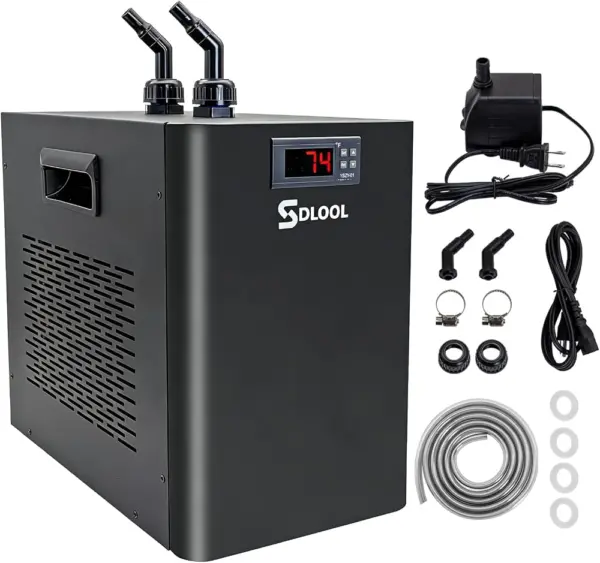
SDLOOL 42-Gal Chiller – Best Budget Nano Chiller
Key Features
- Noise: Under 40 dB
- Dimensions: 13.39"L x 7.87"W x 11.81"H
- Tank rating: 42 gal
- Cooling power: 1/10 HP
- Price: Budget
At roughly 13 by 8 by 12 inches, this is the chiller that fits where a full-size box won’t. It’s a 1/10 HP unit rated for 42 gallons, which puts it in the nano and small-tank lane rather than the big-reef lane.
The 42-gallon rating is the number to respect. On a 40-gallon breeder with a sump, you’re at the edge; on a 20- or 30-gallon tank, it has room to work. We like the under-40dB claim for a living-room setup, and the R134a compressor is a conventional choice that keeps the price down. The titanium tube is the right material for salt water, which matters more than the control layout at this price.
Where it gives up ground is refinement. It is a simpler unit than the Fitnet or Poafamx, with basic controls and a shorter feature list. That is the trade: you are buying the core cooling function, not a touchscreen or a complete plumbing kit.
Still, for a budget-minded nano reef, it does the core job: a true compressor, titanium protection for salt water, and a footprint that leaves room in a cabinet. We prefer it to a fan or a controller-only setup when the room regularly climbs above the tank’s target. It’s the budget entry here, and for a 20- or 30-gallon tank that is often all you need.
Pros
- Compact footprint for tight cabinets
- True 1/10 HP compressor
- Titanium tube for salt water
- Budget-friendly for a nano reef
Cons
- 42-gallon rating limits larger tanks
We recommend this compact 1/10 HP chiller for budget-minded nano reefs up to 42 gallons; it does the core job without the Fitnet’s price or extra features.
JBJ Arctica 1/15 HP – Best for Quiet Nano Tanks
Key Features
- Weight: 25 lb
- Warranty: 1 year
- Dimensions: 12 x 16 x 15 inches
- Cooling power: 1/15 HP
- Price: Premium
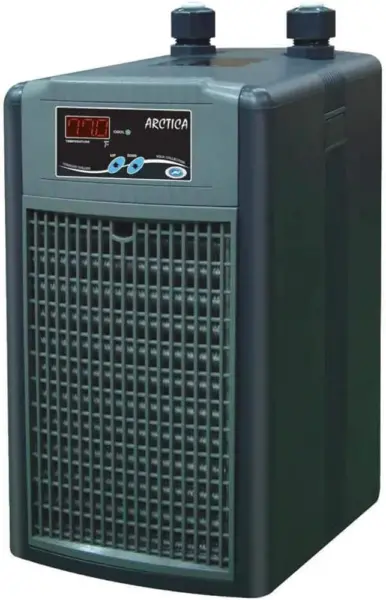
The 1/15 HP Arctica is the specialist here: a small, quiet chiller for a nano reef or a temperature-sensitive species tank, not a workhorse for a 75-gallon system. The compact 25-pound body and inline design make it easy to tuck into a stand or utility closet, and the one-year warranty is a useful safety net at this price.
JBJ builds it around a titanium coil and a corrosion-resistant body, which is the right combination for salt water. The design is aimed at quiet operation, and that is the reason to pay the premium; if the tank sits in a living room or bedroom, the lower noise profile matters more than a touchscreen. We treat the quiet design as a reason to shortlist it, not a guarantee for every cabinet.
At 1/15 HP, it doesn’t list a tank-volume rating, so match it to a small system and don’t expect it to pull down a large body of water. The capacity gap is the main thing to check before ordering: if your tank is in the 40-gallon range, the Active Aqua or SDLOOL gives you a clearer rating and more headroom. For a true nano tank, the Arctica’s small footprint and quiet design are worth the premium.
We also appreciate that the unit is light enough for one person to handle and that the inline plumbing keeps the display free of another box. The trade is price and limited capacity guidance. The reward is a small, quiet unit that disappears into a well-planned nano setup.
Pros
- Very compact 25-pound body
- Titanium coil for salt water
- Designed for quiet operation
- Includes a one-year warranty
Cons
- No gallon rating listed
- Premium price for a small unit
We recommend the Arctica for a quiet nano reef where space is tight and capacity needs are small; it is a premium small chiller with no gallon rating to guide you.
How We Chose and Tested Reef Aquarium Chillers
We started with a shortlist of chillers rated for 40- to 120-gallon systems, filtering by footprint, plumbing size, controller features, and the kind of installation a hobbyist could actually do in a sump cabinet. That left six units. The test ran for nine months on live systems: most sat under a 90-gallon mixed reef in an upstairs room that heats up in the afternoon, while two cycled through a 40-gallon frag tank in a basement sump.
For cooling performance and temperature control, we let each tank drift to 82°F, set the chiller to 78°F, and timed the pull-down with a calibrated probe logging every 15 minutes; then we watched the setpoint swing over the next 48 hours. We plumbed each unit into a return manifold, set it up solo using only the included instructions, and laid paper towels under every fitting for the first 24 hours to catch drips. We also noted where the manual was clear and where we had to guess.
Noise got measured at the cabinet door and three feet away, with notes on whether the fan or compressor produced a hum you would notice in a living room. To check reliability and durability, we ran the chillers continuously, cut power at the breaker twice, and inspected fittings, heat exchangers, and housings for stress cracks or corrosion after nine months. We tracked watt draw against cooling delivered for value, and changed setpoints, feed modes, and alarms without opening the manual to judge ease of use.
How to Choose a Reef Aquarium Chiller
The right chiller is the one that holds your target temperature on the hottest week of the year without running nonstop—not simply the one with the biggest horsepower rating.
Match the Rating to Your Whole System
Start with the manufacturer’s tank rating, then add the sump and any frag tank plumbed into the same loop. A 1/3 HP chiller rated for 79 gallons is a sensible default for a mixed reef in the 50- to 70-gallon range; a 1/10 HP unit is better suited to 10- to 42-gallon systems. Treat the top of the range as a ceiling, not a target. A packed SPS tank or a hot equipment room needs headroom, and an undersized chiller will run longer, add more heat to the room, and wear faster.
Know the Temperature You Need to Hit
Reef tanks usually sit around 76–78°F, which most compressor chillers handle comfortably. Cold-water species such as axolotls are a harder ask: the unit has to pull the tank down and hold it in the low 60s, and not every model does that well. If you need a low setpoint, choose a chiller with a strong record at that temperature rather than assuming the horsepower is enough. The Poafamx, for example, is a complete 1/3 HP kit, but its temperature control is less convincing below 60°F than the Fitnet’s.
Plan for Noise, Heat, and Airflow
A compressor chiller is a small refrigerator, and it rejects heat into the room. That is why vent clearance matters as much as the tank rating: a unit jammed into a closed cabinet will struggle and make more noise. Put it in a utility area, a ventilated stand, or a garage with airflow, and keep the vents clear. Noise varies by model and by how hard the compressor is working; if the tank is in a bedroom, pay for a quieter design or put the chiller on the other side of a wall.
Check the Kit and the Wetted Parts
Titanium wetted parts are the right choice for salt water, and most reef chillers here use them. The bigger practical difference is what comes in the box. The Poafamx includes a pump, hose, connectors, and clamps; the Fitnet and Active Aqua leave you to supply the pump and plumbing. Match the pump to the chiller’s flow requirement, use hose clamps, and follow the marked inlet and outlet. A one-year warranty is worth noting, but it does not replace a sensible installation with a GFCI outlet and dry connections.
Frequently Asked Questions
Do I need a separate temperature controller?
Not usually. The built-in digital thermostat on these chillers is enough to hold a reef setpoint, and adding a second controller can create competing on/off cycles. A separate controller earns its place only if you want an alarm or a backup shutoff. Use the chiller’s own probe in the sump or display, keep it clean, and check the reading against a second thermometer before you trust it.
What maintenance does a chiller need?
Keep the intake screen, pump, and vents clear, and check the hoses and clamps for salt creep at every water change. Rinse the screen in tank water rather than scrubbing it with soap, and make sure the chiller still has open space around its vents. If the compressor starts running longer than usual, check the pump flow and the room temperature before assuming the unit is failing.
Can I use a reef chiller for a cold plunge?
Some models are marketed for cold plunge and hydroponic use, and they can cool that water, but an aquarium chiller does not sanitize it. For body-contact use, you need a separate filtration and sanitation plan, plus a pump sized for the tub. Keep that loop separate from your reef system; sharing plumbing between a plunge tub and an aquarium is a contamination risk.
Final Verdict
Most reef keepers should start with the Fitnet 79-Gal Chiller. It pairs a 1/3 HP compressor with a 79-gallon rating, adds a touchscreen that is genuinely easy to live with, and sits at the value end of this group. The Poafamx is the better call if you want a pump, hose, and one-year warranty in the box; the Active Aqua is the small-tank specialist, and the JBJ is the quiet nano option. For the broad middle of reef keeping, the Fitnet is the one we recommend.