This post contains affiliate links. We may earn a small commission when you buy through our links — at no extra cost to you.
Half the jobs in an aquarium happen just out of reach. Pressing a frag plug into putty, dropping a food wafer in front of a shy fish, nudging a fallen coral out from behind the rockwork — all of it used to mean rolling up a sleeve and getting your shoulder wet. Tongs turn those jobs into a five-second reach, which is why they earn a permanent spot next to the test kits. The catch is that cheap ones bend at the hinge, long ones whip and flex like a fishing rod under any real pressure, and stainless models that look great new can pit and start leaching rust into water you’ve been babying for months.
My team and I have spent the past four months with 14 pairs of tongs, from stubby nano-tank models to extra-long angled ones, and the differences show up fast once you’re actually using them instead of looking at them. One thing worth knowing before you shop: match the length to your tank’s depth, not to what looks comfortable to hold. A 12-inch tong in a deep tank puts your knuckles at the waterline, and you’ll be back to the wet-sleeve method within a week. The picks below are the ones that stayed square at the tip and clean at the joint.
Our Top Picks
The Best Aquarium Tongs, Reviewed
unlumm 15-Inch Tweezer Set – Best Overall
Key Features
- Jaw: Serrated, non-slip tips
- Pack: 2 pieces
- Tips: Straight and curved
- Length: 15 in
- Price: Midrange
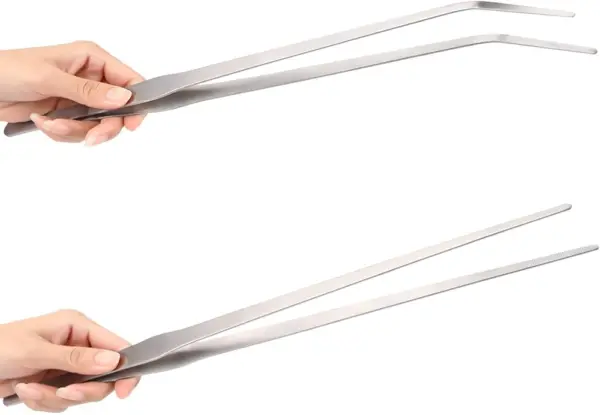
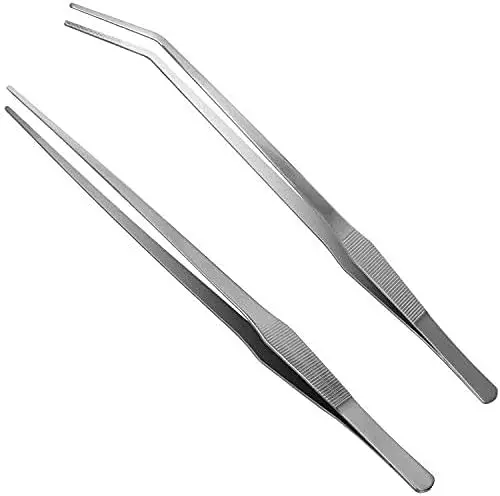
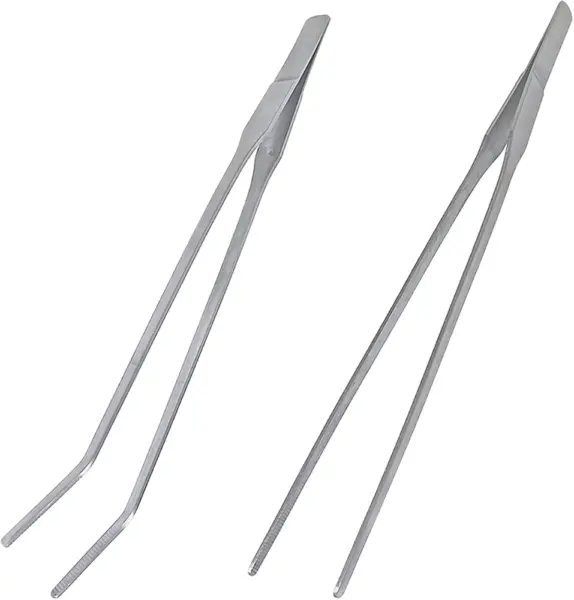
Fifteen inches is the length that keeps your sleeve out of a standard 55-gallon, and this set gives you that reach twice: one straight pair for pushing stems into the substrate, one curved pair for working behind rocks and holding food at an angle. Getting both shapes together is the quiet luxury here. With a single tweezer you are always improvising the other job.
This is the set we recommend when someone wants one purchase that handles planting and feeding. The steel feels solid rather than whippy, which matters when you are pushing a stem down into gravel, and the serrations run right to the tips, so a stem caught near the end still has something to bite on. It is not a delicate instrument, and for tank work that is the right trade.
Water is where it needs looking after. Stainless this thin can spot-rust if it goes back in the cabinet damp, and saltwater gets there faster, so a rinse in fresh water and a wipe before storage is the whole routine. The curved pair is the one we end up using more than expected, not for planting but for nudging a frag or a stone back where it belongs.
Pros
- Both tip shapes at a full 15 inches
- Serrated tips grip stems and food
- Solid, springy feel in the hand
Cons
- No case or sleeve for storage
- Serrations slip on small, smooth items
The set we point most people to: full 15-inch reach in both tip shapes, at a mid-range price that covers planting and feeding in one buy.
Thyores 3-Piece Feeding Tweezer Set – Best Budget Set
Key Features
- Jaw: Serrated tips
- Pack: 3 pieces
- Tips: Two straight, one curved
- Length: 10.6 in straight, 10.4 in curved
- Price: Budget
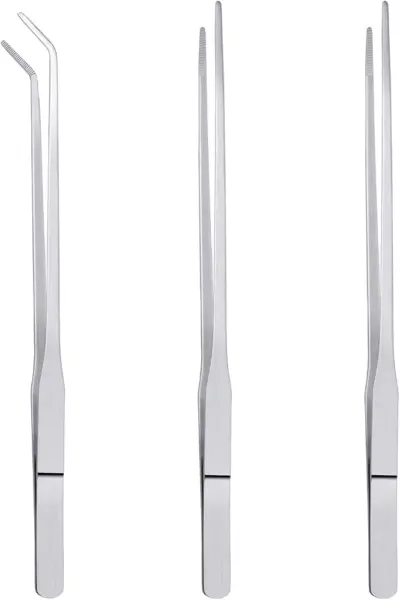
Three tweezers arrive in this pack, two straight and one curved, all around ten and a half inches. Extra tools sound like filler until you have walked to the garage mid-water-change because the only pair is somewhere in a bucket. A spare straight pair lives in the cabinet and the job does not stop.
The serrations are cut deep and the tips meet squarely, so a worm, a cricket, or the stem of a cryptocoryne stays where you put it. In a small tank this is the easiest set here to control: shorter arms mean less leverage out at the far end, and you can place a stem in a ten-gallon without the tip drifting off target.
The one habit worth breaking is letting your fingers creep up the arms as you squeeze, because the two halves close like scissors and can catch a knuckle. Hold them mid-way and it stops happening. It is also the only three-piece set in this group, and the value is the reason we point new planted-tank owners at it.
Pros
- Three tools instead of two
- Deep serrations hold live food
- Best value per tool in the group
Cons
- Short 10.6-inch reach stops at shallow tanks
The one we hand to anyone setting up a small tank: three tools, deep serrations that hold live food, and a spare pair left over.
Luxiv 15-Inch Tweezer Set – Best for Planting
Key Features
- Jaw: Sawtooth tips and handles
- Pack: 2 pieces
- Tips: Straight and curved
- Length: 15 in
- Price: Midrange
Sawteeth cut into the tips are the detail that makes this the planting set we reach for. They bite into a stem without crushing it, so you can push a cutting into the substrate and let go without the plant coming back up with the tweezers. That is the job it does as well as anything here for the money.
Both tools are 15 inches, straight and curved, which puts the whole substrate within reach of a medium or tall tank. It is the same length and the same two shapes as our top pick, so the decision between them comes down to the price and how the handles feel in your hand rather than how far down you can go.
Where it fits in this group is simple: it is the 15-inch set for someone who plants more than they feed. The curved pair earns its keep around rockwork and for lifting a dead leaf out of a corner, but the straight one is the tool that stays by the tank. Give the jaws a squeeze before your first session; they close easily and do not need a hard grip.
Pros
- Sawtooth tips hold stems without crushing
- Full 15-inch reach in both shapes
- Light squeeze to keep the jaws closed
Cons
- Can spot-rust, especially after saltwater use
This is the pair we keep for planting: sawtooth tips that grip a stem without crushing it, 15 inches of reach, and a price below the top pick.
DXOBAY 18.9-Inch Tweezer Set – Best for Deep Tanks
Key Features
- Pack: 2 pieces, straight and curved
- Length: 18.9 in
- Material: SUS 304 stainless steel
- Thickness: 0.1 in
- Price: Premium
Nearly nineteen inches is a lot of tweezer, and the first time you lower one into a deep tank you understand why it exists: the tips touch the substrate while your shoulder stays outside the rim. If your tank is two feet tall, this is the difference between planting properly and planting by feel.
The steel is grade 304 stainless and the arms run about a tenth of an inch thick, which is where the clamping force comes from. Extra processing has gone into the clamp so it closes tighter than the thin sets here, and it shows: a whole prawn or a chunk of tilapia sits in the jaws without rotating. The serrated bands where your thumb and forefinger sit matter more than they sound when your hands are wet.
That stiffness lands on your hand. Twenty stems in, your forearm knows it has been holding a heavy clamp, and this is the one tool here we put down between planting bursts. For a few stems a week in a deep tank you will never notice, because the reach is the point.
Reach is the whole argument, and no other set in this group gets you this far down. The stiffness that tires your hand is also what keeps the arms from bowing, so the tip goes exactly where you point it instead of skidding sideways through the substrate.
Pros
- Nearly 19 inches of reach
- 304 stainless with a heavy clamp
- Tips do not bow under pressure
Cons
- Small, slippery food can slip past the jaws
Buy these if your tank is two feet deep: at 18.9 inches nothing else here reaches the substrate, and the clamp holds a whole prawn without twisting.
yuntop 10.6-Inch Tweezer Set – Best for Small Tanks
Key Features
- Pack: 2 pieces
- Tips: Straight and curved
- Length: 10.6 in (27 cm)
- Price: Budget
A ten-gallon tank holds about a foot of water, and 10.6 inches of tweezer is enough to reach the substrate in one without hanging over the rim like a crane. That is the case this pair makes: both shapes, straight and curved, at a length you can steer accurately inside a small footprint.
In a nano tank, accuracy matters more than reach. Working between stems is where these earn their place, because the shorter arms give finer control at the tip and you can plant a corner without knocking over the hardscape on the way in. The serrated tips hold a stem, the spring is light enough to work one-handed, and the pair costs less than anything else on this page.
The honest limit is depth. Past a standard 20-gallon the tips stop reaching the substrate, so this is a pair for the small tank rather than a set to grow into. Within that, the curved one earns its place more than we expected: it is the tool for a corner where a straight tip cannot get the angle.
Pros
- Both tip shapes at a nano-friendly length
- Fine control inside a small tank
- Lowest price of any set here
Cons
For a ten-gallon or a nano, we reach for these: both tip shapes, a length you can steer, and the lowest price in the group.
EvaGO 15-Inch Curved Tweezers – Best for Hand Feeding
Key Features
- Tip: Curved
- Length: 15 in
- Material: Coated stainless steel
- Price: Midrange
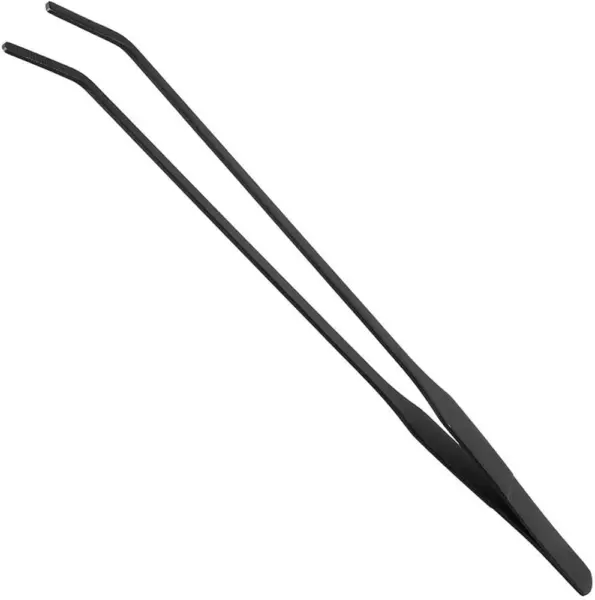
The black finish is the first thing you see, and it is not only cosmetic: it is a protective coating over the stainless, meant to hold rust off a tool that spends its life wet. The shape underneath is what earns the spot. A curve holds a worm or a cricket at an angle a straight pair cannot manage, which keeps your fingers clear of the water and the food where the fish can see it.
The serrations and the anti-skid handle do their part on live food, and the 15-inch shaft means you are feeding at arm’s length rather than elbow-deep. Where it falls down is anything smooth and heavy: a piece of prawn rotates out of the jaws, and you end up chasing it around the glass with a tool that squeezes but cannot scoop.
Treat it gently. Squeezing hard on something the jaws do not want to hold is how a tip ends up bent out of alignment, and once the two halves stop meeting you have a stick with a coating. Lift rather than lever, and rinse and dry it after every dip, because the coating helps but does not make drying optional.
Pros
- Curved tip holds food at an angle
- Coated finish against rust
- 15 inches keeps your hand dry
Cons
- Only one curved tool, no straight tip
Worth it if you feed more than you plant: the curved tip holds food at an angle a straight pair cannot, and the black coating is meant to hold rust off.
FEITA 15-Inch Coated Tweezer Set – Best for Tidy Setups
Key Features
- Tips: Straight and curved
- Extras: Storage bag
- Length: 15 in
- Material: Coated stainless steel
- Price: Midrange
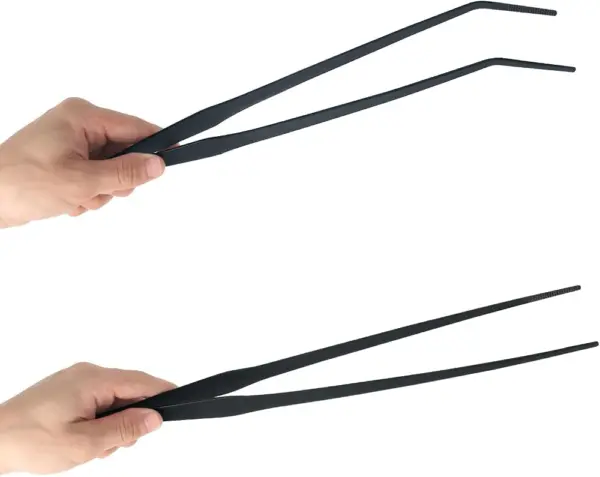
Two black tweezers and a pouch. The pouch is the part that makes this set easy to live with: both tools stay together, the tips stay off the other metal in the drawer, and you can carry the pair to a friend’s tank without hunting for something to wrap them in.
The tools are 15 inches, one straight and one curved, with serrated tips and ridged handles. The jaws close evenly along their length rather than touching at a single spot, which is what keeps a stem from rolling sideways as you push it down. The black finish is a titanium coating meant to keep rust at bay, and in a lit tank it looks smarter than bare steel.
What keeps it out of the top tier is how little separates it from the plainer sets: it plants and feeds to the same standard, and the coating plus the pouch are the difference rather than the reach or the grip. If you like the look and want the storage, you will be happy with it. One caution: a coating is a coating, so keep abrasive pads away when you clean them.
Pros
- Storage bag keeps both tools together
- Jaws align evenly along their length
- Coated finish on both shapes
Cons
The set to buy if you want both shapes in a coated finish with somewhere to store them; the tools do the same jobs as the plainer 15-inch pairs.
How We Chose and Tested Aquarium Tongs
We started by rounding up every style we could find — straight, curved, angled-tip, serrated, extra-long, and the tweezer-style models sold for planted tanks — then narrowed the field to 14 pairs based on stated length, material, tip shape, and whether the joint was riveted, welded, or a single bent piece. Everything after that was hands-in-tank work.
Testing ran for four months and happened where tongs actually get used: Tuesday-night feedings, Saturday maintenance, and the occasional late-night scramble when a snail gets knocked into the filter intake. In a 40-gallon tank and a small nano, we target-fed frozen mysis to a shy fish, pressed frag plugs into putty, repositioned a toadstool that kept tipping over, and lifted debris off the substrate. We noted how much of a forearm stayed dry at each reach, and how much the shaft bowed when we squeezed hard at full extension.
Grip got its own round of abuse: picking up thawed, slippery food cubes and wet frag plugs and watching whether they held or slid out of the tip. After every session the tongs were rinsed and left damp in a bucket, and every couple of weeks we checked the hinge and jaws for spotting, pitting, and stiffness. Value came down to how each pair opened, closed, and looked after four months of that treatment relative to what it cost.
How to Choose Aquarium Tongs
Buy the length first and the tip shape second; everything else about an aquarium tweezer is a detail next to whether it reaches the bottom of your tank without your knuckles going under.
Length: Match It to Your Water, Not the Listing
A standard 10-gallon tank is roughly 12 inches tall and a 55-gallon about 21, and you lose an inch or two of that to substrate. That is why 10.6-inch tweezers work in a nano tank and stop being useful past a 20-gallon, while 15 inches reaches the floor of a standard 55 with your hand still at the rim.
The trap is buying the longest tool you can find. An 18.9-inch pair in a ten-gallon is hard to steer between stems and knocks over hardscape on the way down. Measure from the substrate to the rim, add a couple of inches, and stop there.
Straight, Curved, or Both
Straight tips do the planting: they push a stem into the substrate on a vertical line, which is the direction the plant wants to go. Curved tips reach around rockwork, angle food toward a fish, and lift a leaf out of a corner a straight pair cannot address.
Two-piece sets cost barely more than a single tool, and the shape you do not buy is the one you will want the day a plant floats loose behind the filter. If you only ever buy one, buy straight. A curved tip is awkward at pushing a stem into gravel.
Grip, Squeeze, and What the Jaws Do to a Stem
Serrations are what hold a stem or a worm, and they are also what crushes a soft leaf if you clamp hard. Grip lightly and let the substrate hold the plant. The teeth can catch a fingertip too, so keep your hand mid-way down the arms rather than creeping up toward the pivot.
Squeeze effort rises with steel thickness. A heavy clamp like the DXOBAY holds a whole prawn without twisting and tires your hand after twenty stems. If your grip is not strong, work with a lighter pair for planting and save the heavy set for feeding.
Rust Is What Ends These Tools
Stainless is rust-resistant, not rustproof, and any of these can spot brown where water sits in the jaw or along a scratch. Saltwater gets there faster. The dunking is not the problem; putting them away wet is.
Rinse in fresh water after a saltwater dip, dry with a towel, and do not leave a pair standing in the tank or in a wet bucket between jobs. A coated set buys some margin, but no coating survives being stored damp.
Frequently Asked Questions
How do I plant a stem so it doesn’t float back up?
Grip the stem an inch above the roots, push the tips into the substrate at a slight angle, open the jaws, and withdraw slowly rather than pulling straight out. The slow withdrawal is the step people skip, because a fast pull drags the stem up with the tweezers. In gravel rather than soil, plant deeper than looks right.
Can I use the same tweezers for reptile food and my fish tank?
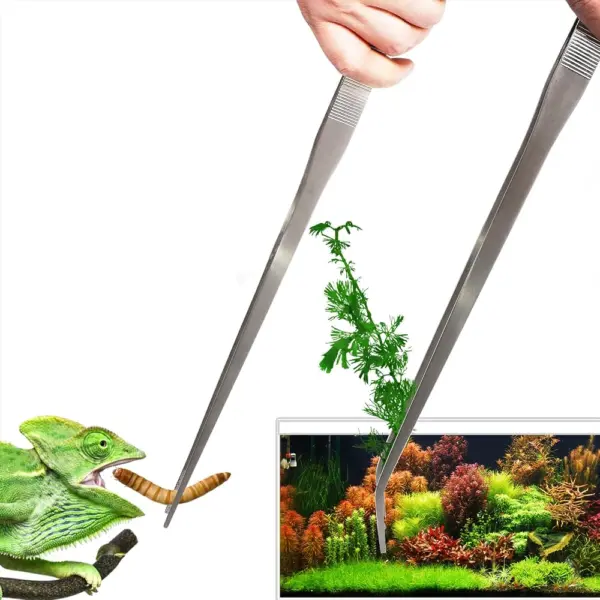
Most of these are sold for both jobs, so the tool is not the issue; the state it goes back in is. Rinse and dry between uses, since insect dust and bedding do not belong in tank water, and a damp tool that gets put away is the one that rusts. If you feed reptiles and plant in the same week, a second pair is easier than cleaning one constantly.
What do I do if the tips stop meeting evenly?
A jaw that no longer closes flat will drop food and roll stems, and it usually happens when the tool has been used to lever or pry instead of grip. Straighten a mild bend by hand, gently, and check the tips against each other along their length. If they still do not meet, retire that pair before it loses something in the tank.
Final Verdict
For most tanks, buy the unlumm two-piece set. Fifteen inches covers a standard 55-gallon, and you get both tip shapes without paying for a coating or a deep-tank shaft you do not need.
If your tank is genuinely two feet deep, the DXOBAY pair is the only one here that reaches the substrate without a struggle, and its clamp is worth the stiffness. For a ten-gallon or a nano, the yuntop set is easier to steer and costs the least of anything on this page.