This post contains affiliate links. We may earn a small commission when you buy through our links — at no extra cost to you.
Many nano tank owners face a frustrating choice: a cheap power filter that can leak or stop working, or a sponge filter that needs an extra air pump and occasional modification. The trade-offs are real.
The truth is that the most dependable nano filters are often the simplest. Air-driven sponge filters from specialized brands have proven track records, while budget HOBs under $20 frequently sacrifice build quality. This guide focuses on filters that balance simplicity, reliability, and cost.
Whether you keep bettas, shrimp, or fry, the right filter is one that matches your tank size and your tolerance for maintenance. We’ve identified the models that consistently deliver without surprises.
Top Picks
Best for Betta & Shrimp
AQUANEAT Bio Sponge

Rating: 4.7 ★ | Price: Budget | Filtration Type: Air-driven sponge | Tank Size: Up to 10 gal | Flow Adjustability: No | Noise Level: Quiet
The AQUANEAT Bio Sponge Filter provides consistent mechanical and biological filtration for nano tanks up to 10 gallons. Its dense sponge traps debris while offering surface area for beneficial bacteria, and setup requires only an air pump and tubing. Cleaning is straightforward—just rinse the sponge in tank water during water changes.
Best suited for betta and shrimp tanks, fry rearing, and beginners who want a low-maintenance filter. The cylindrical sponge is compact enough for standard 10-gallon tanks but can appear bulky in smaller nano aquariums under 5 gallons or heavily scaped setups. Pair with an airstone if you need finer bubble output.
Pros
- Effective mechanical and biological filtration for small tanks.
- Simple one-step setup with no assembly required.
- Easy to clean—rinse the sponge under tank water and reinstall.
Cons
A cost-effective, no-fuss filter that handles the basics well for small freshwater tanks.
Best for Betta & Shrimp
AQUANEAT Corner Sponge

Rating: 4.7 ★ | Price: Budget | Filtration Type: Corner sponge | Tank Size: Up to 10 gal | Flow Adjustability: No | Noise Level: Quiet
Low-current corner design fits neatly into planted betta tanks, hugging the glass to preserve swimming space. The included tubing, valves, and suction cups mean you won’t need to hunt for extra parts. Mechanical and biological filtration is effective for nano tanks up to 10 gallons. In tanks smaller than 5 gallons, the sponge’s footprint may feel bulky, and the bubbles can feel coarse. Adding an airstone smooths the output into a fine column. It’s a solid match for betta and shrimp keepers who want a corner-ready filter without sacrificing water quality.
Pros
- Very effective mechanical and biological filtration for tanks up to 10 gallons
- High-quality sponge and sturdy plastic construction
- Includes all necessary accessories – tubing, valves, suction cups
Cons
- Bubbles can feel coarse; adding an airstone helps
- May occupy too much room in tanks smaller than 5 gallons
For betta and shrimp keepers with tanks 5–10 gallons who want a corner-fitting sponge filter with everything included, this is a practical, affordable pick.
Best for Bedroom/office
Marina S10 Power Filter

Rating: 4.4 ★ | Price: Mid-Range | Filtration Type: Hang-on-back | Tank Size: Up to 10 gal | Flow Adjustability: Adjustable flow | Noise Level: Quiet
The Marina S10 delivers ultra-quiet operation that makes it a strong alternative to the top pick sponge filter for nano tanks where silence is the priority. Its adjustable flow and slim profile suit bedroom or office setups, while the cartridge-based filtration provides mechanical and chemical media. The higher price and ongoing cartridge replacement cost are tradeoffs worth noting — buyers who prefer low-maintenance simplicity may find sponge filters more economical.
Pros
- Virtual silence in operation keeps nano tanks from disturbing a quiet room.
- Adjustable flow control gives hobbyists fine-tuning over water movement.
- Slim, discreet design fits neatly on small tanks without blocking the view.
Cons
- Higher upfront cost than basic sponge filters; worth considering for budget-limited setups.
- Replacement cartridges create an ongoing expense not present with reusable sponge media.
The S10 is the right call for nano tank keepers who value near-silent filtration and flow adjustability — just account for the higher price and cartridge costs.
Best for Micro Tanks
Pawfly Mini Sponge

Rating: 4.5 ★ | Price: Budget | Filtration Type: Mini sponge | Tank Size: 1-3 gal | Flow Adjustability: No | Noise Level: Quiet
At just 1.5 inches in diameter, the Pawfly Mini Sponge Filter is the smallest air-driven sponge filter available, fitting bowls and jars that can’t accommodate larger units. The included airline tubing and control valve get you started, though the tubing is notably flimsy and some buyers choose to replace it. This filter suits nano shrimp jars, betta bowls under 3 gallons, and hospital tanks where gentle flow and small footprint matter. While not suitable for tanks above 3 gallons, within its size range it provides efficient filtration at an unbeatable price.
Pros
- Fits perfectly in bowls, jars, and cubes under 3 gallons.
- Effective for light bioloads like a single betta or shrimp.
- Affordable with airline tubing and valve included.
Cons
- Included airline tubing feels flimsy and may need replacement.
- Too small for tanks over 3 gallons; check dimensions before buying.
For micro tanks under 3 gallons, this is the sensible budget option. For larger nano tanks, the top pick offers more surface area.
Best for Planted Tanks
AQUANEAT Multi-Media Corner

Rating: 4.5 ★ | Price: Budget | Filtration Type: Corner box sponge | Tank Size: Up to 20 gal | Flow Adjustability: No | Noise Level: Quiet
This corner filter packs ceramic rings, coarse and fine sponges, and a polishing pad into one small box — a step up from a plain sponge for planted nano tanks that benefit from chemical filtration. It floats until fully waterlogged and may need weighting, a tradeoff that suits hobbyists who don’t mind an extra setup step. Best for shrimp and betta tanks with moderate bioload, not for ultra-compact tanks under 5 gallons.
Pros
- Includes mechanical, biological, and chemical media in one unit
- Polishes water noticeably in small tanks
- Easy to disassemble for cleaning
Cons
- Floats until waterlogged; may need to be weighted down during initial setup
A capable multi-media filter for nano tanks that rewards a bit of patience during initial setup.
Best for Beginners
Tetra Whisper Internal
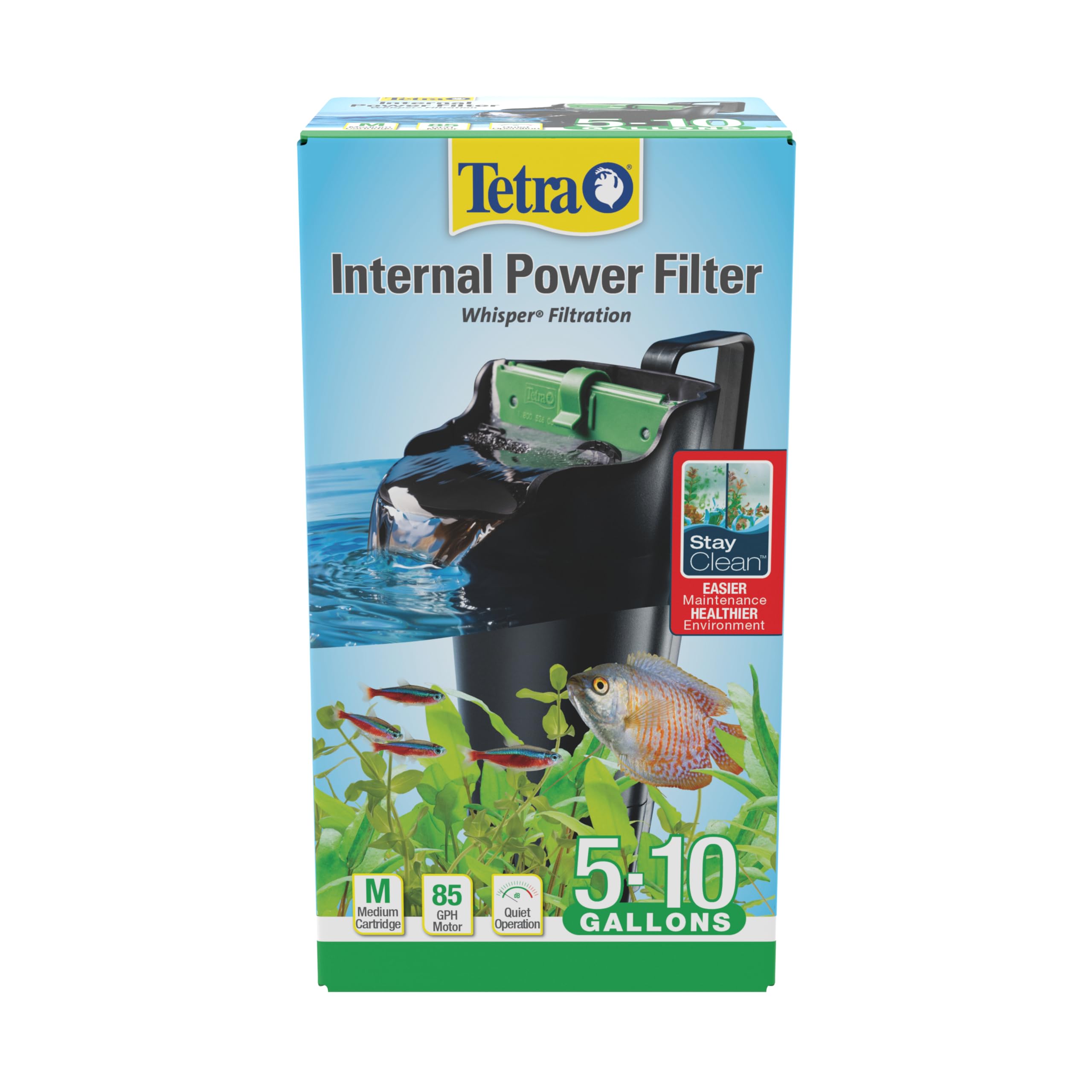
Rating: 4.3 ★ | Price: Mid-Range | Filtration Type: Internal submersible | Tank Size: 5-10 gal | Flow Adjustability: No | Noise Level: Quiet
Operates very quietly and provides effective mechanical and chemical filtration for 5-10 gallon tanks right out of the box. This filter fits best in temporary quarantine tanks or for budget-conscious beginners willing to replace it after about a year.
Pros
- Stays exceptionally quiet in small bedroom or office tanks.
- Cartridge-based design makes debris removal and water polishing simple.
Cons
- Motor may stop running or become noisy within months – ideal only for short-term use.
A capable filter for temporary tanks or budget-first beginners, where the risk of early replacement is acceptable.
Best for Tiny Tanks
NICREW Slim HOB

Rating: 4.2 ★ | Price: Budget | Filtration Type: Hang-on-back | Tank Size: 1-5 gal | Flow Adjustability: Adjustable flow | Noise Level: Quiet
This NICREW Slim HOB offers whisper-quiet operation, a slim profile for tanks under 5 gallons, and adjustable flow – ideal for betta bowls or nano setups. However, its long-term durability is uncertain, with some units ceasing to function within months, which is why it falls short of a top recommendation.
Pros
- Extremely quiet operation
- Compact design fits small tanks
Cons
- Some units may malfunction shortly after purchase
Best for nano tank enthusiasts who prioritize silence and form factor over long-term certainty – a worthwhile gamble for the right setup.
Best for Betta/shrimp
Pawfly Nano Sponge

Rating: 4.6 ★ | Price: Budget | Filtration Type: Air-driven sponge | Tank Size: 5-10 gal | Flow Adjustability: No | Noise Level: Quiet
Budget-friendly nano sponge filter that provides solid biofiltration for small planted tanks and fry setups. Its compact size limits effectiveness in 10-gallon tanks with moderate bioload — better suited for 5–7 gallon betta or shrimp aquariums.
Pros
- Provides effective biofiltration for nano tanks up to 7 gallons.
- Easy to set up and clean with minimal maintenance.
Cons
- Sponge surface area may be insufficient for 10-gallon tanks with moderate bioload.
Best for smaller nano aquariums where cost and space are priorities, not for heavily stocked 10-gallon setups.
Best for Hardy Fish
NICREW Internal 2-5 Gal

Rating: 4.2 ★ | Price: Budget | Filtration Type: Internal submersible | Tank Size: 2-5 gal | Flow Adjustability: Adjustable | Noise Level: Moderate
The NICREW filter provides effective mechanical and carbon filtration in an easy-to-clean submersible unit. The 40 GPH flow can overwhelm bettas and small nano fish even with the regulator dialed low, and motor hum may be noticeable in quiet rooms. That’s acceptable for quarantine tanks or active fish like danios, where strong circulation is a plus.
Pros
- Effective filtration for its size
- Easy to clean
Cons
- Strong current may overwhelm bettas even with the air regulator dialed down.
It works well as a quarantine filter or in a 2-3 gallon tank with danios or other active fish that can handle brisk flow.
Best for Planted
AQQA Sponge with Media

Rating: 4.3 ★ | Price: Mid-Range | Filtration Type: Sponge with media | Tank Size: 5-20 gal | Flow Adjustability: No | Noise Level: Quiet
This filter delivers solid mechanical and biological filtration thanks to its included ceramic balls and dual sponges. Some units may arrive with cracked plastic parts, so inspecting upon delivery is wise. For hobbyists who want ceramic media without a separate purchase, it’s a budget-friendly entry point.
Pros
- Includes ceramic bio media for biological filtration
- Quiet air-driven operation suitable for noise-sensitive setups
Cons
- Media chamber bottom can be hard to pry open for cleaning
A decent option for those who want ceramic media in a sponge filter and are prepared to check for defects on arrival.
How to Choose
For nano tanks, a simple air-driven sponge filter often outlasts and outperforms budget power filters.
Filtration Type
Sponge filters are air-driven and create gentle water movement, ideal for bettas, shrimp, and fry. They require an external air pump but have no motor to fail.
Internal and HOB filters use impellers that can wear out or clog. HOBs offer easier chemical filtration but are more prone to noise and breakdown over time.
Tank Size
Match the filter’s rated tank capacity to your actual tank volume. A filter rated for 10 gallons works well on a 5-gallon tank but may be too large for a 3-gallon setup.
Oversizing a filter can create excessive current; undersizing leaves waste unprocessed. Stick to the manufacturer’s recommended range for best results.
Flow Adjustability
Adjustable flow lets you dial down current for sensitive fish. Many HOBs have a flow control dial; sponge filters rely on air pump adjustment or a valve.
Without adjustability, a fixed-flow filter may stress bettas or uproot plants. If your tank houses delicate species, prioritize a filter with flow control.
Noise Level
Sponge filters are silent except for bubble noise, which can be softened with an airstone. The air pump’s hum is the main noise source.
HOB filters can be quiet when new but often develop buzzing from impeller wear. For bedrooms or offices, a sponge filter paired with a low-vibration air pump is the quietest option.
Reliability & Durability
Sponge filters have no moving parts, making them nearly indestructible. They only need occasional squeezing to clean the sponge.
Budget HOBs frequently experience motor failure within the first year. Check owner reviews for early failure patterns before buying a power filter.
FAQ
Why does my sponge filter float to the top?
New sponge filters float until the pores absorb water, which can take up to a day. Place a small rock or ceramic ring on top to weigh it down. Once waterlogged, they stay submerged.
Do I need an airstone with a sponge filter?
Not required, but adding an airstone reduces bubble size, making the filter quieter and less likely to disturb fish. Many sponge filters include a built-in bubble diffuser, but a separate airstone is a cheap upgrade.
How often should I clean a sponge filter?
In a nano tank, squeeze the sponge in old tank water every 2 to 4 weeks. Avoid tap water, as chlorine kills beneficial bacteria. Replace the sponge only when it starts falling apart, typically after a year or more.
What size air pump do I need for a sponge filter?
A basic 1–2 watt air pump with an adjustable valve is sufficient for most sponge filters up to 10 gallons. For double sponge or corner filters, a pump with slightly higher output (2–3 watts) provides adequate flow.