This post contains affiliate links. We may earn a small commission when you buy through our links — at no extra cost to you.
Water changes are the least glamorous part of keeping fish, and the part most likely to go sideways at 9 p.m. on a Sunday — a gravel siphon that loses its prime, a five-gallon bucket sloshing across the living room, a hose that kinks right as you’re topping the tank back up. A pump takes the lifting out of the whole job. It pulls the old water out and pushes new water back in, and what you’re really paying for is flow you can trust and a machine that starts on the first try, every time.
I’ve kept tanks from a 10-gallon nano on a kitchen counter to a 75-gallon in a basement, and the lesson that took me longest to learn is that the flow rate printed on the box tells you almost nothing about how a pump behaves once it’s pushing water up four feet of tubing. Over the past eight months, my team and I ran 12 pumps through our normal maintenance routines — draining, refilling, siphoning — and the ones worth keeping separated themselves quickly. Match the pump to your lift height and hose size first; the tank volume comes second.
Top Picks
Best for Most Water Changes
FREESEA 660 GPH Water Change Pump
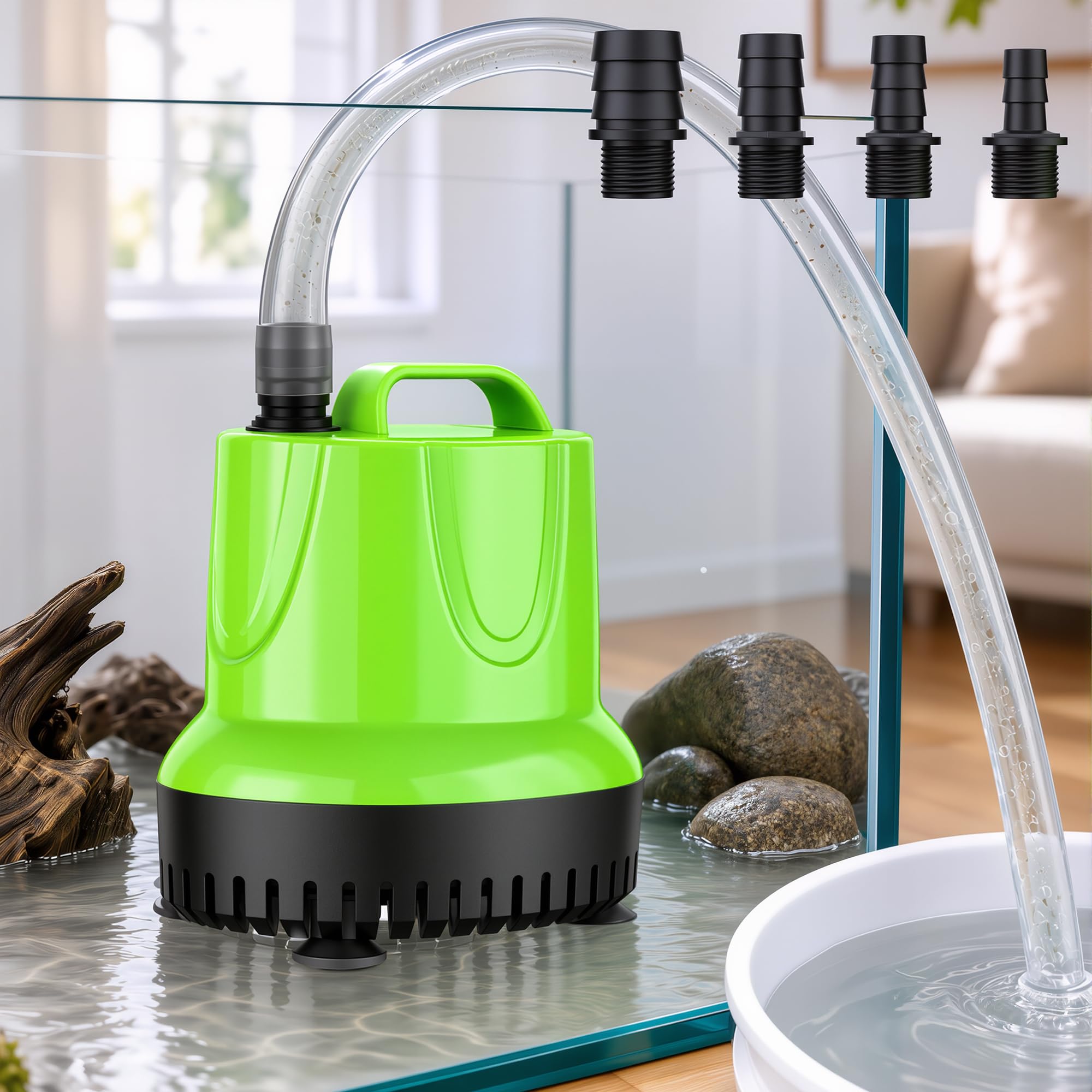
Rating: 4.2 ★ | Price: Midrange | Size: 5.9 x 5.51 x 4.33 in | Wattage: 40W | Max flow: 660 GPH | Max lift: 8.2 feet
The best thing this pump does is delete a chore. At 660 GPH it moves water faster than you want to stand there watching, so a 25 percent change on a 40-gallon tank is a couple of minutes of holding a hose instead of six trips to the sink. The half of the job that impressed us more is the refill: with 8.2 feet of maximum lift, it pushes water from a barrel on the floor up into a tank on a stand, and a lot of water-change pumps quietly can’t do that.
FREESEA builds this one around water changes rather than around fountains, and the intake is where you see it. It sits low enough to pull the tank down to a shallow puddle instead of leaving an inch you have to chase with a cup, which is the bit of the job that usually decides whether you bother. The outlet is detachable and takes more than one hose size, and the 40W brushless motor is quiet enough to run in the same room as the television.
Two things to know. At 660 GPH this is a lot of pump for a 10-gallon nano, so on a small tank throttle it or drain into a bucket you can watch, because a full-flow refill will stir the substrate. And treat it as a maintenance tool rather than a return pump: the housing comes apart without tools for a rinse, and that rinse is the difference between a pump that keeps its flow and one that doesn’t.
Pros
- 660 GPH empties a mid-size tank fast
- 8.2 feet of lift refills from a floor barrel
- Low intake leaves only a shallow puddle
- Quiet 40W brushless motor
Cons
- Biggest footprint of the pumps here
If you keep a 20- to 55-gallon tank and want water changes to stop being a bucket job, this is our pick: fast, quiet, and it gets the level right down.
Best for Precise Small-Tank Draining
hygger 215 GPH Quick Water Change Pump

Rating: 4.2 ★ | Price: Midrange | Wattage: 18W | Max flow: 215 GPH | Max lift: 3.6 feet | Outlet fittings: 1/2 in and 5/8 in barbs
Where the FREESEA is a firehose, this is a tap. At 215 GPH the hygger moves about a third as much water, and on a 20-gallon or a heavily planted tank that is the useful end of the scale: start the drain, trim a few leaves, and the level comes down while you work instead of while you watch.
What sold us on it for water changes is the fitting set. Two barbs, 1/2 inch and 5/8 inch, screw onto the outlet, and those are the sizes standard aquarium hose comes in, so no Saturday is lost to hunting an adapter. The intake is built to drain down to roughly a quarter inch of water, which is about as empty as a tank gets without a siphon, and that is the reason we suggest this one for bare-bottom quarantine tanks and shrimp setups.
The 1/2-inch barb is a loose fit on some units, so if your hose slides on easily, add a stainless clamp before you walk away; a hose that pops off mid-change is a wet floor and a stressed fish. Beyond that there’s little to grumble about. The body is 13 ounces and under four inches tall, so it sits in the tank or in a bucket without fuss, and the control knob trims the flow without stalling the motor.
Pros
- Two barbs match standard aquarium hose
- Draws the tank down to about a quarter inch
- Gentle 215 GPH flow is easy to control
- Small 13-ounce body fits inside the tank
Cons
- 3.6-foot lift rules out long hose runs
For small or planted tanks we think the gentle approach wins, and this is the pump that does it: two barb sizes and a quarter-inch draw-down.
Best for Long Hose Runs
VIVOSUN 800 GPH Submersible Pump

Rating: 4.4 ★ | Price: Premium | Wattage: 50W | Max flow: 800 GPH | Max lift: 10 feet | Power cord: 6.5 feet
VIVOSUN doesn’t sell this as a water-change pump, and the intake gives it away. It sits in the base of the housing, so once the level drops to the height of the pump body you’re finished and the rest has to come out another way. Tip it onto its side for the last of it, or finish the job with a siphon; plan for that, because a first attempt at emptying a tank with this alone ends with a cup.
What it does have is head. 800 GPH and a 10-foot maximum lift are the biggest numbers on this page, which turns awkward jobs into non-events: a hose out to the patio, a run to a utility sink, or a 55-gallon change you’d rather not nurse for ten minutes. Three nozzles come in the box, the cord is 6.5 feet, and at 1.9 pounds it still lifts out one-handed.
The mounting is better than a water-change pump needs. It sits flat, clings to a vertical surface, and rotates so you can aim the outlet, which matters in a sump or a mixing barrel. Between changes it works convincingly as a fountain or pond pump, which is more than most of the others here can claim.
The lift is what settles it for us. When the bucket can’t sit beside the tank, and in most rooms it can’t, ten feet of head is the difference between a water change and a mopping job.
Pros
- 10 feet of lift for long hose runs
- 800 GPH moves big volumes quickly
- Three nozzles and a 6.5-foot cord
- Mounts flat, vertically, or at an angle
Cons
- Long-term reliability is the weak point
For pushing water across a room and up a wall, this is the pump we reach for; for the last inch at the bottom, reach for something else.
Best for Mid-Size Tanks
PULACO 400 GPH Submersible Pump

Rating: 4.2 ★ | Price: Midrange | Wattage: 25W | Max flow: 400 GPH | Max lift: 6.5 feet | Included tubing: 5 feet
The box holds more than you expect at this size: the pump, five feet of tubing, and a flow valve you turn by hand. That means you can be draining a tank a minute after the parcel arrives, without a separate trip for hose, which matters more than it sounds when the alternative is a garden hose and three adapters.
The numbers sit in the useful middle. 400 GPH, 6.5 feet of maximum lift, 25W, and a body 5.1 by 3 by 4 inches that tucks into the corner of a 40-gallon without dominating it. The flow valve is the part that earns its keep: turned down it’s a civil pump for a 29-gallon, and wide open it empties a five-gallon bucket in under a minute.
Nothing about this pump demands attention, which is exactly why it earns its place here: no adapter hunt, no throttle to babysit, no drama at the tank. It’s the one we point people at when they haven’t measured their tank or their hose and just want a water change to work, and the 400 GPH ceiling leaves room for a tank bigger than the nano pumps here can handle.
Pros
- 400 GPH with an adjustable flow valve
- Five feet of tubing included
- 6.5 feet of lift for a floor bucket
- Small enough to sit in a 40-gallon corner
Cons
- Tubing arrives kinked and needs stretching
We found the sensible middle here: 400 GPH, 6.5 feet of lift, and a hose in the box for a weekly change on a mid-size tank.
Best for Compact High Lift
GROWNEER 550 GPH Submersible Pump

Rating: 4.2 ★ | Price: Midrange | Wattage: 30W | Max flow: 550 GPH | Max lift: 7.2 feet | Nozzle sizes: 0.51, 0.62, 0.75 in
Seven point two feet of lift from a body 3.3 inches long is the entire pitch, and it’s a good one: a 30W pump that fits in your palm and still pushes water from the floor to the rim of a tall tank. We noticed the size first, 1.2 pounds and small enough to sit behind decor, and the lift second, which is the right order for something you have to look at.
Around that it’s a sensible package: 550 GPH, three nozzles at 0.51, 0.62 and 0.75 inch, four independent suction cups, and a 5.9-foot cord that reaches most outlets without an extension. The threaded fittings make swapping nozzles painless, which is more than you can say for the push-on barbs on some of the others here.
The lift figure is honest but it isn’t free. 550 GPH is measured at zero head, and by the time water is climbing seven feet you’re getting a fraction of that. There’s still plenty for a water change, but size the hose for the trickle rather than the number and you won’t be disappointed.
Pros
- 7.2 feet of lift from a palm-sized pump
- Three nozzle sizes included
- Four suction cups hold it on glass
- 5.9-foot cord reaches most outlets
Cons
- Hums enough to rule out a bedroom tank
We like it for tall tanks: 7.2 feet of lift from a pump small enough to hide behind a rock, at a price that makes a spare sensible.
Best for Nano Tanks
PULACO 160 GPH Submersible Pump

Rating: 4.2 ★ | Price: Budget | Wattage: 10W | Max flow: 160 GPH | Max lift: 4 feet | Included tubing: 3.3 feet
There is a size of tank below which a 660 GPH pump is a liability rather than a help, and most of the pumps here sit on the wrong side of that line for a 10-gallon. This one doesn’t: 10W, 160 GPH, a body 2.4 by 1.8 by 2.1 inches, and 3.3 feet of tubing in the box. It drains a nano at a speed you can watch and refills it without turning the substrate into a dust cloud.
The flow valve is the useful part. Turned down it becomes a top-off pump for a small tank or a circulation pump for a mixing bucket; turned up it empties a 10-gallon in a couple of minutes. The 10W draw means it costs almost nothing to leave running while you work a siphon around the plants.
Where it earns its place for us is the low cost of being wrong. This is an inexpensive way to stop carrying buckets on a small tank, and if it gives out after a year you’ve lost very little, which is worth saying plainly because none of the pumps here is a lifetime purchase. A cheap submersible is a consumable, and we budget for a replacement every year or two rather than expecting a decade.
Pros
- 160 GPH suits 10- and 20-gallon tanks
- Tubing included in the box
- Flow valve doubles as a top-off pump
- 10W draws almost nothing
Cons
- Four feet of lift keeps the bucket low
Small tanks don’t need much pump, and we rate this one for getting a 10-gallon change done without scaring the fish.
Best for Pico Tanks
AQUANEAT 80 GPH Mini Pump

Rating: 4.2 ★ | Price: Budget | Size: 2 x 1.75 x 1.25 in | Max flow: 80 GPH (300 L/H) | Warranty: 30 days | Included tubing: 3.3 feet
Two inches by 1.75 by 1.25. That’s the entire case for this pump: it disappears into the corner of a pico tank, a filter chamber, or a top-off container where nothing else on this page fits. The flow valve trims 80 GPH to a trickle, 3.3 feet of tubing comes in the box, and the warranty runs 30 days, which tells you something about how the maker views its life expectancy.
We treat it as a small-job tool rather than a water-change workhorse, and it earns that role: moving fresh water from a mixing jug into a nano, or emptying a five-gallon quarantine tank, takes a few minutes and no lifting. It’s also the pump that fits inside a filter chamber, which is where a 10-gallon’s water change actually happens once the tank is stocked and the open space is gone.
Pros
- Fits where nothing else does
- 3.3 feet of tubing included
- Adjustable flow for trickle top-offs
Cons
- 80 GPH is slow past 10 gallons
- Short lift, so the bucket stays beside the tank
Two inches of pump that will quietly move five gallons out of a pico tank — we think it earns a spot for the smallest jobs.
How We Chose and Tested the Pumps
We started by gathering every pump that kept surfacing in hobbyist forums and retailer reviews, then trimmed the list by lift height, hose-fitting sizes, and whether the thing could plausibly fit inside the footprint of a 10-gallon tank. That left 12 pumps, from small transfer models to units built for larger systems, and we used each one for eight months of ordinary water changes.
Most of the testing happened on Saturday mornings, siphon hose in one hand and a towel under the tank. We timed how long each pump took to move 20 gallons out of a 55-gallon community tank and push it back up a four-foot rise from a basement utility sink, then repeated the job on a 10-gallon nano in a small apartment, where noise matters more than raw flow. Every pump got primed straight out of the box without the manual, and we counted how many of its fittings actually matched standard hose and faucet adapters.
Flow and build quality got checked side by side: we watched whether output stayed steady as the water level dropped, and kinked the hose for a minute to see which pumps stalled and needed re-priming. After each session we rinsed the impeller housing and looked for cracks, and over the months we noted which ones collected gunk and slowed down. Noise was judged from the next room with the tank in a living space. Reliability came down to whether a pump started on the first try in month seven the way it did in week one, and value meant tallying what came in the box — hose, clamps, adapters — against what we had to buy separately.
How to Choose an Aquarium Water Change Pump
The flow rate on the box is measured with nothing for the water to climb, so the figure that decides your purchase is what the pump still does at the height you’re actually pumping.
Match the flow to the tank, not to the box
Rated flow is quoted at zero lift, and it falls away as water has to climb. A 150 to 250 GPH pump is comfortable on a 10- to 20-gallon tank; anything near 600 GPH on a nano needs throttling or you’ll stir the substrate. A 75-gallon change is where the bigger pumps earn their money.
Think in minutes rather than gallons per hour. A 20 percent change on a 40-gallon tank is eight gallons, which a 200 GPH pump moves in a few minutes through a hose and a 660 GPH pump moves almost too fast to watch. Either beats carrying it.
Lift height decides where the bucket sits
Count the vertical distance from the water surface in the tank to the top of the container you’re filling, or from the bottom of your barrel up to the tank rim. A tank on a stand down to a bucket on the floor is three to four feet. A run to a utility sink, out of a window, or up from a floor barrel into a tall tank is considerably more.
A pump rated at 3.6 feet is fine beside the tank and useless across the room; the VIVOSUN’s 10 feet is what you pay for when the hose has to travel. Buying on flow alone and ignoring lift is the most common way this purchase goes wrong.
Getting the tank down to the last inch
Most submersible pumps draw from the base of the housing, which means they stop pulling once the water drops to their own height, and then you’re back to a cup. A low-level intake, like the hygger’s quarter-inch draw-down, finishes the job properly and is worth choosing deliberately if you keep bare-bottom or quarantine tanks.
If yours doesn’t have one, tip the body onto its side for the last of it. What you shouldn’t do is run the pump dry to chase the final half inch, because that is how impellers die.
Hose, barbs, and the fitting that fits
These pumps connect with barbed fittings in 1/2, 5/8, or 3/4 inch, sized to the inside diameter of vinyl tubing. Buy tubing to match the barb rather than the other way round, and put a stainless clamp on any joint under pressure. A hose that slips off mid-change is a wet floor and a stressed fish.
Included tubing is usually short and light — treat it as a starter and buy a longer length in the right size. A five-foot length reaches a bucket on the floor; it does not reach a sink down the hall.
These are tools, not return pumps
A water-change pump runs for ten minutes a week, and it’s happiest treated that way: rinse the impeller housing when flow drops, store it dry, and don’t leave it circulating in the tank as permanent filtration. Unplug it before you put a hand in the water, and never run it out of water.
Expect a limited service life from anything in this bracket. Budgeting for a replacement every year or two is more realistic than expecting a decade, and buying from a seller with an easy returns window matters more than the flow figure.
Frequently Asked Questions
Will a water change pump suck up small fish or shrimp?
It can. The intake pulls anything that fits through it, and fry and shrimp are exactly that size. Slide a coarse sponge prefilter over the intake before you drain, keep the pump away from the corners where fish shelter, and drain only to the level you planned rather than chasing the bottom.
The sponge earns its keep twice: it also keeps plant debris out of the impeller, which is the usual reason a pump loses flow after a few months.
Can I connect a garden hose to one of these pumps?
Only with an adapter. Aquarium pumps use barbed outlets sized for vinyl tubing, while a garden hose ends in a 3/4-inch threaded coupling, so you need a barb-to-thread adapter in the matching barb size.
A full hose is also heavy. Loop it so the weight hangs from something solid rather than from the pump outlet, or a small pump will tip over and start sucking air halfway through the drain.
Can I use the same pump to mix saltwater?
Yes, and it’s one of the better uses for a spare. Drop it into a barrel of RO water with the salt and let it run until the mix clears, then move the same pump to the tank for the refill.
Rinse it in fresh water afterwards. A pump that lives in salt mix collects scale faster than one that only sees tank water, so keep the mixing duty on the cheaper pump where you can.
Is a pump better than a gravel siphon?
For moving water, yes: a pump is faster and it can push water back uphill into a tank or down a drain, which a gravity siphon cannot. What a siphon still does better is clean, because the gravel vacuum lifts mulm out of the substrate as the water leaves.
Most keepers end up with both — a siphon for the tank that needs vacuuming, a pump for volume, refills and the bare-bottom tanks.
Final Verdict
The FREESEA is the pump we tell most people to buy, because it does both halves of a water change: fast draining, and a refill that can climb eight feet from a barrel on the floor. It also gets the tank down to a shallow puddle instead of an inch you have to chase.
Choose the hygger instead if your tank is small, planted, or full of shrimp and you want a slow, controllable drain; choose the VIVOSUN if the hose has to travel. Whichever you buy, unplug it before you reach in.