This post contains affiliate links. We may earn a small commission when you buy through our links — at no extra cost to you.
The biggest frustration with CO₂ injection for planted tanks isn’t the cost or the setup—it’s finding a system that won’t silently build up CO₂ levels overnight. Across the category, solenoid valves that should shut off gas at night can stick partially open, and a misaligned gasket can drain a new cartridge in hours.
Instead of avoiding CO₂ entirely or spending a fortune on a lab-grade regulator, the solution is pairing the right generator with a drop checker and an airstone—or choosing a simpler method if your tank is small. This guide matches four very different CO₂ systems to the tanks and habits that make them shine, and flags exactly where to add the safety gear that turns a good generator into a fish-safe one.
Top Picks
Best for Large Planted Tanks
FZONE 5.5L CO2 Generator

Rating: 4.4 ★ | Price: Mid-Range | Tank Capacity: 5.5L | Solenoid Shutoff: 12V Solenoid | Needle Valve: Precision needle + bubble counter | Build Material: Stainless Steel
The 5.5L SUS304 stainless steel tank and precision needle valve deliver steady CO₂ output that visibly accelerates plant growth and pearling in tanks from 20 to 75 gallons. The reaction between citric acid and baking soda produces enough gas to keep even densely planted aquariums thriving for months between refills.
Build quality is solid — the 1.5mm‑thick tank and over‑pressure relief valve inspire confidence. The included solenoid does reduce CO₂ flow on a timer, but in some cases it may not seal completely when powered off, allowing gas to leak at night. This is a known behavior that can upset sensitive livestock if left unaddressed.
This generator suits DIY aquarists who are comfortable mixing chemicals and who plan to pair the system with a separate pH controller or a higher‑grade solenoid. For anyone seeking a hands‑off, worry‑free setup, the solenoid limitation is a reason to look elsewhere or budget for additional safety gear.
Pros
- Accelerates plant growth and pearling in medium to large planted tanks
- Stainless steel tank and regulator hold up well under continuous use
- More gas capacity per dollar than comparable pressurized cylinder systems
Cons
- Solenoid may not close fully when powered off, allowing CO₂ to leak at night — a risk to fish without a pH controller
For planted tank enthusiasts who don’t mind monitoring or adding a pH controller, this generator offers unmatched capacity per dollar — just don’t rely on the built-in solenoid as a complete safety stop.
Best for Nano Tanks
FZONE Desktop CO2 System
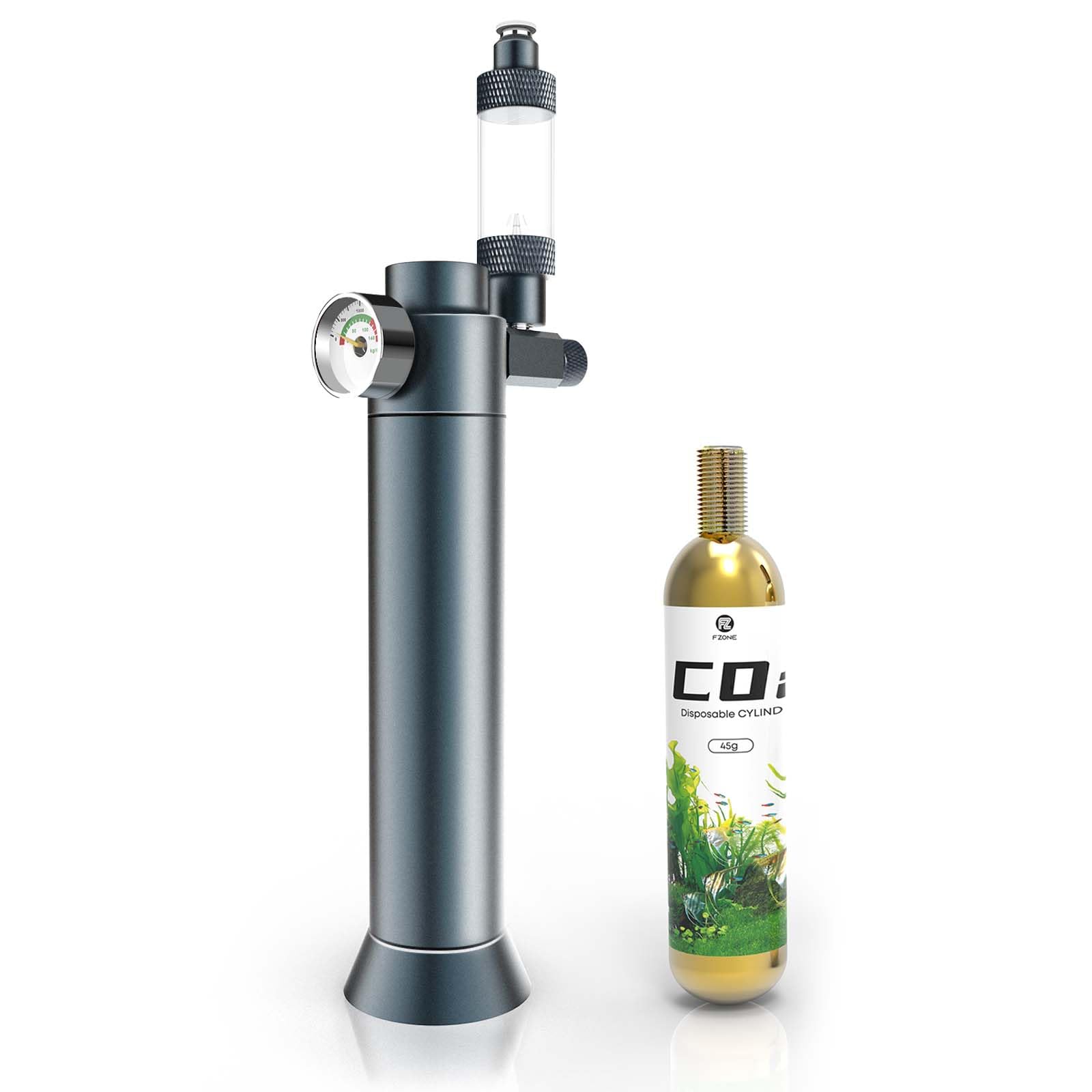
Rating: 4.4 ★ | Price: Budget | Tank Capacity: 45g Cartridge | Needle Valve: Needle valve | Build Material: Metal alloy
Unlike full-size generators that demand cabinet space and periodic powder refills, this system compresses CO₂ delivery into a slim cylinder that mounts discreetly on nano tanks. Disposable 45g cartridges thread on in seconds, and the quick-connect tubing integrates with the integrated bubble counter immediately, no chemistry mixing required.
It’s suited to nano aquarium owners (10 gallons or less) with limited desk room, or beginners wanting a low-commitment introduction to CO₂ injection. The trade-off: the small white gasket required for the cartridge seal can be overlooked during installation, and if not seated correctly, the entire cartridge may vent overnight. Checking it before each install eliminates the risk.
Pros
- Fits on the smallest desktops, ideal for nano tanks where space is at a premium.
- Assembles in minutes and begins delivering CO₂ almost immediately.
- Metal body with satin finish feels durable and looks clean on display.
Cons
- A small white gasket can be misplaced during cartridge installation, causing the CO₂ cartridge to empty overnight.
- Disposable cartridge costs accumulate over time, making this less economical than refillable generators for long-term use.
For nano tanks requiring a low-profile, plug-and-play CO₂ injection without chemical mixing, this system fills the niche with minimal fuss.
Best for Budget Planted Tanks
Hygger 2L CO2 Generator
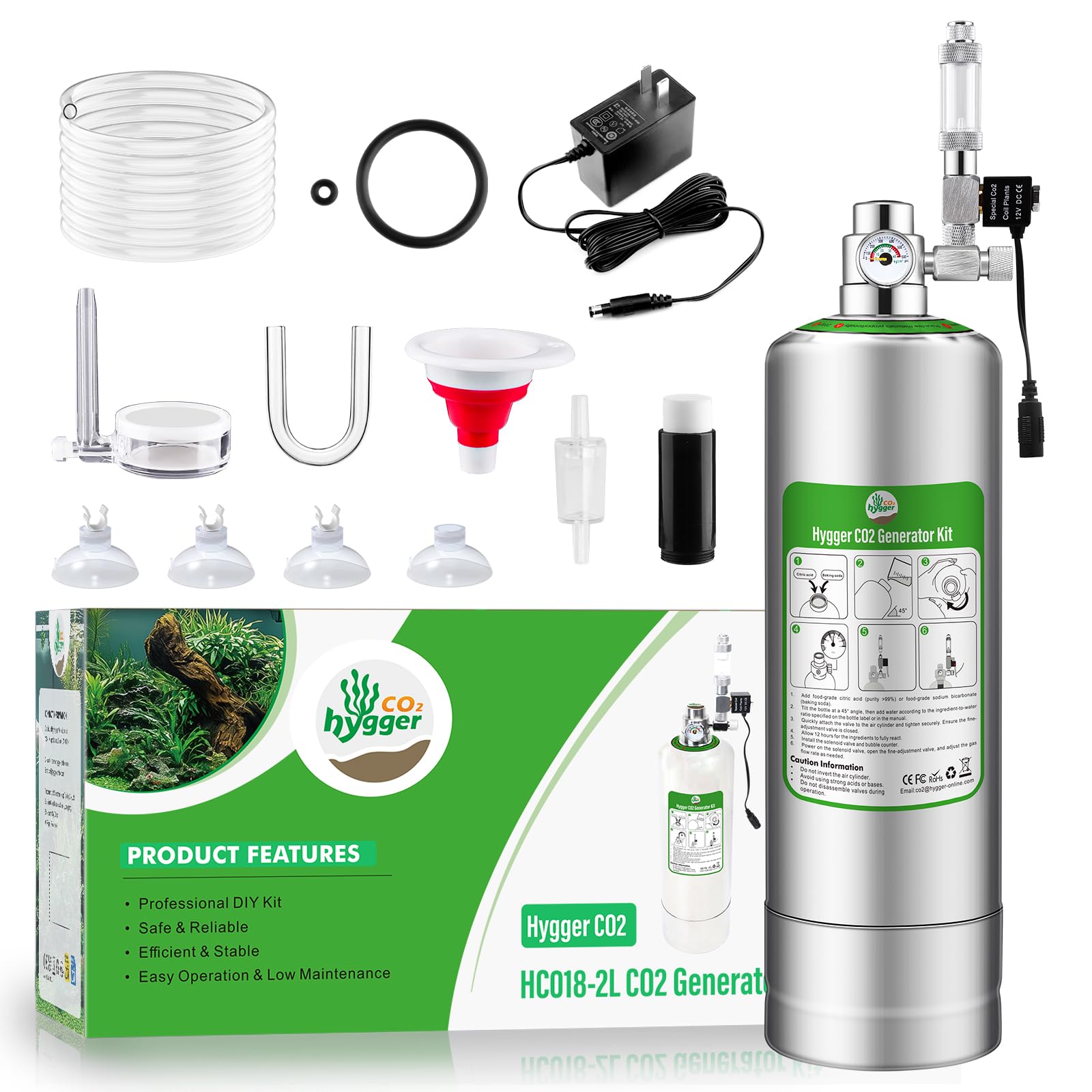
Rating: 4.2 ★ | Price: Budget | Tank Capacity: 2L | Solenoid Shutoff: 12V Solenoid | Needle Valve: Precision needle + bubble counter | Build Material: Stainless Steel
This 2L stainless steel generator includes a solenoid, needle valve, bubble counter, and all accessories for immediate use — a complete bundle at a price well below the larger 5.5L alternatives. The setup is simple enough for first-time CO2 users, and the solenoid lets you automate injection with a timer.
Best suited for budget-conscious aquarists running 10- to 30-gallon planted tanks who are comfortable with occasional maintenance. The needle valve and check valve can degrade after several months, requiring replacement to keep CO2 delivery consistent — not a dealbreaker for those prepared to swap small parts periodically.
Pros
- Budget-friendly stainless steel generator with solenoid for smaller tanks.
- Beginner-friendly assembly suits first-time planted tank owners.
- All essential accessories included — diffuser, check valve, tubing, and bubble counter.
Cons
- Needle valve and check valve may degrade after several months, leading to inconsistent CO2 delivery without replacement.
For smaller planted tanks where budget is a priority, this kit delivers solenoid automation and a stainless steel tank at an entry-level price — just factor in periodic valve replacement.
Best for Small Low-Tech
Aquario Neo CO2 Kit

Rating: 4.3 ★ | Price: Budget | Tank Capacity: 150ml Bottle | Needle Valve: Basic valve | Build Material: Plastic
Starts producing CO₂ within 24 hours of mixing the included yeast packet — no electricity, no solenoid, no gas cartridges. The gel pack runs for roughly 2.5 months before needing replacement, while the yeast packets supply about two weeks each. Compared to the compact cartridge system that requires careful gasket checks, this kit eliminates all electrical and mechanical complexity.
This kit fits absolute beginners with small low-tech tanks (≤15 gallons), terrariums, or paludariums. Because it runs 24/7, adequate nighttime aeration is necessary to prevent CO₂ buildup in the water — a manageable tradeoff for nano setups. For medium or large tanks requiring adjustable injection rates, or for anyone unwilling to add an airstone at night, this isn’t the right tool.
Pros
- Ideal for first-time CO₂ users — no prior experience needed, just mix and place.
- Noticeably improves plant growth and coloration in small low-tech tanks.
- Gel pack provides ~2.5 months of continuous CO₂ before needing replacement.
Cons
- Runs 24/7 with no off-switch; must provide nighttime aeration to prevent CO₂ buildup.
- CO₂ output is capped and not adjustable — unsuitable for tanks over 15 gallons or high-demand plants.
The easiest way to test CO₂ in a nano tank — pair with a small airstone on a timer overnight for safe, noticeable plant growth.
How to Choose
The real safety of any CO₂ system comes not just from the generator but from the fail-safe gear you add to it.
Tank Capacity
A 2L generator can keep a 20-gallon tank supplied for 3–4 weeks, but a 5.5L unit stretches refills to 2–3 months, cutting maintenance drastically. The trade-off is that larger tanks take up more cabinet space and cost more upfront—but for tanks over 40 gallons, the longer runtime pays off quickly.
For nano tanks under 10 gallons, a disposable 45g cartridge or a gel bottle avoids the bulk entirely, but you’ll replace cartridges more often. Match capacity to your patience for mixing chemicals.
Solenoid and Nighttime Safety
A solenoid automatically stops CO₂ flow at night, but the solenoids on budget generators often fail to seal completely, allowing gas to trickle in after hours. Pair your system with a pH controller or a secondary quality solenoid to guarantee a true shutoff.
Needle Valve Adjustability
Fine bubble control is what makes CO₂ injection consistent. A precise needle valve lets you dial in 1–2 bubbles per second without constant tweaking; cheap valves are hypersensitive—a tiny nudge can double the rate or stop it. Look for a valve with a bubble counter and a knurled knob that holds its position.
Build Material
Stainless steel reactors resist citric acid corrosion and handle pressure reliably, while plastic-bottle kits can pressurize dangerously and crack. Even among stainless generators, check that the tank is SUS304 food-grade steel and includes an over-pressure relief valve.
Leak Protection and Pressure Relief
Every generator should have an automatic blow-off valve that releases pressure if the reaction gets too aggressive. Missing this feature in a plastic bottle setup is a serious risk. Also examine o-ring and gasket placement—a poorly seated gasket will leak the entire CO₂ charge overnight.
FAQ
Why does my CO₂ generator keep leaking after the solenoid is off?
The solenoid valve in many budget generators may not seat completely, either due to debris or weak spring tension. Even a tiny gap lets gas flow overnight. Adding a separate high-quality solenoid downstream or using a pH controller that cuts power to the generator entirely can prevent this.
Can I use a CO₂ cartridge system for a 20-gallon planted tank?
Cartridge systems like the FZONE Desktop are designed for nano tanks under 10 gallons. In a 20-gallon, the CO₂ supply would deplete in days and the diffusion would be insufficient. A refillable 2L or 5L generator is the right tool for that tank size.
How long does a 2L citric acid generator last before needing a refill?
With typical citric acid and baking soda mixture, a 2L reactor running 8 hours a day at 1 bubble per second lasts roughly 3–4 weeks. Heavy planting and higher injection rates can shorten that to 2 weeks. A 5.5L unit extends refill intervals to 2–3 months.
Is the Aquario Neo CO₂ kit safe for fish at night?
The kit runs 24/7; CO₂ builds up if the tank isn’t aerated at night. Adding an airstone on a timer that runs after lights off safely off-gasses excess CO₂. For tanks under 10 gallons, this combination keeps fish safe without needing a solenoid.