This post contains affiliate links. We may earn a small commission when you buy through our links — at no extra cost to you.
Setting up CO2 on a planted tank should be straightforward, but many regulators introduce more problems than they solve. Solenoids that stop closing, leaks at bubble counters, and needle valves that drift are common complaints. The result is wasted CO2, stressed fish, and frustration.
The real choice comes down to how much control and safety you need. Single-stage regulators are cheaper but dump CO2 as the tank empties—a risk for fish. Dual-stage models maintain steady pressure until the last drop, but cost more. And between compact paintball-friendly designs and expandable multi-tank setups, each serves a different space and scale.
This guide helps you match your tank size, budget, and tolerance for tinkering with the right regulator. The key is choosing one that fits your specific setup—nano tank or multi-aquarium—without overspending on features you won’t use.
Top Picks
Best for Multi-Tank Setups
FZONE Pro Dual Stage
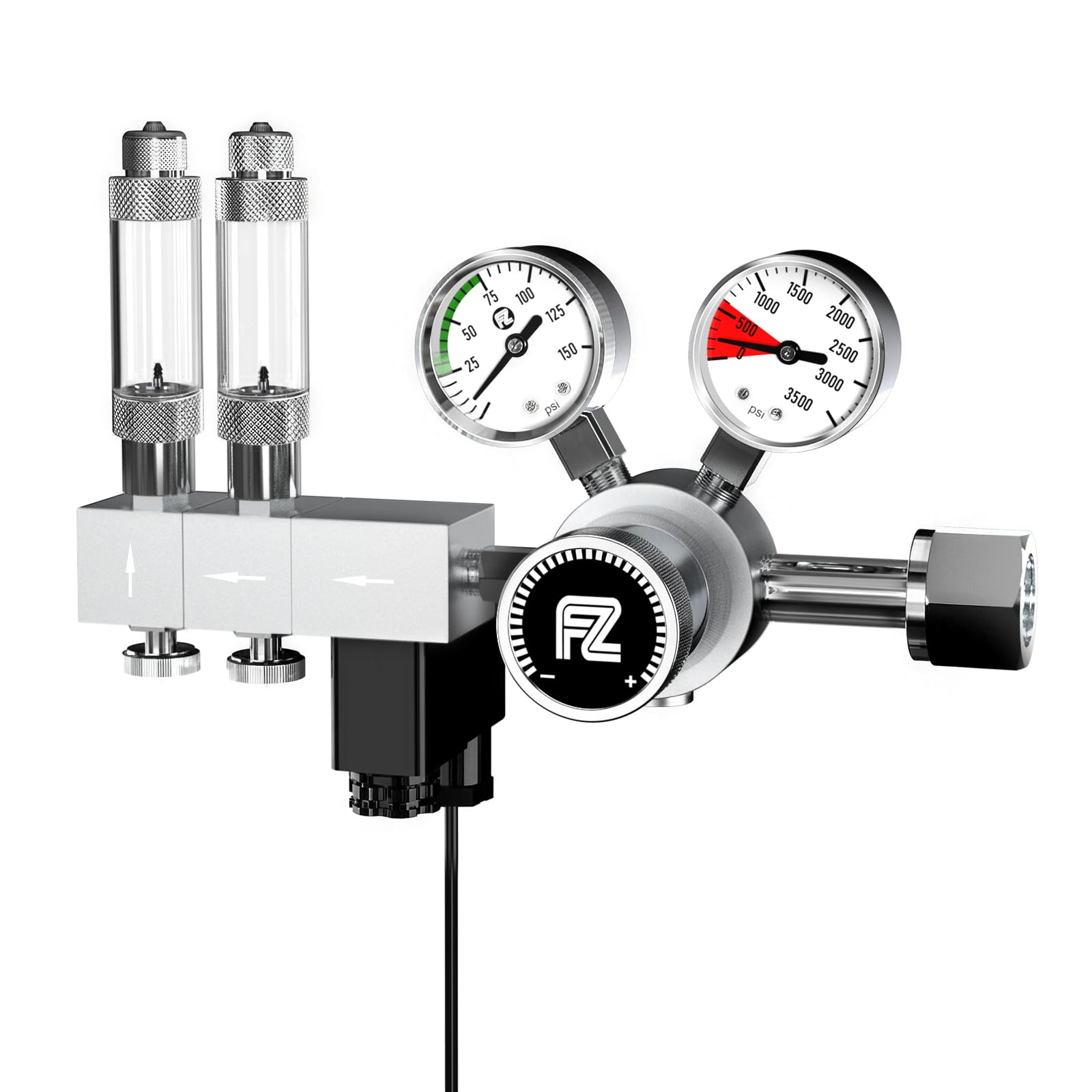
Rating: 4.2 ★ | Price: Premium | Stage Type: Dual | Adjustable PSI: 0-65 PSI | Solenoid Type: 12V DC | Bubble Counter: Included
Dual-stage regulation prevents the sudden CO2 dump that can stress fish when a tank runs low, making this a genuine safety upgrade for planted tanks. The body is machined with heft that inspires confidence during setup, and the dual manifolds let you run two separate lines without extra splitters — useful for multi-tank or high-flow layouts. Output pressure adjusts from 0 to 65 PSI, giving you fine control over bubble rate across different diffusers or reactors.
This regulator is best for medium to large planted tanks (40–100 gallons) where consistent CO2 matters and you want room to expand later. The solenoid and needle valve are the main variables: some units may need a solenoid replacement down the road, and the needle valve can be touchy during fine-tuning. Plan for a short break-in period to find your stable bubble count — after that, the dual-stage holds pressure well.
Pros
- Dual-stage design eliminates end-of-tank dump risk for fish safety
- Solid build with machined body and heavy feel at connection points
- Expandable dual manifolds allow independent control of two lines
Cons
- Solenoid performance can vary between units — some may not shut off fully or need early replacement
- Needle valve may be sensitive to small adjustments and can drift over time
If you want dual-stage safety and the ability to run multiple tanks or high-flow setups without stepping up to a pricier brand, this regulator delivers that capability at a fair cost.
Best for Small Tanks
FZONE Mini Dual Stage V3.0

Rating: 4.3 ★ | Price: Mid-Range | Stage Type: Dual | Adjustable PSI: 0-60 PSI | Solenoid Type: 12V DC | Bubble Counter: Included
The FZONE Mini delivers dual-stage regulation in a compact body that works with paintball, CGA320, and disposable cylinders — ideal for nano tanks and space-constrained setups. The trade-off: you get no tank pressure gauge to monitor remaining CO2, and some units may have seal issues at the bubble counter that require leak testing upon setup. Compared to the larger Pro model, you lose adjustable output manifolds and dual gauges, but gain a small footprint and direct paintball compatibility.
Pros
- Compatible with paintball, CGA320, and disposable CO2 cylinders — one regulator covers multiple tank types without adapters.
- Compact dual-stage design prevents end-of-tank CO2 dumps while fitting into tight cabinet spaces.
Cons
- DC power connector can be fragile under strain — reinforcing with heat shrink or a cable tie is advisable.
A practical dual-stage regulator for nano tanks and paintball setups — a space-saver compared to larger dual-stage models.
Best for Nano Tanks
Aquatek Mini Regulator

Rating: 4.0 ★ | Price: Mid-Range | Stage Type: Single | Adjustable PSI: Fixed | Solenoid Type: Cool-touch | Bubble Counter: Included
The AQUATEK Mini has a track record of 3–6 years of continuous use in nano paintball setups – that longevity makes it a reliable foundation for a small planted tank. The needle valve is very sensitive: a tiny turn can shift from a few bubbles to full flood, so it suits those who don’t need precise bubble-by-bubble control. The single-stage design means end-of-tank CO2 dump is possible, but on a nano tank the volume is low enough to monitor without issue.
Pros
- Lasts 3–6 years under continuous use in nano paintball setups
- Comes with bubble counter and check valve for easy setup
Cons
- Needle valve requires very fine turns – a small rotation can cause large CO2 flow changes
- Single-stage design allows end-of-tank CO2 dump – worth monitoring on any setup
A solid choice for nano paintball CO2 setups if you can work with the finicky needle valve – skip it if you need precise bubble counting.
Best for Budget Small Tanks
Hygger Dual Gauge Regulator
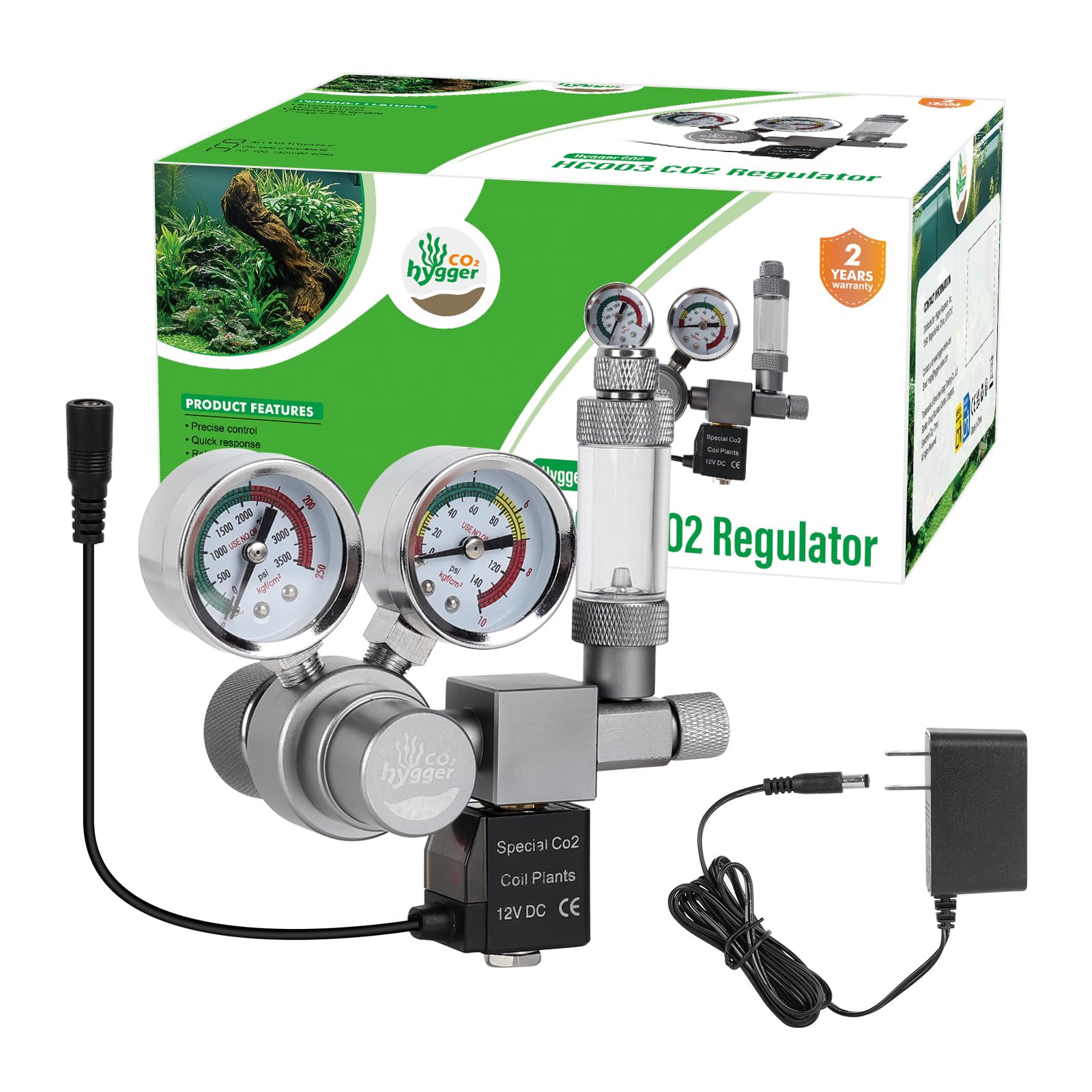
Rating: 4.3 ★ | Price: Budget | Stage Type: Single | Solenoid Type: 12V DC | Bubble Counter: Included
Compared to the cheaper alternatives in this segment, the Hygger adds dual gauges for monitoring both tank and working pressure, plus a longer warranty. The build quality feels solid for its price, and the solenoid operates consistently with timers in early use.
This regulator is best suited for budget-conscious aquarists running small tanks where the cost of a potential replacement is manageable. Buying through a retailer with a flexible return policy is worth considering.
Pros
- Dual gauges provide clear readouts of tank and working pressure
- Solenoid shuts off dependably when unpowered, works well with timers
- Strong value for the features offered at this price tier
Cons
- Some units may arrive with gauge or solenoid defects, requiring replacement
If you want dual gauges and a warranty without spending much, the Hygger is a sensible starting point for a small planted tank.
Best for Budget Tinkerers
DaToo Dual Gauge Regulator

Rating: 4.1 ★ | Price: Budget | Stage Type: Single | Bubble Counter: Included
For the price, this regulator includes dual gauges, bubble counter, and solenoid. However, some units have missing gas paths or a solenoid that may not shut off, risking uncontrolled CO2 flow. Suitable only for buyers willing to inspect and possibly replace, not for those seeking consistent operation.
Pros
- Very affordable price point
- Compact and functional
Cons
- Solenoid may not stop gas flow when de-energized
Only consider this if you are comfortable inspecting each unit and have a flexible return strategy – it works for some, but not as a primary setup.
Best for Simple Small Tanks
Clscea Dual Gauge Regulator

Rating: 4.1 ★ | Price: Mid-Range | Stage Type: Single | Adjustable PSI: 30 PSI fixed | Solenoid Type: 12V DC | Bubble Counter: Included
This regulator is compact and straightforward to set up, with decent build quality for a mid-range price. It delivers a fixed 30 PSI output, so it works best with diffusers that operate at that pressure – not for tanks requiring adjustable pressure or larger planted systems where pressure stability matters more over time.
Pros
- Compact design with easy setup right out of the box.
- Good build quality for the price – feels well-constructed.
Cons
- Output pressure is fixed at ~30 PSI – verify diffuser compatibility before buying.
Worth considering for simple small tanks where fixed 30 PSI works, but not for setups needing adjustable pressure or larger planted systems.
How to Choose
The most critical decision is whether to buy a dual-stage or single-stage regulator, because that determines safety as your CO2 tank empties.
Regulation Stage: Dual vs Single
Single-stage regulators deliver constant output pressure until the tank pressure drops near zero, then they suddenly dump the remaining CO2—a phenomenon called end-of-tank dump. This can cause a dangerous pH crash in your aquarium.
Dual-stage regulators maintain a steady secondary pressure regardless of tank pressure, so the output remains stable until the cylinder is empty. The trade-off is higher cost, but the safety margin is significant for any tank larger than 20 gallons.
Adjustable Output Pressure
Not all diffusers work at the same pressure—some require 30 PSI, others need 50 PSI or more. A regulator with adjustable output lets you fine-tune the pressure to match your diffuser’s spec, improving CO2 dissolution and reducing waste.
Fixed-pressure regulators (typically around 30 PSI) limit your diffuser choices. If you later upgrade to a more efficient diffuser that needs higher pressure, you’ll be stuck replacing the entire regulator.
Solenoid Type and Reliability
A 12V DC solenoid is the standard for timed CO2 operation, allowing you to turn the gas on and off with a timer. Solenoids can fail in two ways: they stop opening (no gas) or, more problematically, they stop closing (gas flows continuously).
The second failure is the more dangerous one. Some budget solenoids have internal springs that lose tension over time. A simple user-accessible adjustment (often a tiny hex screw) can re-tension the spring and restore proper shut-off. Check for this adjustment before tossing a failed solenoid.
Needle Valve Precision
The needle valve controls your bubble rate—the number of CO2 bubbles per second. A precise, stable valve lets you dial in exactly 1 or 2 bubbles per second without creeping overnight.
Many budget regulators have needle valves that are either too coarse (a 5-degree turn jumps from 1 bubble to a full flood) or drift over time. If you need consistent CO2 dosing, look for a valve that holds its setting after a week of use.
Bubble Counter and Check Valve
The bubble counter visually confirms your CO2 flow rate. It should be easy to read and positioned so bubbles are clearly visible. An integrated check valve prevents water from siphoning back into the regulator when the system is off.
A check valve is non-negotiable—without it, a power outage or timer turn-off can send aquarium water up the CO2 line and damage the regulator. Most regulators include one, but verify it’s present before installation.
FAQ
Why is my CO2 regulator leaking after installation?
Most post-install leaks are caused by inadequate sealing on threaded connections. Wrap PTFE tape (plumber’s tape) three to four times clockwise on every male fitting—the bubble counter, gauge ports, and tank connection. If the leak persists, check the O-rings inside the solenoid housing; they can shift during assembly.
How do I adjust the solenoid on my FZONE CO2 regulator to make it shut off?
If your FZONE solenoid fails to close fully, locate the small hex screw on the solenoid body (often recessed). Turn it clockwise about 1/8 of a turn to increase spring tension, then test the shut-off. Repeat until the solenoid clicks shut when power is removed. This adjustment is common and often fixes the issue without replacement.
Can I use a paintball CO2 tank with a standard CGA320 regulator?
No—paintball tanks use a 5/8" UNF thread, while CGA320 regulators have a different thread pattern. You need either a regulator designed for paintball (like the FZONE Mini or Aquatek Mini) or a CGA320-to-paintball adapter. Do not force a connection; cross-threading can damage the tank valve.
What size CO2 tank is best for a 20-gallon planted aquarium?
A 20-ounce paintball tank or a 5-pound CO2 cylinder is ideal for a 20-gallon tank. A 20-ounce tank lasts about 3–4 months at 1 bubble per second. Larger tanks (10 lb) are overkill for small tanks and harder to hide. For a 20-gallon, a 5 lb tank under the stand offers the best balance of refill frequency and footprint.