This post contains affiliate links. We may earn a small commission when you buy through our links — at no extra cost to you.
A digital display and adjustable temperature sound great on paper. But the reality is that many budget heaters pack those features while cutting corners on quality control—overheating incidents and early failures are far more common than most buyers expect.
Choosing the right heater means balancing features with reliability. Precision adjustment matters for large tanks, but for small setups, a simple, safe design often wins. The best picks in this guide keep fish alive by delivering consistent heat without the drama.
You don’t have to spend a fortune to protect your tank. But ignoring safety or using a heater that can’t hold its set temperature will cost you more in the long run—through lost fish or replacement costs.
Top Picks
Best for Small Tanks
hygger Betta Heater

Rating: 4.6 ★ | Price: $ | Wattage & Tank Size: 10-100W, up to 26 gal | Digital Display / Controller: External controller, LED display | Temp Accuracy: Digital adjustable | Safety Features: Dry-run, overheat protection
The hygger Small Betta Heater delivers dry-run and overheat protection with an adjustable digital display — a feature set rarely found at this price point. Its compact body fits easily in 1–10 gallon tanks, and the LED readout makes temperature checks straightforward. For small freshwater or marine setups, this unit maintains its set point with minimal fuss.
This heater is best matched to nano and betta tanks up to 16 gallons, where its size and digital controls shine. The built-in thermometer may read about 2°F higher than the actual water temperature, so using a separate thermometer is a simple workaround. A small number of units have been known to stop working within a month — a risk worth accepting for budget-focused setups, but less ideal for critical or unattended tanks.
Pros
- Adjustable digital temperature control with dry-run and overheat protection
- Compact size that fits easily in 1–10 gallon tanks without crowding
- Simple setup and stable temperature maintenance
Cons
- Some units may stop working within a month of use
- Built-in thermometer may read about 2°F higher than actual water temperature
For nano tanks on a budget, the hygger offers the best blend of safety features and adjustability — just verify the temperature with a separate thermometer.
Best for Large Tanks
Fluval E300

Rating: 4.3 ★ | Price: $$ | Wattage & Tank Size: 300W, up to 100 gal | Digital Display / Controller: Digital display, color-coded | Temp Accuracy: 0.5°F increments
The Fluval E300 offers 0.5°F adjustment increments and dual sensors for precise temperature control in large tanks up to 100 gallons. Maintaining that accuracy requires careful placement in a high-flow area; some units may run slightly warm or cool otherwise. This heater suits hobbyists who value digital readouts and a 5-year warranty over plug-and-play convenience, and who are willing to monitor placement for optimal performance.
Pros
- Fine temperature adjustment in 0.5°F increments
- Digital display with color-coded temperature indicators
- Simple setup and operation
Cons
- Temperature consistency depends on heater placement and water flow; may run warm or cool in low-flow areas
- Some units may require warranty replacement within the first year
The Fluval E300 is the right choice for dedicated aquarists who want granular temperature control and warranty peace of mind for large tanks, provided they’re mindful of placement requirements.
Best for Turtle Tanks
HITOP PTC 300W

Rating: 4.3 ★ | Price: $$ | Wattage & Tank Size: 300W, 40-80 gal | Digital Display / Controller: External digital controller | Temp Accuracy: Digital adjustable | Safety Features: Protective cover
The HITOP PTC heater uses a ceramic element and a protective cover to eliminate glass shatter risk — a clear advantage for turtle tanks where breakage is a concern. Temperature control is less precise than some glass heaters, and a few units may struggle to maintain the set point, making an independent thermometer a worthwhile addition. This heater suits owners of medium to large freshwater and turtle tanks who prioritize safety and budget over pinpoint accuracy.
Pros
- Protective cover and ceramic element prevent glass breakage entirely.
- External digital controller makes temperature adjustments simple.
- Heats 40–80 gallon tanks effectively with PTC technology.
Cons
- Temperature consistency may drift from the set point — an independent thermometer helps confirm.
- Durability across units is variable; a flexible return policy is worth considering.
The HITOP PTC heater is the right call for turtle tank owners who want shatterproof safety and don’t mind a less precise temperature hold — a solid value in its niche.
Best for Budget Small Tanks
HITOP 100W Digital

Rating: 4.6 ★ | Price: $ | Wattage & Tank Size: 100W, 12-30 gal | Digital Display / Controller: External digital LED | Temp Accuracy: Digital control
An external digital controller lets you set the temperature without reaching into the tank – a convenient feature at this price point. The 100W heater maintains steady heat in 12–30 gallon setups, making it a fit for small fish or turtle tanks. The tradeoff: the LED display is dim and may be hard to read from across the room, and some units show temperature drift over time. Budget-conscious buyers who don’t need precision will find this a capable entry-level heater.
Pros
- External digital controller for convenient temperature adjustments
- Consistent heating in small to medium tanks (12–30 gal)
- Budget-friendly price for a digital model
Cons
- Dim display can be difficult to read; temperature accuracy may vary between units
A capable budget heater for small tanks – worth pairing with a separate thermometer to account for minor display and accuracy quirks.
Best for Nano Tanks
hygger Mini 50W
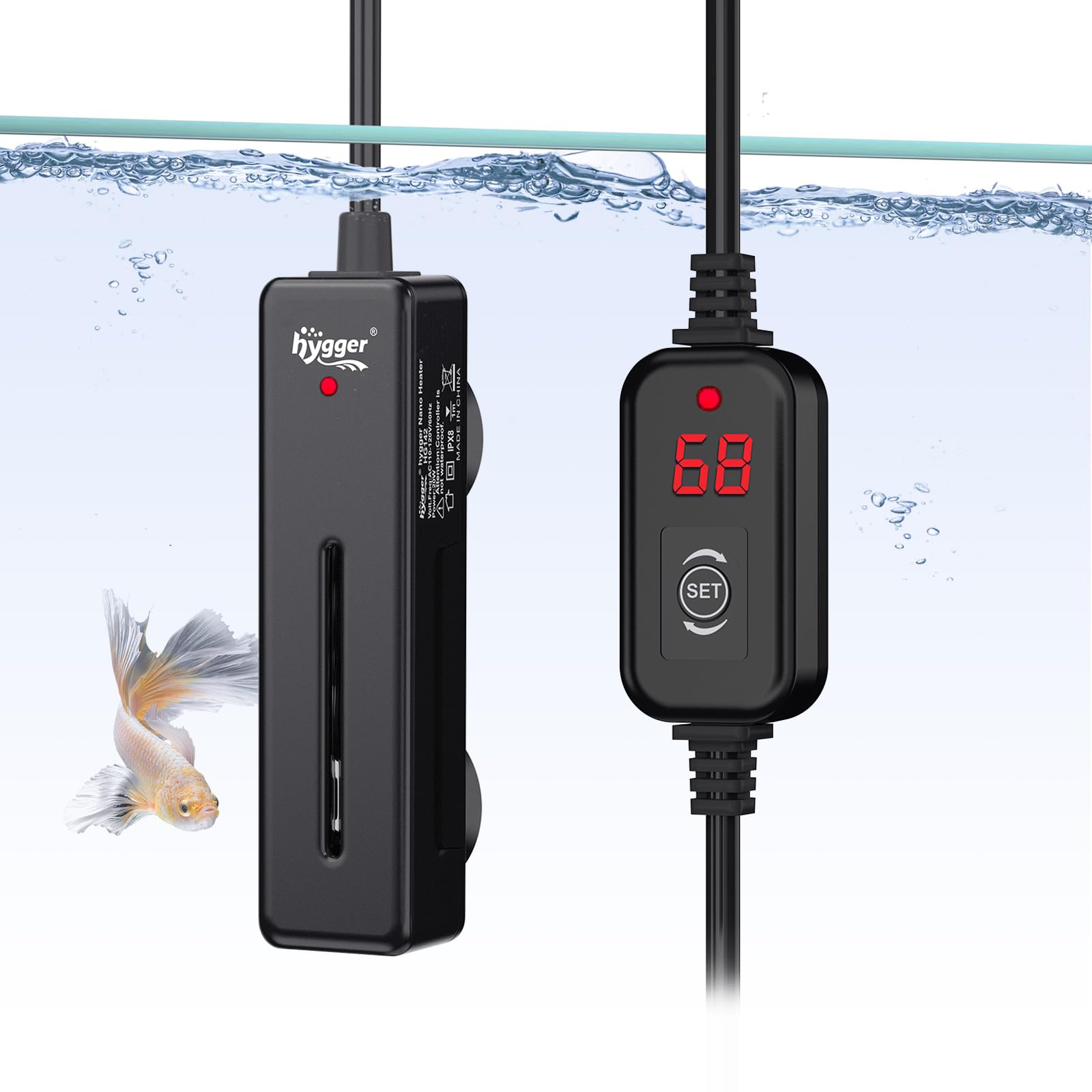
Rating: 4.5 ★ | Price: $ | Wattage & Tank Size: 50W, 5-10 gal | Digital Display / Controller: External digital controller | Temp Accuracy: Digital adjustable | Safety Features: Dry-run, overheat protection
This heater brings dry-run and overheat protection to the smallest nano tanks, heating quickly and holding temperature steadily. However, some units may not reach the set temperature exactly—acceptable for casual setups. Its narrow 5–10 gallon range and lack of multiple wattage options makes the top pick a more flexible choice for similar money.
Pros
- Maintains stable temperature in 5–10 gallon setups.
- Heats water quickly and holds temperature without wide swings.
Cons
- Built-in thermometer can be off by a couple of degrees, requiring an external check for precision.
A capable safety-minded heater for dedicated nano tanks where minor temperature offsets are acceptable.
Best for Betta Tanks
SEAOURA 50W
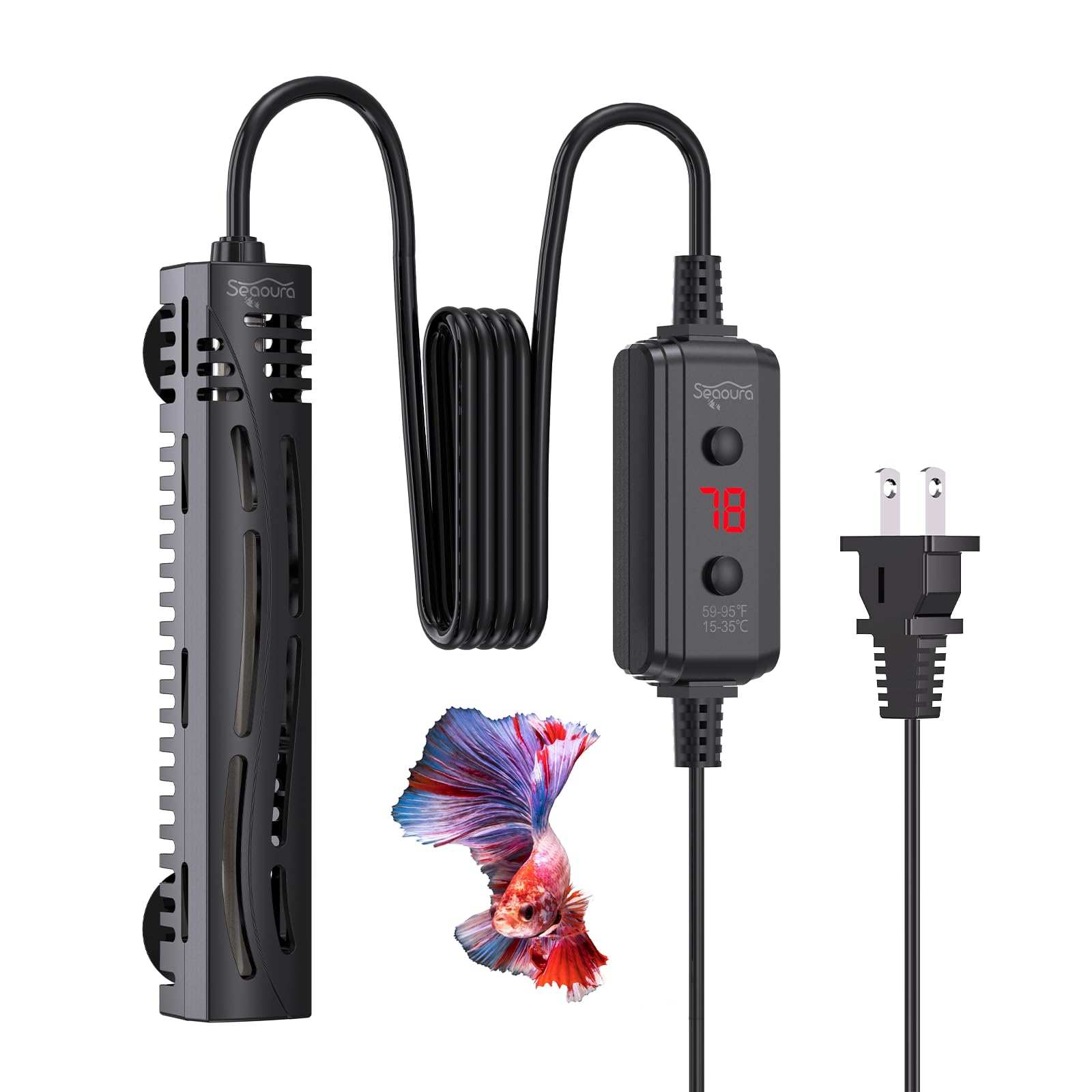
Rating: 4.4 ★ | Price: $ | Wattage & Tank Size: 50W, 5-15 gal | Digital Display / Controller: External LED controller | Temp Accuracy: Digital control | Safety Features: Overheat protection
The SEAOURA 50W hits the lowest price among digital heaters for small tanks, and when it works, it keeps a betta tank comfortable. The external controller shows set vs. actual temperature with a red/green indicator. The catch: the displayed reading can be off by 5°F or more, and occasional units may stop responding within the first year. This is less of a concern for budget-first buyers who keep a separate thermometer in the tank and prefer a heater they can replace every year or two.
Pros
- Lowest price point among digital heaters for 5–15 gallon tanks
- External controller with set/actual temperature display and overheat protection
Cons
- Temperature reading can be off by 5°F or more, requiring a separate thermometer
Worth considering only if your budget is tight and you’re willing to verify temperature with a separate thermometer and accept that the unit may need replacing within a year.
Best for Controller Backup
Inkbird ITC-306T

Rating: 4.6 ★ | Price: $$ | Digital Display / Controller: LCD dual display | Temp Accuracy: Calibration, day/night | Safety Features: Over/under-temp alarm
The Inkbird ITC-306T is a controller, not a heater — it sits between your wall outlet and an existing submersible heater, adding dual-zone scheduling and an over/under-temperature alarm. This makes it a strong accessory for larger tanks or DIY setups where you want separate day/night temperatures or a safety backup. However, it requires an additional heater to function, so it won’t replace a standalone unit. The external probe provides accurate readings, but the suction cup mount can lose grip over time, and the sensor itself may develop relay issues after years of continuous use — a tradeoff for the added control.
Pros
- Dual heating outlets with day/night scheduling give precise temperature control for different periods.
- Over/under-temperature alarm adds a safety layer for existing heaters.
Cons
- The probe suction cup may lose grip over time, requiring a replacement or adhesive backup.
Buy this only if you already have a submersible heater and want programmable cycles or a safety monitor — not a primary heating solution.
How to Choose
The biggest mistake is buying a heater based on wattage alone while ignoring the safety record and accuracy of its built-in thermostat.
Wattage and Tank Size
Wattage determines how fast a heater can raise water temperature and how well it maintains it against room heat loss. A 300W heater in a 20-gallon tank will cycle on and off frequently, shortening its lifespan and causing temperature swings. The general rule is 3–5 watts per gallon, but thicker insulation or a cooler room may need more. Oversizing by 50% is safer than undersizing, as long as the heater can handle the flow and doesn’t overheat in a small space.
Digital Display and Controller
A digital display lets you set a precise temperature and see the current reading. But the real trade-off is between a built-in display on the heater body and an external controller. External controllers allow adjustments without disturbing the tank and often have brighter screens. However, some built-in displays are so dim you need a flashlight to read them, especially in planted tanks with heavy lighting.
Temperature Accuracy and Stability
Accuracy refers to how closely the heater’s reading matches actual water temperature; stability is how well it holds that temperature over time. Many budget heaters claim ±1°F, but user reports often show offsets of 2–5°F. This happens because the sensor is close to the heating element and measures internal water that may differ from the rest of the tank. Placement near a filter outflow improves stability, but the only way to verify accuracy is with a separate glass thermometer.
Safety Features
Dry-run protection shuts off the heater if the water level drops, preventing thermal shock to the glass and potential shattering. Overheat protection cuts power if the internal temperature exceeds a safe limit, which is critical when a thermostat fails. These features are common on paper but vary in reliability; a heater that triggers false alarms or fails to shut off is worse than no protection at all. Always unplug during water changes as a manual backup.
Build Quality and Warranty
A heater’s lifespan depends on the materials and assembly. Quartz tubes are less prone to thermal shock than cheaper glass, and sealed electronics prevent moisture damage. A long warranty—like Fluval’s 5-year—covers defects, but it doesn’t cover user error or a cook-off. For budget models, a 1-year warranty is typical; expect failures after 12–18 months. The real cost is not the heater but the fish it could lose, so consider the warranty length a proxy for confidence.
FAQ
Why does my digital aquarium heater show HH error code?
HH means the heater’s internal sensor reads a temperature above its safety limit—usually above 95°F (35°C). This can happen if the heater runs dry, is accidentally unplugged and placed in hot water, or the sensor itself fails. Unplug the heater, let it cool in air, then test in a separate container of water at room temperature. If the error persists, replace the heater; a faulty sensor cannot be trusted to protect your fish.
Can I use a 300W heater in a 20-gallon tank?
Physically yes, but it’s not recommended. A 300W heater in a 20-gallon tank will cycle on and off rapidly, causing temperature overshoot and increased wear on the thermostat. The result is less stable temperature and a shorter heater lifespan. Stick with 75–100W for a 20-gallon tank for steady, efficient heating.
How accurate are built-in thermometers on aquarium heaters?
Most built-in sensors are accurate within ±2°F when new, but drift over time due to mineral buildup or component aging. Many budget models can be off by 5°F or more. Always cross-check with a standalone thermometer weekly, and adjust the heater setting to compensate for any offset. Never rely solely on the heater’s display for safety-critical tanks.
What wattage heater do I need for a 55-gallon tank?
For a 55-gallon tank, aim for 200–300W. A 200W heater is sufficient in a heated room; a 300W handles colder basements or heavily planted tanks. Two 150W heaters placed at opposite ends provide better heat distribution and redundancy than a single 300W unit.