This post contains affiliate links. We may earn a small commission when you buy through our links — at no extra cost to you.
Many 30-gallon tank owners discover that cheap heaters drift a few degrees or quit after a season. To get consistent temperatures, you often have to jump to a premium model — but the gap between budget and premium is not always worth the leap.
A digital controller with adjustable setpoint and multiple safety cutoffs is the sweet spot for most setups. The challenge is finding one that holds its calibration over years of use without demanding a luxury price tag.
This guide focuses on heaters that deliver ±1°F accuracy and reliable shut-offs while staying within a reasonable budget — because your fish’s health shouldn’t depend on either a lottery or a premium markup.
Top Picks
Best for 20-40 Gal Digital
HiTauing 200W Digital

Rating: 4.5 ★ | Price: Mid-Range | Wattage: 200W | Temperature Control: Digital, 63-94°F | Safety Features: Overheat, dry-run, alarms | Build Material: Quartz glass + ABS | Suction Cup & Cord: Short cord (6 in.)
The HiTauing 200W maintains water temperature within 1°F of the set point, using an external digital controller that displays current and target temperatures. Five safety systems — overheat protection, dry-run shut-off, and diagnostic alarms — cover the main failure modes of submersible heaters. The controller’s interface is intuitive, and the unit mounts easily with suction cups.
The power cord from the controller to the wall plug is only about 6 inches, which may require an extension cord depending on tank placement. While most units hold temperature reliably, some have been noted to stop heating after several months of use — a risk worth considering for those who plan to run it continuously.
This heater fits a 30-gallon freshwater or saltwater tank where the outlet is within a short cable’s reach, or where the owner is prepared to use an extension cord. It offers digital precision at roughly half the cost of premium models like the Fluval E200, making it a strong value for aquarists who want adjustability and safety without the 5-year warranty premium. Those needing absolute long-term reliability or a longer cable may want to look at higher-end options.
Pros
- Keeps temperature within 1°F of the set point, reducing guesswork for sensitive fish.
- Five safety protections provide automatic shut-off and alarms for overheat, dry-run, and sensor faults.
- Setup is quick with a clear external controller and suction cup mount.
Cons
- Power cord from controller to plug is only 6 inches, limiting where the tank can sit relative to an outlet.
- Some units may stop heating after several months of continuous operation.
For a 30-gallon tank where the outlet is close, this heater delivers digital accuracy and safety at a compelling mid-range price — the best value for aquarists who don’t need a 5-year warranty.
Best for Sensitive Fish
Fluval E200 Digital

Rating: 4.3 ★ | Price: Premium | Wattage: 100W | Temperature Control: Digital, color LCD | Safety Features: Dual sensors, shut-off | Build Material: Quartz glass + guard | Suction Cup & Cord: Strong suction cups
Dual sensors and a five-year warranty set the Fluval E200 apart from typical digital heaters. Where the top pick in this roundup balances precision and price, the Fluval leans further into accuracy and long-term support — ±0.5°F temperature control that matters for delicate fish and reef systems. The color-coded LCD gives an immediate visual readout: blue for cooling, green for set, red for heating.
This heater suits dedicated aquarists who keep sensitive species or reef tanks where stable temperature is non-negotiable. The tradeoff is a premium price that undercuts the value argument — for a standard 30-gallon community tank, a cheaper digital model provides sufficient control. Also worth noting: the flow sensor can trigger an ‘LF’ low flow error if the heater isn’t placed near the filter outlet; this is a placement consideration, not a flaw.
Pros
- Temperature control holds within ±0.5°F of the set point.
- Color-coded LCD gives instant temperature status at a glance.
- Sturdy build and five-year warranty support long-term use.
Cons
- Costs more than comparable digital heaters with similar wattage.
- Requires placement near filter output to avoid low flow warning.
For aquarists who demand ±0.5°F accuracy and a five-year warranty, the Fluval E200 delivers — provided you can accommodate its placement needs.
Best for Budget Beginners
Tetra 100W Preset Heater

Rating: 4.4 ★ | Price: Budget | Wattage: 100W | Temperature Control: Preset 78°F | Safety Features: Auto shut-off | Build Material: Quartz glass | Suction Cup & Cord: Standard
For setups that only need a steady 78°F, the Tetra delivers consistent temperature retention with minimal fuss. It trades the digital precision and adjustable thermostat of the top pick for a simpler, more approachable design that has been a go-to for budget-conscious keepers for years. The compact size fits 10–20 gallon tanks without clutter, and the automatic shut-off adds a layer of safety.
This heater suits newcomers maintaining a stable-room-temperature tropical tank, or as a backup unit for quarantine. The preset 78°F works for most community fish but cannot be changed, so it is not a fit for treatments requiring higher temperatures or for tanks in cold rooms. Occasional early failure has been noted in a minority of units, making a flexible return window a sensible precaution.
Pros
- Budget-friendly entry price for basic heating needs
- Compact size fits small tanks without obstruction
- Maintains steady 78–80°F in stable environments
Cons
- Preset 78°F cannot be adjusted, limiting use for disease treatment or cooler rooms
- Some units may stop heating within the first year, so a return-friendly purchase is advisable
A straightforward, low-cost heater for those who only need 78°F and not the flexibility of a digital model. If you value adjustability or need precision for sensitive fish, the top pick is a better fit.
Best for Nano Tanks
hygger 100W Mini

Rating: 4.3 ★ | Price: Budget | Wattage: 100W | Temperature Control: Analog knob, 68-90°F | Safety Features: Fully submersible | Build Material: Quartz glass | Suction Cup & Cord: Suction cups loosen
The hygger 100W Mini’s inline quartz design frees up valuable space in compact tanks, making it one of the smallest heaters in its class. Unlike some digital budget heaters that require calibration, this analog unit maintains its temperature setting without frequent adjustment, and the external controller lets you adjust warmth without reaching into the water. Its shatter-resistant quartz glass and built-in thermometer deliver straightforward heating for small freshwater environments.
This heater targets shrimp and betta keepers with tanks under 20 gallons, where its 100W output comfortably maintains tropical temperatures. It can also serve as a backup heater in larger setups during mild weather. However, the temperature knob can shift if bumped, so placement matters, and the suction cups may need occasional repositioning. For a 30-gallon tank in a home that dips below 70°F, the 100W rating is marginal — consider stepping up to a 200W model for reliable heating.
Pros
- Compact inline body leaves room for aquascaping in small tanks.
- Consistent warmth over years of use when properly maintained.
- External display shows temperature without bending over the tank.
Cons
- Suction cups may loosen over time, requiring occasional readjustment.
- Temperature knob can be accidentally turned during cleaning or netting.
A quiet performer for nano and betta tanks where space is tight, but the 100W output falls short for a 30-gallon aquarium — stick with this if your setup is 20 gallons or less, and secure the controller to avoid unintended temperature shifts.
Best for Aesthetic Tanks
Fluval M200 Mirror

Rating: 4.4 ★ | Price: Mid-Range | Wattage: 200W | Temperature Control: Analog dial | Build Material: Mirror borosilicate glass | Suction Cup & Cord: Standard
The Fluval M200 draws attention for its mirror-like borosilicate glass that nearly disappears in a planted tank — a rare aesthetic in submersible heaters. The 200W rating handles a 30-gallon setup comfortably, and temperature stability is solid once the analog dial is set. However, adjusting the dial to an exact degree takes patience; a separate thermometer helps confirm the actual temperature.
This heater fits aquarists who prioritize tank appearance and want a warranty with actual support. The glass can break if jostled by large fish or during cleaning, so it works best in calm community tanks or planted layouts. If digital precision is a must, the top pick offers that at a lower price — but you give up the mirror finish and the three-year coverage.
Pros
- Near-invisible mirror glass blends into planted or clear-water tanks.
- Solid warranty backing for peace of mind.
- Holds temperature steadily once calibrated.
Cons
- Analog dial makes fine temperature adjustments fiddly; manual calibration may be needed.
- Glass can break if struck by active fish or during routine maintenance.
Best for aquarists who value tank aesthetics and a solid warranty over digital control, but be aware of the analog dial and glass fragility.
Best for Small Budget Tanks
HITOP 100W Digital

Rating: 4.6 ★ | Price: Budget | Wattage: 100W | Temperature Control: Digital, 68-93°F | Safety Features: Overheat shut-off | Build Material: Quartz glass | Suction Cup & Cord: Standard
Unlike preset heaters that lock you at 78°F, the HITOP lets you dial any temperature from 68–93°F via an intuitive digital controller. Owners say the LCD matches separate thermometers closely, so you get reliable readings without guesswork. The trade-off is a dimmer display — fine when you’re right next to the tank, but hard to catch from across the room.
This heater suits beginners setting up a 12–30 gallon tank who want digital precision without paying for premium safety features or a long warranty. The dim screen is a minor inconvenience for close-up use, making it a practical entry-level choice for budget-conscious fish keepers.
Pros
- Simple digital controls make setting target temperature quick.
- LCD reading stays accurate when cross-checked with a separate thermometer.
Cons
- The LED can be hard to read from a few feet away in bright rooms.
For a beginner with a 30-gallon tank on a budget, the HITOP delivers digital control without the upfront cost of premium models — just keep the controller within easy viewing distance.
Best for Compact Spaces
AquaMiracle 150W
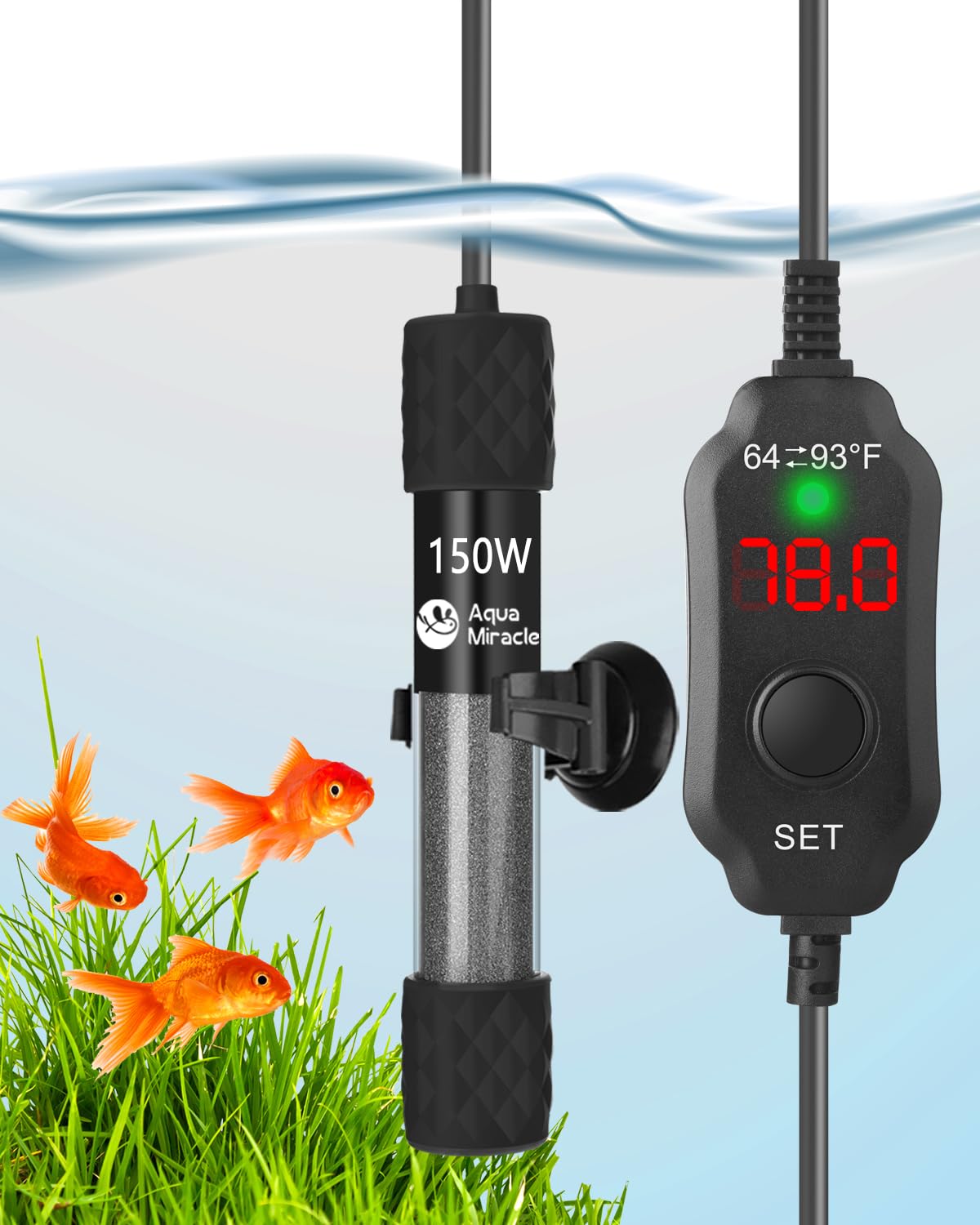
Rating: 4.3 ★ | Price: Budget | Wattage: 150W | Temperature Control: Digital, 64-93°F | Safety Features: Dry-run, overheat | Build Material: Quartz glass | Suction Cup & Cord: Standard
At half the length of standard heaters, the AquaMiracle fits easily in cramped sumps or small tanks where every inch counts. The external digital controller provides clear temperature readouts and includes dry-run protection and memory function. Durability is a consideration — some units may stop working sooner than expected, making this better suited for quarantine setups or short-term use than a permanent display tank.
Pros
- Compact length fits tight spaces.
- Digital controller offers easy temperature adjustment and dry-run protection.
Cons
- Possible for the heater to stop working within months of use.
- Temperature consistency can vary between individual units.
A sensible pick for quarantine tanks or tight budget builds where full-size heaters won’t fit – just buy with a return policy.
Best for Turtle Tanks
HITOP 200W PTC

Rating: 4.3 ★ | Price: Budget | Wattage: 200W | Temperature Control: Digital, 68-93°F | Safety Features: Protective cover | Build Material: Ceramic PTC | Suction Cup & Cord: Removable cover
The HITOP 200W PTC heater prioritizes safety over precision. Its ceramic heating element and protective cover make it ideal for turtle tanks or aquariums with active fish that might break glass heaters. However, temperature consistency can vary between units, and long-term durability may not match traditional quartz models. For a 30-gallon fish tank requiring stable temperature, a quartz heater with better accuracy is a more straightforward choice.
Pros
- Shatterproof ceramic element removes risk of glass breakage
- Removable protective cover makes cleaning easy
Cons
- Temperature consistency can vary between units; verify with a separate thermometer
- Long-term durability may not match that of traditional quartz heaters in extended use
Best for turtle tanks or active setups where shatterproof construction matters more than pinpoint accuracy.
Best for Simple Setups
Aqueon 200W Preset

Rating: 4.3 ★ | Price: Mid-Range | Wattage: 200W | Temperature Control: Preset 78°F | Safety Features: Auto shut-off | Build Material: Plastic | Suction Cup & Cord: Standard
The Aqueon 200W preset heater offers straightforward plug-and-play heating for a 30-gallon tank, with shatter-resistant plastic that reduces breakage risk. In consistently warm rooms, the fixed 78°F works fine. But in colder environments the heater may struggle to maintain temperature, and some units may stop heating after a year or two. It suits budget buyers whose tank is in a heated room and who accept occasional unit variance.
Pros
- No temperature dials to adjust — just submerge and plug in.
- Budget-friendly 200W power suitable for tanks up to 75 gallons.
Cons
- In a cool basement or drafty room, the fixed 78°F setting may not hold.
- Some units may stop functioning after a year or two, so a backup is worth having.
Best for budget shoppers with a consistently warm room who want a simple, no-adjustment heater for a 30-gallon tank.
Best for Turtles & Reptiles
TetraFauna 100W Reptile

Rating: 4.2 ★ | Price: Mid-Range | Wattage: 100W | Temperature Control: Preset 78°F | Safety Features: Cage guard | Build Material: Plastic over glass | Suction Cup & Cord: Suction cups fail
This heater’s protective plastic cage is a genuine safety feature for turtle and amphibian tanks, preventing burns and glass breakage. However, its preset 78°F temperature cannot be adjusted, and some units may stop heating after a few months. These limitations make it unsuitable for fish tanks that require flexible temperature control and consistent long-term operation.
Pros
- Protective plastic cage prevents burns and glass breakage in turtle tanks.
- Suction cups provide strong initial hold on glass.
Cons
- Fixed 78°F preset cannot be adjusted for fish that need different temperatures.
- Heating unit may cease functioning within a few months of use.
For turtle and amphibian enclosures needing a caged heater, this model serves its purpose; for fish tanks, look elsewhere.
Best for Safety-Focused
HANLESHUKA 200W

Rating: 4.4 ★ | Price: Budget | Wattage: 200W | Temperature Control: Digital, ±1°F | Safety Features: Dry-run alarm, overheat | Build Material: Quartz glass + guard | Suction Cup & Cord: Standard
Audible alerts for dry-run and overheat conditions, plus a digital display that holds within ±1°F, give this heater safety-focused appeal at a low price. Its long-term dependability remains uncertain, as some units have shown performance loss within weeks — a trade-off for the cost and feature set. Best for budget-conscious aquarists who want alarms and digital control rather than a proven track record.
Pros
- Dry-run and overheat alarms provide audible warnings for added safety.
- Temperature control holds steady within ±1°F, visible on a digital display.
Cons
- Durability under sustained use is uncertain; some units may develop issues after weeks.
A strong pick for low-stakes 30-gallon setups where audible safety alerts matter more than a long, established service record.
Best for High Precision
hygger 200W Digital
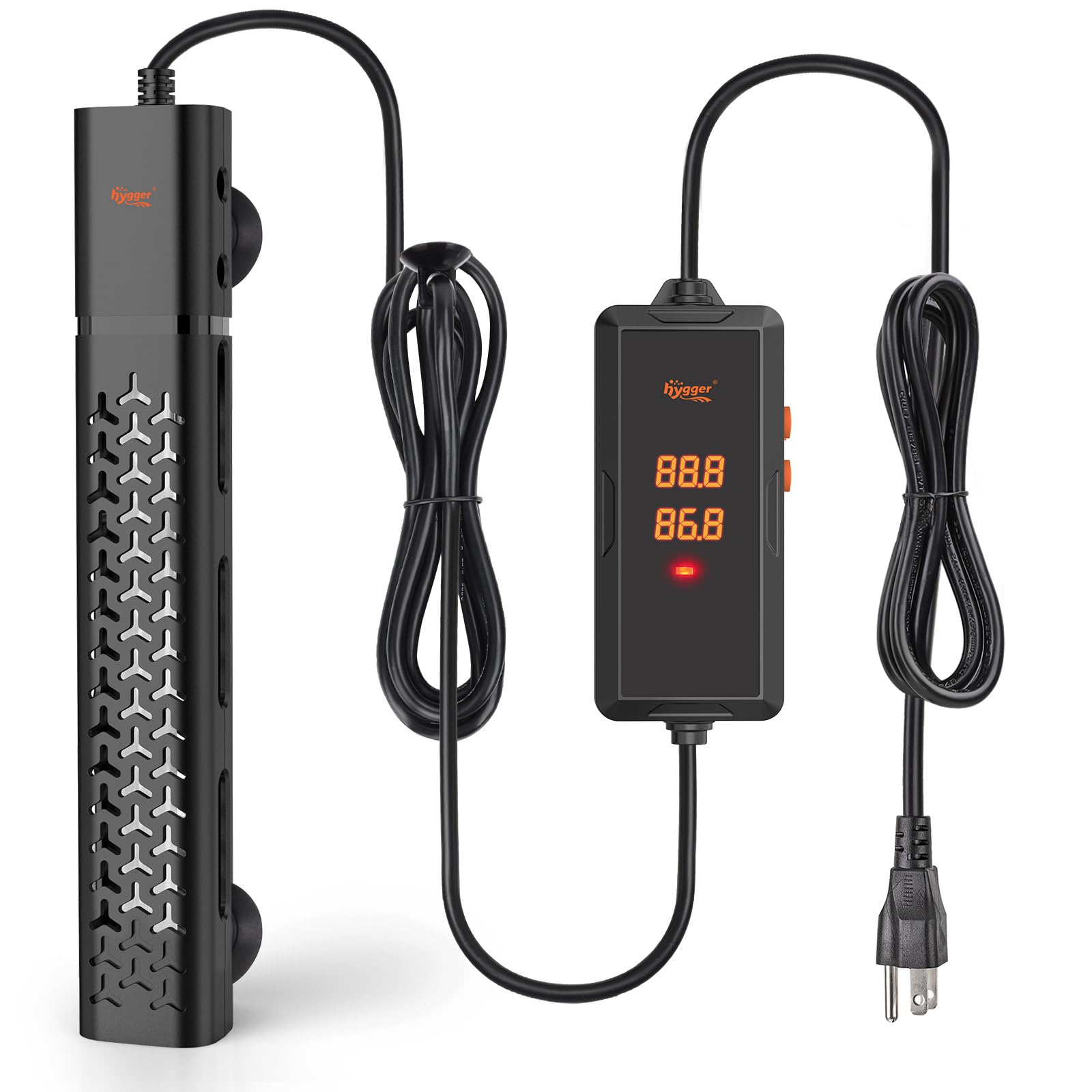
Rating: 4.5 ★ | Price: Mid-Range | Wattage: 200W | Temperature Control: Digital, 0.5°F steps | Safety Features: APS anti-boiling | Build Material: Quartz glass + ABS | Suction Cup & Cord: Standard
The hygger 200W delivers precise 0.5°F temperature adjustments, a feature typically found on costlier heaters. Early user reports note accuracy and a sturdy quartz glass and ABS build. Its limited track record, however, means it cannot yet match the long-term confidence offered by heaters with a longer history of use. This makes it a suitable choice for aquarists who prioritize precision at a mid-range price and are open to testing a newer design.
Pros
- Very accurate temperature control with 0.5°F increments
- Solid build quality with quartz glass and ABS materials
Cons
- Long-term durability under continuous use is uncertain given the limited number of early user reports.
A good match for early adopters who want high precision at a mid-range price and are comfortable with some uncertainty about long-term performance.
Best for Ultra-Compact
AquaMiracle 200W Compact
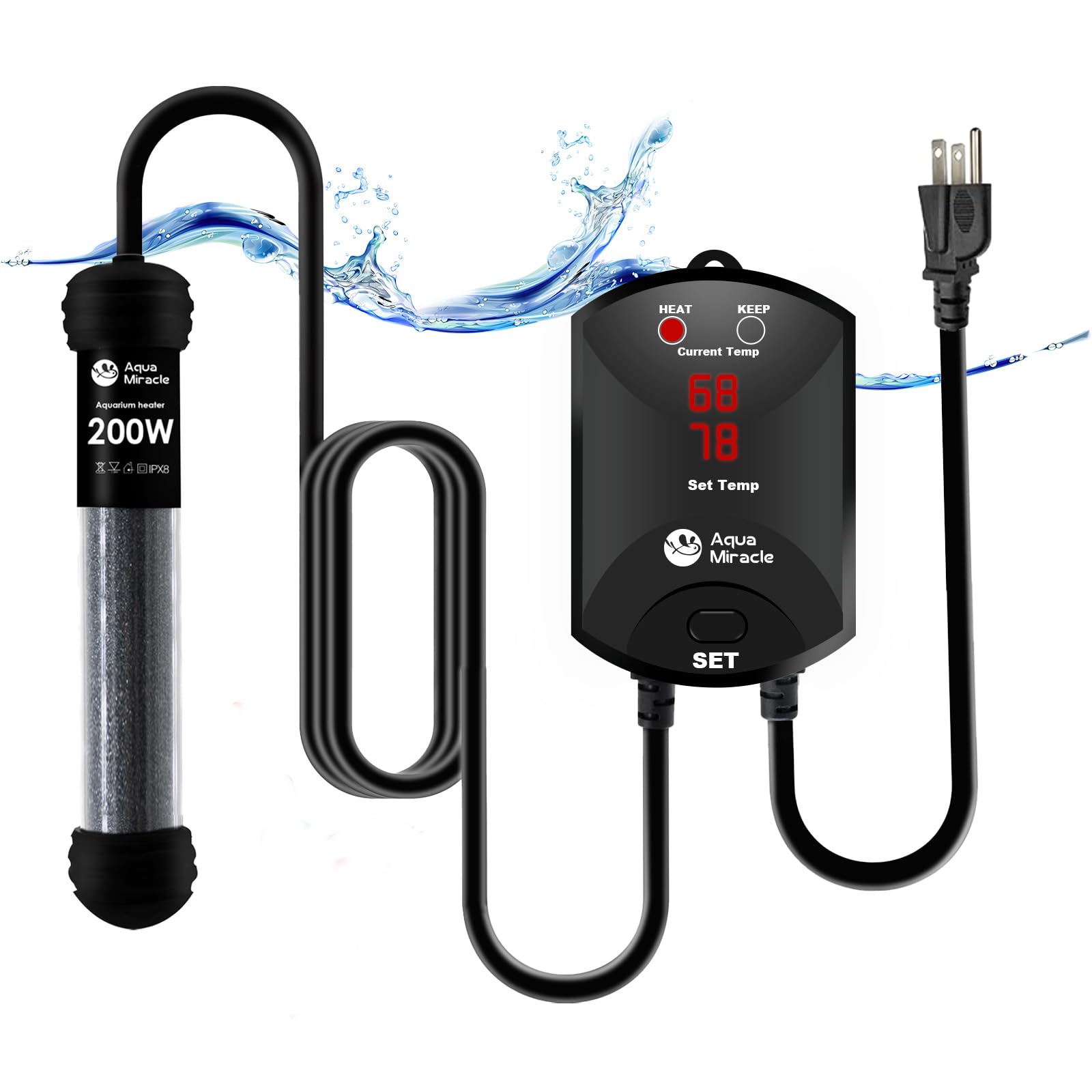
Rating: 4.4 ★ | Price: Budget | Wattage: 200W | Temperature Control: Digital, 64-93°F | Safety Features: Memory function | Build Material: Quartz glass | Suction Cup & Cord: Standard
The AquaMiracle 200W is about half the length of a standard heater, making it a strong fit for tanks where space is limited, and the memory function keeps your temperature setting even after the power flickers. That compact footprint and digital convenience come with tradeoffs: the temperature sensor can read 2°F off from the actual water, and some units have stopped working within weeks. This heater works best as a temporary solution or in a setup where you can independently verify the water temperature and don’t mind the possibility of early replacement.
Pros
- Compact size fits in tight tank spaces
- Memory function retains settings after power loss
Cons
- Temperature reading may differ from actual by up to 2°F
- Possible for the heater to stop working within a few weeks of use
Grab this if your top priority is squeezing a heater into a small space and you’re comfortable monitoring temperature separately — it’s not a set-and-forget solution.
Best for Large Tanks
Orlushy 300W Adjustable

Rating: 4.4 ★ | Price: Budget | Wattage: 300W | Temperature Control: Adjustable knob | Build Material: Quartz glass + ABS | Suction Cup & Cord: Standard
This heater delivers ample power for large aquariums at a low price, and includes a free external thermometer for convenience. However, the 300W output is excessive for a 30-gallon tank — it can cause overheating and short cycling. Temperature control may fluctuate between units, and the glass construction has shown occasional cracking. This heater fits best if you plan to upgrade to a 55-gallon or larger tank; for a 30-gallon, a 100-200W digital model with stable temperature control is a safer choice.
Pros
- Adequate heating power for 55-75 gallon tanks
- Includes a free external thermometer
Cons
- 300W output is too high for 30-gallon tanks, risking overheating and short cycling
- Temperature consistency can vary between units
Only consider this heater if you’re planning to move to a 55-gallon or larger tank in the near future — for a 30-gallon, look for a lower-wattage model with tighter temperature control.
Best for Large Tanks
HiTauing 300W Digital

Rating: 4.5 ★ | Price: Mid-Range | Wattage: 300W | Temperature Control: Digital, 63-94°F | Safety Features: Water sensor, overheat | Build Material: Quartz glass + ABS | Suction Cup & Cord: Standard
The HiTauing 300W offers precise digital temperature control and multiple safety features, making it a strong choice for larger aquariums. For a 30-gallon tank, however, the 300W output is excessive — it may cycle on and off too frequently, leading to temperature swings. The 200W variant addresses this mismatch. Long-term temperature stability has been noted to vary between units, so initial monitoring is worth considering.
Pros
- Digital display lets you set and read temperature within 1°F of the target.
- Heats large tanks quickly without extended wait times.
Cons
- Overpowered for 30-gallon tanks; can cause short cycling and temperature fluctuations.
- Temperature consistency can vary between units over time.
A capable heater for 40–75 gallon tanks, but the 300W rating makes it a poor fit for 30-gallon setups — the 200W variant is the better option there.
How to Choose
The right wattage and temperature control are the backbone of a stable aquarium environment — choose wrong and your fish pay the price.
Wattage
For a 30-gallon tank, 100–200 watts is the standard range. A 100W heater will maintain temperature in a room at 70°F but may struggle in a cold basement or drafty spot. A 200W heater provides a safety margin and reduces on-off cycling, which extends the heater’s lifespan. Oversizing to 300W risks short cycling and wide temperature swings because the heater turns on and off too quickly to stabilize.
Temperature Control
Preset heaters are simple — plug in and they aim for 78°F. But that fixed setting locks you out of raising the temperature for ich treatment or adjusting for different fish species. Adjustable digital controllers give you precise setpoints (often within 1°F) and a readout so you can verify performance. The trade-off is that analog knobs can be bumped, while digital buttons are less prone to accidental changes.
Safety Features
Auto shut-off when the heater runs dry or overheats is essential — without it, a water level drop during maintenance can crack the glass or start a fire. Look for models with dry-run protection, overheat sensors, and audible alarms. These features add a few dollars but can prevent a tank disaster. Pay attention to the type of shut-off: some trip once and need manual reset, others auto-recover.
Build Material
Quartz glass heaters heat quickly but can shatter if bumped by a large fish or during cleaning. Shatterproof options (ceramic PTC, ABS plastic) are safer for turtle tanks or active fish but often heat slower and have lower accuracy. Borosilicate glass with a protective guard is a good middle ground — it resists thermal shock but still needs gentle handling.
Suction Cup and Cord Length
Suction cups are the most common failure point after the heating element itself. Look for cups made of silicone rather than hard plastic — silicone holds grip longer and doesn’t become brittle. Cord length matters more than most buyers expect: a short power cord (under 12 inches from controller to plug) forces you to place the heater near an outlet or use an extension cord, which is a tripping hazard. Before buying, measure your tank’s distance from the nearest outlet.
FAQ
Why does my aquarium heater not reach the set temperature?
The most common cause is a room temperature that’s too low for the wattage. A 100W heater in a 68°F room may struggle to maintain 78°F. Check that your wattage matches tank size and ambient conditions. Also verify the heater is fully submerged and has good water flow around it; stagnant spots can cause false readings. If it still undershoots, the thermostat may be miscalibrated or failing.
Can I use a 300W heater in a 30 gallon tank?
Technically yes, but it’s not recommended. A 300W heater in a 30 gallon will heat extremely fast and then shut off, then turn on again quickly, causing short cycling. This wears out the thermostat and produces temperature swings of 2–4°F. Stick to 100–200W for stable conditions. If you already own a 300W, use a controller with a narrower differential or pair it with a secondary smaller heater.
How long should an aquarium heater last before failing?
A well-made heater typically lasts 2–5 years. Budget models often fail within the first year, while premium heaters with good build and warranty (like Fluval’s 5-year) can last a decade. The most common failure is a stuck thermostat (either always on or never on). Replacing a heater proactively every 2–3 years is cheaper than losing a tank of fish.
Do I need a heater guard for my fish tank?
Only if you keep large, boisterous fish (cichlids, oscars) or turtles that can bump the glass and crack it. For community fish like tetras or guppies, a guard is optional but adds peace of mind. Some heaters come with built-in guards; otherwise, aftermarket plastic sleeves are available. In a 30 gallon with typical fish, the risk of breakage is low.
How do I handle a short power cord on my heater?
If your heater’s cord is too short to reach the outlet, use a high-quality aquarium-safe extension cord with a drip loop. Never splice cords or use a power strip near water. Some models (like the HiTauing 200W) have a short cord from controller to plug — plan your setup so the controller sits above the waterline within 6 inches of the outlet.