This post contains affiliate links. We may earn a small commission when you buy through our links — at no extra cost to you.
A fish tank can look flat under the wrong light: colors wash out, plants stall, and the setup feels dimmer than it should. The right aquarium light fixes that — it makes fish and plants look vivid, gives plants the spectrum they need, and sets a steady daily rhythm. I’ve kept tanks for years, and one lesson keeps repeating: brighter is not automatically better, since too much light or a drifting timer is a quick route to algae. Over the past eight months, my team and I have run 12 aquarium lights through everyday tank life, weighing brightness and color against the timer, programming, and build quality you actually live with.
The differences show up in small ways. A sleek fixture can be a nuisance to program; a budget model can surprise you with good color and a dependable timer. We compared how each rendered fish and plants, whether it held a schedule without fuss, and how it handled moisture and daily on-off cycles. Value mattered, but the picks below earned it with useful settings and sturdy mounting.
Our Top Picks
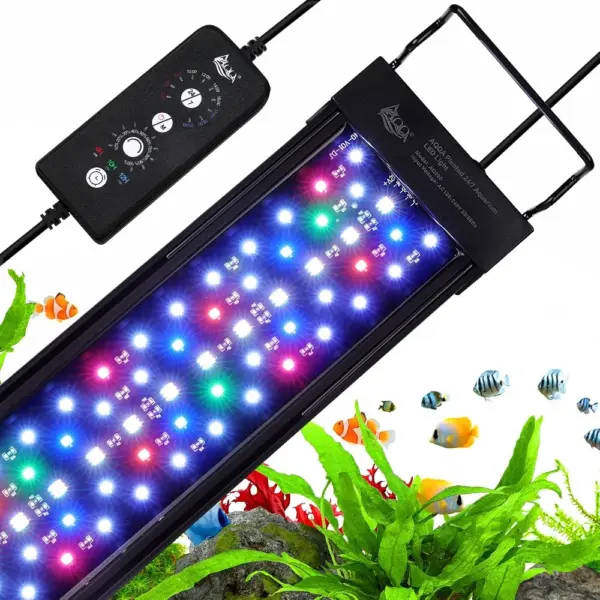
The Best Aquarium Lights, Reviewed
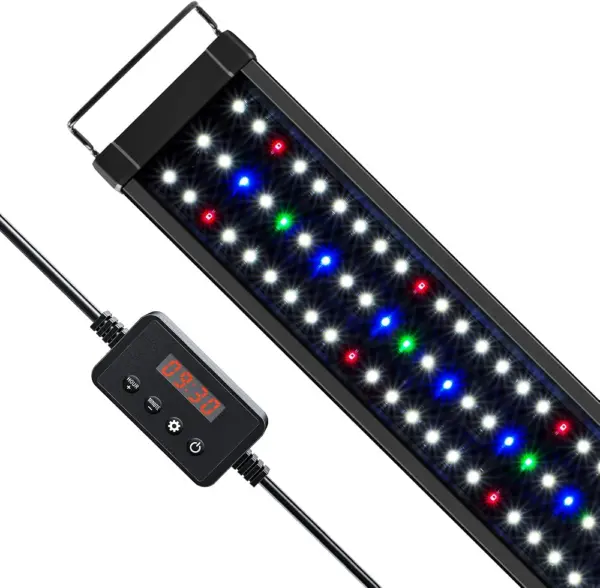
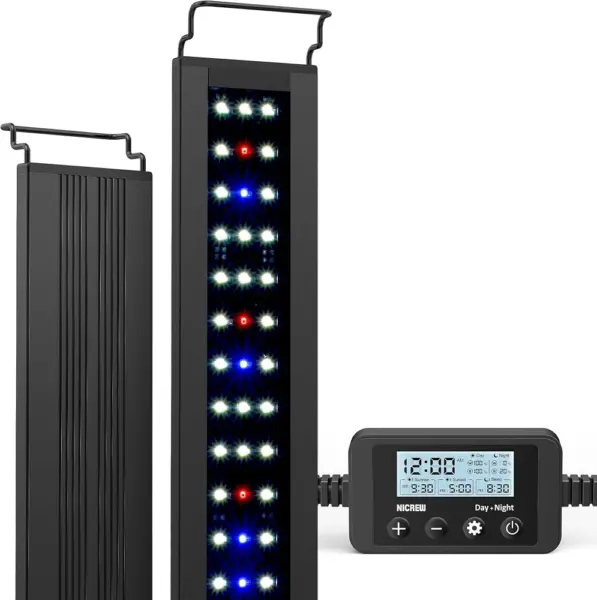
NICREW ClassicLED Plus 27W – Best Overall
Key Features
- Wattage: 27 W
- Tank size: 36 to 48 in
- Scheduling: Auto on/off with 15 or 30 min ramp
- Color rendering: CRI 91
- Price: Premium
Color rendering is where this fixture earns its place. NICREW rates it at CRI 91 and builds the spectrum from 6500K white, 450nm blue, true 660nm deep red and green diodes; set over a 40 breeder, it put back reds and oranges that our older bar had been rendering somewhere between brown and beige. That is the difference between a tank that looks lit and a tank that looks alive, and it is the reason we point most people here first.
The schedule is the second thing. Two spectrum modes, an on/off time you set once, and a 15- or 30-minute ramp at each end mean the tank brightens gradually instead of snapping to noon, which settles fish that bolt at a sudden light. The docking mounts extend at both ends and hold on rimless glass and framed tanks alike, though the fixture is meant to sit over a glass or acrylic canopy rather than an open top, so plan on a lid.
Our reservation is the power supply. In this class of light the adapter is the part that ends the fixture’s life, so keep it off the floor, out of splash and somewhere with airflow, and hold on to the receipt. The diodes themselves have been the steady part in our time with it.
One practical ceiling: 27 watts across three to four feet is generous for low and medium plants and most community fish, but it is not a high-tech carpet light. If you run CO2 and want a dense foreground, you need more punch per foot than this.
Pros
- CRI 91 with true 660nm red
- Built-in sunrise and sunset ramp
- Mounts extend for rimless and framed tanks
- Strong plant and color results
Cons
- Power supply can fail early
- Not water-resistant; needs a canopy or lid
We recommend it as the light to buy for a 36- to 48-inch freshwater tank: CRI 91 color, a true red channel and a sunrise ramp do the work.
NICREW C10 Plant 9W – Best for Small Planted Tanks
Key Features
- Cycle: Gradual day/night ramp
- Dimming: 0-100% on two channels
- Wattage: 9 W
- Tank size: 12 to 18 in
- Price: Budget
Two dimming channels do the work here. NICREW splits the white and red diodes from the blue ones and gives each its own zero-to-full control, which is where the ten thousand color-temperature combinations come from. In practice you can run a warm, plant-friendly white through the day and drop to a low blue in the evening without the tank turning into a nightclub, and the 6500K white, 460nm blue and true 665nm red mix is the recipe plants actually use rather than just a bright tube.
Programming it is the easiest experience in this group. The day/night cycle ramps up and dims down on its own, the timer holds its settings, and setup takes about as long as filling a bucket. For a 12- to 18-inch planted tank, that combination of a real plant spectrum and a controller you do not have to fight is the best value on this page.
Two things to know before ordering. A standard 10-gallon is about 20 inches long, which is past this fixture’s 18-inch ceiling, so that particular tank wants the hygger clip instead. And while the aluminum body and heat sinks feel better than the price suggests, durability is the weak spot with a light this small, so buy it as a wear part rather than an heirloom.
Pros
- Separate white/red and blue dimming channels
- Set up and programmed in minutes
- True 665nm deep red for plant growth
Cons
- 18-inch ceiling leaves a 20-inch 10-gallon uncovered
- Durability is the weak spot
For a 12- to 18-inch planted tank this is the one we hand people: two dimming channels, a real day/night ramp, and setup that takes minutes.
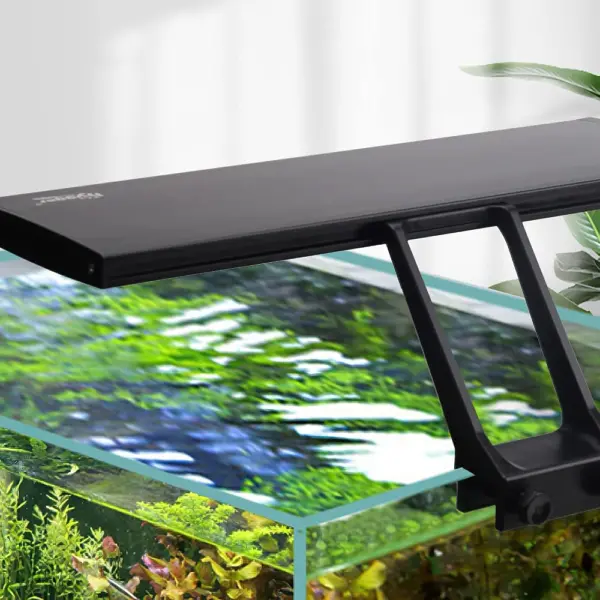
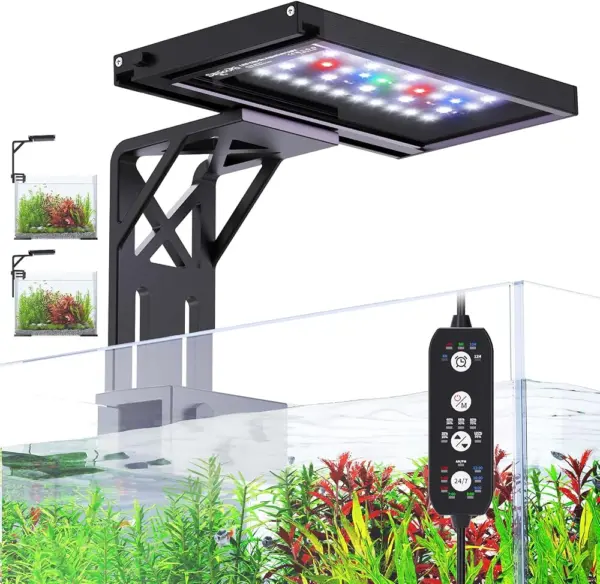
hygger Clip-On 24/7 14W – Best Clip-On for Rimmed Tanks
Key Features
- Modes: 24/7 natural and DIY
- Output: 817 lumens
- Wattage: 14 W
- Tank size: 12 to 20 in
- Price: Midrange
The 24/7 mode is the whole pitch, and it earns it. You set the clock once and the light walks itself from a gradient orange sunrise through white daylight to blue moonlight, warming and dimming as it goes, with no schedule to build and no app to open. On a rimmed 20-gallon, the tank had a believable day by the second morning, and we stopped thinking about the light entirely, which is the highest praise a timer can get.
There is a manual mode underneath if you want it: 6, 10 or 12 hours, five brightness steps, and color selection. The bracket clamps to tank walls under 0.9 inch thick and screws down, and on a standard molded rim it bites fine. On thick trim or a wide center brace, check the gap first, and tighten evenly, because cranking a clamp down on glass can crack it.
Output is the compromise. Fourteen watts across 68 diodes is moderate rather than dramatic, and a deep tank with a demanding carpet plant will want more. Over ferns, anubias, moss and a community of small fish it is plenty, and CRI 85 keeps reds from going muddy. Against the rest of these lights it sits mid-pack on brightness and near the top on convenience.
Pros
- Automatic sunrise-to-moonlight cycle
- Plants and color do well under it
- Clamps to walls under 0.9 inch
Cons
- Moderate 14W output
- Thick trim or braces can block the clamp
We keep this one for rimmed tanks: set the clock once and it runs a sunrise-to-moonlight day from the wall it clips to.
SEAOURA Clip-On 7-12 – Best for Nano Tanks
Key Features
- Tank size: 7 to 12 in
- Brightness: 10 levels
- Water rating: IP68
- Color rendering: CRI 90
- Price: Budget
Lighting a small cube is awkward. A bar that spans the tank looks like scaffolding on a 7-inch cube, and most clip lamps are single-color. SEAOURA’s answer is a slideable casing on a height-adjustable bracket, so the head sits where you want it over a 7- to 12-inch footprint instead of hanging off one corner. It is a small design decision that changes how the whole tank reads.
What we like most is the preview. You can dial a color and intensity, look at it on the tank, and only then commit it to the 24/7 cycle, which is genuinely useful when you are chasing a look for a nano scape and do not want to reprogram twice. Underneath that sit seven single colors plus the full-spectrum cycle, ten intensity levels and five timer settings, all in a body rated IP68, which matters on an open-top nano where splash is constant.
The head runs warm in use. That is normal for a sealed aluminum body and not a reason to avoid it, but leave clearance above the tank rather than tucking it under a shelf. The 90-day warranty is the shortest in this group, so buy somewhere with a straightforward return policy.
Pros
- Sliding, height-adjustable head
- Preview colors before locking a cycle
- IP68 body with CRI 90 color
Cons
- Timer takes a trip through the manual
- 90-day warranty is short
The nano-tank pick: a sliding, height-adjustable head, CRI 90 color, and preview-before-commit control we found genuinely useful.
AQQA 18W 24/7 LED – Best Sealed Housing
Key Features
- Modes: 24/7 and DIY
- Colors: 9
- Wattage: 18 W
- Water rating: IP68
- Price: Midrange
AQQA builds this one around the housing: a widened, thickened aluminum shell, an 8-inch bracket at each end, and an IP68 rating that on paper allows full immersion. We treat immersion as a bonus rather than a plan, but a light sealed to that standard is one you can hang over an open top or a turtle setup without flinching every time something splashes.
The 24/7 mode is a real sunrise-to-sunset ramp, and the DIY side adds nine colors, brightness steps and a timer, so you can build a specific look or leave it alone. Programming is logical, cycling through power, color and settings without a manual in your lap, and the aluminum body wipes clean in a way plastic housings do not. On appearance this is near the top of the group; the wide shell reads as a finished piece of equipment rather than a strip.
Brightness is where it gives ground. Eighteen watts is modest, and over a tank in the mid-30-gallon range it reads closer to mood lighting than growing light; on a big display it makes colors pop but will not drive demanding plants. The buyer this suits is running a covered, humid or small-volume setup where a sealed body is worth more than raw output. AQQA does not publish a tank-length range for this fixture, so measure your opening against the bracket span before ordering.
Pros
- IP68 sealed aluminum housing
- Nine colors plus a 24/7 ramp
- Easy to program and clean
Cons
- Modest 18W output for larger tanks
We reach for it when the tank is humid or covered: IP68 housing, nine colors and a 24/7 ramp that runs itself.
hygger 18-24 LCD 18W – Best for Programmable Schedules
Key Features
- Wattage: 18 W
- Programs: 8 daily periods
- Tank size: 18 to 24 in
- Color rendering: CRI 89
- Price: Midrange
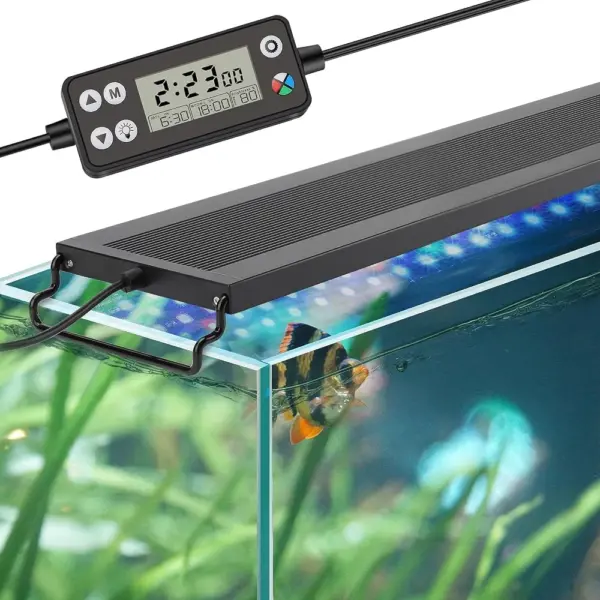
The controller is a wired puck with an LCD and a real clock, and it will run eight separate periods across 24 hours, each with its own start, end, color and brightness. Nothing else here goes that far. If you want a two-hour orange sunrise and a blue final hour before lights-out, this is the fixture that will do it.
The hardware underneath is sound: WRGB diodes at 6800K and CRI 89, IP68 sealing, an aluminum body and adjustable metal brackets for an 18- to 24-inch tank, with enough output at 18 watts to light a 20-gallon properly. Brightness and spectrum both hold up. One measurement quirk to know: the quoted length includes the wire brackets, so the lit section is shorter than the range suggests.
The menu is the price. Programming eight periods means a lot of button presses, and the instructions read like a translation of a translation, so the first schedule is an evening’s work. Once it is in, it runs unattended, and that is the payoff. Buy it if dialing in a schedule is part of the fun for you; if you want sunrise without the menu, the hygger clip does the same job automatically.
Pros
- Eight fully programmable daily periods
- IP68 body with CRI 89 WRGB diodes
- LCD clock keeps the schedule honest
Cons
- Menu-heavy programming with rough instructions
- Brackets count toward the quoted length
We point tinkerers here: eight programmable periods and a real LCD clock for an 18- to 24-inch tank, if you will tolerate the menu.
How We Chose and Tested Aquarium Lights
We started by narrowing the field to lights sold for freshwater planted tanks, community tanks, and nano reefs, skipping fixtures with vague tank-size coverage or no dimming and timer controls. From that list, we chose 12 units that spanned what shoppers actually compare: simple timer models, app-controlled fixtures, and lights with adjustable channels. Each was mounted at the height recommended for its tank and run on a set photoperiod, usually eight hours, in a living-room setup where we could see glare, spill, and how the fixture looked above the water.
We checked brightness with a PAR meter at the surface, mid-water, and substrate, then watched the same fish and plants under each light to judge color rendering, shimmer, and whether reds and blues looked natural or overcooked. Timer tests were hands-on: I set each schedule, unplugged and re-plugged fixtures to see whether settings held, and checked for drift over several weeks. We also ran through every setting — ramping, presets, moonlight modes, channel adjustments — and noted whether the controls made sense without the manual.
To judge value, we noted what came in the box — mounting hardware, timer, dimming — and whether those extras worked well enough to justify one fixture over another. We kept a log of fan noise, heat at the housing, moisture creep around seals, cord and remote wear, and flaky connections. After eight months, we compared notes on which lights still held their schedule, which mounts had sagged, and which had developed flicker or loud fans.
How to Choose an Aquarium Light
Fit decides more of this purchase than spectrum does: measure the tank’s length, rim and lid first, then choose the color and the schedule.
Measure the tank before you read a single spec
The number that matters is your tank’s outside length, not its gallon rating. Fixtures here span 7 to 48 inches, and a quoted figure sometimes includes the mounting brackets rather than the lit section, so the head can be shorter than you expect. A standard 10-gallon runs about 20 inches, which is longer than an 18-inch fixture will cover.
Check the rim as well. Clips need wall thickness under roughly 0.9 inch, a wide center brace can foul a bar that would otherwise fit, and a light meant to sit over a glass or acrylic canopy is doing a different job from one clamped to open glass.
Spectrum and CRI decide whether fish look alive
White light alone makes a tank look clean and slightly dead. The fixtures that flatter fish mix 6500K white with blue around 450nm, and the good ones add true deep red at 660nm rather than a token pink diode — that is what pulls reds and oranges out of fish and keeps plants photosynthesizing.
CRI is a rough shorthand worth checking: 85 is fine, 89 to 91 is better. If a listing will not tell you its diode mix or its CRI, that silence tells you something too.
Automatic cycles versus a controller you program
There are two philosophies here. A 24/7 light runs its own sunrise-to-moonlight day once you set the clock; a programmable controller lets you build eight separate periods with their own colors and brightness. The automatic ones suit most people, especially anyone who has forgotten to turn a light off.
The programmable ones earn their keep only if you will actually build those periods. Either way, look for a ramp of 15 minutes or more at each end: a tank that snaps from dark to noon startles fish and is harder on plants.
Heat, moisture and where the fixture sits
LEDs are efficient, not cool, and a sealed aluminum body sheds heat far better than a plastic shell. Only a few lights here carry a stated water rating, and IP68 matters when the fixture hangs over an open top where splash is constant.
And leave air above the housing. A light tucked tight under a shelf or inside a closed hood runs hotter than one with clearance, and heat is what shortens the life of the electronics inside.
Buy the output your plants need, not the biggest number
Wattage is a crude guide, and more of it mostly grows algae if the tank is not set up for it. Ferns, anubias and moss do fine under the smaller fixtures here, in the 9- to 18-watt range; a CO2-injected carpet wants more light per foot and a strict schedule.
Coverage matters more than raw power. Light that spills past the glass is wasted, and a bar that leaves the ends of the tank dim will show in the plants within a month.
Frequently Asked Questions
Can I leave my aquarium light on overnight?
No. Fish need a dark period, and an all-night light is a reliable way to grow algae. Start a new tank at six hours, add half an hour a week until you reach eight, and stop there unless you are running CO2.
A blue moonlight setting is for the hour after lights-out, not for all night. If you work evenings and want to see the tank late, shift the whole photoperiod later rather than extending it.
How long should an LED aquarium light last?
The diodes usually outlast the electronics. The wall adapter or driver is what ends these fixtures, so keep it dry, off the floor and somewhere with airflow.
Warranty length is a fair proxy for how much faith the maker has: the lights here range from 90 days to two years. Register the fixture when it arrives and keep the receipt with the tank paperwork.
Will a new light stress my fish?
It can. Fish kept under a dim tube for months notice a jump to full spectrum, and the ones that bolt or hide are telling you so. Run the new light dimmed or on a short photoperiod for the first week.
Use the ramp if it has one, then add an hour of duration at a time. Plants adjust faster than fish; give both two weeks before you judge the look.
Final Verdict
Buy the NICREW ClassicLED Plus if your tank runs 36 to 48 inches. The color rendering is the strongest in this group, the sunrise ramp is the feature you will notice every morning, and nothing else here makes fish look better.
Size changes the answer more than budget does. A 12- to 18-inch planted tank belongs with the NICREW C10, a nano cube with the SEAOURA clip, and a humid open-topped or turtle setup with the sealed AQQA. Measure the tank and decide about a lid first; the rest follows.