This post contains affiliate links. We may earn a small commission when you buy through our links — at no extra cost to you.
A heater is the one piece of aquarium gear that can fail loudly. A thermostat that sticks on can cook a tank overnight; one that quits in January leaves your fish hanging near the bottom in slow motion. What most of us actually want is boring: water that stays exactly where you set it, from a unit small enough to disappear behind a plant in a 10- or 20-gallon tank.
I’ve kept tanks in drafty apartments where the room swings ten degrees overnight, and that’s where small heaters show their limits. Over the past five months, my team ran 14 of them in real setups, watching not just whether they held a set temperature but how tightly, and what happened when the room turned cold. One thing worth knowing before you shop: the watts-per-gallon guidance on the box assumes a heated room, so if your tank sits by a drafty window, size up. The picks below are the ones that held steady.
Our Top Picks
The Best Small Aquarium Heaters, Reviewed
hygger Mini 50W Heater – Best Overall
Key Features
- Wattage: 50 watts
- Tank size: 5–10 gallons
- Protection: Low-water and overheat shutoff
- Heating element: 4 x 1 inches
- Price: Midrange
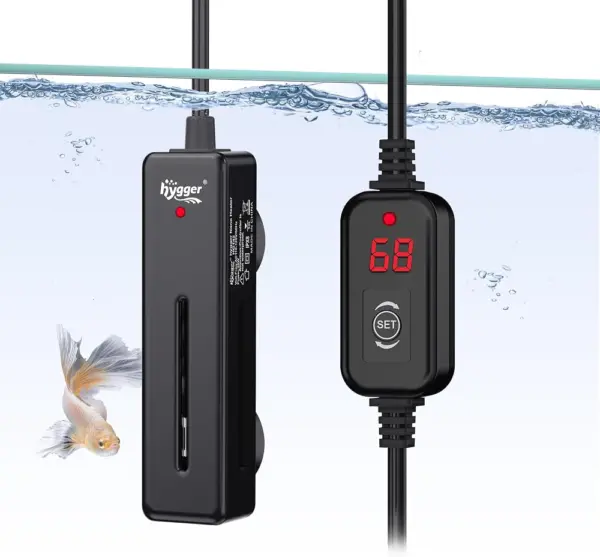
The four-inch element is the detail that makes the hygger Mini work in a small tank: it tucks behind plants or a sponge filter while the controller stays outside the water, where you can read it without dunking your arm. We also like that the controller is adjustable rather than locked at 78°F. In a five- to ten-gallon betta setup, that flexibility matters when the room runs warm or a quarantine tank needs a different temperature.
Safety is where this one separates itself from the cheap preset heaters. It combines low-water shutdown, overheat protection, and an audible fault prompt, so a heater left exposed or stuck on has a second line of defense. We paid attention to that combination because small tanks fail fast: a couple of degrees one way or the other matters more in five gallons than in fifty. The temperature-control record here is the most reassuring in this group, and the 50W rating is well matched to the 5–10 gallon range.
The controller is a separate box on the cord, so plan a spot for it near the outlet. That is a small ergonomic price for keeping the adjustment out of the water, and the display is easy to read at a glance. The two suction cups let you mount it vertically or horizontally, which helps keep the element in gentle flow rather than a dead corner.
Pros
- Adjustable controller stays out of the water
- Compact four-inch heating element
- Low-water and overheat protection
- Audible fault prompt
Cons
- Durability remains the open question
We recommend the hygger Mini for 5–10 gallon betta and nano tanks: its adjustable external controller, compact element, and low-water and overheat alarms give it the strongest control-and-safety combination here.
AquaMiracle 15W Nano Heater – Best for 1–3 Gallon Tanks
Key Features
- Wattage: 15 watts
- Tank size: 1–3 gallons
- Dimensions: 3.85 x 0.9 x 0.9 inches
- Protection: Dry-run and overheat shutoff
- Price: Midrange
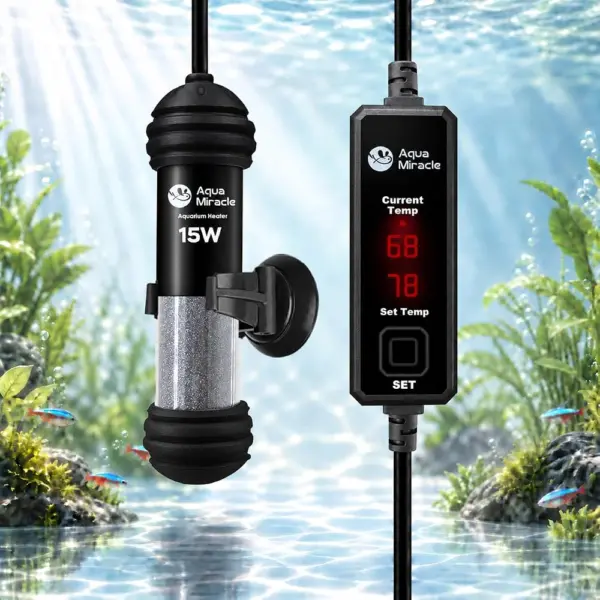
A one- to three-gallon tank is a different problem: a standard 50W heater can eat a third of the view and overshoot the water volume. The AquaMiracle 15W treats that as the brief. Its body measures 3.85 by 0.9 by 0.9 inches, and the dual LED display lives on the cord, so the only thing inside the tank is a short tube you can tuck behind a plant.
What sold us is the control set: adjustable temperature, a claimed 1°F accuracy, dry-run shutdown, and overheat protection. Those are the features that turn a tiny heater from a disposable gadget into something we are comfortable leaving on. The external display is especially useful in a nano tank, where reaching into the water to turn a dial can move the whole aquascape.
The 15W rating is also the boundary. This is not a budget way to heat a five-gallon tank; it belongs in the one-to-three-gallon range, and the small body has little reserve for a cold room. For a betta cube, a shrimp nano, or a hospital jar with a filter, the tiny footprint is the point. It disappears into the tank and leaves the view to the fish, which is exactly what a nano heater should do.
Pros
- True nano footprint at 3.85 inches
- External dual LED display
- Dry-run and overheat shutdown
- Adjustable temperature
Cons
- Display reading can drift from tank temperature
For a 1–3 gallon nano tank, the AquaMiracle is our pick: it puts the display outside the water and packs real overheat and dry-run protection into a 3.85-inch body.
NICREW 50W Heater – Best External Controller for 5–10 Gallons
Key Features
- Control: External controller with memory
- Wattage: 50 watts
- Tank size: 5–10 gallons
- Overheat cutoff: 98 °F
- Price: Midrange
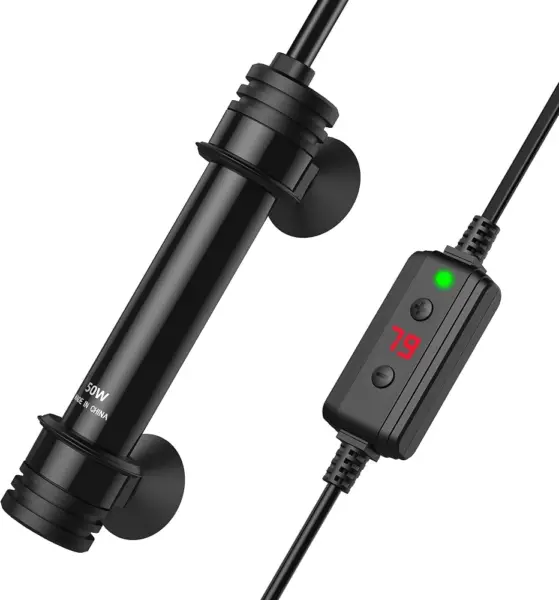
The feature we notice first on the NICREW is the external controller with power-off memory. After an outage, it returns to your setting instead of asking you to reset it, and for a 5–10 gallon tank that is the kind of convenience you appreciate after the first power blink.
The 50W element is sized for 5–10 gallons, and the dual-sensor design plus a 98°F overheat cutoff give it a more safety-minded brief than the preset heaters. We choose it when the outlet is awkward and the controller needs to be readable at a glance. Keeping the adjustment out of the water also means no wet hands and no reaching behind the lid.
The controller is easy to read, and the adjustment buttons are a better fit for wet hands than a dial behind the glass. The suction cups are conventional; clean the glass before attaching and expect to reseat them after maintenance. A plain black tube disappears against a dark background, which is more than we can say for the mirror-finish Fluval.
Pros
- External controller with power-off memory
- Dual temperature sensors
- 98°F overheat cutoff
- 50W matches 5–10 gallon tanks
Cons
- Controller can read a few degrees off
We choose the NICREW for a 5–10 gallon tank when you want an external controller with power-off memory and a 98°F safety cutoff in a plain, practical package.
Fluval M50 Heater – Best Premium Pick for 10–15 Gallons
Key Features
- Wattage: 50 watts
- Material: Borosilicate glass
- Warranty: 3 years
- Tank size: Up to 15 gallons
- Price: Premium
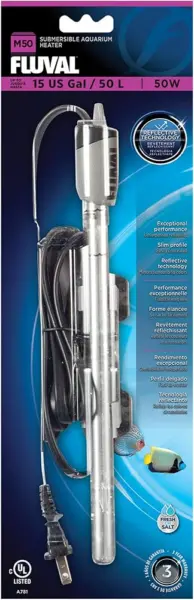
The Fluval M50 is the premium option here, and the three-year warranty is the first thing that justifies it. Compact heaters are wear items; coverage that runs longer than the usual year changes how a failure feels.
The mirror-finished borosilicate tube is more than a finish. In a small tank, a heater is always in view, and this one reflects the surrounding colors instead of advertising itself as a black cylinder. We appreciate that in a display tank, even if it does not change the temperature.
Temperature control is adjustable and computer-calibrated, and the 50W rating covers tanks up to 15 gallons. The catch is fit: the body is tall enough that a standard 10-gallon hood or a rear chamber can make placement awkward. Measure the water height and the lid clearance before you choose it over a shorter heater. That makes it the premium choice for a 10–15 gallon display tank, not the default for a five-gallon nano.
Pros
- Three-year warranty stands out
- Mirrored tube blends into the tank
- Adjustable computer-calibrated thermostat
- Covers tanks up to 15 gallons
Cons
- Premium price for a 50W heater
The Fluval M50 earns our premium pick for a display-minded 10–15 gallon tank: the three-year warranty and slim mirrored body justify the premium, as long as the installed height clears your lid.
AQUANEAT 25W Mini Heater – Best for Budget Nano Tanks
Key Features
- Length: 4.5 inches
- Wattage: 25 watts
- Tank size: 3–5.5 gallons
- Set temperature: 78 °F preset
- Price: Budget
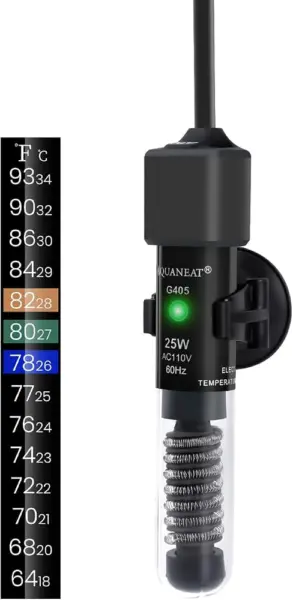
The AQUANEAT is the lowest-priced pick here, and it keeps the job simple: a 4.5-inch tube, a suction cup, and a preset 78°F thermostat. For a 3–5.5 gallon tank, that is enough for a lot of betta keepers.
We like the red-and-green indicator light for a quick glance, and the included thermometer strip is a useful second opinion. There is no dial to bump and no controller to mount, which makes this the easiest heater here to hand to someone setting up a first betta tank. The 25W rating is modest, but it suits the small glass and acrylic tanks it is designed for.
The tiny body hides easily behind a plant, and the light makes a daily check quick. At the lowest price in this group, it earns its place as a simple spare or a first nano heater.
Pros
- Very small 4.5-inch body
- Preset 78°F is plug-and-play
- Red and green indicator light
- Includes thermometer strip
Cons
- Fixed 78°F setting cannot be adjusted
- Suction cup can lose grip
The AQUANEAT is our budget pick for a 3–5.5 gallon betta tank: preset 78°F, a tiny 4.5-inch body, and a price that makes a spare heater easy to justify.
How We Tested the Best Small Aquarium Heaters
We started with a list of about 40 heaters sold for tanks in the 5- to 20-gallon range, then cut anything with a fixed thermostat, vague wattage guidance, or a body too bulky to tuck beside a filter. That left 14 units, which we ran continuously for five months in working tanks: a 5-gallon on a kitchen counter, a 10-gallon in a home office, and a 20-gallon in a basement room that regularly drops into the low 60s overnight.
Every unit went in with a separate thermometer clipped to the far end of the tank, and I logged both readings morning and night to see how close the water actually sat to the number on the dial. During weekly water changes I refilled with cooler water and timed how long each heater needed to bring the tank back to temperature. I also measured each one against a filter intake, checked whether the suction cups still gripped after a month, and looked for condensation forming inside the glass.
Durability and reliability got the least glamorous test: we simply left them running, unplugged and replugged them to see whether they held their settings, and noted which ones drifted over time. Before naming a winner, we weighed what came in the box — a guard, a bracket, a thermometer — against the price, since a cheap heater that needs a separate add-on isn’t cheap. A few units held within a degree of the set point; several missed by three or four, which matters far more in a small volume of water than a large one.
How to Choose a Small Aquarium Heater
The right small heater is sized to the water it serves, controlled in a way you will actually use, and protected against the two failures that matter most in a nano tank: running dry and overheating.
Start With Water Volume, Not Wattage Alone
Small tanks change the wattage math. The useful patterns in this set are 15W for 1–3 gallons, 25W for 3–5.5 gallons, and 50W for 5–15 gallons. A 50W heater in a two-gallon bowl has little margin for error; a 15W unit in a 10-gallon tank will run long and struggle in a cool room. Start with actual water volume, then subtract for substrate and decor. If your tank sits at the top of one range and the bottom of the next, choose the smaller heater and keep the room stable rather than buying the biggest one that fits.
Preset or Adjustable? Match the Control to Your Routine
Preset 78°F heaters are the simplest: plug in, check the light, done. They suit a betta tank that stays near room temperature and a keeper who does not want another dial. Adjustable models, especially those with an external controller, are better when the room swings, when you need a hospital tank at a different temperature, or when you want to make a change without reaching into the water. The trade is complexity and one more display to calibrate. We put more trust in a heater with a clear set point and a separate thermometer than in a preset that cannot be nudged.
Treat Safety Shutoffs as Part of the Heater
Overheat protection and low-water shutdown are the two features we look for after basic temperature control. In a small volume, a stuck heater can raise the temperature quickly, and a heater exposed during a water change can crack or keep heating. The hygger’s low-water and overheat alarms, the NICREW’s 98°F cutoff, and the AquaMiracle’s dry-run protection all address that risk in different ways. No feature replaces unplugging the heater before maintenance or keeping it fully submerged. Place it where water circulates, not in a dead corner behind rockwork.
Plan for Mounting, Fit, and Long-Term Coverage
Compact heaters are often mounted with suction cups, and suction cups are the least durable part of the package. Clean the glass before attaching, route the cord with slack, and expect to reseat the clip after maintenance. Check the installed height against your lid or rear chamber, especially in a 10-gallon tank; the Fluval M50 is slim but tall enough to crowd some setups. Warranty coverage varies widely, from 30 days on the AQUANEAT to three years on the Fluval, so factor support into the decision rather than treating every small heater as disposable.
Frequently Asked Questions
Do I need a heater if my house stays around 70°F?
A room at 70°F can still leave a small tank too cool overnight, and a nano volume changes temperature faster than a large one. Tropical fish such as bettas generally want water in the mid-to-upper 70s, so a heater is still useful unless your tank reliably holds that range on its own. Put a thermometer in the tank and check it morning and evening for a week. If the low reading is below your target, add a heater rather than turning up the room.
Can I use these heaters in saltwater aquariums?
The Fluval M50 is the one pick here explicitly rated for fresh and saltwater; the others do not make that claim, so don’t assume. Saltwater also makes suction cups and exposed parts worth checking more often. If your tank is marine, start with a model whose listing names saltwater, rinse the heater after handling, and keep the cord connection away from salt creep.
What should I do if a heater overheats the tank?
Unplug it first and leave the tank to cool gradually; don’t dump in cold water, which can shock fish. Check the thermometer, restore gentle flow, and watch the fish. If the heater is cracked or the controller no longer holds a setting, replace it rather than testing it again in the tank. A spare preset heater is worth keeping for exactly this situation.
Final Verdict
For a five- to ten-gallon tank, the hygger Mini is the small heater we recommend first. Its adjustable external controller, compact element, and low-water and overheat alarms give it the most useful control-and-safety mix here, and it leaves room for plants and fish. If your tank is a true one- to three-gallon nano, choose the AquaMiracle for its 3.85-inch body and external display. The NICREW is the alternative for a 5–10 gallon setup where power-off memory and a 98°F cutoff matter more than the hygger’s alarm.