This post contains affiliate links. We may earn a small commission when you buy through our links — at no extra cost to you.
Nothing in a fish tank fails quite as badly as a heater. A thermostat that sticks can push a 10-gallon from comfortable to 95 degrees overnight, and an undersized one lets the water slide down while you’re asleep. Ten gallons has almost no buffer, so the temperature moves fast and your fish feel every degree of it. What you’re actually buying here is a thermostat you can trust, and water that stays where you set it.
I’ve kept small tanks for years and made the usual mistakes: buying by wattage alone, then discovering the heater was too long for the back glass, or that the dial read 78 while the water sat at 74. My team has spent the past four months running 14 heaters in 10-gallon tanks, from preset pucks to adjustable glass tubes, and the split comes down to one thing. An oversized heater isn’t a safety margin in a small tank; it heats so fast it overshoots before the thermostat catches up. The picks below are the ones that held their setting and stayed out of the way.
Our Top Picks
The Best Aquarium Heaters for a 10-Gallon Tank, Reviewed
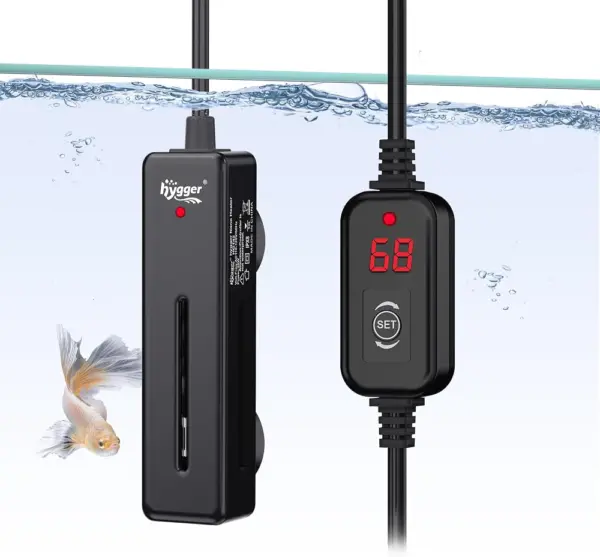
hygger Mini 50W – Best Overall
Key Features
- Wattage: 50 W
- Tank Rating: 5 to 10 gallons
- Element Length: 4 in
- Temperature Control: Adjustable, external controller
- Price: Midrange
The controller is why this one is at the top. It sits on the cord outside the tank and shows two numbers at once: the temperature you asked for and the temperature the water is actually at. In a tank this size, where a degree or two can vanish overnight, being able to read that without lifting a hood or fishing out a thermometer changes how the whole thing feels.
We kept coming back to it for the same reason. Ten gallons is not much water, so it warms and cools faster than a big tank does, and the heater you can watch and adjust with dry hands is the one you actually manage. The 50-watt element is rated 5 to 10 gallons, so your tank sits inside the rating rather than past it, and 50 watts is the usual size for ten gallons anyway. The element itself is about four inches long and an inch across — small enough to disappear behind a sponge filter or a fistful of hornwort.
The rest of the package aims at the same idea. Low water shuts the element down, overheat protection sits behind that, and when something is wrong the controller beeps and shows a fault code instead of quietly carrying on. Two suction cups let you run it upright or flat, which matters more than it sounds in a tank where a built-in filter already owns one corner.
Pros
- Controller shows set and actual temperature
- Rated 5 to 10 gallons, so a 10 fits
- Low-water and overheat shutoffs with an alarm
- Four-inch element hides easily
Cons
- Short track record on how long it lasts
For a 10-gallon, this is the 50-watt to buy: rated for the tank, adjustable from a dry controller, with two shutoffs behind it.
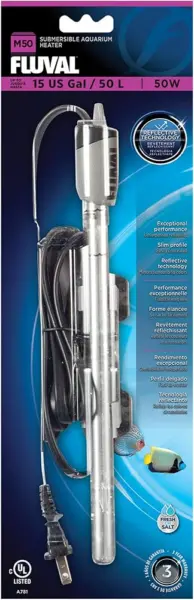
Fluval M50 – Best for a Discreet Setup
Key Features
- Build: Borosilicate glass, ceramic heat sink
- Wattage: 50 W
- Warranty: 3 years
- Tank Rating: Up to 15 gallons
- Price: Premium
The tube is mirrored rather than black, so it takes on the color of whatever sits behind it. Against a dark background with a bit of green it goes genuinely hard to spot, and the cord ends up being the thing that gives it away. We think it is the best-looking heater of the five here, and in a 10-gallon on a desk or a kitchen counter that counts for more than it sounds like it should.
Underneath the finish it is borosilicate glass with a ceramic heat sink and a computer-calibrated thermostat you turn on the body, rated to 15 gallons on 50 watts. The three-year warranty is the longest in this group by a distance — the rest carry one year — and in a category where a heater can quietly quit after a season, that coverage is the real premium.
Two practical notes before you commit. The set point and the water temperature can drift apart by a degree or two, so give it a week alongside a separate thermometer and turn the dial to whatever the tank actually needs rather than the number you want to see. And check the length against your water line: this is a full-length tube, and a 10-gallon with a deep gravel bed and a hood leaves less clear vertical space than the footprint suggests.
Pros
- Mirror finish nearly disappears in a lit tank
- Three-year warranty, the longest here
- Rated to 15 gallons on 50 watts
Cons
- Most expensive heater in this group
We think it earns its price in a tank you actually look at: the mirrored body nearly vanishes, and no other pick here carries a three-year warranty.
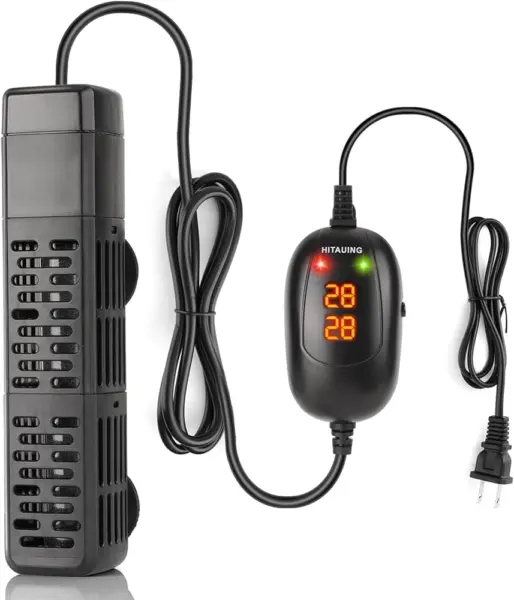
HiTauing 50W – Best for Water Changes
Key Features
- Display: External digital controller
- Wattage: 50 W
- Protection: Overheat and out-of-water shutoff
- Tank Rating: 5 to 10 gallons
- Price: Midrange
Water changes are where heaters get hurt. You drain the tank, the element comes out of the water with the cord still live, and a glass tube that was fine a minute ago is suddenly running dry. The HiTauing has a water sensor that cuts the heat the instant the element leaves the water and picks it up again when it goes back under, which is the most useful single piece of protection on this list for a tank you are in every week.
Two red digits on the cord-mounted controller show the set temperature and the actual one, in Fahrenheit or Celsius. The quartz glass is explosion-proof and thick enough that a fish can brush against it, or a snail crawl over it, without harm — and the whole thing is rated 5 to 10 gallons on 50 watts, which is exactly the tank in question.
For us, the extra outlay over the other 50-watt picks here buys that shutoff, and it is why this one sits above them for a tank with a hood you open constantly. Two things to do on day one: turn the adjustment ring slowly and work out which direction takes the fine steps, because it moves more easily one way than the other, and set it against a glass thermometer rather than trusting the display on its own.
Pros
- Cuts heat when the element leaves the water
- External controller shows set and actual temperature
- Thick quartz glass is safe around fish
- Rated 5 to 10 gallons on 50 watts
Cons
- Costs more than the other 50-watt picks
This is the heater we point at a tank that gets worked in — the element shuts down the moment it leaves the water.
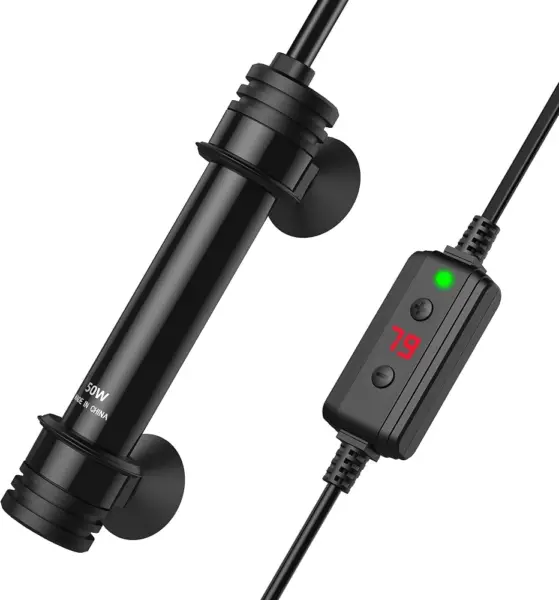
NICREW 50W – Best for Power Cuts
Key Features
- Sensors: Dual temperature sensor
- Wattage: 50 W
- Tank Rating: 5 to 10 gallons
- Overheat Cutoff: 98 °F
- Price: Midrange
Lose power for an afternoon and the NICREW comes back on at the temperature you left it at. That memory function sounds like a small thing until the day the breaker trips while you are at work — the difference between a tank resuming at 78 °F and one resuming at whatever the dial happens to be pointing at is the difference between an ordinary evening and a stressed fish.
Dual temperature sensors and an overheat cutoff at 98 °F are the substance behind it, and together with the 5-to-10-gallon, 50-watt rating they make this the comfortable middle of the group: enough control to be genuinely useful, not so much hardware that the tank starts looking like a laboratory. The suction cups are the best of the five in our handling — the unit stays where you put it on the glass instead of creeping down overnight.
The readout is the part to calibrate. Expect the controller’s number to sit a degree or two away from a separate glass thermometer, and to run slightly warm against the set point, so spend the first week with both in the tank and set the controller to whatever the water actually reads. Once that is done, it holds quietly and you stop thinking about it.
Pros
- Remembers your setting through a power cut
- Overheat cutoff at 98 °F
- Suction cups hold the heater in place
Cons
- Readout can sit a degree or two off
A sensible buy if your power blinks: it comes back at your setting, with a 98 °F cutoff watching the tank while you are out.
HANLESHUKA 100W – Best for Cold Rooms
Key Features
- Wattage: 100 W
- Accuracy: ±1 °F
- Protection: Dry-burn and overheat shutoff
- Tank Rating: 10 to 20 gallons
- Price: Premium
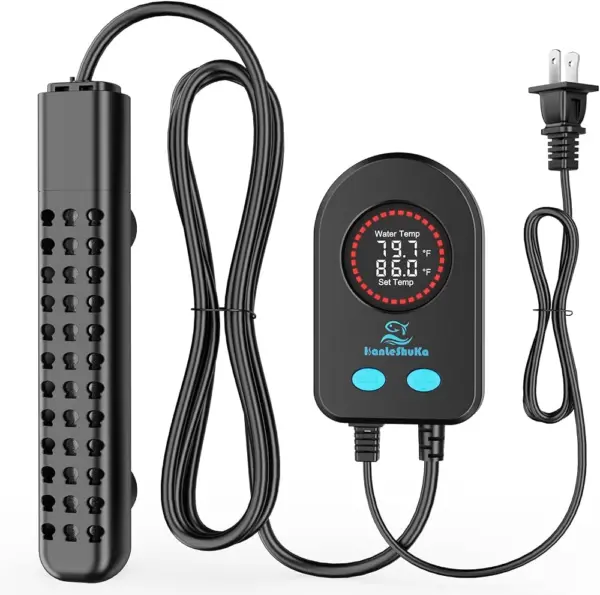
A hundred watts is more than a 10-gallon needs in a heated living room — ten gallons of water is 50-watt territory, and the extra power buys faster recovery rather than a steadier tank. Where it earns its place is the opposite case: a 10-gallon in a cool basement, a garage, or a room that drops overnight, where the heater spends the winter making up for the room instead of just holding a line. For that tank we think the headroom is the right call.
Protections are the fullest of the five: dry-burn cutoff when the water drops below the element, overheat cutoff, and an automatic stop at maximum temperature. A two-line display on the cord shows set and actual, glowing red while it heats and green once it is there, and a shell-shaped guard wraps the element so nothing brushes the hot part.
What holds it back is how much there is to go on. Fewer people are running this one than the others here, and units that stopped after about five months are recent enough that we treat longevity as unproven rather than settled. Run it against a second thermometer for the first month, and take the wattage seriously in both directions: in a warm room this is more heater than the job needs.
Pros
- Dry-burn and overheat shutoffs, plus max-temp stop
- Two-line display shows both temperatures
- Rated 10 to 20 gallons for cold rooms
Cons
- Little long-term history to judge it by
Buy this one for the cold room, not as an upgrade: the wattage is more than a warm 10-gallon needs, and it earns its place in a chilly one.
How We Tested Aquarium Heaters for 10-Gallon Tanks
We started with research, pulling every model we could find that was rated for 10 to 20 gallons, then filtered the list by things that actually matter at this size: an adjustable thermostat rather than a fixed preset, a fully submersible body, a length that would clear the water line on a standard 10-gallon, and enough owner reports of steady performance to be worth a look. That left 14 heaters, spanning budget glass tubes to pricier units with guards and external controls.
Each one went into its own cycled 10-gallon tank with a sponge filter and a lid, set to 78 degrees, in a room held at 68. We checked the water twice a day against a separate glass thermometer, once before the lights came on and once after feeding, and logged the reading against the dial. We also watched how tightly each heater held its setpoint over 24 hours, noting the high and low before the element kicked back on.
Alongside that, we timed how long each took to lift a tank from 72 to 78, turned the dial up with wet hands to see whether the markings were readable under a hood, and measured every body against the fill line and the clearance behind the filter. We tugged the cords to see whether the suction cups slid, and turned each unit to its maximum to confirm the thermostat cut out rather than running hot. After four months of continuous running we checked for condensation inside the glass, stiff or frayed cords, and any drift between the dial and the actual water temperature. We also weighed what came in the box at each price, since a guard and spare cups are worth more than a nicer box.
How to Choose a Heater for a 10-Gallon Tank
Ten gallons is a small enough body of water that the heater you choose matters more than the wattage on the box — you want a set point you control and a shutoff you can trust.
Wattage, and the room the tank sits in
Ten gallons of water is 50-watt work in a normal heated room, which is the size four of our five picks use. A 25-watt heater is built for a five-gallon desktop and will spend the winter playing catch-up. A 100-watt unit buys recovery speed you only need if the room runs cold or swings overnight. Size for the coldest week the tank will see rather than the average. Bigger does not make a tank more stable; it makes each heating cycle shorter and sharper if a thermostat ever sticks.
A set point you control
Most tropical fish want the water around 78 °F, which is why so many small heaters arrive preset to that number and why none of our picks are. The difference shows up the first time you keep a betta that does better at 80, or want a degree cooler for a species that prefers it. An adjustable heater also lets you correct for its own inaccuracy: dial it against a glass thermometer instead of trusting the printed ring, and you get the water you actually asked for.
Where the control lives
A dial on the heater body means wet hands and a flashlight every time you change something. A controller on the cord means you set it standing up and read the number from across the room, which is why we lean hard toward external controllers on a 10-gallon — the heater itself is usually tucked behind something. The trade is one more piece of hardware to mount clear of splashes, and a cord with a join in it to route tidily.
The shutoffs that matter in ten gallons
Small water volume means a stuck heater has less to warm and less time before it does harm, so protections earn their place here more than in a big tank. Two are worth insisting on: an overheat cutoff that kills the element above a set temperature, and a cutoff that notices the element is out of the water during a change or after evaporation drops the level. A heater with only a pilot light is telling you it is on, not that it is safe.
How much of the tank you give up
Most 50-watt tubes run six to eight inches long and about an inch across, which is a real object in a tank roughly twenty inches wide. Measure from the water line down to the substrate before ordering, then decide whether it goes vertical in a corner or lies low behind plants. Check that the suction cups come with it, too — they lose their grip over a season, and spares cost almost nothing.
Frequently Asked Questions
Do I actually need a heater for a 10-gallon tank?
For tropical fish, yes. Most of them want the water near 78 °F, and an aquarium in a normal room tends to sit a few degrees below the air around it because of evaporation. Float a thermometer for a full day before you decide: if the tank holds in the high 70s overnight on its own, you can wait; if it slides into the low 70s by morning, you need one.
Where should the heater go in a 10-gallon tank?
Somewhere the water moves — near the filter outlet rather than in a still corner, so warmed water gets carried around instead of rising straight to the lid. Keep the whole element below the water line, leave yourself room to lift it out, and keep it clear of the spot you siphon. Laying a tube horizontally along the back is usually the easiest way to keep it out of sight.
How do I check the heater is holding the right temperature?
Put a separate thermometer at the opposite end of the tank from the heater and read it twice a day, once before the light comes on and once in the evening. The morning number is the one that matters. If it drifts more than a degree or two across the day, look at the room and the water flow first — a draft or a dead corner will do that on its own.
Final Verdict
The hygger is the heater we recommend for most 10-gallons: it is rated for the tank rather than past it, and the controller lets you see the temperature and change it without reaching into the water. If the tank is a showpiece you look at every evening, the Fluval M50’s mirrored body and three-year warranty are worth the premium. If you want the element to look after itself while you siphon, the HiTauing is the one — and if the tank lives somewhere cold, step up to the 100-watt HANLESHUKA instead.