This post contains affiliate links. We may earn a small commission when you buy through our links — at no extra cost to you.
Freeze-dried tubifex worms do two jobs at once: they get protein into a picky eater, and they do it without clouding the tank. The larvae are dried rather than frozen or live, so they float first, soften, then drift down through the water column where mid-water and bottom fish can actually reach them. That’s the fix — the fish that ignores flakes, the new arrival that won’t come up, the bottom feeders that never see a meal.
The differences between brands live in the details: how evenly the worms are dried, how much dust and broken bits settle in the bag, and whether the pieces hold onto the glass long enough for a shy fish to find them. We’ve fed 15 different tubifex products across our tanks and my team’s over the past four months, and the pricier bags did not automatically win. Freshness matters more than most people realize — one whiff of a bag that smells sharply of old fish and you’ll know it’s past its prime. The picks below are the ones that got eaten first.
Our Top Picks


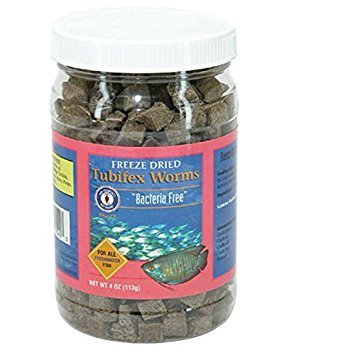
The Best Freeze-Dried Tubifex Worms, Reviewed
Hikari Bio-Pure Tubifex – Best Overall
Key Features
- Form: Freeze-dried cubes
- Packaging: Nitrogen-charged can
- Net weight: 0.18 oz (12 g)
- Price: Budget
The tin is smaller than the photos suggest, and the worms inside are pressed into firm little cubes rather than packed loose. That turns out to be the whole design: you pinch a corner off for a tank of neon tetras, drop a whole cube in for angels, and the can lasts far longer than its size implies. Nothing about feeding it feels like guesswork.
We hand this one to people first because it gets the boring parts right. The worms don’t cloud the water, the tin is nitrogen-charged so an opened can doesn’t go stale the moment air gets in, and there’s a vitamin enrichment most tubifex cans don’t bother with. It’s also the pick with the most consistent reception here: guppies, bettas, cardinals and angels all turn up eating it, and the fish that take to it attack it.
Two things to know before you buy. The worms float, which is an asset if you press a cube against the glass, where it sticks while surface feeders pick at it, but corys and loaches will never see it unless you soak a cube in tank water and squeeze it out first. And this is the smallest can in the group at a premium, so by weight it’s the most expensive tubifex here. For a treat fed a few times a week, the portion control and the packaging are worth the difference to us.
Pros
- Cubes pinch apart for exact portions
- Nitrogen-charged tin survives slow, occasional use
- Won’t cloud the water like loose foods
- Sticks to the glass for surface feeders
Cons
- Smallest can here, sold at a premium
We reach for the Hikari tin first: cubes that portion cleanly, water that stays clear, and the most consistent reception in this group.
Omega One Tubifex Worms – Best High-Protein Pick
Key Features
- Crude fat: 9% min
- Net weight: 1.5 oz
- Crude protein: 54% min
- Price: Midrange
Fifty-four percent minimum crude protein, nine percent fat, five percent maximum moisture. Omega One prints a full guaranteed analysis on the label, and that’s why this can sits high on our list. These are guaranteed minimums and maximums rather than aspirations, and the protein figure is a couple of points above the San Francisco Bay canister. For a food that is mostly protein by design, that’s the number that matters.
The bottle is the middle of this group, well up on Hikari’s tin and well short of the four-ounce canisters, and it’s a workable size for one or two tanks. In water the cubes soak up quickly and break into individual worms instead of sitting there as a lump, which suits mid-water fish that chase pieces: tetras, barbs, angels and discus.
The catch is powder, and it’s the thing that pulls this below the Hikari for us. The cubes shed fine dust as they come apart, and whether fish eat it is the most divided result of any pick here: some hit it hard, others ignore it and leave the dust to settle. If you keep a fussy betta, start with a smaller can and see; if yours are greedy, the bigger bottle and the printed guarantee make this the better buy.
Pros
- 54% minimum protein, printed as a guarantee
- Bigger bottle than the Hikari tin
- Breaks into worms mid-water fish chase
- A fair price for the volume
Cons
- Sheds powder; some fish refuse it
We rate this one on its printed guarantee: 54% minimum crude protein, a couple of points above the big San Francisco Bay can, though fussier fish may refuse the powder it sheds.
San Francisco Bay Tubifex – Best Bulk Value
Key Features
- Crude fat: 12% min
- Net weight: 4 oz
- Crude fiber: 8% max
- Crude protein: 51.5% min
- Price: Premium
The four-ounce canister is what tubifex looks like when you stop treating it as a luxury: a big, plain tub of cubes that costs less per ounce than any other tubifex-only can here and doesn’t need rationing. If you run three or four tanks, this is the one that stops you counting worms.
It isn’t only volume. The label carries a 51.5% minimum crude protein guarantee with 12% fat, a slightly richer profile than the Omega One, and the fish that get it go straight for it, discus and blood parrots included. The cubes are dense and break easily, so a big canister doesn’t force big portions on a small tank.
What you give up is structure. These worms come apart quickly once wet, so a cube doesn’t sit on the glass for long and the pieces drift: fine in a community tank where everything gets chased, less good if you wanted a slow graze for a surface feeder. Keep the lid tight between feeds as well. With this much food in one can, moisture is the enemy, and a clumped canister is a spoiled one.
Pros
- Biggest tubifex-only canister here
- 51.5% protein guarantee with 12% fat
- Fish go straight for these cubes
- Cubes break easily for mixed sizes
Cons
- Worms crumble quickly once wet
We like this best for anyone running several tanks: a big tubifex-only canister, a 51.5% protein guarantee, and fish that go straight for it.
Aquatic Foods Tubifex Canister – One-Can Variety
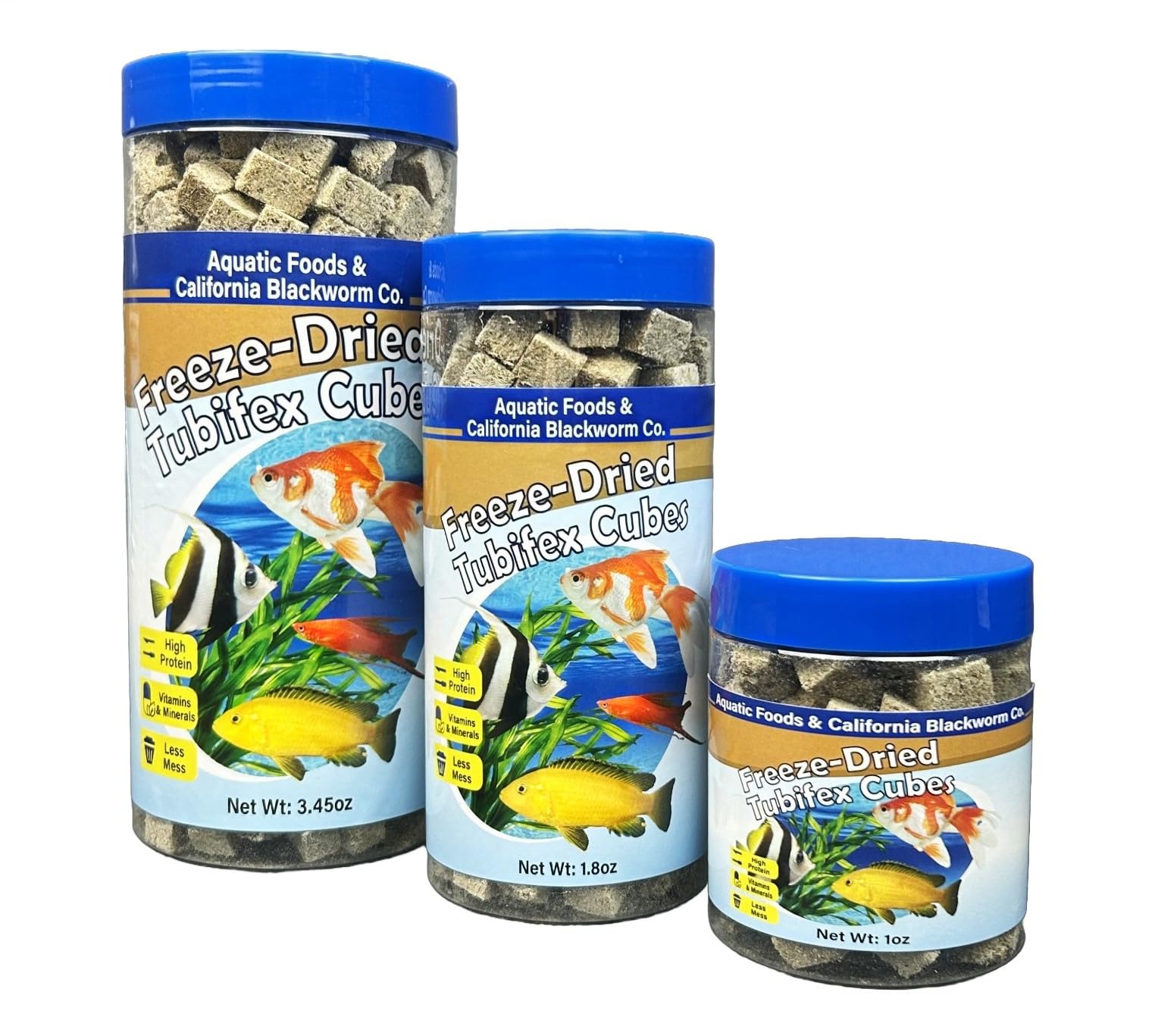
Key Features
- Form: Tubifex cubes
- Net weight: 3.45 oz
- Also included: Twelve pellet types, four wafer types
- Price: Midrange
Aquatic Foods sells this as a tubifex can, but the contents are broader than that: worm cubes alongside a twelve-type pellet mix and a four-type wafer mix, all in one 3.45-ounce canister. Whether that’s the point or the problem depends entirely on what you came for.
We treat it as a convenience buy. One order covers a community tank’s pellets, a bottom feeder’s wafers and a tubifex treat, and the company sifts the food before packing, so you aren’t paying for half a can of dust and broken pieces. What you don’t get is a can full of tubifex: the worm share is a portion of the net weight, and there’s no guaranteed analysis on the listing to tell you how protein-dense the mix is. If tubifex is the whole reason you’re shopping, the Hikari tin or the San Francisco Bay canister are the better buys. If you want one can doing several jobs, this is a tidy way to get it.
Pros
- Tubifex, pellets and wafers in one canister
- Sifted to cut dust and broken pieces
- One order covers a whole community tank
Cons
- Tubifex is only part of the can
- No guaranteed analysis published
We see this as a one-order convenience: tubifex plus pellets and wafers in a single can, not the best value if you want worm and nothing else.
Aquatic Provisions Tubifex Cubes – Best for Fry and Inverts

Key Features
- Packaging: Jar with oxygen absorbers
- Net weight: 1 oz (28.3 g)
- Ingredients: Single ingredient
- Price: Midrange
One ounce, one ingredient, one small jar. Aquatic Provisions keeps it plain: freeze-dried tubifex cubes, nothing blended in, packed with oxygen absorbers rather than a nitrogen charge.
There’s real appeal in that for anyone feeding a single fussy fish or a tank of fry. Single-ingredient means you know exactly what goes in, the cubes crumble predictably for small mouths, and the jar is small enough to live in the stand rather than the cupboard. The maker lists invertebrates and fry alongside the usual community fish, and you’ll want to crumble a cube rather than drop it whole for either.
The catch is acceptance, and it’s the honest reason this sits in our also-consider tier. Some fish take to these cubes immediately and some ignore them entirely, and that split is the main thing we want a buyer to know going in. The small jar turns it into a cheap experiment rather than a commitment, so try one and see what your tank does. Where a crumbled cube beats a pressed block, as it does with fry, this is the pick we reach for.
Pros
- Single ingredient, nothing blended in
- Small jar to trial before committing
- Oxygen absorbers keep the food fresh
- Cubes crumble finely for fry
Cons
- Acceptance splits between individual fish
We think it earns a trial on fry and invertebrates: one ingredient, a small jar, and a price that makes experimenting painless, though acceptance is genuinely split.
BNYEE Tubifex Worm Food – Best for Long-Term Storage

Key Features
- Shelf life: 12-24 months
- Crude protein: 60-70%
- Sterilization: Irradiated
- Price: Midrange
BNYEE is the one we keep in the cupboard as a backup. The label claims a shelf life of twelve to twenty-four months without refrigeration and a crude protein content of 60 to 70 percent, the highest figure on paper of anything here and the least rigorous, because it’s a range rather than a guaranteed analysis with minimums.
The rest of the pitch is sensible: freeze-drying plus irradiation as a pathogen control, and chitin from the worm itself for digestion. What the listing doesn’t tell you is how much food is in the container, because no net weight appears anywhere on it. Check the pack size before you assume it’s the bargain the protein number suggests, since a big claim on a small can is no bargain at all. Buy it for shelf life and a bit of tank-ready protein in reserve, not as your main can.
Pros
- Longest shelf-life claim of these picks
- Highest on-paper protein figure here
- Irradiation used as a pathogen control
Cons
- Protein figure is a range, not a guarantee
- No net weight to compare value
We keep this as the dry spare: the longest shelf-life claim here and a big protein number, provided you check the pack size before comparing it with the cans.
How We Tested Freeze-Dried Tubifex Worms
We started with a long list of roughly 40 tubifex products and cut it down by reading labels and doing arithmetic: ingredient lists that named nothing but tubifex, weights given in grams rather than vague scoop counts, and a price per gram we could genuinely compare. That left 15 bags, which we fed across established community tanks, a couple of nano setups, and one very opinionated betta over four months. Every bag went in the same tank on the same schedule in the same amount, so what we were judging was the food and not the mood of the fish.
The first test of any batch was floatability — we dropped a pinch on the surface and timed how long it stayed up before waterlogged worms began to sink. Then adhesiveness: we pressed a few worms against the front glass and counted how many were still stuck there ten minutes later, since that is how most people feed a shy or nocturnal fish. At every feeding we noted which fish actually came for it, whether anything was taken and spat back out, and whether the water hazed over within the hour.
Over the long haul we tracked fish happiness the boring way: body condition, color, activity, and any bloating or buoyancy trouble in the week after switching to a new bag. We also kept one bag of each open on the shelf for the full four months, smelling and inspecting it every couple of weeks — a sharp, stale odor or browned edges meant it was finished. Value came down to a kitchen scale. We weighed the dust and broken fragments left in the bottom of each bag and subtracted them from what we paid, because a cheap bag that is a third powder is not cheap.
How to Choose Freeze-Dried Tubifex Worms
The right tubifex is the one your fish will actually eat and you’ll actually finish before it goes dusty; everything else on the label is detail.
Match the cube to the mouths in your tank
Pressed cubes are the friendliest format for a mixed community because they tear along a seam: a corner for tetras and rasboras, a whole cube for angels and goldfish. Loose-packed worms and crumbly cubes shed powder the moment they hit water, which small fish ignore and your filter collects.
If you keep anything with a mouth smaller than a neon tetra, plan on crumbling a corner between your fingers rather than dropping a cube. The cans worth buying are the ones whose cubes hold their shape long enough for you to pinch them.
Plan for floating
Almost all freeze-dried tubifex floats, and few listings say so plainly. For surface feeders that’s a gift: press a cube against the inside of the glass and it sticks there while barbs and swordtails work at it. For corys, loaches and plecos it’s a dead loss.
Soak a cube in a cup of tank water, squeeze the air out, and let it sink before it goes in. If you keep both kinds of fish, feed two small pieces in two places rather than one big cube.
Read the guaranteed analysis, not the adjective
The tubifex cans that publish a full analysis land in the low-to-mid fifties for minimum crude protein: Omega One at 54%, San Francisco Bay at 51.5%. That’s the range a good product delivers, and it’s the figure to compare across cans.
A protein number with no minimum attached, or a range like 60 to 70 percent, is a claim rather than a guarantee. Moisture matters as much: five percent maximum is what keeps a can shelf-stable and stops the worms fusing into lumps.
Buy the size you’ll actually finish
A 12-gram tin and a 4-ounce canister are two different purchases, not two sizes of the same one. One or two tanks fed a few times a week take months to work through a big canister, and a can left open for a year loses whatever freshness the packer built in.
Count your tanks first. The small Hikari tin suits a single community; the San Francisco Bay canister only makes sense if there are several mouths waiting.
Single ingredient or mixed can
If you’re feeding tubifex for a specific reason, such as bringing a discus onto prepared food, tempting a fussy betta or adding protein for fry, buy a can that is tubifex and nothing else. Mixed cans that bundle pellets and wafers stretch one order across a whole tank, but you can’t tell how much of the net weight is worm.
We keep the tubifex-only can for treating and buy the staple food separately, so that a portion of worms means what it says.
Frequently Asked Questions
Can I feed freeze-dried tubifex every day?
It’s a treat, so a few times a week alongside a staple food is plenty. The usual rule is to feed only what your fish clear in about two minutes; anything left drifting breaks down and works your filter harder. Rotating tubifex with pellets and frozen food gives variety without unbalancing the diet.
Will freeze-dried tubifex cloud the water?
Pressed cubes mostly won’t, and Hikari specifically claims they don’t, but loose worms and crumbled cubes shed a fine dust that hangs for a while. Drop cubes in whole and let the fish break them up, and don’t dig a scoop out of the bottom of the canister where the crumbs collect. If the water fogs at every feed, you’re crumbling too much.
Is freeze-dried tubifex safe for fry and shrimp?
Yes, with a size adjustment: a whole cube is far too big for fry or shrimp. Crumble a corner until it’s nearly powder and feed only what gets eaten. One reason these products exist is that freeze-drying avoids the parasites and bacteria live tubifex can carry in from the water it was raised in.
Should I refrigerate an opened can?
No. Keep it sealed, dry and at room temperature, with any desiccant sachet left inside. Moving a can between a cold fridge and a warm fish room causes condensation, which is exactly what turns freeze-dried worms soft and clumpy. If the worms smell sharp or have fused into lumps, replace the can.
Final Verdict
For most community tanks, the Hikari tin is the one we point people to: cubes you can pinch to any size, water that stays clear, and a response that holds up across the widest spread of species here. It’s the smallest can in the group, and worth it for a treat fed a few times a week.
If you’re feeding four tanks rather than one, the San Francisco Bay canister gives you far more worm for the money with a protein guarantee attached. And if your fish have refused tubifex before, buy the smallest can on offer first, whichever brand you pick.