This post contains affiliate links. We may earn a small commission when you buy through our links — at no extra cost to you.
Many ammonia detoxifiers promise total removal, but ‘locked’ ammonia still shows up on test kits and requires water changes. The real difference lies in whether a product binds ammonia temporarily or converts it, and whether it also handles nitrite and heavy metals. A formula that works perfectly for a 10-gallon desktop tank may be impractical for a 150-gallon community setup.
One trade-off is choosing between a convenient liquid that doses by the capful and a highly concentrated powder that cuts costs but demands a precision scale. Another is the sulfur smell that often accompanies the most effective formulas. This guide breaks down which trade-offs matter for your tank size, stocking level, and tolerance for odor.
A sulfur odor typically signals superior binding chemistry, but not every tank needs that level of potency. Understanding the difference between ammonia locking and removal will save you from chasing false readings later.
Top Picks
Best for All Aquariums
Seachem Prime 500ml

Rating: 4.8 ★ | Price: Mid-Range | Ammonia Action: Detoxifies all forms | Cost Efficiency: 5 mL per 50 gal | Odor: Strong sulfur | Water Type: Both | Extra Features: Heavy metal removal
Seachem Prime detoxifies ammonia, nitrite, and heavy metals in a single dose — handling spikes and routine water changes for both freshwater and saltwater tanks. Its high concentration means 5 mL treats 50 gallons, keeping recurring costs low, and it can be safely used at up to five times the normal dose during emergencies without risk to fish.
This makes it a strong choice for any aquarist who wants a single conditioner for all needs. The strong sulfur odor from the formula is noticeable when dosing but dissipates quickly — a tradeoff for its effectiveness. For very small tanks, the tiny dose required can be inconvenient, but it’s not a dealbreaker for most setups.
Pros
- Detoxifies ammonia, nitrite, nitrate, and heavy metals in one dose
- Highly concentrated — 5 mL treats 50 gallons, minimizing recurring costs
- Safe to use at up to 5x normal dose during ammonia spikes without harming fish
Cons
- Strong sulfur (rotten-egg) smell when dosing, though it fades within minutes
- In very small tanks, measuring the tiny dose required can be impractical
Seachem Prime is the one conditioner to stock for any freshwater or saltwater aquarium — its broad-spectrum detoxification and safe overdose margin make it a practical default for both daily maintenance and emergencies.
Best for Large Tanks
Seachem Safe 250g

Rating: 4.7 ★ | Price: Budget | Ammonia Action: Same as Prime | Cost Efficiency: Treats up to 50,000 gal | Odor: Very strong sulfur | Water Type: Both
Seachem Safe delivers the same broadly effective water conditioning as Seachem Prime, but in a concentrated powder that treats up to 50,000 gallons per jar. This makes it the most cost-effective choice for tanks over 100 gallons or multiple setups. For budget-conscious hobbyists willing to handle a powder format, it’s an excellent value.
Pros
- Cost-effective for large or multiple tanks — a single jar treats up to 50,000 gallons.
- Same ammonia-binding and dechlorination chemistry as Seachem Prime.
- Long-lasting — a single jar can last years for most hobbyists.
Cons
- Strong sulfur smell when mixing — noticeable in smaller rooms or if sensitive to odors.
- Dosing requires a precision measuring spoon or scale — the small amounts needed for tanks under 30 gallons can be especially tricky.
For owners of large aquariums or multiple tanks who want to minimize ongoing costs, Safe is the clear value pick.
Best for Injured Fish
Seachem StressGuard

Rating: 4.8 ★ | Price: Mid-Range | Ammonia Action: Reduces toxicity, heals | Cost Efficiency: 10 gal per cap | Odor: Strong sulfur | Water Type: Both | Extra Features: Wound healing, immune
StressGuard reduces ammonia toxicity alongside actively healing torn fins and wounds — something the top pick doesn’t do. This makes it the right call for fish keepers managing injured or stressed fish, quarantine setups, or delicate species like discus and bettas. The tradeoff: it can leave reddish stains on white silicone, airlines, and wood surfaces, so take care around light-colored equipment.
Pros
- Heals torn fins and injuries while reducing stress levels
- Supports immune system for faster recovery from illness
- Safe for reef and planted tanks at pH 7.0
Cons
- Can leave reddish stains on white silicone, airlines, and wood surfaces
A targeted treatment for wound care and stress reduction that justifies its cost — but for routine water changes, Prime is the more practical everyday conditioner.
Best for New Owners
TankFirst 500ml
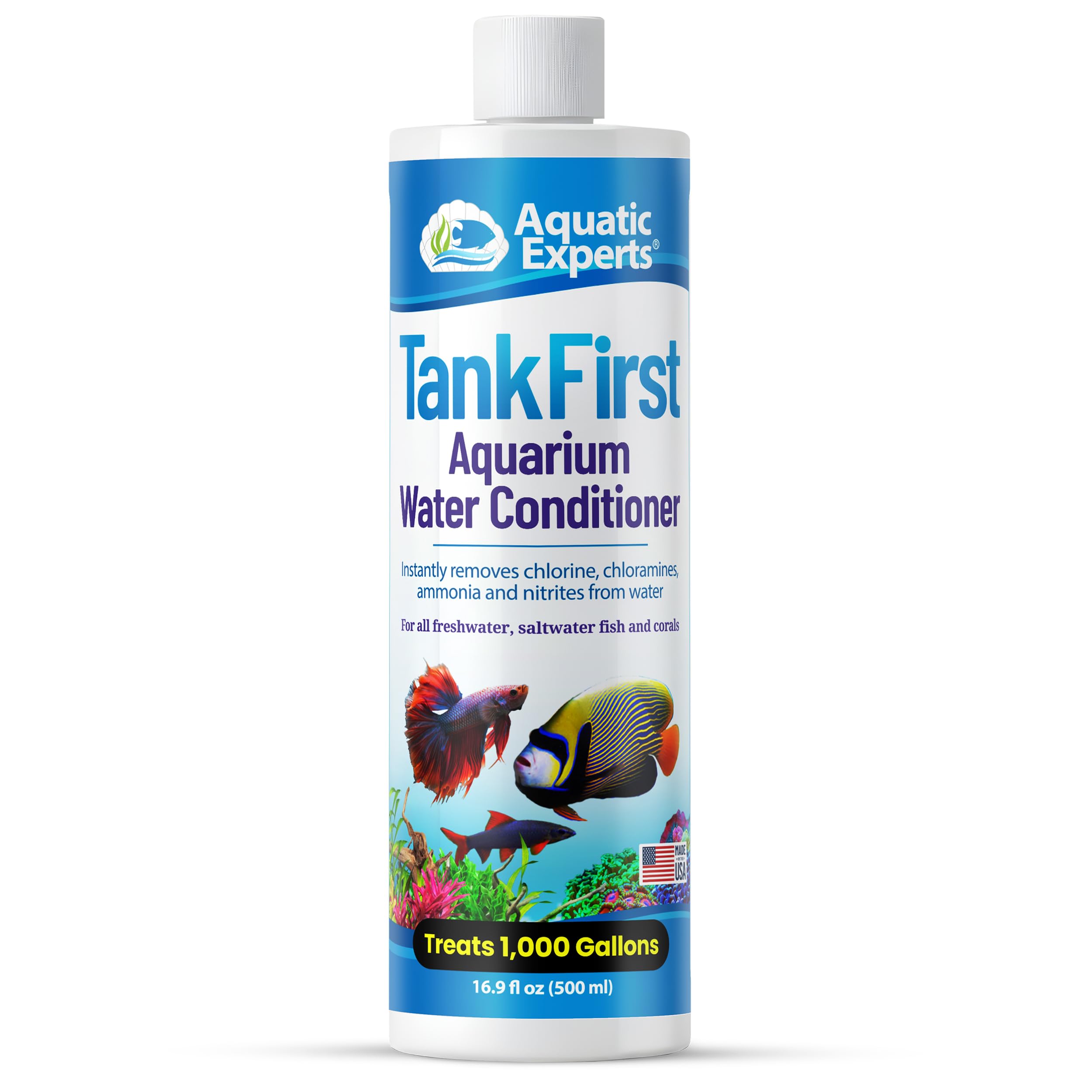
Rating: 4.7 ★ | Price: Mid-Range | Ammonia Action: Detoxifies ammonia | Cost Efficiency: 500 mL bottle | Water Type: Both | Extra Features: Water clarity
Unlike the top pick’s strong sulfur odor, TankFirst eliminates chlorine, chloramines, and ammonia without any smell, making water changes more pleasant. It handles standard maintenance reliably, though its track record for sudden ammonia spikes in heavily stocked tanks is less extensive.
Best suited for new aquarium owners or anyone sensitive to chemical odors who keeps small to medium freshwater tanks with routine water changes. If you routinely manage high ammonia loads, the market leader offers broader documented performance.
Pros
- Effectively removes chlorine and chloramines with good ammonia detoxification for routine water changes.
- Odor-free formula eliminates the sulfur smell common with many conditioners.
- Improves water clarity, leaving the tank crystal clear after each use.
Cons
- For emergency ammonia control in densely stocked tanks, the track record is less extensive than the leading alternative.
- Does not help with nitrites, which some users discovered needed separate treatment.
A no-odor option that reliably covers standard water changes, but not the best choice for tanks that see frequent ammonia spikes.
Best for Single Solution
Natural Rapport 16oz

Rating: 4.5 ★ | Price: Mid-Range | Ammonia Action: Detoxifies ammonia/nitrite | Cost Efficiency: Treats 960 gal total | Water Type: Both | Extra Features: Slime coat, pH buffer
This all-in-one conditioner packs dechlorination, ammonia and nitrite detox, slime coat, and pH buffering into one capful-per-10-gallons dose — simplifying water treatment for those who want fewer bottles on the shelf. The tradeoff is that temporary water cloudiness can appear after dosing in some tanks, and ammonia control is less consistent than the top pick when water parameters shift. Best suited for hobbyists maintaining stable, lightly stocked aquariums where routine water changes are the norm, not emergency spikes.
Pros
- Replaces multiple products with one capful for dechlorination, ammonia detox, slime coat, and pH buffering.
- Cost-effective for the number of treatments per bottle.
Cons
- May cause temporary water cloudiness in some tanks after dosing.
- Ammonia and nitrite control can be less reliable than alternatives during sudden parameter changes.
A practical all-in-one for keepers of stable, lightly stocked tanks who value convenience — but not the go-to for tanks prone to ammonia spikes.
Best for Emergency Only
API Ammo-Lock 16oz

Rating: 4.6 ★ | Price: Budget | Ammonia Action: Locks only | Water Type: Both
API Ammo-Lock is a budget-friendly option for sudden ammonia spikes: it rapidly locks ammonia into a less toxic form, buying time during water changes. However, it does not remove ammonia permanently, so readings will persist, and effectiveness can vary between tanks – some fish may still show stress. This makes it a useful backup for occasional emergencies, not a daily water conditioner.
Pros
- Acts quickly to reduce ammonia toxicity during spikes
- Budget-friendly price for an emergency treatment
Cons
- May produce inconsistent results, with occasional reports of fish stress after use
Keep Ammo-Lock as a backup for sudden ammonia spikes while performing water changes – it is not reliable enough for ongoing conditioning.
How to Choose
The most important factor is whether the product locks ammonia (requiring water changes) or actually removes it, and whether you need additional benefits like nitrite control or wound healing.
Ammonia Action
Products that ‘lock’ ammonia bind it into a less toxic form but leave it measurable on test kits. This means the ammonia remains in the water until removed by biological filtration or water changes. Products that ‘detoxify’ fully render ammonia non-toxic and are often combined with dechlorination.
The distinction matters most during cycling or spikes. A locker gives you time to perform water changes, while a true detoxifier can be used as a standalone safeguard. Read the label: if a product says ‘locks ammonia’ expect persistent test readings.
Cost Per Gallon
Liquid conditioners like Prime offer a measured dose per capful, convenient for most tanks. Powdered options like Safe provide the same chemistry at 5–10× the concentration, drastically lowering the cost per gallon treated. However, powder requires a precision measuring spoon or scale for small tanks.
For a single 20-gallon tank, a liquid bottle may last months and cost less than $20. For a 200-gallon system or multiple tanks, the powder pays for itself quickly. Calculate your monthly water change volume to decide which form saves more.
Odor
The sulfur smell in Seachem products comes from sodium dithionite, a reducing agent that binds ammonia and chloramine effectively. The odor is strongest when first mixed and dissipates within minutes. It is not a sign of spoilage or danger.
If you are sensitive to the smell or keep the aquarium in a living area, an odor-free conditioner like TankFirst avoids the issue entirely. Just be aware that odor-free formulas may use different chemistry that hasn’t been as extensively tested for severe ammonia spikes.
Water Type
Nearly all ammonia detoxifiers work in both freshwater and saltwater. The active ingredients are water-independent. However, some additives like slime coat may behave differently in saltwater due to osmotic pressure. Check the label for ‘reef safe’ if you keep invertebrates.
For planted tanks, ensure the product does not contain copper or other algaecides. Most mainstream conditioners are plant-friendly.
Extra Features
Additional benefits like wound healing, slime coat, or heavy metal removal can justify a premium. StressGuard’s ability to accelerate fin regeneration is unique among conditioners and invaluable for quarantine tanks. All-in-one formulas simplify routine but may trade off potency in any single area.
If your primary need is ammonia control during cycling, extra features are unnecessary. If you frequently introduce new fish or treat injuries, a specialized product like StressGuard saves you from buying separate medications.
FAQ
Why does Seachem Prime smell like rotten eggs?
The sulfur odor comes from sodium dithionite, the active ingredient that binds ammonia and chloramine. It is normal and harmless to fish. The smell dissipates quickly after dosing. If it bothers you, consider an odor-free conditioner like TankFirst, though you sacrifice Prime’s proven track record for severe spikes.
Can I use API Ammo-Lock for long-term ammonia control?
No. API Ammo-Lock only locks ammonia into a non-toxic form, it does not remove it. The ammonia will still show on test kits and requires water changes or a working biofilter to eliminate. It is best kept as an emergency treatment during spikes, not as a daily water conditioner.
Is Seachem Safe better than Prime for a 100-gallon tank?
Yes, if you don’t mind measuring powder. Safe is the dry version of Prime and treats water at a fraction of the cost per gallon. A 250g jar can condition up to 50,000 gallons. For a 100-gallon tank doing weekly water changes, Safe will last years and save significant money over Prime. Prime’s liquid form is more convenient for small tanks or quick dosing.
Does Natural Rapport water conditioner make the aquarium water cloudy?
Some users report temporary cloudiness after dosing, likely due to the all-in-one formula’s pH buffers or slime coat components. The cloudiness usually clears within a few hours. If your tank is heavily stocked or you have sensitive fish, consider a simpler conditioner like Prime to avoid this risk.