This post contains affiliate links. We may earn a small commission when you buy through our links — at no extra cost to you.
Tropical fish can be finicky in a way that doesn’t show up until you’ve watched a perfectly good flake drift past a tetra and settle into the gravel untouched. A flake that dissolves too fast clouds the water; one that’s too large or too hard gets ignored or spat out. The right flake is the one your fish actually eat—before it becomes waste—and that keeps the tank clearer and the fish looking better.
We’ve spent the past three months feeding 15 different tropical fish flakes to our own community tanks, and the differences were not subtle. Some disappeared within seconds; others sat on the surface until they broke apart and sank. We also paid attention to cost per feeding, because a bargain tub that half the tank ignores is no bargain at all. A quick test at home: watch the first five minutes after you feed. If flakes are still floating or landing on the gravel, your fish aren’t eating them—and you’re paying for cloudy water. The picks below are the ones that passed.
Our Top Picks


The Best Tropical Fish Flakes, Reviewed
TetraMin Plus Tropical Flakes – Best Overall
Key Features
- Formula: Staple with shrimp
- Container: 7.06 oz tub
- Feeding frequency: Multiple times daily
- Price: Midrange
Shrimp shows up in the name, and it’s the reason this is the flake we hand to most people. Fish that ignore a plain fishmeal flake tend to come up for this one; in our feeding, the surface was cleared before the flakes had spread far, with the tetras still working the mid-water for the bits that sank. Tetra builds it as a staple rather than a treat, with omega-3s and its ProCare blend behind the flavor, so eagerness isn’t the only thing you’re buying.
The 7.06-ounce tub is what we think of as the sensible size. It’s enough that you’re not reordering constantly and small enough that a single community tank finishes it while it’s still fresh, which matters more with flake than with pellets. One thing that surprised us: the flakes run larger than the name suggests. For neon tetras and chili rasboras, pinch and crush; for angelfish, barbs and mollies, drop them in whole.
Water clarity is where flake food gets a bad reputation, and this one keeps the tank clear as long as you feed lightly. The clear-water claim is about the formula, but the bigger factor is how much lands in the tank: feed what the fish clear and siphon what reaches the gravel. Where it fits less well is a single nano tank, which is more food than you’ll get through before it fades.
Pros
- Fish come up for it fast
- Sensible tub size stays fresh
- Complete staple, not just flavor
- Keeps water clear when fed properly
Cons
- Tub is oversized for a single nano tank
Our default tropical flake: the shrimp pulls fish to the surface fast, the tub is a sensible size for one or two tanks, and the water stays clear when you feed sensibly.
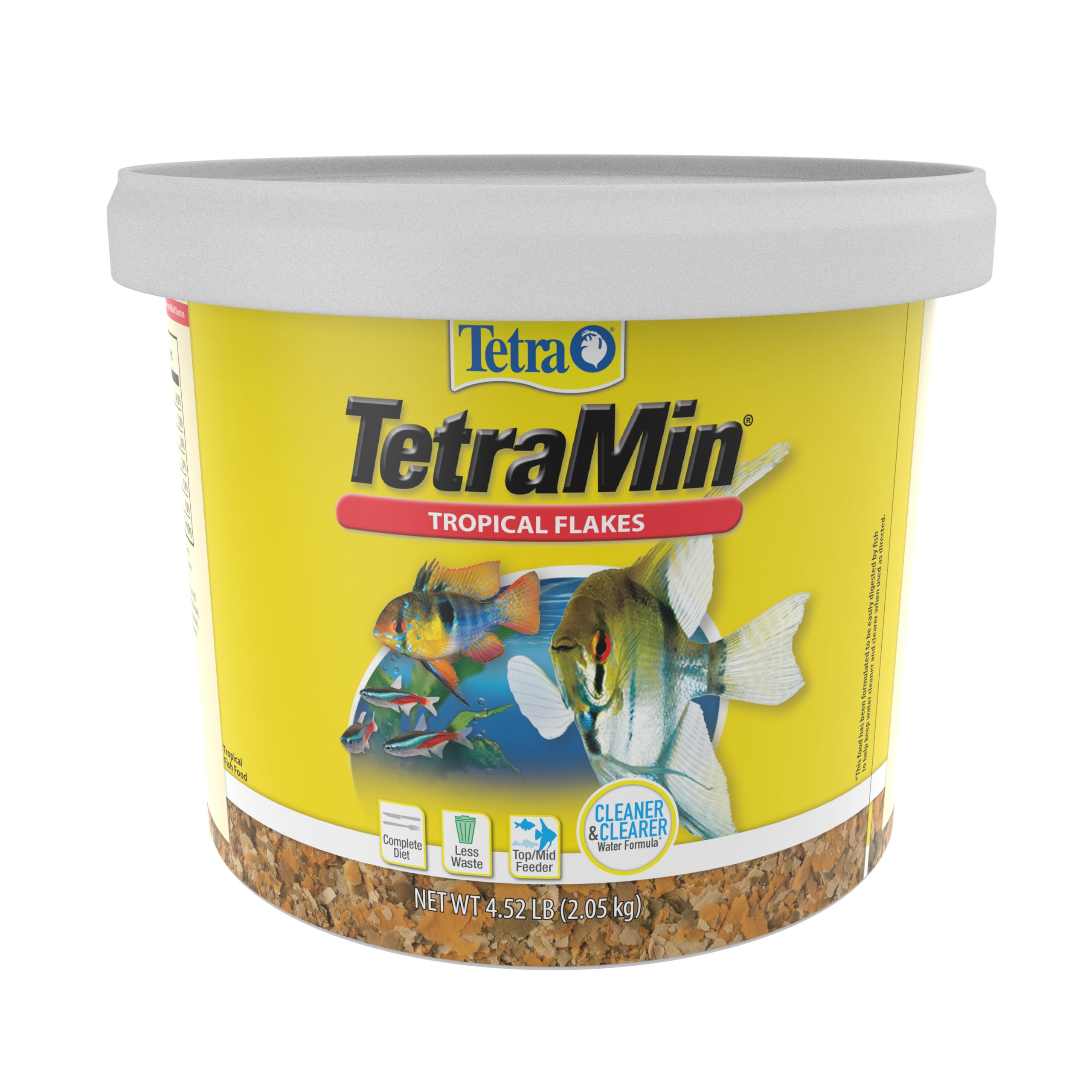
TetraMin Tropical Flakes 4.52 lb – Best Bulk Value
Key Features
- Formula: Staple, Active Life
- Container: 4.52 lb bag
- Feeding window: Within 3 minutes
- Price: Premium
Four and a half pounds of flake is a different category of purchase, and we only recommend it to someone feeding several tanks. If that’s you, the math is simple: one bag, one order, months of staple. If it isn’t, you’ll be spooning out flakes that have gone flat long before the bag is empty.
The format is the first thing to solve. It arrives as a bulk bag rather than a tub, so there’s no shaker top: decant a week’s worth into a screw-top jar and keep the rest sealed and cool. The formula is the original TetraMin staple with the Active Life additions, antioxidants, select proteins and prebiotics, rather than the shrimp-forward blend in our top pick. The three-minute rule on the label is the most useful line on the packaging, and the water stays clear when you stick to it.
What we noticed in use is the mix of floating and sinking pieces, which suits a community with both top and mid feeders; crushing a pinch for fry works fine. It’s also the cheapest way to keep a staple on the shelf when you’re feeding a rack, a grow-out setup, or splitting an order with a local club. The honest boundary is scale, not quality.
Pros
- Bulk bag ends the reorder cycle
- Original TetraMin staple formula
- Floats and sinks for top and mid feeders
Cons
- Bag has no shaker top; needs decanting
- Far more than one tank can finish fresh
We point multi-tank keepers to this bag: the original TetraMin staple in a size that ends the reorder treadmill, provided you have somewhere to decant it.
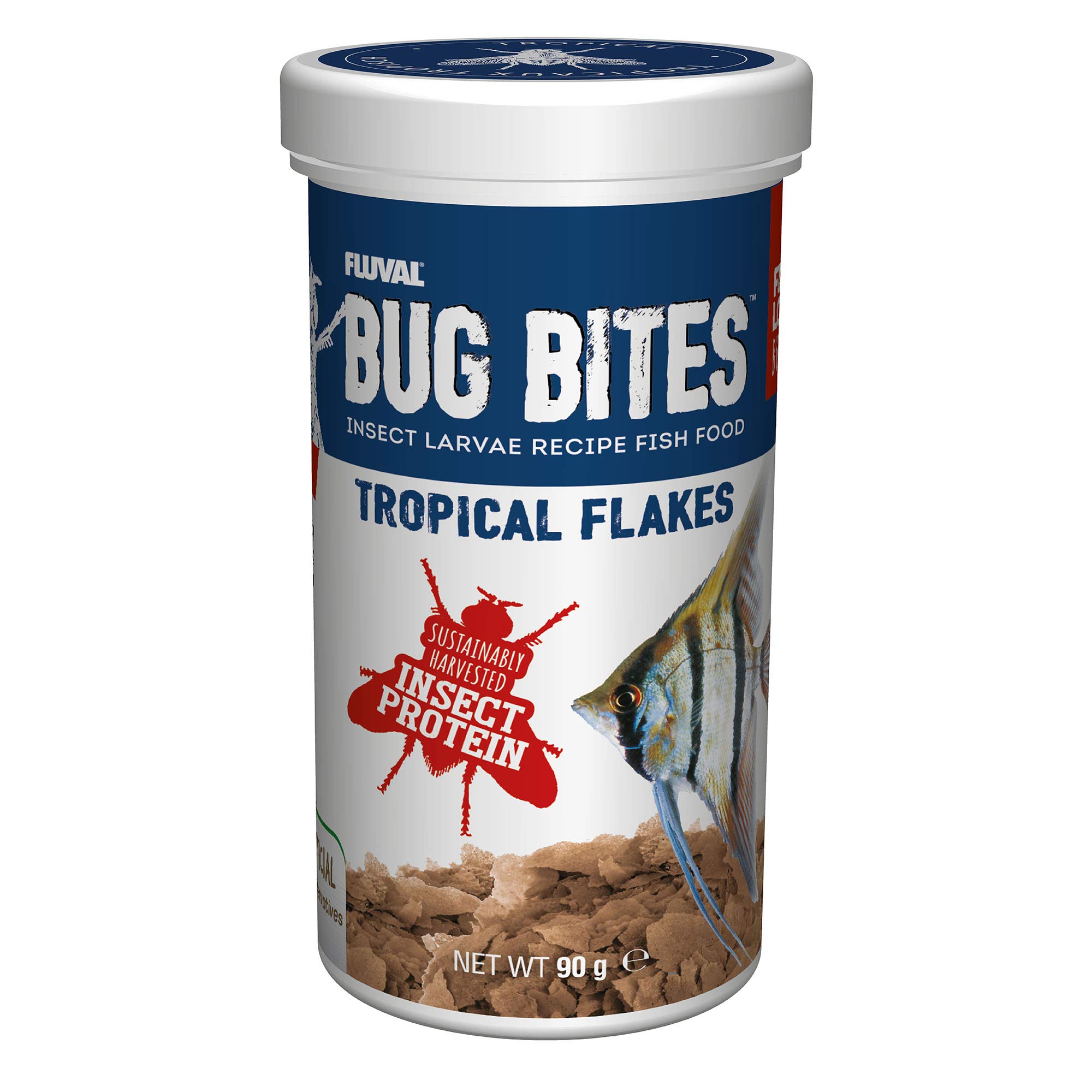
Fluval Bug Bites Tropical Flakes – Best Insect-Protein Formula
Key Features
- Container: 3.17 oz tub
- Added protein: Whole salmon
- Feeding window: Within 2 minutes
- First ingredient: Black soldier fly larvae
- Price: Budget
Black soldier fly larvae are the first ingredient here, at up to 40 percent of the formula, with whole salmon behind them for omega-3 and omega-6. That reads like a marketing angle until you watch fish work through it. What struck us is how soft the flakes are: they come apart between your fingers, so you can size a pinch to the tank instead of guessing.
The tub is 3.17 ounces, which is small for the shelf and generous for a single tank, and the flakes are light enough that a little goes a long way. Be ready for the smell when you open it. The insect meal gives it an earthier, less fishy note than a standard flake, and that seems to be part of why fish that snub fishmeal food take this one.
Where it earns its place for us is as the food you try when a tank has gone off its old staple, or as a rotation alongside a conventional flake. It’s a complete daily diet rather than a supplement, and Fluval’s own guidance is two or three small feeds within a two-minute window, so it can carry a tank on its own. It’s genuinely different from the fishmeal flakes that make up most of this list, and for a stubborn eater that difference is the point.
Pros
- Insect-first formula with salmon for omega-3
- Soft flakes crumble to fit small mouths
- Works as a complete daily staple
Cons
- Flake size is inconsistent in the tub
- Tub runs out fast across several tanks
We reach for this when a fish ignores everything else: an insect-first flake with salmon behind it, soft enough to crumble for small mouths.
Aqueon Natural Tropical Flakes – Best for Small Fish
Key Features
- Formula: Natural with kelp
- Container: 7.12 oz jar
- Flake style: Floating, fine
- Price: Midrange
These flakes run small, closer to a crumb than the broad translucent flakes you might be picturing, and that single fact decides whether you should buy the jar. In a tank of neons, harlequin rasboras or guppy fry, they’re already the right size, so you’re not spending every feed crushing a pinch against the glass while half of it turns to dust.
We think that’s the whole point of this jar. Floating flakes keep food at the surface long enough for mid-water fish to work it, and the formula leans on natural ingredients with kelp plus added vitamins and trace nutrients rather than a heavy color additive load. Point it at the wrong tank and the advantage reverses: with angelfish, adult mollies or anything with a mouth bigger than a rasbora’s, you end up feeding more volume to make up for the size, and more of it reaches the gravel.
The 7.12-ounce jar suits a small-fish setup well, since one order covers a long stretch for a tank that never eats much in a sitting. It’s the pick we make when someone’s whole community is tiny, and it’s the one we leave on the shelf when the tank has any real mouths in it.
Pros
- Fine flake suits small mouths and fry
- Floats for surface and mid-water feeders
- Natural formula with kelp and vitamins
Cons
- Too fine for medium and large fish
The one we buy for a tank of neons, rasboras, or fry: the flakes are already fine enough for small mouths, and they float where small fish feed.
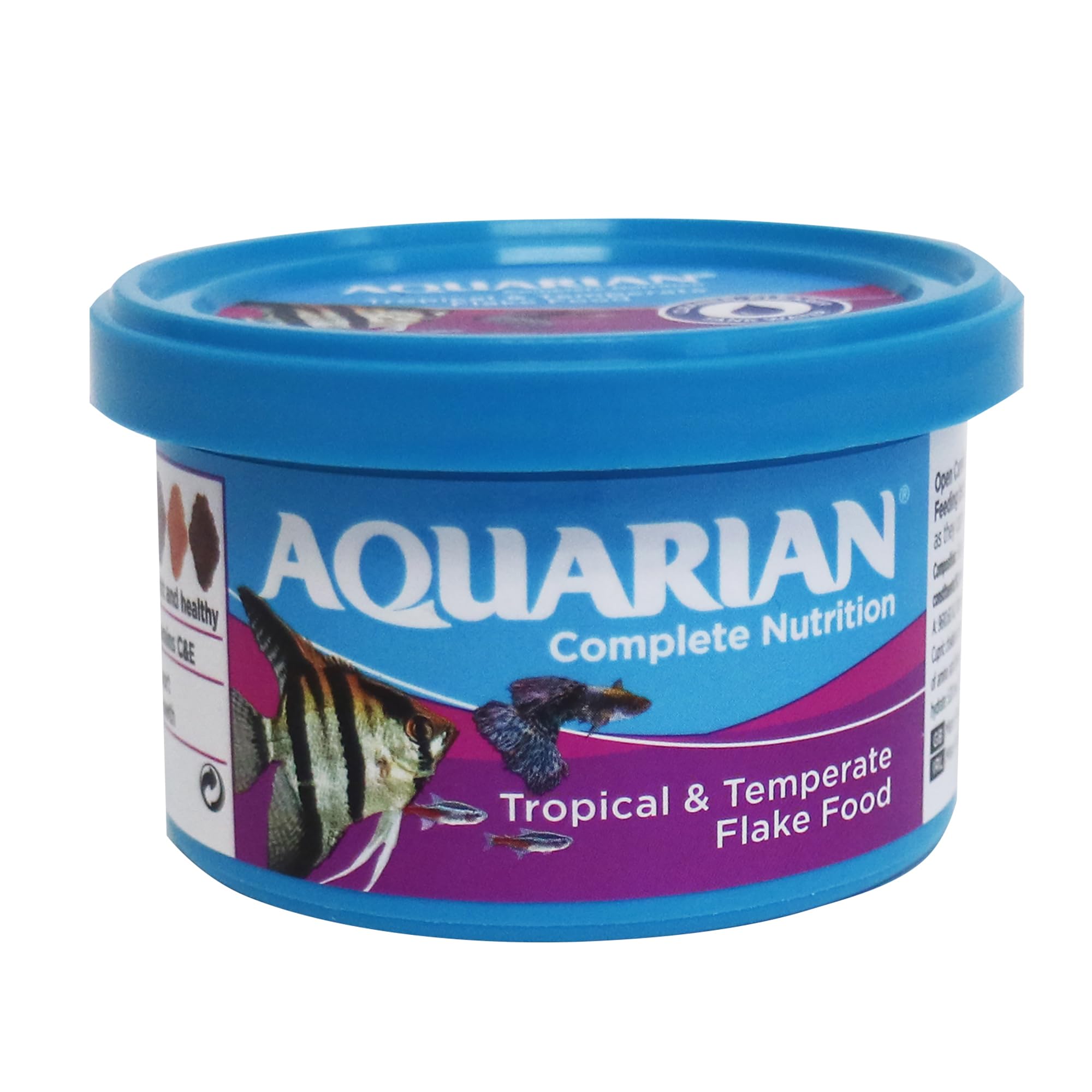
Aquarian Tropical Fish Flakes – Single Small Tank
Key Features
- Container: 50 g (1.76 oz)
- Feeding window: Within 5 minutes
- Color ingredient: Marigold meal extract
- Price: Midrange
Fifty grams is a small tub even next to the seven-ounce jars here, and for plenty of people that’s the whole appeal. A single tank, a quarantine tank, or a shelf that already holds three half-used containers doesn’t need another big commitment.
The formula is a complete flake for community tropical fish, with natural marigold meal extract doing the color work, the plant source of the pigments that bring out reds and oranges. It’s positioned as natural and non-GMO, and the feeding note is refreshingly blunt: twice a day, only what the fish clear in about five minutes.
Where it makes sense for us is the trial run. A tank you’re still working out, a species you’re learning, or a color-leaning food you want to test before buying a larger tub all suit a container this size, and because it’s a complete diet it can be the staple while you decide. Feed more than one aquarium and you’ll be back to order another before the month is out.
Pros
- Small tub suits one tank or a trial
- Complete community flake with marigold for color
- Simple twice-daily feeding guidance
Cons
- Tub disappears fast across several tanks
A small tub we reach for when a tank is new or the cupboard is already full: a complete community flake with marigold for color, sized for one tank.
GloFish Special Flake – Best for Glofish Tanks

Key Features
- Formula: For GloFish
- Container: 1.59 oz tub
- Fish size: Small to mid-size
- Feeding window: About 1 minute
- Price: Budget
A GloFish tank is a specific setup, and this flake is built for it in a way the general staples aren’t: small flakes for small to mid-size fish and a formula aimed at keeping the fluorescence bright under blue lighting. If that’s the tank in your living room, it’s the obvious match, and the label is clear that the same food can go to other small community fish.
The flake is fine and the tub is 1.59 ounces, small enough to sit behind the tank instead of in a cupboard. What we appreciate is the portion discipline the label asks for, roughly a minute’s worth per feed, which is a tighter window than most of these foods print and the right instinct for a flake this fine.
What to watch is acceptance. Fish raised on fishmeal flakes don’t always switch, and a community where one species hammers the food while another ignores it leaves flake drifting in the water. Feed small amounts at the same time each day and keep a general staple on hand for the fish that turn it down.
Pros
- Formulated for GloFish and small tropicals
- Fine flake for small to mid-size fish
- One-minute feeding window encourages restraint
Cons
- Clouds water when flake goes uneaten
- Small tub for a whole community
We only recommend this one for a dedicated GloFish tank, where the small flake and the fluorescence pitch actually line up with what you’re keeping.
How We Tested Tropical Fish Flakes
We started by reading ingredient panels and recent customer reviews, then narrowed a long list of flakes by protein content, first ingredients, flake size, and price per ounce. That left 15 flakes, from budget tubs to premium small-batch options, which we fed to our home aquariums over three months. Our tanks are community setups with tetras, rasboras, guppies, and angelfish—fish that feed at different levels, so we could see whether a flake worked for surface feeders and mid-water fish alike.
Twice a day, morning and evening, we dropped in a pinch and watched. We noted how quickly fish came to the surface, whether they took flakes on the way down or waited for them to sink, and whether they spat out a flake after the first bite or came back for more. After five minutes, we checked how much was still floating or sitting on the gravel. We crumbled each flake between our fingers to judge size and how evenly it broke apart—large, hard flakes that needed crushing got marked down. We also smelled every tub, since a fresh, shrimp-like scent tracked with ingredients fish went for, and checked water clarity 24 hours later to catch anything that clouded the tank.
To judge value, we calculated cost per feeding based on what our fish actually ate, not the tub size, and tracked how much of each container ended up as waste. The flakes that moved fastest from surface to fish—without fouling the filter—rose to the top.
How to Choose Tropical Fish Flakes
Flake food is the least expensive thing you’ll put in the tank and the easiest to buy badly, and most of the decision comes down to the mouths you’re feeding and how many tanks you keep.
Match the flake to the mouths in your tank
Flake size decides how much of the food gets eaten and how much ends up in the gravel. Neons, rasboras, guppies and fry do best with a fine flake, and a crumb-style food such as Aqueon’s means you’re not crushing every pinch against the glass while half of it turns to dust. Angelfish, barbs and adult mollies handle a broad flake and often prefer something they can tear at.
If you keep both, buy the larger flake and crush a little for the small fish. Going the other direction isn’t possible, which is why the big-flake foods are the safer default in a mixed community.
Put a staple first and the extras second
Almost everything sold as tropical flake is a complete daily diet, so what separates one from another is usually what’s been added. Shrimp is an attractant that brings fussy fish to the surface, carotenoids from marigold or algae support color, and an insect-first formula like Fluval Bug Bites changes the protein base rather than just the flavor.
Treat the color flakes as a supporting act. Pigment shows on a fish that’s already eating well and living in decent water, so fix the staple first and add the color food once the tank is settled. A color flake a fish won’t eat improves nothing.
Buy a size you’ll finish, not just the best deal
Bulk is where flake looks like a bargain and where a lot of it goes stale. An opened container loses potency over months, so a single tank is better served by a seven-ounce tub than by a bag that will still be half full next year.
Feed several tanks, run a breeding rack, or split an order with a club and the big bag flips to the sensible buy. Decant a week’s worth into an airtight jar you can shake, keep the rest sealed, and store both somewhere cool and dry.
Clear water is a feeding habit, not a label claim
Nearly every tub promises clear water and most deliver it when you feed properly. The variable is quantity: follow the window on the label, whether that’s a minute for a small tank or up to five for a big community, and stop while the fish are still chasing food rather than after they’ve lost interest.
Flake that reaches the gravel breaks down and shows up as haze. A quick siphon before the next feed deals with what the fish missed, and it’s a far better fix than switching brands.
Frequently Asked Questions
Will these flakes reach my corydoras and plecos?
Mostly no. Tropical flakes are built for top and mid-water feeders and float until they’re waterlogged, so bottom dwellers get what’s left rather than what’s fed. Soak a pinch in tank water, squeeze it so it sinks, and feed it after lights out, or give the tank a dedicated sinking wafer. Either way, the corys and plecos are better served by food that reaches the substrate on purpose.
How do I switch my fish to a new flake?
Mix rather than swap. Feed a pinch of the new flake alongside the old one at the time of day your fish are most active, and increase the share of the new food over several feedings instead of going cold turkey. If a fish still refuses it, crush the flake finer and try again; texture is often the sticking point, not flavor.
Can I feed tropical flakes to goldfish or pond fish?
No. Tropical flakes are formulated for warm-water community fish, and goldfish are cool-water animals that produce far more waste and are normally fed a goldfish-specific staple, often a sinking pellet. Keep a separate container for the pond and don’t stretch a tropical tub to cover it.
Final Verdict
Buy TetraMin Plus with Shrimp as your default. It’s the flake most fish take on the first feed, the tub is sized for a normal household rather than a fish room, and it does the everyday job without asking you to gamble on an unfamiliar ingredient.
Change the pick when the situation changes. Feeding a rack of tanks makes the bulk TetraMin bag the sensible buy; a tank of neons and fry makes Aqueon’s fine flake worth the switch; and if your fish have gone off standard fishmeal flakes, Fluval’s insect-based flake is the next thing to try.