This post contains affiliate links. We may earn a small commission when you buy through our links — at no extra cost to you.
Battery-powered air pumps are a convenient backup for power outages and fish transport, but many fail within months. Quality control varies widely across near-identical designs, making it hard to pick a reliable one. The key is focusing on battery capacity, build quality, and how the pump handles intermittent use.
This guide focuses on models that consistently deliver on their advertised runtime and stay quiet under load. Whether you need a compact unit for a 10-gallon tank or a high-flow pump for a 100-gallon aquarium, the right choice depends on matching airflow and battery life to your specific scenario. The picks here are the ones that minimize the risk of early failure.
Top Picks
Best for Emergency Backup
fishkeeper 2600mAh 80GPH

Rating: 4.6 ★ | Price: $$ | Battery & Runtime: 2600mAh, 16-58h | Airflow: 80 GPH | AC/DC Auto-Switch: Yes | Noise Level: Very quiet
The fishkeeper delivers up to 30 hours of continuous runtime on a single charge — enough to cover a full day of power loss or a long fish transport. Its 80 GPH airflow handles tanks from 5 to 125 gallons, and the automatic AC/DC switching means you can leave it plugged in as a steady aerator that kicks in when the mains go out. Build quality and quiet operation place it a step above the typical OEM designs in this price bracket.
This pump suits anyone who needs a reliable backup for a medium or large tank, or a portable unit for moving fish. The tradeoff: it’s splash-resistant only (IP64), not submersible, so keep the body dry. Some units have shown battery capacity loss after several months of frequent use — worth buying with a flexible return window in mind if you plan to rely on it daily.
Pros
- Runs 16–30 hours continuously on a single charge for overnight power outages or long trips
- Quiet enough for indoor tanks without disturbing daily life
- Solid value with few quality complaints compared to similar-priced alternatives
Cons
- Battery capacity may degrade over many months of regular use
- Not fully waterproof – splash-resistant only, so avoid submerging the pump body
If you want a backup pump that actually works when you need it — without gambling on quality control — this is the one to grab. Battery degradation is the only real caveat, and it’s manageable with occasional charging cycles.
Best for Emergency Backup
AquaMiracle 2200mAh
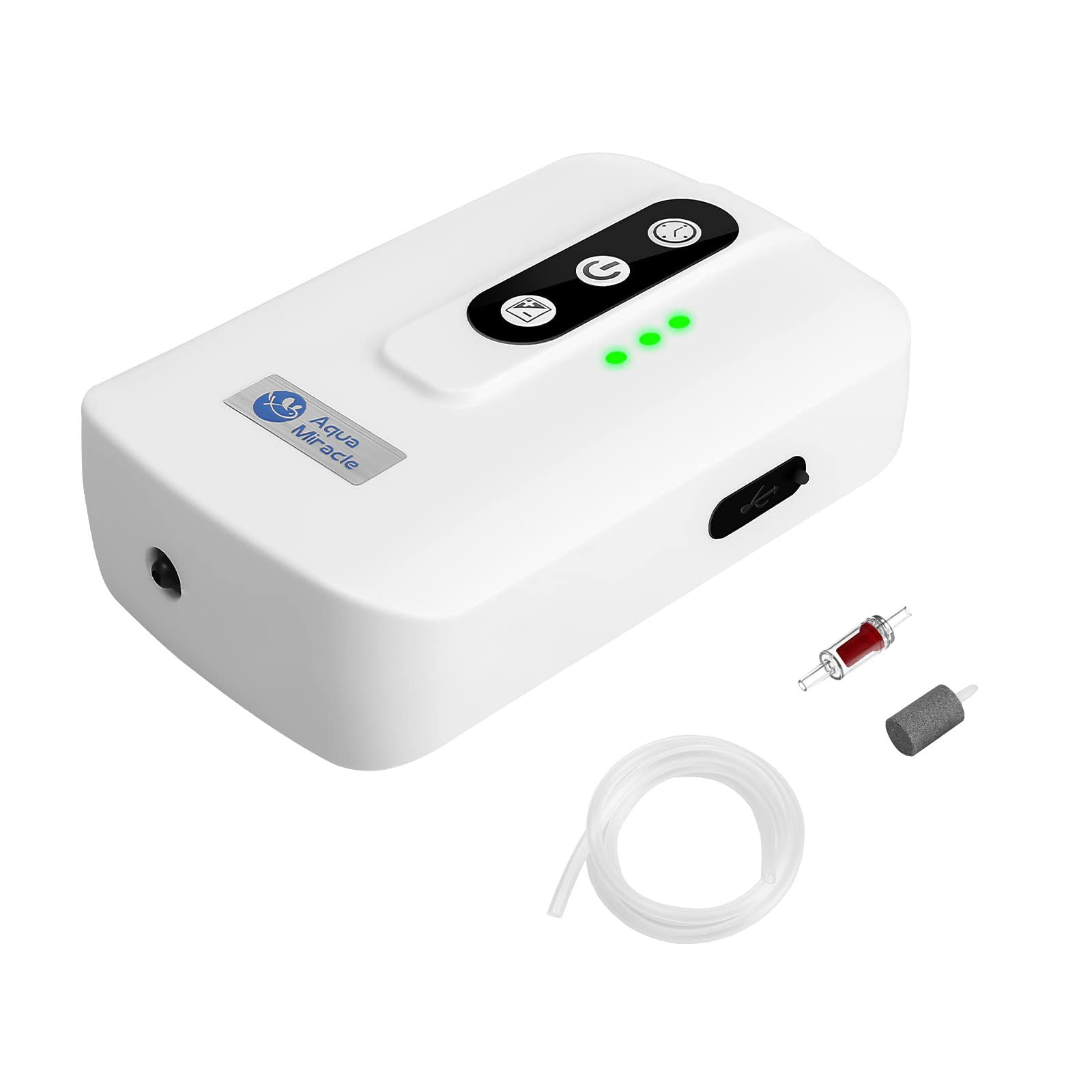
Rating: 4.4 ★ | Price: $ | Battery & Runtime: 2200mAh, 20-40h | Airflow: 11-24 GPH | AC/DC Auto-Switch: Yes | Noise Level: Quiet
The AquaMiracle delivers over 24 hours of runtime on a single charge and runs nearly silently, making it a strong budget-friendly option for emergency backup or portable bait aeration. The included accessories and USB rechargeability add convenience that pricier models often lack.
The tradeoff is quality control: some units may stop charging or lose motor function within weeks or months, so buying from a retailer with a flexible return policy is wise. This pump suits occasional emergency use or short trips where a failure is inconvenient but not catastrophic – not for daily reliance or critical tank setups.
Pros
- Battery runs over 24 hours on a single charge – enough for a full day out or overnight backup.
- Operates very quietly, barely audible in most aquarium setups.
- Budget-friendly price with USB rechargeable convenience and included accessories.
Cons
- Motor or battery failure may occur after weeks or months, making a return policy worth checking.
- Internal components can degrade over time, with some units losing battery capacity sooner than expected.
A smart pick for emergency backup or bait aeration if you’re comfortable rolling the dice on unit consistency – the runtime and quiet operation are worth the price when it works.
Best for Emergency Backup
SEAOURA Temp Monitor

Rating: 4.5 ★ | Price: $$ | Battery & Runtime: 2000mAh, 30-45h | Airflow: 60 GPH | AC/DC Auto-Switch: No | Noise Level: Quiet
The SEAOURA pump adds a temperature probe and alarm — a feature rarely seen on portable air pumps. The 2000mAh battery lasts up to 45 hours on intermittent mode, and operation stays quiet enough for a bedroom. For hobbyists with delicate tanks, the temperature monitor offers real-time peace of mind. Compared to the top pick (the fishkeeper pump), this model trades some long-term track record for added functionality. The tubing connection to the nozzles can be loose in some cases — worth checking before relying on it in an emergency.
Pros
- Built-in temperature monitor with alarm alerts you to water shifts during power outages.
- Battery runs over two days on lower settings for extended backup.
- Operates quietly enough for most rooms and overnight use.
Cons
- Tubing connection to the nozzles can be loose, allowing the tube to pop off during setup.
A solid backup for sensitive tanks, with a temperature alarm most competitors skip — just double-check the tubing fit before trusting it in an outage.
Best for Power Outage
hygger Commercial

Rating: 4.4 ★ | Price: $$$ | Battery & Runtime: 8-100h runtime | Airflow: 238-301 GPH | AC/DC Auto-Switch: No | Noise Level: Moderate
The hygger Commercial delivers the highest airflow in the category at 301 GPH, enough to run multiple sponge filters or keep a pond oxygenated through a power outage. On the low setting, battery runtime extends to days, making it a serious emergency tool for large setups.
The internal battery is built-in and non-replaceable — some units may lose charging capacity over time, so treat this as a finite-life investment for fish rooms, garages, or outdoor ponds where noise is secondary to performance.
Pros
- Highest airflow in the category — powers multiple tanks or a pond.
- Exceptional battery life on low setting — lasts through extended outages.
- Build quality feels robust and durable.
Cons
- On higher settings, the pump hum is noticeable — best for non-quiet spaces.
- Internal battery is non-replaceable and may lose capacity over time.
This is the go-to pump for heavy-duty aeration where airflow volume matters most.
Best for Emergency Backup
Devopet 1800mAh

Rating: 4.4 ★ | Price: $ | Battery & Runtime: 1800mAh, 25-35h | Airflow: 48 GPH | AC/DC Auto-Switch: No | Noise Level: Quiet
The Devopet offers a day or more of runtime from its 1800mAh battery, which is decent for a budget pump and enough for most emergency backup needs in tanks up to 60 gallons. Few early failures have been reported, giving it a leg up over some cheaper alternatives. The tradeoff is a modest battery compared to larger 4800mAh models like the compact competitor – so it’s best suited as an occasional backup or for short trips rather than all-day aeration. This pump fits budget-conscious buyers who want a rechargeable option for small or medium aquariums and don’t need maximum runtime.
Pros
- Battery lasts a day or more on a full charge.
- Few reported failures out of the box.
Cons
- Battery capacity is average – may not cover a full day of continuous use in larger tanks.
A straightforward, reliable backup pump at a low price – ideal for small tanks and occasional use, but not the longest-run option.
Best for Emergency Backup
AQQA 1.7W Single

Rating: 4.4 ★ | Price: $$ | Battery & Runtime: 2600mAh, 14-28h | Airflow: 27 GPH | AC/DC Auto-Switch: Yes | Noise Level: ≤30 dB
The AQQA pump delivers good battery life and quiet operation, with automatic switching to battery during power outages. For smaller tanks (up to 100 gallons), it works well as an emergency backup or daily-use pump. The main tradeoff: some units may stop working after a few months. This pump suits budget-conscious aquarists who need a simple backup and are comfortable with possible early replacement.
Pros
- Battery lasts through the night on intermittent mode
- Quiet operation without vibration noise
- Switches to battery seamlessly during power outages
Cons
- Included air stone may fall apart quickly
A quiet, automatic backup pump for smaller tanks – consider replacing the included air stone for better longevity.
Best for Extended Runtime
hygger 4800mAh
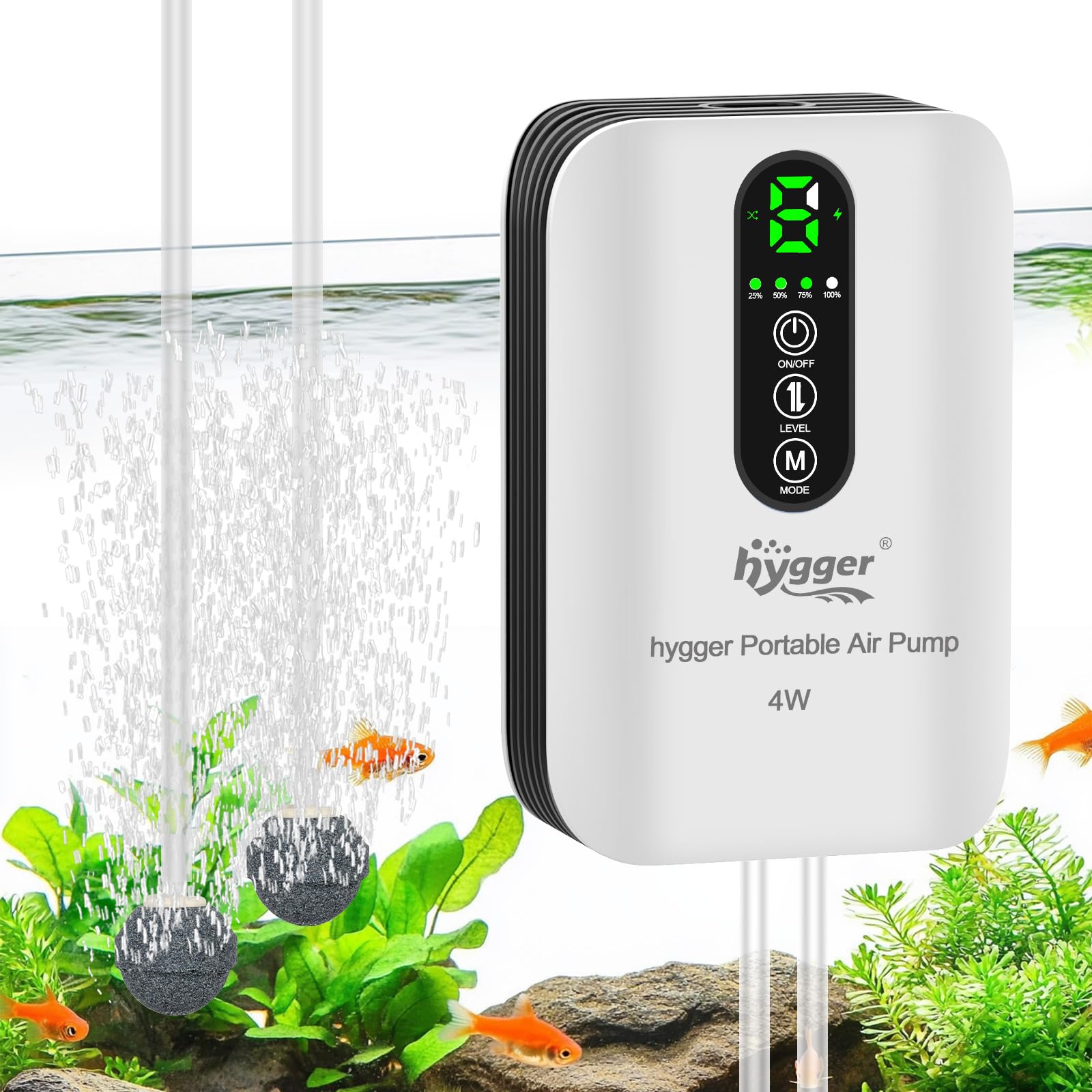
Rating: 4.5 ★ | Price: $$ | Battery & Runtime: 4800mAh, 12-79h | Airflow: 64 GPH | AC/DC Auto-Switch: Yes | Noise Level: <35 dB
The hygger packs a 4800mAh battery that can run a sponge filter for multiple days on intermittent mode, and its automatic switching between AC and DC means the pump recharges itself when the power comes back. In very quiet rooms, the higher airflow settings produce noticeable hum – less of an issue in a garage or basement setup. This is a capable backup for medium tanks, but the noise tradeoff and the fact that it’s a newer model mean it suits buyers comfortable testing unproven hardware.
Pros
- Battery lasts multiple days on intermittent mode, covering extended power outages.
- Automatically switches between AC and DC and recharges when power returns.
Cons
- In quiet rooms, higher airflow settings produce noticeable hum – less of an issue in basements or garages.
A strong runtime option for medium tanks if you can accept the noise on higher settings and are willing to test a relatively new pump.
Best for Fishing Trips
Skywin 32H
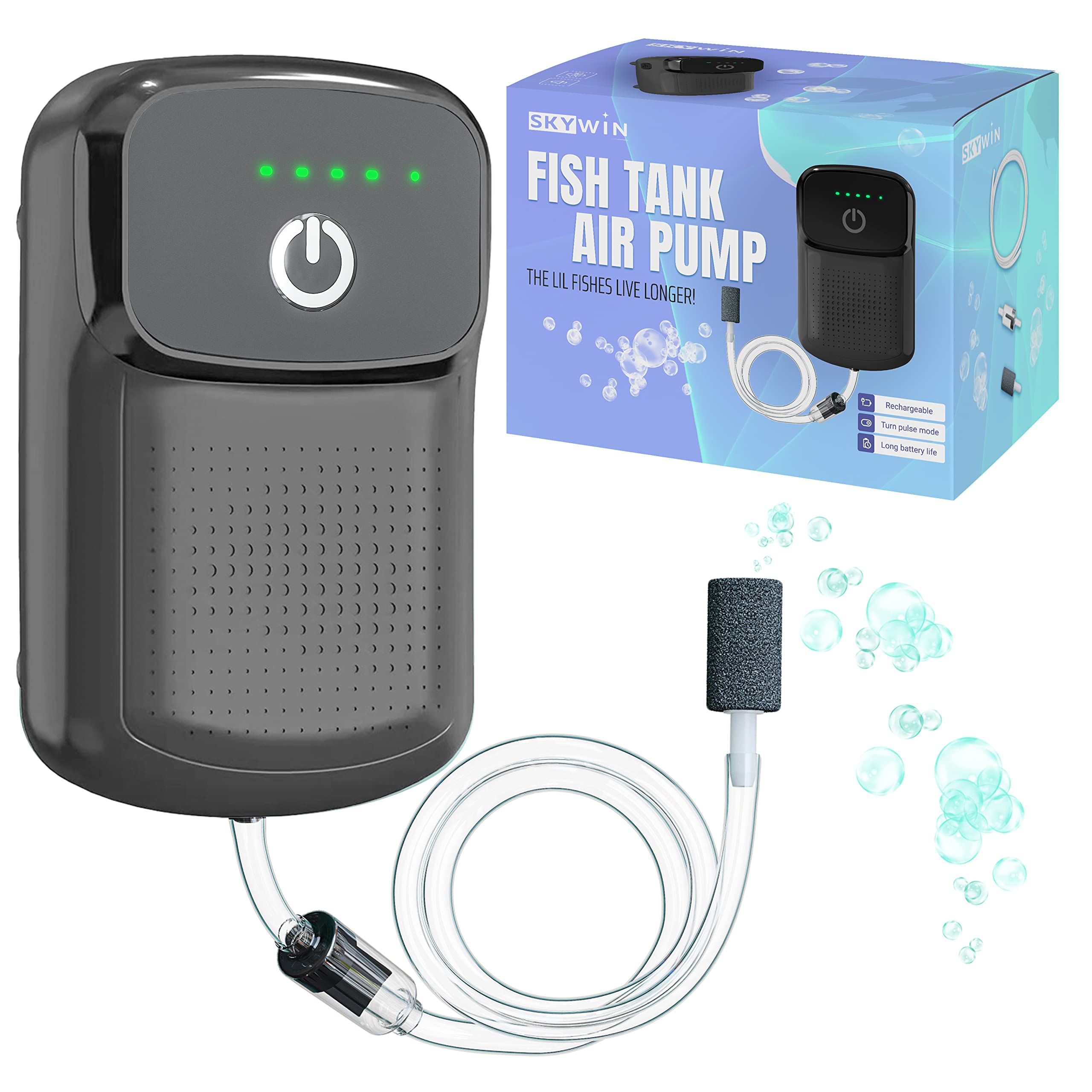
Rating: 4.3 ★ | Price: $$ | Battery & Runtime: 2200mAh, 18-32h | Airflow: 22 GPH | AC/DC Auto-Switch: No | Noise Level: Quiet
This pump keeps bait alive for days in a cooler with very quiet operation and decent battery life for the price. However, durability is limited: some units may develop charging or motor issues after a few uses. It works well for occasional fishing outings where you can swap it out easily, but for daily aquarium emergency backup or permanent installation, the top pick in this category has a much lower failure rate.
Pros
- Keeps bait alive for days in coolers and buckets
- Quiet enough not to disturb sleep or conversation
Cons
- Some units may have charging or motor issues after limited use
A cost-effective pick for short fishing trips where you can accept the possibility of an early replacement, but not for anyone needing a consistent long-term aerator.
Best for Bait Aeration
Pawfly Lithium 25GPH
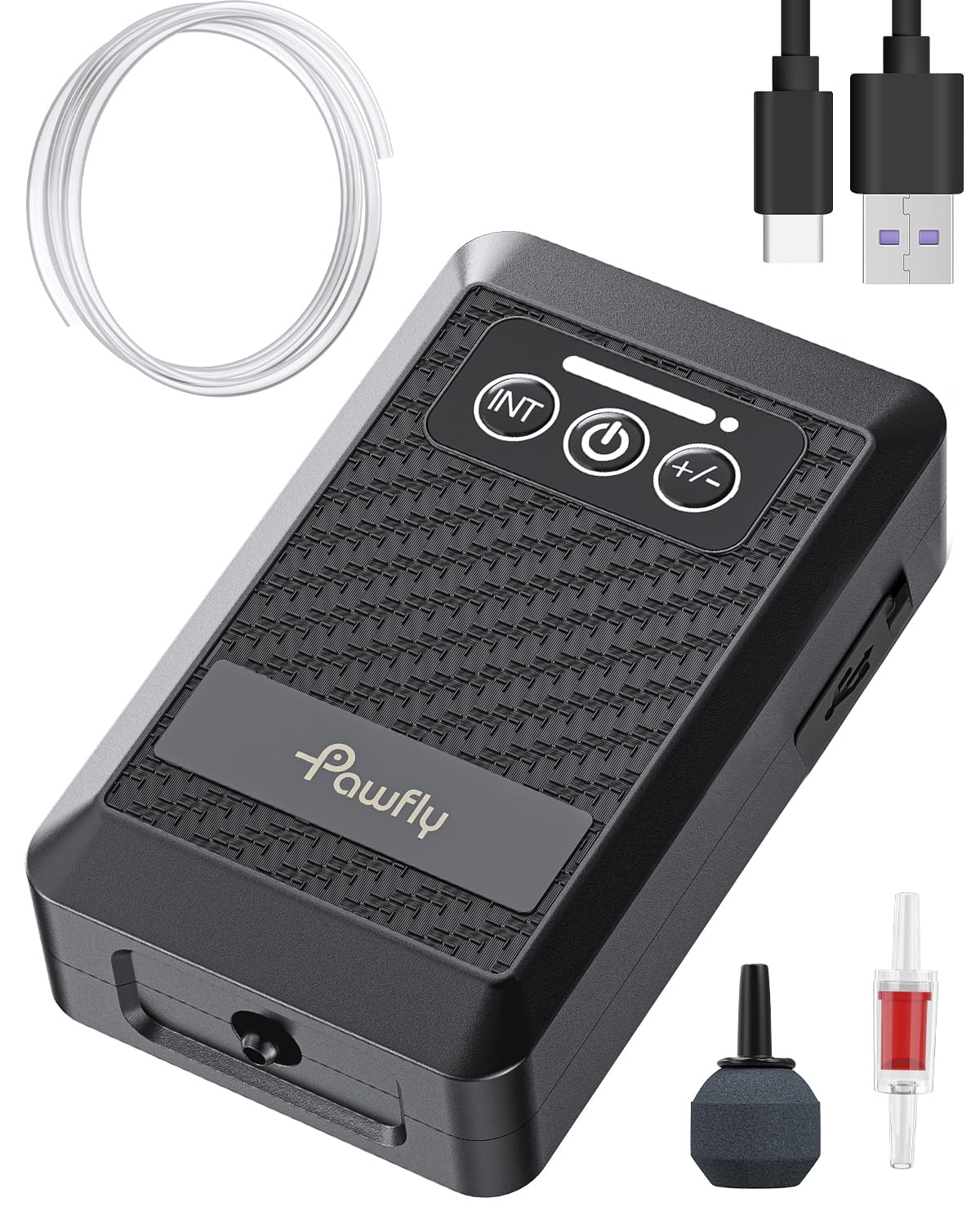
Rating: 4.4 ★ | Price: $ | Battery & Runtime: 2200mAh, 24-36h | Airflow: 25 GPH | AC/DC Auto-Switch: Yes | Noise Level: Quiet
This compact lithium pump runs over 24 hours on a charge and stays quiet, making it a good companion for fishing trips where bait aeration is needed. However, its airflow is too weak for tanks larger than 20 gallons, limiting it to small setups or bait buckets.
Pros
- Runs over 24 hours on a single charge, enough for day-long fishing trips.
- Operates quietly, barely audible during use.
Cons
- Water exposure can damage the unit despite splash-resistant claims – best kept completely dry.
Best for anglers who need portable aeration for bait buckets and can keep it dry – not for aquarium backup where splashes are likely.
Best for Emergency Backup
Pawfly D-Cell 40GPH

Rating: 4.5 ★ | Price: $ | Battery & Runtime: 2 D-cell, ~18h | Airflow: 40 GPH | AC/DC Auto-Switch: No | Noise Level: Up to 45 dB
At the lowest price in this category, the Pawfly runs on two D batteries with no charging required, delivering enough airflow for emergency aeration in tanks up to 30 gallons. Build feels sturdy enough for occasional use, and the integrated clip makes it easy to strap onto a bucket or cooler. Where it falls short is noise level—the unit can be loud enough to notice in a quiet room—and the switch and battery contacts may lose reliable connection after a handful of uses. That tradeoff makes sense for short fishing trips or as a disposable backup pump, but not for daily aquarium use or quiet indoor environments.
Pros
- Delivers reliable airflow for emergency aeration in a 5-30 gallon tank.
- Lightweight with an integrated clip for easy transport.
Cons
- Noise may be noticeable in quiet indoor spaces.
- Switch and battery contacts can lose connection after a few uses.
Works well for short fishing trips or as a cheap emergency pump where noise isn’t a dealbreaker and you don’t mind occasional replacement.
Best for Short-Term Use
MoonOrange 4800mAh

Rating: 4.4 ★ | Price: $$ | Battery & Runtime: 4800mAh, up to 70h | Airflow: 2×48 GPH | AC/DC Auto-Switch: No | Noise Level: ≥40 dB
This pump delivers a large 4800mAh battery and dual outlets for aerating multiple tanks or transport buckets at a relatively low cost. It runs quietly on the lowest setting, which is helpful for sensitive fish. However, some units may develop charging or motor issues after a few months, and the included tubing and check valves are restrictive—plan to swap those with standard parts from the start.
Pros
- Large 4800mAh battery powers dual outlets for extended runtime on trips or multi-tank setups.
- Quiet on the lowest flow setting, suitable for sensitive fish or quiet rooms.
Cons
- Some units may experience charging or motor issues within months; included tubing restricts airflow.
Worth considering for short-term trips or temporary setups where battery capacity is the priority and you’re prepared to replace the included accessories.
Makerele Mini
MAKERELE Mini
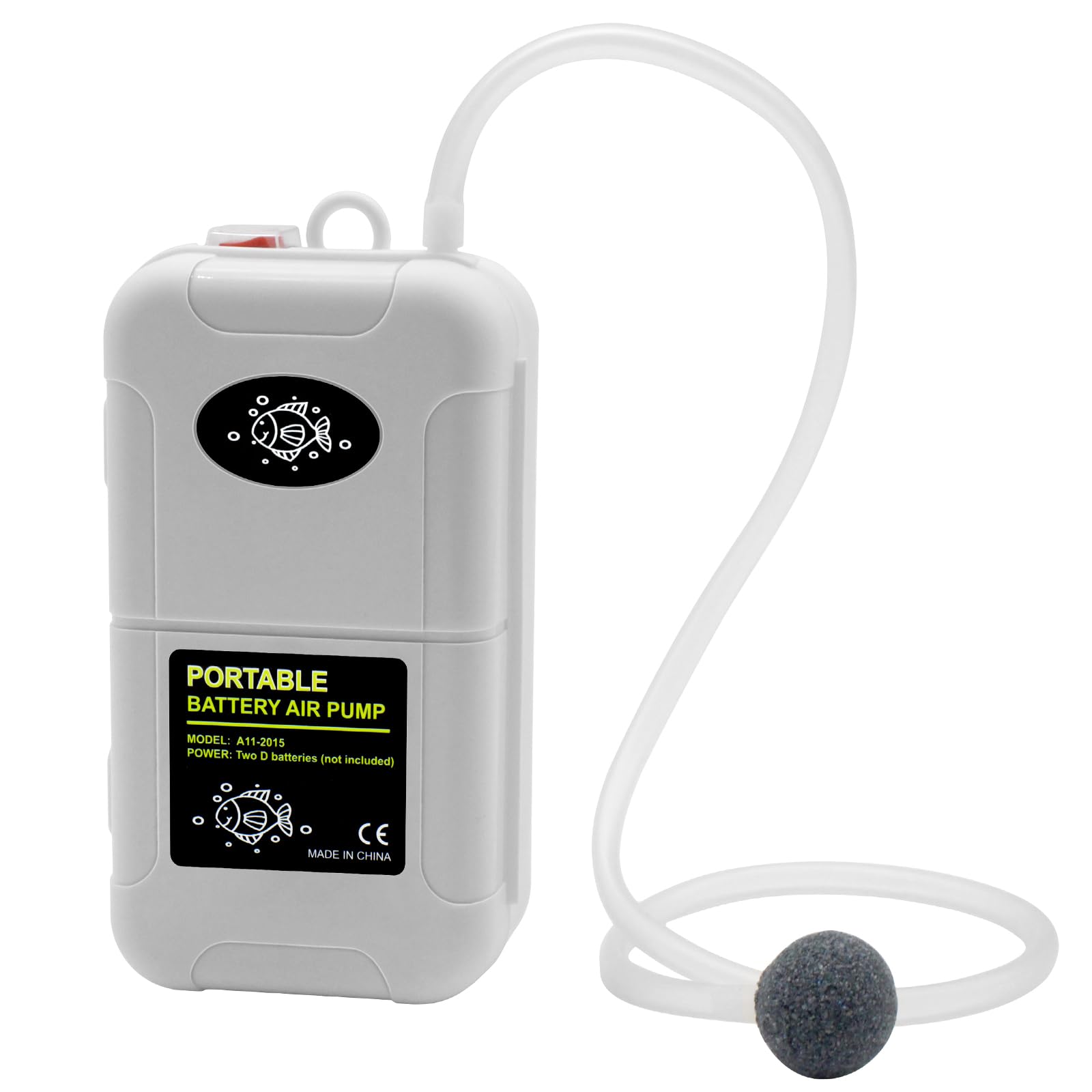
This compact pump includes a bracket, waterproof switch, air stone, and tubing — convenient for setting up in small tanks or bait buckets. However, its airflow is limited to tanks up to 6 gallons, making it unsuitable for standard aquariums. It fits best in desktop betta bowls or for aerating minnows during ice fishing trips, not as a general-purpose backup pump.
Pros
- Comes with mounting bracket and all accessories (tubing, air stone, switch).
- Good for very small tanks and keeping bait alive in buckets.
Cons
- Only works reliably for tanks up to 6 gallons — not useful for larger setups.
Best for owners of tiny tanks or ice fishing setups who need a compact pump with mounting hardware, not for standard aquarium use.
How to Choose
The most common mistake is buying based on price alone, ignoring that battery degradation and airflow mismatch cause early failure.
Battery Capacity & Runtime
Battery capacity (mAh) determines how long the pump can run before needing a recharge. Higher mAh numbers (e.g., 4800mAh) can last days on intermittent mode, but real-world runtime depends on the airflow setting and pump efficiency. Most pumps lose capacity after hundreds of charge cycles, so expect a gradual drop over a year of regular use.
If you need the pump only for occasional power outages, a 2200–2600mAh unit is sufficient. For frequent transport or extended outages, look for 4800mAh or a model that runs on D-cells for longer shelf life without charging.
Airflow Rate
Airflow (measured in GPH or L/min) must match your tank size. A 10-gallon tank needs only about 20 GPH, while a 100-gallon requires 80+ GPH for adequate oxygenation. Running a low-flow pump on a large tank starves fish of oxygen during an outage.
High-flow pumps (like the 300 GPH hygger) can drive multiple sponge filters or air stones, but they are louder and consume more battery. Match the pump output to your specific setup and how many outputs you plan to use.
AC/DC Auto-Switch
An automatic AC/DC switch lets the pump run on wall power normally and instantly switch to battery during a blackout. This is critical for emergency backup because you don’t have to manually plug in or turn on the pump when the power dies.
Pumps without this feature can still be used as manual backups, but you must remember to activate them during an outage. Some models also recharge the internal battery when plugged in, so the pump stays topped off and ready.
Noise Level
Noise is a trade-off: high-output pumps generate more vibration and hum. For indoor tanks in bedrooms or living rooms, look for pumps rated under 35 dB. D-cell pumps often get louder over time as components wear.
If noise is a top concern, rechargeable lithium pumps with rubber feet and brushless motors (like the fishkeeper or AQQA) tend to be the quietest. Check recent reviews to confirm actual noise levels, as some claimed dB ratings are inaccurate.
FAQ
How long do rechargeable aquarium air pumps last on a single charge?
It varies by battery capacity and setting. A 2200mAh pump typically runs 20–40 hours continuously, while a 4800mAh model can last 70+ hours on intermittent mode. Higher flow settings drain the battery faster, so check the manufacturer’s runtime estimates but subtract 20–30% for real-world use.
Can I leave a battery aquarium air pump plugged in all the time?
Yes, if the pump has an automatic AC/DC switch and a built-in charger. Many rechargeable pumps are designed to stay plugged in, running on wall power and recharging the battery. This keeps the battery topped off for emergencies. Avoid leaving cheap pumps plugged in permanently, as they may overcharge and degrade the battery faster.
Why does my battery air pump stop working after a few months?
The most common cause is battery degradation or a failed motor. Lithium batteries lose capacity after repeated charge cycles, and some pumps use low-quality cells that die early. Another culprit is water damage – even a small splash can corrode the charging port or internal electronics. Storing the pump in a dry place and unplugging it when not in use can extend its life.
What is the quietest battery powered air pump for aquarium?
Based on user feedback, the fishkeeper and AQQA single-outlet models are consistently described as very quiet, with noise ratings around or below 30 dB. The SEAOURA also runs quietly. If absolute silence is needed, look for pumps with low dB claims and positive reviews mentioning ‘barely audible’ operation; avoid D-cell models, which tend to get louder over time.