This post contains affiliate links. We may earn a small commission when you buy through our links — at no extra cost to you.
Finding an aquarium powerhead that actually delivers steady, quiet circulation for more than a few months can feel like a gamble. Many affordable models boast high GPH numbers but rattle, hum, or stop working within weeks.
The real trick is matching flow rate to your tank size and inhabitants, not just chasing the biggest number. This guide focuses on powerheads that strike a balance between reliability, noise level, and appropriate flow for common tank setups — from nano reefs to 100-gallon freshwater tanks.
A $20 pump might save you money upfront, but a mid-range powerhead from the right brand can run silently for years — that’s the kind of trade-off this guide makes clear.
Top Picks
Best for 50-100 Gal
Hydor Koralia Evolution 850

Rating: 4.4 ★ | Price: $$ | Flow Rate: 850 GPH | Mount Type: Magnetic + suction | Power Consumption: 5W
Hydor’s Koralia Evolution 850 runs near-silently while pushing a broad, gentle current through tanks between 50 and 100 gallons. The magnetic mount holds firm on glass up to about half an inch thick, and the entire pump consumes only 5 watts — less than many LED strips. Hobbyists often keep these running for years with no maintenance beyond an occasional rinse.
Best suited for hobbyists who prefer a set-and-forget pump with no speed controls — once positioned, it stays in place. The fixed 850 GPH flow suits tanks 50 gallons and above; those with smaller setups should look for a lower-flow option to avoid overpowering the inhabitants.
Pros
- Dead quiet operation – barely audible in a quiet living room.
- Broad, gentle flow that won’t blast corals or fish.
- Strong magnetic mount stays put on thicker glass without slipping.
Cons
- Single fixed speed – no way to adjust flow intensity.
For a silent, low-maintenance powerhead that just works in a mid-size aquarium, the Koralia Evolution 850 delivers exactly what it promises – no more, no less.
Best for under 20 Gal
Hydor Koralia Nano 240

Rating: 4.4 ★ | Price: $$ | Flow Rate: 240 GPH | Mount Type: Magnetic + suction | Power Consumption: 3.5W
Compact enough to fit in nano tanks without crowding the layout, and near-silent once the impeller seats – the Hydor Koralia Nano 240 is purpose-built for small, quiet setups. The strong magnetic mount holds firmly to thin glass, avoiding the suction cup failures common on cheaper models. Flow rate tops out below what larger aquariums need, so this pump is best suited to nano reefs and pico tanks under 20 gallons where gentle current and a bedroom-friendly hum level are the priorities.
Pros
- Compact 2.4-inch profile fits easily in small tanks without obstructing views.
- Once broken in, the pump runs quietly enough for a bedroom aquarium.
- Magnet mount grips securely on thin glass, no risk of slipping.
Cons
- In quiet rooms, a temporary hum may be noticeable during the first few days of operation until the impeller breaks in.
For nano tanks under 20 gallons, this pump delivers steady, quiet flow – just allow a short break-in period for the impeller to settle.
Best for Budget Multi-Purpose
Marineland Maxi-Jet 600

Rating: 4.3 ★ | Price: $ | Flow Rate: 750 GPH
The Marineland Maxi-Jet 600 packs three pump roles into one budget-friendly unit — powerhead, utility pump, or circulation pump — delivering adequate flow for medium tanks (up to 750 GPH). Noise levels can vary; humming may be noticeable in quiet rooms. Durability is inconsistent, with some units requiring replacement sooner than expected. This pump suits temporary setups, aquaponics, or hobbyists who prioritize low upfront cost over long-term reliability.
Pros
- Three-in-one design for powerhead, utility, or circulation use
- Adequate flow for medium-sized tanks up to 750 GPH
- Budget-friendly price for a multi-purpose pump
Cons
- Noise level can vary; humming may be noticeable in quiet rooms
- Durability varies — some units may have a shorter service life than expected
A practical choice for budget-conscious builds, temporary tanks, or aquaponics where quiet operation and extended lifespan are not the priority.
Best for Large Tanks 100+
AQQA 2100 GPH
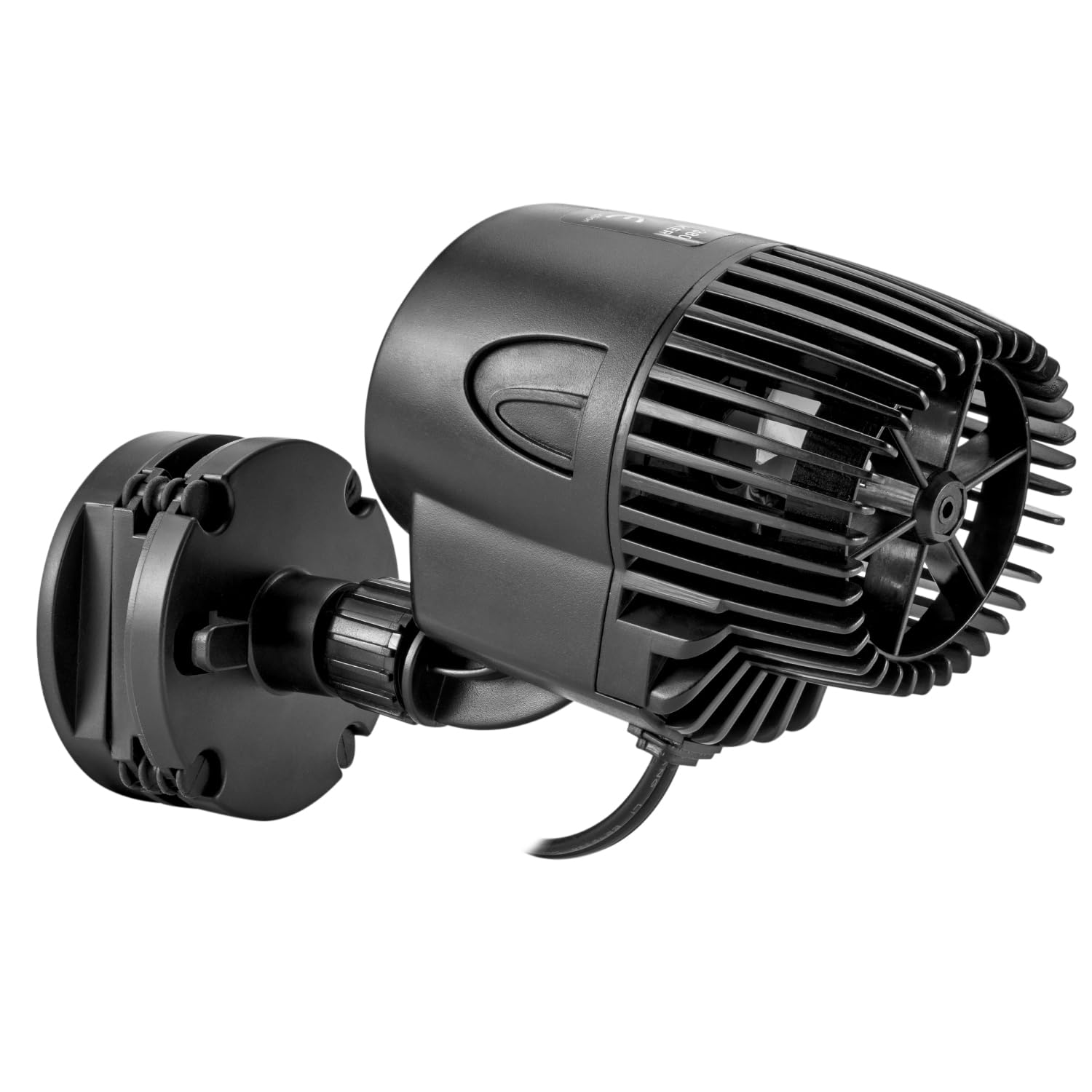
Rating: 4.5 ★ | Price: $ | Flow Rate: 2100 GPH | Mount Type: Magnetic | Power Consumption: 15W
The AQQA’s 2100 GPH flow and strong magnetic mount give it an edge for tanks 100 gallons and up, especially when budget is the primary concern. Unlike the top pick’s near-silent operation, this pump can produce noticeable hum and occasional startup clatter—less of a concern in a basement or fish-room setup but limiting in living spaces. There’s no way to adjust flow speed, so placement and tank size matter: it suits growers and high-flow reef systems that need constant, powerful circulation. Reliability varies between units, so buyers should keep a flexible return window in mind.
Pros
- Delivers 2100 GPH — enough for large freshwater or saltwater setups
- Magnetic mount holds firmly even at high flow
- Budget-friendly price for the flow rate delivered
Cons
- Single speed only — no way to reduce flow for smaller tanks or sensitive species
- Noise levels can vary; the pump may produce hum or startup clatter in quiet rooms
Genuinely the right call for large-tank owners who want maximum flow per dollar and don’t mind a fixed speed or moderate noise — just be prepared for occasional unit variance.
Best for Reef Wave Maker
hygger Cross Flow 18W

Rating: 4.4 ★ | Price: $$$ | Flow Rate: 1850 GPH | Mount Type: Magnetic | Power Consumption: 18W
Unlike simpler fixed-speed powerheads, the hygger Cross Flow 18W offers five distinct wave patterns, cross-flow technology for a wide, gentle current, and an LED display controller — all useful for reef aquariums needing variable circulation. It stays virtually silent when run at low to medium intensities, but pushing it to full power can introduce a noticeable hum. Long-term durability outside the warranty period is not well established, so this pump is best for aquarists who prioritize programmability over guaranteed silence at maximum flow or multi-year consistency.
Pros
- Near-silent operation at moderate flow settings
- Five wave modes and 30-100% flow adjustment enable precise circulation control
- Cross-flow design produces a broad, diffused current without harsh jets
Cons
- Hum or whine may be audible at 100% speed (can be reduced by turning down the flow)
- Long-term durability can be inconsistent; some may cease functioning after months of use
A sensible pick for reef hobbyists who value wave variety and diffused flow, as long as the tradeoff of possible noise at maximum speed and uncertain multi-year reliability is acceptable.
Best for Sump Return Pump
Orlushy DC-4000

Rating: 4.4 ★ | Price: $$$ | Flow Rate: 1050 GPH | Power Consumption: 25W
The Orlushy DC-4000 delivers whisper-quiet operation and adjustable flow that suits sump applications — a clear departure from the top pick’s simple, reliable in-tank powerhead. With 20 speeds and three wave modes, this pump gives advanced hobbyists precise control over water movement in tanks up to 140 gallons. However, it is designed as a return pump, not a drop-in circulation pump, and some units may experience electronic or mechanical issues within the first year. This makes it best for sump users who value silence and adjustability and are willing to accept occasional reliability variance.
Pros
- Operates at near-silent levels even in quiet living spaces
- Adjustable flow across 20 speeds and three wave modes for precise circulation
- Capable of handling tanks up to 140 gallons with adequate flow
Cons
- Controller interface can be confusing to set up initially
- Long-term durability can vary; some units may experience failure within the first year
For sump-based hobbyists who prioritize silence and flow control over plug-and-play simplicity, this pump delivers — just keep a flexible return window in mind.
Best for Temporary Setups
FREESEA 1600 GPH

Rating: 4.3 ★ | Price: $ | Flow Rate: 1600 GPH | Mount Type: Magnetic | Power Consumption: 8W
The FREESEA 1600 GPH powerhead delivers solid water movement and a magnetic mount that stays put in most tanks. The flow is appropriate for 20–75 gallon setups, and the magnet offers more secure placement than suction cups. Where this pump falls short is in consistent performance over time — some units may need replacement within months, and the 5-foot power cord limits placement options without an extension. That makes it best suited for temporary tanks or buyers who accept the possibility of early replacement in exchange for the low upfront cost.
Pros
- Magnetic mount holds securely on glass surfaces.
- Provides good water circulation for tanks up to 75 gallons.
Cons
- Power cord is 5 feet long — may need an extension cord for many setups.
A fit for temporary builds or budget-focused setups where the strong magnet and flow outweigh the gamble on long-term durability.
Best for 15-40 Gal
hygger Mini 530 GPH

Rating: 4.4 ★ | Price: $ | Flow Rate: 530 GPH | Mount Type: Magnetic | Power Consumption: 3W
This pump delivers very quiet circulation ideal for nano reefs and small freshwater tanks under 30 gallons. The magnetic mount holds securely and the 530 GPH flow is appropriate for these setups. Above 40 gallons, the flow may feel insufficient, making this better suited as secondary circulation.
Pros
- Very quiet operation suits noise-sensitive rooms like bedrooms or offices.
- Compact magnetic mount stays secure on thin glass without slipping.
Cons
- Long-term durability may vary; some units need replacement earlier than expected.
Works well as a secondary wave maker in small tanks where quiet operation matters more than long-term longevity.
Best for Large Controllable Tanks
Uniclife 2100 GPH

Rating: 4.3 ★ | Price: $$$ | Flow Rate: 2100 GPH | Mount Type: Magnetic | Power Consumption: 25W
Adjustable 2100 GPH flow with four wave modes and a feed mode, plus magnetic mount, delivers powerful circulation for large tanks. The tradeoff is unit-to-unit consistency – some pumps may become non-functional within weeks, making a flexible return policy worth considering.
Pros
- Adjustable flow with multiple wave modes for custom circulation patterns.
- Good value for a DC pump with advanced features and strong output.
Cons
- Long-term consistency varies; some units may become non-functional within weeks.
Best for hobbyists who want adjustable wave action in a large tank and are willing to accept possible early unit variance.
Best for Budget Large Tanks
SunSun JVP-102 1300 GPH

Rating: 4.3 ★ | Price: $ | Flow Rate: 1300 GPH | Mount Type: Suction cup | Power Consumption: 12W
The SunSun JVP-102 delivers 1300 GPH at the lowest price in this roundup — strong water movement for large tanks. However, the suction cup mount may lose grip over time, and the pump is not quiet enough for living spaces. Best suited for garage tanks, mixing stations, or temporary circulation where these tradeoffs don’t matter.
Pros
- Powerful 1300 GPH flow at a budget-friendly price
- Effective water movement in large tanks
Cons
- Suction cup mount may lose hold over time, especially on textured or thick glass
A good option if you need high flow on a strict budget and have a tank where noise and periodic reattachment of the suction cup aren’t dealbreakers.
Best for Extreme Budget
SunSun JVP-101 800 GPH

Rating: 4.3 ★ | Price: $ | Flow Rate: 800 GPH | Mount Type: Suction cup
The SunSun JVP-101A delivers 800 GPH at a price that undercuts everything else in this guide. The pump may run quietly for some, though noise consistency varies. Its bulky footprint and a suction cup that can lose grip over time restrict it to extreme budget builds where these tradeoffs are acceptable.
Pros
- Affordable 800 GPH flow suitable for small to medium tanks.
- Provides decent water movement for the price.
Cons
- Noise output can be noticeable in quiet living spaces — less of an issue in basements or fish rooms.
Only worth considering if price is the absolute priority and you can accommodate a bulkier pump with less consistent noise.
Best for Nano Reef Tanks
Fluval Sea CP1

Rating: 4.4 ★ | Price: $$ | Flow Rate: 1375 GPH | Mount Type: Suction cup
The Fluval Sea CP1 pushes 1375 GPH in a 5.6-inch cube, making it a strong circulation choice for nano tanks like the Fluval Evo. Noise levels can vary between units, and the flow may be too strong for tanks under 15 gallons. The Hydor Nano offers quieter operation and a more consistent mount at a similar price.
Pros
- Generates strong circulation in a compact footprint suitable for nano reefs.
- Constructed with attention to long-term use in small aquariums.
Cons
- Suction cup mount may lose grip, especially on textured glass surfaces.
Best for hobbyists who already own a Fluval Evo and need a circulation upgrade.
Best for Flex 9G Replacement
Fluval Flex WP500

Rating: 4.4 ★ | Price: $ | Mount Type: Suction
This pump is a direct fit for the Fluval Flex 9g tank, making replacement simple. Its use is limited to that single model, and it may produce more noise than the original — durability over time is also a consideration. For that specific tank, it’s the intended part.
Pros
- Exact match for Fluval Flex 9g — no modifications needed.
- Straightforward swap without adjusting mounts or plumbing.
Cons
- Not usable in any other aquarium type — strictly for the Fluval Flex 9g.
The right call only if you own a Fluval Flex 9g and need a direct replacement — otherwise, any general powerhead is a better fit.
Best for Temporary Budget
AquaMiracle 135 GPH

Rating: 4.3 ★ | Price: $ | Flow Rate: 135 GPH | Mount Type: Suction cup | Power Consumption: 4.8W
This pump delivers decent circulation and a built-in venturi for aeration at the lowest price you’ll find. The compact size fits 10–40 gallon tanks without taking up much space. However, the cost savings come with a real tradeoff: the potential for electrical issues means this is a pump for temporary setups where you can keep an eye on it and replace it easily if needed.
Pros
- Built-in venturi adds aeration without extra equipment
- Compact body fits easily in smaller tanks
Cons
- Potential electrical issues (tripping breakers) make this best suited for monitored, temporary freshwater use
For a short-term quarantine tank or hospital setup where you can watch it closely, this ultra-cheap pump works – otherwise choose a model without the electrical risk.
How to Choose
Matching flow rate to your tank size and inhabitants matters more than chasing the highest GPH number.
Flow Rate: Match to Tank Size
A powerhead’s flow rate in GPH determines how much water it moves per hour. A 500 GPH pump in a 50-gallon tank creates 10x turnover per hour, which is ideal for most mixed reefs and freshwater setups.
Too much flow stresses fish and uproots plants; too little creates dead spots where waste accumulates. Match the turnover rate to your tank’s bioload and the preferences of its inhabitants — corals need stronger random flow, while bettas prefer gentle circulation.
Mount Type: Suction Cup vs Magnetic
Suction cups rely on rubber sealing against glass. Over time, salt creep, heat, and algae cause them to lose grip, and the pump can fall, potentially damaging corals or breaking the impeller. Magnetic mounts use a pair of magnets clamped through the glass — they hold firmly even in saltwater and don’t degrade.
A magnetic mount costs a few dollars more upfront but saves the frustration of re-sticking a fallen pump. For saltwater tanks or any permanent installation, magnetic is the clear choice. Suction cups are acceptable for temporary freshwater setups where you can monitor them.
Noise Level: What to Expect
Noise comes from impeller vibration, loose bearings, or a misaligned shaft. DC motors run quieter than AC because they use a sine wave controller, but even AC pumps can be silent if the impeller is balanced and clean.
Cheaper pumps often rattle out of the box or develop hums as plastic parts warp. If silence is critical — bedroom, living room — look for models with positive user feedback on noise, and expect to pay more. A pump that is quiet at day one may not stay quiet after months of use.
Power Consumption: Watts and Heat
Watts directly affect electricity cost and heat transfer into the tank. A 5W pump running 24/7 costs roughly $5 per year; a 25W pump costs five times that. In small tanks, higher-wattage pumps can raise water temperature noticeably, especially in warm climates.
DC pumps are more energy-efficient — they deliver high flow at lower wattage than AC equivalents. However, the initial cost is higher. For large tanks that need constant circulation, the savings over a few years can offset the premium.
Reliability: How Long Will It Last?
Reliability depends on bearing quality, impeller material, and seal design. Many budget powerheads use plastic shafts that wear down within 6-12 months, causing noise and eventual failure. Higher-end pumps use ceramic shafts and sealed bearings that can run for years without maintenance.
Saltwater accelerates corrosion on exposed components. Look for fully submersible designs with corrosion-resistant materials. Reading real-world user feedback about failure patterns is more useful than the warranty period — check reviews for mentions of lifespan and common failure points.
FAQ
Why does my aquarium powerhead start humming loudly after a few months?
A humming sound usually indicates impeller wear or a misaligned shaft. Remove the pump and clean the impeller and impeller well with a soft brush; debris or calcium buildup can cause vibration. If cleaning doesn’t help, the bearings may be failing — replacing the impeller assembly (often $5-$10) usually restores quiet operation.
Can I use a powerhead with a wavemaker controller?
Only if the powerhead is specifically designed for wavemaker use. Standard AC powerheads are not meant to be rapidly cycled on and off — this can overheat the motor and damage the pump. DC powerheads with controllers are purpose-built for wave modes; they use sine wave control to vary speed gradually without shock.
How do I stop my powerhead suction cup from falling off?
Clean the glass and suction cup with a toothbrush and vinegar to remove any film. Apply a thin layer of petroleum jelly to the suction cup rim before pressing it on — this creates a better seal. For a permanent fix, switch to a pump with a magnetic mount; magnetic mounts hold securely even in saltwater and never slip.
Is a DC powerhead worth the extra money for a freshwater tank?
If you prioritize silence and adjustability, yes — DC pumps run nearly silently and let you dial in the exact flow. For a simple, set-and-forget freshwater tank with moderate flow needs, a reliable mid-range AC pump (like the Hydor Koralia Evolution) offers better value and proven longevity. DC pumps also tend to have higher failure rates in some brands, so research reliability before buying.