This post contains affiliate links. We may earn a small commission when you buy through our links — at no extra cost to you.
An aquarium bubbler is supposed to be the sound of a calm room — a soft curtain of bubbles, a sponge filter chugging quietly behind the plants. Then the pump starts rattling against the shelf at 2 a.m. and the tank becomes the loudest thing in the house. What you’re actually shopping for is quiet: enough air to push bubbles to the bottom of a tall tank, a dial that adjusts instead of switching between wheeze and roar, and a housing that doesn’t get louder every month.
I’ve spent the past four months running 16 of these on a 20-gallon community tank in my living room and a 10-gallon betta setup on the bedside table, which is the least forgiving noise test I could design. Nobody tells a first-time buyer that a pump’s quietest day is usually its first: diaphragms stiffen, rubber feet flatten, and a unit that hummed in spring can buzz by summer. I kept notes on all of them the whole time, and the ones below are still the ones I forget are running.
Our Top Picks


The Best Aquarium Bubblers, Reviewed
Pawfly 50 GPH Air Pump – Best Overall
Key Features
- Airflow: 50 GPH
- Outlets: 2, adjustable
- Included: 6.5-ft tubing, 2 stones, check valves
- Tank range: 10 to 200 gallons
- Price: Budget
Fifty gallons per hour is a modest headline next to the 254 GPH pump here, and that is part of why the Pawfly 50 GPH earns our top spot. It is sized to handle a 10- to 40-gallon community tank, with two outlets and a top-mounted dial that let you run a sponge filter and an airstone without turning the tank into a jacuzzi. The kit is unusually complete: 6.5 feet of airline, two stones, two check valves, and connectors.
The dual outlet is the feature we kept coming back to. One line can drive a sponge filter while the other feeds a stone, and the knob gives finer control than the high/low switches on some larger pumps. We also appreciate the shockproof rubber feet and space-saving body: the pump tucks behind the tank instead of demanding shelf space. Noise is low for a 50 GPH unit, though this is still a diaphragm pump, not a silent piezo nano.
The 10- to 200-gallon rating needs context. At 50 GPH, this is a good match for small and mid-size tanks; for a 200-gallon system, the four-outlet Pawfly 254 is the better fit. Treat the 200-gallon figure as the outside edge of what the pump can support, not the sweet spot.
Pros
- Dual adjustable outlets for filter and stone
- Complete kit with tubing, stones, and valves
- Quiet for a 50 GPH diaphragm pump
- Strong value for a full-featured kit
Cons
- Mixed durability over the long term
We recommend the Pawfly 50 GPH as the default for most tanks: quiet, adjustable, and complete enough to install without a parts run.
hygger 4W Air Pump – Best Quiet Step-Up
Key Features
- Power: 4 W
- Airflow: 360 L/h
- Outlets: 2, adjustable
- Included: 2 stones, 2 lines, check valves
- Price: Midrange
The hygger is the pump we picture on a bedroom tank: a double-wall shell, a stainless dual outlet, and a dial on top. At 4 W and 360 L/h, it has more headroom than the budget picks without turning into a pond compressor. The kit includes two stones, two 4.9-foot airline runs, and check valves, so the install is as complete as the Pawfly’s.
Quiet is the reason we rank it near the top of this set. The double-wall shell and thickened ABS are aimed at the vibration that makes small pumps buzz through a stand, and the dial lets you back off the output instead of choking a line. In our testing, the pump was less noticeable than the single-wall budget units, and the bubbles were the louder part of the setup.
Size is the trade-off: this is a 4-inch cube, not a nano pump you can hide behind a sponge filter. There is no gallon rating on this model, so match the 360 L/h output to your tank and filter rather than a box number. For a 20- to 50-gallon community tank, that extra capacity is useful; for a 5-gallon desk tank, it is more pump than you need.
Pros
- Very quiet double-wall, dual-outlet design
- Adjustable flow from a top dial
- Complete kit with two stones and lines
- More airflow headroom than budget pumps
Cons
- Costs more than the budget picks
We recommend the hygger 4W to anyone who wants a near-silent, adjustable dual-outlet pump and is willing to pay more than the budget picks.
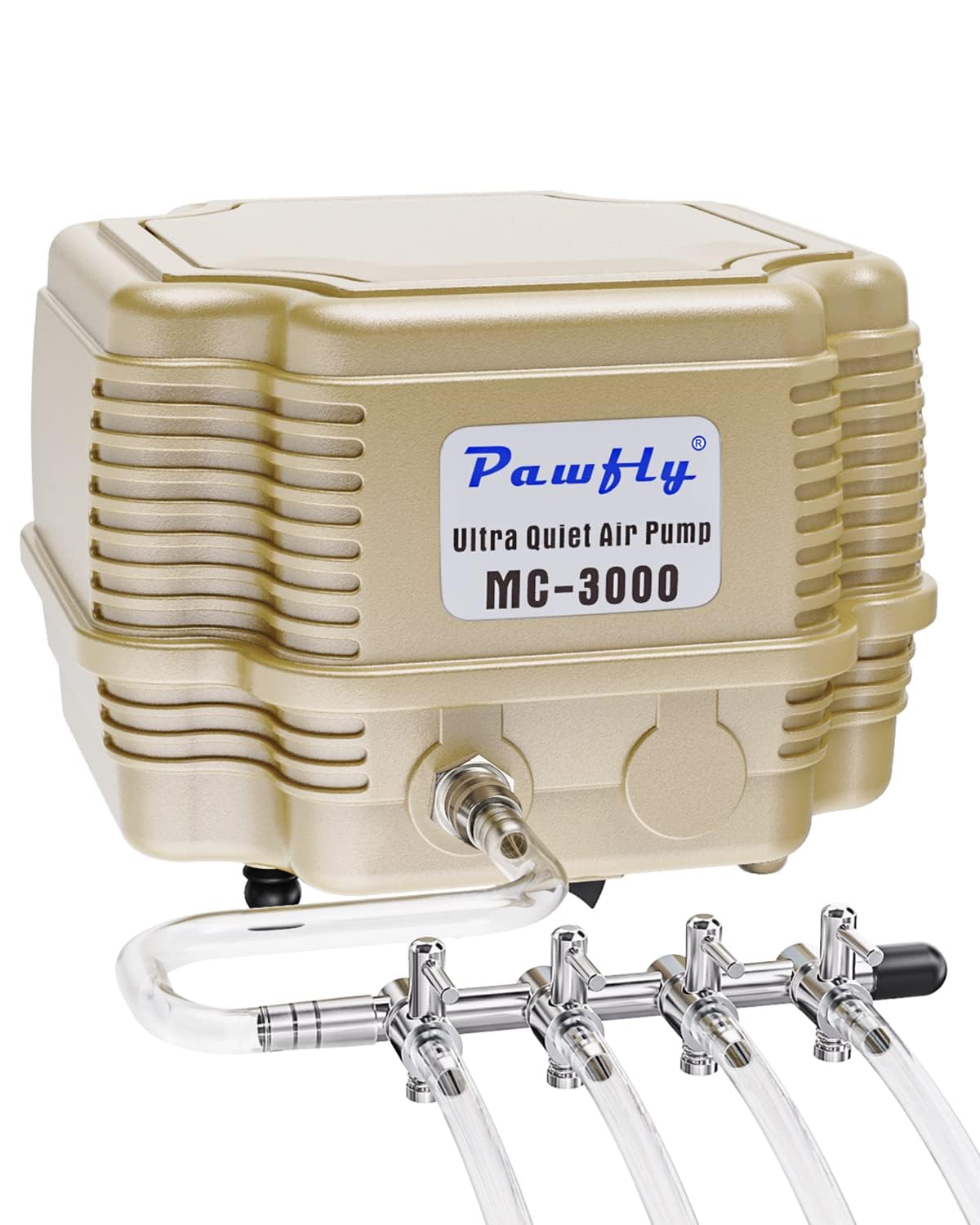
Pawfly 254 GPH Air Pump – Best for Large Systems
Key Features
- Power: 7 W
- Airflow: 254 GPH
- Outlets: 4, adjustable
- Tank range: Up to 300 gallons
- Price: Premium
Four outlets change what a single pump can do. The Pawfly 254 GPH uses a copper distributor with individual valves, so a fish room can run a sponge filter here, an airstone there, and still have two lines in reserve. The 7 W motor is rated for systems up to 300 gallons, and the low/high switch gives you a coarse adjustment before you touch the valves.
What sold us is the combination of volume and control. At 254 GPH, it can supply several tanks at once; the four valves let you dial each line instead of blasting every stone equally. We also noticed the noise control: the muffled case and rubber feet are aimed at keeping a high-output pump from rattling the shelf, and that matters when the pump lives in the same room as the tanks.
This is not a pump for a 10-gallon betta tank. The lowest setting still moves a lot of air, and the 5-inch body wants a real shelf or cabinet. It is a specialist for large tanks, ponds, and fish rooms, and that is exactly how we rank it. If you only need two lines, the smaller Pawfly is easier to live with.
Pros
- Four individually valved air outlets
- High 254 GPH output for large systems
- Low/high switch plus per-line valves
- Quiet for its capacity
Cons
- Mixed durability over months
We recommend the Pawfly 254 GPH for fish rooms, ponds, and large tanks that need four controllable air lines from one pump.
AquaMiracle All-in-One Air Pump – Small Tank Starter

Key Features
- Airflow: 50 GPH
- Included: Stone, tubing, check valve
- Footprint: 4.08 x 2.48 x 1.7 in
- Price: Budget
The AquaMiracle is the pump we tuck behind a small tank: a 4.1-inch body, one airline, and a kit that includes the stone, tubing, and check valve. It is the least fiddly setup here, and for a quarantine tank or a small desktop aquarium that is most of the battle.
We were pleasantly surprised by how much air the 50 GPH pump moves. That is strong output for a small tank, and the compact body makes it easy to place discreetly behind a filter or a plant. The included stone, line, and check valve also mean you can set it up without hunting for the basic parts.
It is a good match for a 10-gallon quarantine or a breeder tank, where the full output is welcome, and the complete kit keeps the install simple. We like it as a straightforward small-tank kit, not as a nano pump for a 3-gallon betta cube.
Pros
- Compact body hides behind small tanks
- Quiet for a small tank
- Complete stone, tubing, and check valve
- Strong 50 GPH output
Cons
- No way to adjust airflow
We recommend the AquaMiracle all-in-one for a simple small-tank setup where full output is welcome and you want every part in the box.
How We Tested the Best Aquarium Bubblers
We started with roughly 40 pumps sold at big-box pet stores, local fish shops, and the online retailers hobbyists actually use, then narrowed by price, outlet count, rated output, and footprint — anything too bulky to hide behind a 10-gallon tank didn’t make the cut. That left 16, and we ran every one of them continuously for four months. None went back in its box: each stayed plumbed into a real tank, including a 20-gallon community setup in the living room, a 10-gallon betta tank on a bedside table, and a rack of sponge filters in the basement.
Noise came first because it’s what people return pumps over. We took decibel readings at arm’s length and again from the couch, then did the test that actually matters — sitting in the room after lights out and deciding whether the pump could be heard over the refrigerator. For output, we hooked every unit to the same 24-inch bubble wand and photographed the curtain it produced, then pushed each one against a 24-inch-deep tank to see whether it could still drive bubbles all the way to the gravel. We also turned every flow dial from stop to full and noted whether it delivered a real range or just clicked between wheeze and roar.
Build quality got judged by hand and by calendar. We checked whether the diaphragm was user-replaceable, whether the housing flexed when squeezed, and whether the feet stayed put on a glass rim, then re-took every noise reading at the four-month mark to see which units had drifted louder. Each pump was unplugged and replugged to see if it restarted on its own, and we weighed price against measured airflow — a silent pump with half the output isn’t a bargain.
How to Choose an Aquarium Bubbler
The tank-size number on the box is a starting point, not a verdict; the right bubbler is the one whose airflow you can dial back, whose noise disappears into your room, and whose parts you can live with replacing.
Match airflow to the tank, then leave yourself a dial
Most community tanks in the 10- to 40-gallon range are well served by a pump in the 50 GPH class, especially when it has two outlets you can split between a sponge filter and an airstone. A 254 GPH pump is not better if it turns a 20-gallon into a washing machine; it is the right tool for a fish room, a pond, or a 125-gallon system. We treat the adjustment dial as the feature that makes a pump useful: it lets one model cover a quarantine tank and a display tank. If the pump has no dial, size it conservatively or add an inline valve.
Noise is a placement problem too
Pumps are rated in decibels, but the number that matters is the vibration that reaches your shelf. We put more faith in a soft mat and a short loop of airline than in the decibel figure on the box, because both can stop the pump from singing through the furniture. Keep the pump out of a closed cabinet if it has no ventilation, because heat and trapped sound make both worse. Quiet models in this group, such as the hygger 4W, put the motor inside a double-wall shell, but placement still decides whether you notice it from the couch.
Outlets and check valves do the real work
Two outlets give you flexibility: one line for a sponge filter, one for a decorative stone, or two stones in a longer tank. A single-outlet pump can still run two accessories with a T-connector, but then both lines share one adjustment. Whatever the outlet count, put a check valve in each line or keep the pump above the waterline. That valve is the cheap part that stops a power-off siphon from backing water into the pump and onto the floor. The complete kits here include them, which is why we rank kit contents as a real feature rather than a freebie.
Plan for wear before the pump gets loud
An air pump is a wear item. Diaphragms stiffen, air stones clog, and a pump that sounds loud after a year can be asking for maintenance rather than replacement. Keep the intake filter pad clean if the model has one, replace a clogged stone before blaming the pump, and choose a model whose replacement parts are available. We prefer a modest pump with a replaceable diaphragm to a sealed unit with a longer feature list. If the pump is central to a sponge filter, keep a spare airstone and a length of airline on hand.
Frequently Asked Questions
Do I really need an aquarium bubbler?
Not every tank does, but a bubbler earns its place when surface film builds up, when a sponge filter needs air, or when the room runs warm. The bubbles themselves add little oxygen directly; the value is the surface movement they create, which helps gas exchange and keeps the water from going stagnant. If your filter already ripples the surface strongly, run a bubbler only at night or skip it. If the surface looks flat, add one.
Can I leave an air pump running all the time?
Yes. Most aquarium air pumps are built for continuous duty, and a sponge filter stops filtering the moment its air supply stops. The practical exceptions are noise and heat: if the pump sits in a closed cabinet, give it ventilation, and if the sound bothers you in a bedroom, put it on a soft mat rather than switching it off. Run it constantly unless you are doing maintenance or treating a fish.
Can I use an aquarium bubbler in a saltwater tank?
Usually, but check the listing: some pumps are sold for freshwater only, while others are rated for marine systems. Salt does not care about the pump’s marketing, but it does attack the stone and the check valve. Rinse salt creep when you do maintenance and replace a crusted stone instead of turning up the pump. If the listing does not say marine, choose another model.
Final Verdict
For most aquariums, the Pawfly 50 GPH is the bubbler we recommend first: it has enough adjustment for a 10-gallon quarantine and enough dual-outlet flexibility for a 40-gallon community tank. If you need to move air across several tanks or a pond, step up to the four-outlet Pawfly 254 GPH; if quiet is the priority, the hygger 4W is the alternative we point to.