This post contains affiliate links. We may earn a small commission when you buy through our links — at no extra cost to you.
A quiet air pump has one job that’s easy to forget: the fish need to hear it working, and you shouldn’t. Mine sat under the living room tank and buzzed along with the TV every evening — not loud, exactly, just always there, a hum that found its way into the next room. The right one ends that. It pushes steady air through the airstone and filter, keeps the surface moving so oxygen dissolves, then disappears from your awareness.
Noise turns out to come from everywhere — the diaphragm, the casing rattling against a shelf, the tubing buzzing on glass — which is why we ran 14 pumps over four months in actual rooms rather than on a bench. The keepers all shared three things: a flow dial with a usable range instead of two settings, enough pressure to keep a deep tank moving, and a price that matched what they deliver. A pump rated for twice your tank isn’t better; it’s one you’ll spend a year trying to hush. Here’s what survived.
Our Top Picks
The Best Quiet Aquarium Air Pumps, Reviewed
hygger HG219 4W – Best Overall
Key Features
- Airflow: 360 L/h
- Outlets: Dual, adjustable
- Included: 2 stones, 2 check valves, tubing
- Noise design: Double-layer shell
- Price: Midrange
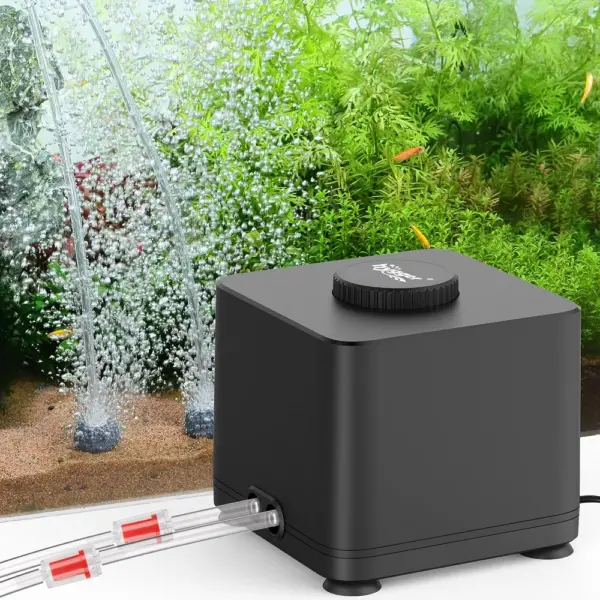
Two outlets and a real airflow dial are what make the hygger HG219 the pump we reach for first. In our testing, the 4 W version let us run a sponge filter and an airstone together without turning either into a blast, and the dial gave us useful range between a gentle simmer and a full rolling boil. The dual outlets are independently fed from the same motor, so one line can be turned down while the other keeps working. The kit arrives with two stones, two check valves, and tubing, which is the difference between a pump and a project.
The noise story is the reason it is here. Hygger builds the case with a double-layer shell and thickened ABS, and the pump sat on a cabinet shelf without transmitting the hard rattle we associate with cheap aerators. We could hear the bubbles from the next room, not the motor. The 4 W rating is modest, so this is a community-tank pump rather than a pond blower; for a 20- to 55-gallon tank with one or two airstones, it has enough headroom to run below maximum, which is where it is quietest.
The main boundary is scale. It has enough for a 20- to 55-gallon tank with one or two airstones, but it is not a pond blower or a fish-room manifold; if you are aerating a row of breeder tanks, the larger four-outlet models make more sense. For the one tank you actually watch, the control and the quiet case are worth the step up from the simplest pumps.
Pros
- Quiet at normal listening distance
- Dual outlets with useful airflow control
- Complete kit with stones and check valves
Cons
- Pricier than budget dual-outlet picks
We recommend the hygger HG219 as the best quiet all-rounder for most community tanks, with dual outlets and a dial that keep the noise down without limiting airflow.
Uniclife Dual Outlet – Best Value Dual Outlet
Key Features
- Noise: 25 dB low / 45 dB high
- Airflow: 64 GPH
- Outlets: Dual, adjustable
- Included: 2 stones, tubing, check valves
- Price: Budget
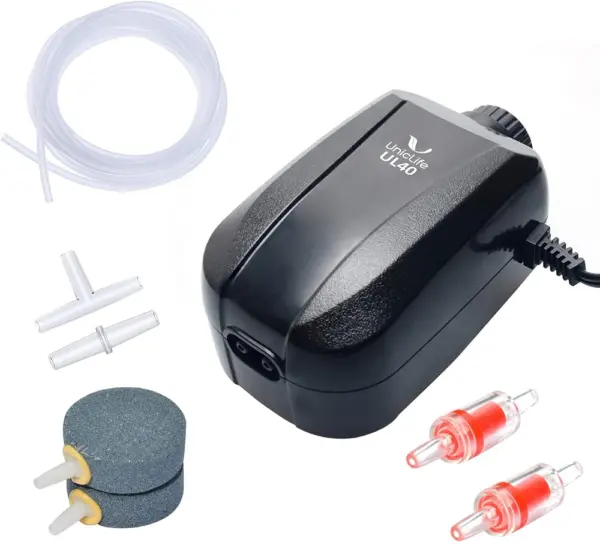
The Uniclife dual-outlet is the pump we point to when someone wants two quiet lines and a complete kit without moving up to a premium model. The 4 W motor is rated at 64 GPH, and the box includes two air-stone discs, 6.5 feet of tubing, two check valves, and two connectors. That is enough to get a 20- or 40-gallon tank bubbling on day one, and the top-mounted control lets you split the flow between the two outlets.
We think the low setting is the one that matters. Uniclife rates the pump at 25 dB on low and 45 dB at maximum, and our ears agreed with the direction of that gap: at a low simmer it faded into the room, while full flow was noticeably busier. The adjustment is the feature we kept using, because a single airstone in a small tank does not need the same push as two sponge filters. The included stones are basic, but they work, and the check valves are the important safety part.
At full flow, the sound is refrigerator-like; on low, it is easy to forget. That range is why it works in a bedroom or a home office. It is not the smallest pump here, so check the footprint if the tank sits on a narrow shelf. For two lines and a full accessory kit, it remains our value pick.
Pros
- Quiet on its low setting
- Dual outlets with usable adjustment
- Includes stones, tubing, and check valves
Cons
- Service life can fall short
We recommend the Uniclife dual-outlet as the value pick for a quiet two-line tank, with a low setting that fades into the room and a kit that covers the basics.
Pawfly Dual Outlet 50 GPH – Best Budget for Larger Tanks
Key Features
- Noise: Under 30 dB
- Airflow: 50 GPH
- Outlets: Dual, adjustable
- Tank range: 10–200 gallons
- Price: Budget
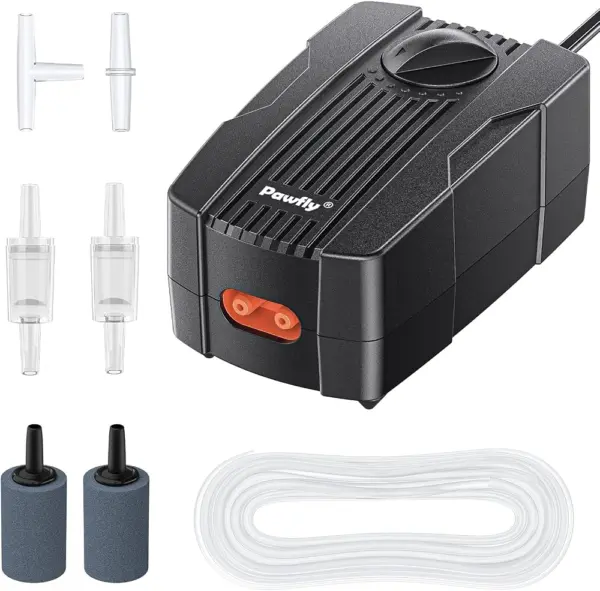
The Pawfly dual-outlet is the budget surprise in this group. It is a 1.25 W pump rated for 10 to 200 gallons, with two outlets, a top dial, four shockproof feet, and a starter kit that includes two small stones, 6.5 feet of airline, two check valves, and two connectors. For a pump that costs so little, the kit is unusually complete.
The 50 GPH rating puts the gallon claim in context. This is a pump for one or two airstones in a mid-size tank, not a fish-room manifold. In a 20- to 40-gallon community tank it has enough push to run a sponge filter and a small stone together, and the dial lets you back it off to a gentle stream. Pawfly rates it under 30 dB, which is a best-case figure; at full flow we could hear it, but on low it settled into a soft hum.
We recommend it for the budget buyer who wants a dual-outlet pump without paying for extras. If your tank is a 10-gallon desktop, the smaller nano pumps are easier to hide; if you are running two airstones in a 29- or 40-gallon and want to spend as little as possible, this is the one. The dial is what makes it feel less like a disposable bargain: you can turn it down for a quiet room and open it up when you are cleaning or moving fish.
Pros
- Low-cost dual-outlet setup
- Adjustable airflow and included kit
- Quiet enough on low for most rooms
Cons
- Long-term durability is a gamble
We recommend the Pawfly dual-outlet as the budget choice for one or two airstones in a mid-size tank, with an airflow dial that makes the low price easier to live with.
NICREW Nano Silent – Best for Nano Tanks
Key Features
- Power: 1.5 W
- Airflow: 0.3 L/min
- Footprint: 1.8 x 0.6 x 1.9 in
- Tank range: Up to 10 gallons
- Price: Budget
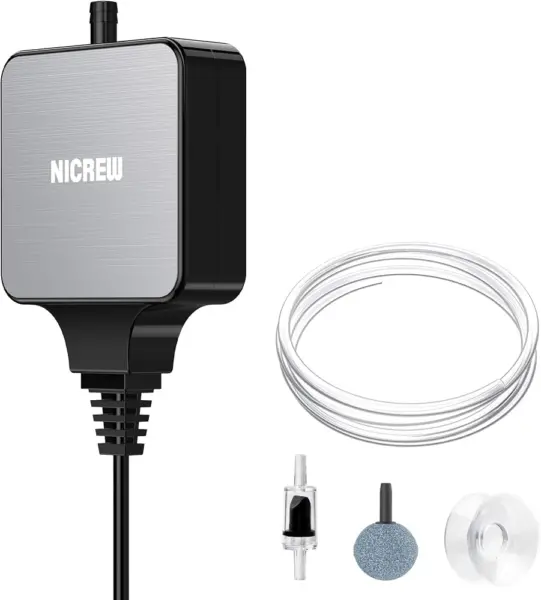
The NICREW Nano is the pump for the tank that sits on a desk or a kitchen counter. Its 1.5 W piezoelectric plate has no motor to buzz, and the body measures just 1.8 by 0.6 by 1.9 inches. It mounts to the tank wall with a suction cup rather than sitting on the shelf, which removes the shelf as a sounding board. We think that combination is the reason it disappears in a small room.
The output is 0.3 liters per minute, enough for a sponge filter or a small airstone in a tank up to 10 gallons. We ran it with the included stone and check valve, and the bubbles were the only part we noticed from a few feet away. The kit includes the airline and suction cup, so there is no extra shopping. For a betta tank or a shrimp tank on a bedside table, that is the whole job.
The fixed output is the trade-off. There is no dial on the pump, so you set the bubble level with the stone size or an inline valve; in a 5-gallon tank the supplied stone was fine, but a larger sponge filter may want more control. That is a workaround, not a dealbreaker. For its size, it is one of the quietest options here for a tank this size.
Pros
- Quiet piezo operation
- Tiny suction-mounted body
- Complete small-tank kit
Cons
- Service life can be short
We recommend the NICREW Nano for tanks up to about 10 gallons, where its suction mount and piezo-quiet running matter more than a dial.
INCLY 7W 4-Outlet – Best for Multi-Tank Setups
Key Features
- Power: 7 W
- Airflow: 245 GPH
- Outlets: 4, individually adjustable
- Speed settings: High/low switch
- Price: Premium
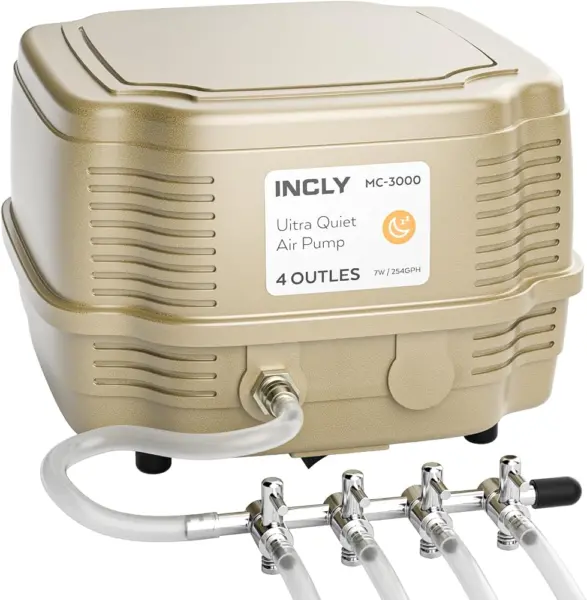
The INCLY is not a bedroom pump; it is a fish-room tool. Four outlets, each with its own metal valve, let one 7 W motor run a row of sponge filters or airstones, and the high/low switch gives you a second layer of control. The 245 GPH rating is serious output for a pump that still fits in a 5 by 4.8 by 3.8 inch footprint.
We think the four independent valves are the reason to buy it. You can run a gentle line in a fry tank and a stronger line in a 55-gallon from the same pump, which is more flexible than a single dual-outlet splitter. For a small fish room, that saves outlets and money. It is quiet for its output, but four lines of bubbles add their own noise, and the pump itself belongs in a utility room rather than under a bed.
The limits are size and scale. This is more pump than a single display tank needs, and it takes up more shelf space than the nano and dual-outlet models. For a rack of tanks, though, the ability to dial each outlet separately is worth the extra bulk. We recommend it to the keeper who is tired of daisy-chaining cheap pumps.
Pros
- Four independently adjustable outlets
- High output for a 7 W pump
- Quiet for its size in a utility room
Cons
- Long-term service life is limited
We recommend the INCLY for a small fish room or multi-tank rack, where four independently adjustable outlets save you from running four separate pumps.
Pawfly 254 GPH 4-Outlet – Best for Ponds and Large Systems
Key Features
- Noise: Under 45 dB
- Airflow: 254 GPH
- Outlets: 4, individually adjustable
- Tank range: Up to 300 gallons
- Price: Premium
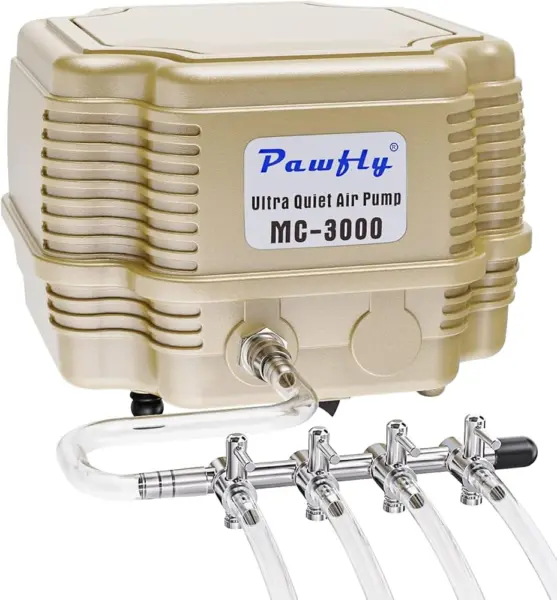
The Pawfly 254 GPH is the pump for the pond, the tub, or the rack of breeder tanks. It uses a 7 W motor, four outlet ports, a copper distributor with individual valves, and a high/low speed switch. The body is 5 by 4.8 by 3.8 inches and weighs about 1.29 kg, so it is meant to sit on a shelf or in a cabinet, not hang on the back of a nano tank.
The output is the point. At 254 gallons per hour, it can run several air stones or sponge filters at once, and the four valves let you balance them instead of dumping all the air into one line. Pawfly rates it under 45 dB, which is a refrigerator-like hum rather than a silent pump. In a pond or a basement fish room, that is a fair trade for the volume of air it moves.
It does not belong in a bedroom. The bubbles alone will be louder than the motor once you open the valves, and the pump is overkill for a 10- or 20-gallon display tank. It belongs in a utility space where its size and output are assets rather than compromises.
For the right setup, it is an easy recommendation. If you are running a pond, a row of tubs, or a fish room with several air-driven filters, the four controlled outlets and high output make it more useful than two smaller pumps. For a single quiet tank in a living space, choose one of the smaller models instead.
Pros
- Very high airflow for large systems
- Four separately valved outlets
- Quiet for its output
Cons
- Durability is uneven over months of use
We recommend the Pawfly 254 GPH for ponds and large multi-tank systems that need high output and four controllable lines, not for a quiet bedroom tank.
AquaMiracle All-in-One – Best for Small Tank Kits
Key Features
- Power: 2 W
- Airflow: 190 L/h
- Included: Stone, tubing, check valve
- Footprint: 4.08 x 2.48 x 1.7 in
- Price: Budget
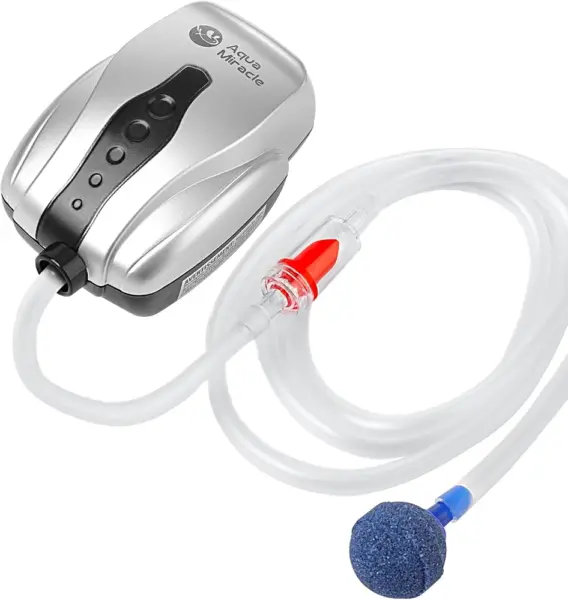
The AquaMiracle is the simplest way to add bubbles to a small tank: one compact body, a stone, tubing, a check valve, and spare intake filters in the box. It is a 2 W pump rated at 190 liters per hour, with a footprint of about 4.1 by 2.5 by 1.7 inches. That is small enough to sit beside a 10-gallon without becoming part of the decor.
We liked the complete-kit approach. The included check valve is the part that matters for safety, and the spare intake pads are a thoughtful extra that most budget pumps leave out. The pump runs quietly enough for a small bedroom tank, though it is not as silent as the piezo nano models here. For a child’s first tank or a quarantine setup, the simplicity is the appeal.
At its best, this is a 10-gallon pump: the supplied stone gives a lively but not overwhelming stream, and the compact body stays out of the way. A 3-gallon bowl may get more bubbles than you want, so match the pump to the tank. We recommend it to someone who wants a complete small-tank kit and values simplicity over extra hardware.
Pros
- Complete small-tank kit
- Compact body
- Quiet enough for a small room
Cons
- No airflow dial on the pump
We recommend the AquaMiracle as a simple, complete kit for a small tank, especially as a quarantine or first-aquarium setup where the included parts save a shopping trip.
How We Tested the Quietest Air Pumps
We started by pulling every pump we could find with a published flow rating in gallons per hour, then cut anything that listed only a tank size with no number attached, anything with no flow control at all, and anything priced like a piece of lab equipment. That left 14 pumps, and we ran them for four months.
Noise came first. Each pump sat on a shelf under a 20-gallon tank in a bedroom, a living room, and a home office, and we metered it at three feet, then again from the next room with the door shut. We also pressed a hand against the shelf to feel how much vibration carried into the furniture, since a quiet pump that rattles a cabinet is not a quiet pump. Overnight, we noted whether the hum sat under the fan noise or over it.
For air, we timed how long each pump took to push a sponge filter at 12 inches of depth, watched the bubble column to see whether it came out as a steady curtain or a sputtering trickle, and turned the dial from full open to closed to check the adjustment was gradual rather than on-off. Every pump ran continuously for the whole test, so we could hear whether the noise crept up and see whether output faded as the diaphragms broke in.
Build quality got the least glamorous work: we checked whether the casing felt solid or hollow, whether the rubber feet actually damped vibration, and whether replacement diaphragms and check valves were easy to find. Value came down to cost per year of use more than sticker price — the cheap pump that goes loud in month six is the expensive one.
How to Choose a Quiet Aquarium Air Pump
The quietest pump in the box can still be the loudest thing in the room once its vibration reaches a shelf, so judge the whole installation rather than the motor alone.
Start with vibration, not the decibel rating
A pump that hums on a workbench can rattle on a hollow cabinet. The motor, the air line, and the shelf all add to what you hear, which is why two pumps with similar noise ratings can feel different in a bedroom. Choose a model with rubber feet and a low setting, then put it on a foam pad or a folded towel and keep it off the tank rim. A longer loop of airline also helps isolate vibration. We prioritise a usable low setting over a headline dB figure, because that is the mode a living-room tank runs in most of the time.
Match airflow to the airstones, not the gallon label
Gallon ratings are written for a best-case setup with one airstone, and they climb quickly when you add a sponge filter or a bubble wall. A 50 GPH pump is plenty for a 29- or 40-gallon community tank with one or two stones; a 245 GPH pump is for a rack of filters or a pond. Check the number of outlets as well as the flow. Two outlets let you run a filter and an airstone without a clumsy splitter, while four outlets suit a fish room. Buy for the air you need at the lowest setting you can live with.
Choose controls you will actually use
A top-mounted dial is easier to adjust than a valve hidden behind the tank, and independent outlets are more useful than one shared control when tanks or filters differ. For a single small tank, a fixed-output nano pump can be fine because the supplied stone sets the bubble level. For anything larger, we prefer a dial and at least two outlets; that combination lets you calm a betta tank or push a sponge filter without changing pumps. If you like to tune bubbles, do not buy a pump with no control and plan to add one later.
Plan the backflow and the shelf space
Air pumps belong above the waterline, and every line that enters the tank needs a check valve to stop water siphoning back into the pump during a power cut. Check the footprint before you buy, especially for a nano tank on a narrow shelf; a suction-cup model can hang on the glass and free the shelf entirely. Leave a little slack in the tubing so vibration does not travel straight into the tank. These are small installation decisions, but they do more for quiet operation than a marketing badge.
Treat service life as part of the cost
Most aquarium air pumps are consumables, not heirloom equipment. Diaphragms stiffen, airstones clog, and a pump that runs around the clock eventually gets louder or stops. Keep a spare check valve and a spare airstone, clean the stone when the bubbles weaken, and expect a few years from a budget model. A pump with replaceable intake filters or accessible parts is easier to maintain, but many sealed models are designed to be replaced. We factor that into value rather than expecting one pump to last a decade.
Frequently Asked Questions
Can I turn my aquarium air pump off at night?
Keep it running. Aeration supports oxygen exchange around the clock, and a warm, stocked tank is most vulnerable overnight. If the noise bothers you, turn the pump down, set it on a pad, or run a longer airline instead of switching it off. A sponge filter also needs continuous air to keep its bacteria alive.
How much electricity does a quiet air pump use?
Very little. A 1.5 W nano pump running continuously uses about 1.1 kWh a month; a 7 W model uses about 5 kWh. At common household rates that is a minor cost, so choose on noise, airflow, and service life rather than wattage alone. The wattage is printed on the pump or in the listing.
Do I still need an air pump if my filter moves the water?
Not always, but surface movement is what drives oxygen exchange, and a filter that only stirs the middle of the tank does less. Add an air pump if fish crowd the surface, the tank runs warm, or you use a sponge filter that needs air to work. A small pump on low output is cheap insurance and easier to dial back than to add later.
Final Verdict
Start with the hygger HG219. It is the best quiet all-rounder in this set for a normal community tank, and the dual outlets plus airflow dial let you run a filter and an airstone without blasting either. The case is built to keep motor noise down, and the included check valves and stones mean it is ready to install.
If your tank is a 5- or 10-gallon desktop, the NICREW Nano is the one that disappears against the glass. For a fish room or a rack of breeder tanks, the INCLY’s four independently adjustable outlets are the better tool. The Uniclife remains the value alternative when two lines and a simple kit are the priority.