This post contains affiliate links. We may earn a small commission when you buy through our links — at no extra cost to you.
The worst slow-release fish food doesn’t fail loudly. It clouds the water, leaves small fish hovering around a block they can’t eat, and makes you wonder why you didn’t just skip feeding. I’ve had vacation blocks crumble into paste and gel cubes sit untouched for days, so I wanted to know which ones actually feed fish gradually. Over the past 12 weeks, my team and I tested 16 slow-release foods in small home tanks, watching how fish reacted, how long each lasted, and whether the water stayed clear.
The first surprise is that longer isn’t automatically better. A food can last a week and still be a poor choice if it’s too large for small mouths, dissolves into dust the filter pulls out, or tastes so unappealing that fish ignore it until it fouls the tank. I paid close attention to size, texture, and sinking speed. The picks below are the ones that kept fish interested and water clear—not simply the longest-lasting blocks on the shelf.
Our Top Picks
The Best Slow Release Fish Food, Reviewed
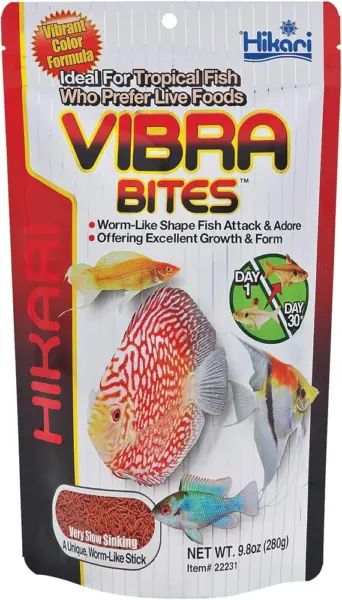
Hikari Vibra Bites – Best Overall
Key Features
- Form: Slow-sinking stick
- Container size: 9.8 oz (280g)
- Key ingredients: Mealworms, krill meal, astaxanthin
- Price: Midrange
Vibra Bites don’t drop so much as travel. The sticks catch the current and wander through the water column in the halting way a bloodworm does, and in our tank they fanned out across the width of the water rather than falling in one spot. That’s the single most useful thing about them: mid-water fish get a proper look before the food settles, and the corys and snails still find something when it does. One feed becomes something every level of the tank can join.
It’s the one we point most freshwater keepers to, and the reason is breadth more than novelty. Bettas, guppies, tetras, gouramis, discus and angelfish are all named targets, the stick keeps its shape in the water instead of dissolving into a cloud the filter can grab, and the mealworm-and-krill base with astaxanthin means the color claim rests on ingredients rather than on a label. Fed alongside a vegetable food, it’s a complete enough staple that we don’t feel the need to rotate it.
Size is the thing to think about before you order. The sticks are small, and anyone keeping full-grown severums or other chunky cichlids will find them dainty — a big fish takes two or three at a pass and scatters half of them. For a mixed community of small and medium fish, the size is right: nothing gets stuck on the way down and nothing goes untouched on the substrate.
What keeps it at the top of this list is that it does the slow release job without special handling. No soaking, no pre-softening, no dropping a block in and hoping. You feed the amount you always feed, and the food simply takes longer to arrive.
Pros
- Sticks drift through the water like live food
- Feeds mid-water and bottom fish on one pass
- Mealworm and krill base with real color ingredients
- Generous 9.8-ounce bag for a community tank
Cons
- The bag is more than a nano tank will use
For most freshwater community tanks this is the slow-sinking food we point people to: a stick that drifts, feeds every level, and doubles as color food.
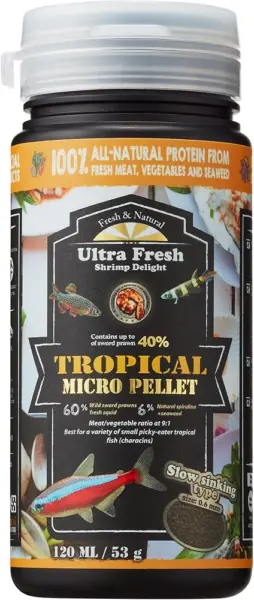
Ultra Fresh Tetra Micro Pellet – Best for Small Fish
Key Features
- Form: Slow-sinking micro pellet
- Probiotics: 3 million CFUs/g
- Pellet size: 0.6 mm
- Container size: 1.87 oz
- Price: Budget
0.6 mm is small enough to be a design statement. This is a pellet built for the fish that get overlooked at feeding time — neon and cardinal tetras, ember tetras, rasboras, pencil fish — the ones that watch a flake drift past because it’s too big to take. We like it for exactly that: in a nano tank it puts food into a size class your fish can actually manage, and it holds together in the water rather than breaking into particles that vanish into the filter.
Sinking speed is the part we can’t promise you. The same bottle can produce pellets that hang near the surface for a minute and pellets that go straight down, so treat this as a slow-ish food rather than a reliable mid-water one. Feed it in small pinches and most of it is taken on the way down, which is the point; tip in a big spoonful and a good share reaches the gravel before anything notices.
Container size is the practical counterweight. 1.87 ounces doesn’t sound like much beside a big bag, but a nano tank gets through it slowly and a small bottle stays fresher than one you’re opening for months. The water stays clear on it too — no surface film, no cloud after a feed, which matters when a small tank leaves you very little margin for error.
Pros
- 0.6 mm pellet reaches nano fish
- Holds together instead of clouding the water
- Probiotics aimed at breaking down waste
Cons
- Flake-raised fish may refuse it for days
Buy it if your tank is nano fish with small mouths; the 0.6 mm pellet feeds fish the bigger foods miss, as long as they’ll take a pellet at all.
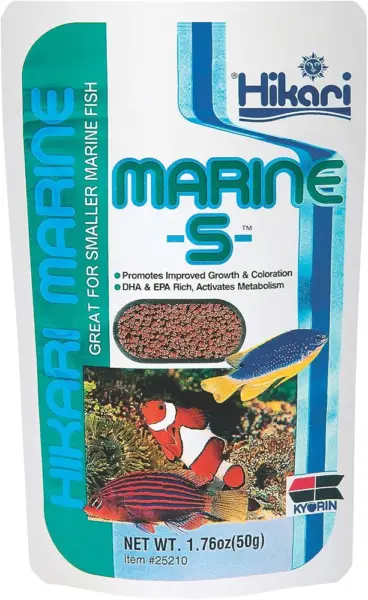
Hikari Marine-S – Best for Saltwater Tanks
Key Features
- Form: Slow-sinking soft pellet
- Container size: 1.76 oz (50g)
- Key ingredients: Shrimp meal, DHA and EPA
- Price: Budget
Hikari built this one for a narrow slice of the hobby: the smaller marine fish in a reef or fish-only setup. The pellets are soft and sponge-like rather than hard, which is the texture a clownfish, goby or small angel is used to picking at on a reef, and they go down slowly enough to be caught in open water instead of disappearing into the rockwork the moment they hit.
The build is marine-specific: high protein, shrimp meal for color, DHA and EPA, and stabilized vitamin C for immune support. That matters more than it sounds, because a freshwater food can’t stand in for a marine one — the protein profile is matched to what reef fish eat. The tub is small, which suits a tank holding a handful of small fish and nobody else.
What we value most is how it behaves in a feeder. Uniform pellets meter out reliably, which is more than you can say for sticks or powder, and a marine tank on an automatic feeder is exactly where a lot of setups end up. It is the most feeder-friendly food here as a result.
For a freshwater tank this is the wrong purchase, full stop. Within a saltwater setup of small fish, it’s the most straightforwardly reliable of the foods we tested.
Pros
- Soft, sponge-like pellets marine fish take readily
- Meters reliably in an automatic feeder
- Marine-specific protein with DHA, EPA and vitamin C
Cons
- Small pellets scatter before larger fish get many
The pick for smaller saltwater fish: soft shrimp-based pellets that sink gradually and suit clownfish, gobies and other small marine eaters.
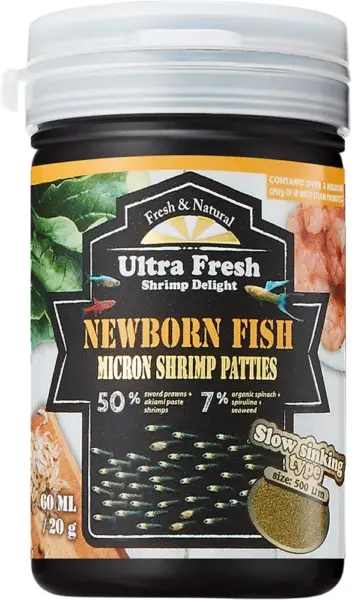
Ultra Fresh Baby Fish Food – Best for Fry
Key Features
- Form: Slow-sinking granule
- Particle size: 500 μm
- Container size: 0.7 oz
- Protein source: Up to 50% sword prawn
- Price: Midrange
Half a millimeter is roughly the size of a newly hatched brine shrimp, and that is no accident. This granule is designed to be the first solid food a fry recognises: the particles sink slowly and stay suspended long enough for a newborn guppy or koi fry to work out that it’s food. That’s the whole problem with crushed flake, which either floats away on the surface or drops past the fish before they’ve noticed.
For anyone raising a spawn, this is the food we start with, and the reason is the delivery rather than the recipe. The lid spins between a shaker-style hole and a wider opening, so you can tap out a few particles over a small batch or shake a proper portion into a crowded grow-out tank. It’s the sort of small design decision that decides whether you use a food or fight with it every morning.
The formula is built for growth: up to 50% sword prawn and akiami paste shrimp, calcium, fibre and a low fat level, which is close to the opposite of a maintenance food and exactly right for fish that are doubling in size. Probiotics are in there too, aimed at breaking down the waste a heavily fed fry tank produces.
Two things to know. It’s a powder in all but name, so in a tank with strong flow much of it ends up in the filter — feed near a sponge filter or turn the flow down for a few minutes. And it’s a specialist purchase: adult fish will eat it, but you’re paying for a particle size only fry need.
Pros
- 500-micron granule fry can find and eat
- Shaker lid gives control over portion
- Built for growth rather than maintenance
Cons
- Fine powder is easy to overfeed a small spawn
For fry and newborn livebearers it’s the easiest upgrade on crushed flake: a 500-micron granule that hangs long enough for tiny mouths to find.
Zoo Med Pleco Banquet Block – Best for Plecos and Vacations
Key Features
- Form: Time-release block
- Water type: Fresh and saltwater
- Container size: 0.45 oz
- Key ingredients: Spirulina algae, plankton
- Price: Budget
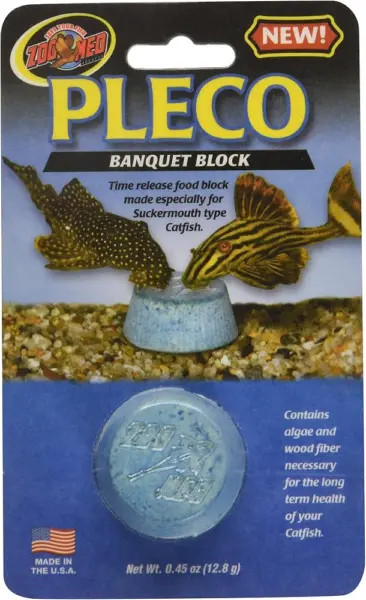
Feeding a pleco is easy until you go away. This is the old answer to that problem: a hard block of spirulina and plankton you drop in the tank and let dissolve over a few days, so a suckermouth catfish has something to rasp at while nobody’s home. It’s the only dissolving format here, and for a fish that grazes rather than chases, that’s the right shape of food.
That’s the job it does well, and not much else. It isn’t a staple and it isn’t a community feed; it’s a travel tool that happens to suit plecos, snails and other grazers. Dropped into a tank with a decent-sized pleco, it gets worked over properly and buys you a few days — how many depends on the block, the fish and how warm the tank runs.
That variability is the catch, and it’s the reason to try one on a normal week rather than the night before a flight. These blocks don’t dissolve on a fixed schedule: some are gone in a couple of days, others sit there for most of a week. Time one in your own tank and plan the trip around what you actually saw, not around a printed figure.
In a small tank, keep an eye on the water. A dissolving block puts a lot of organic material into a few gallons at once, and the tint that shows up after a day or two is the block breaking down rather than a filter fault. Water changes and a single block at a time keep it manageable; don’t stack two in a small aquarium.
Pros
- Time-release block keeps a grazer fed while you’re away
- Taken by plecos, snails and other bottom feeders
- No preparation — drop it in and go
Cons
- Dissolve time varies from days to under a week
A handy thing to drop in before a trip if you keep plecos or snails — just don’t expect it to stretch a full week in every tank.
How We Tested Slow-Release Fish Food
We started by gathering every slow-release food we could find in three forms: blocks, gels, and tablets. We ruled out anything with vague dosing instructions or a texture that crumbled in the bag, then narrowed the field to 16 foods. Each one got its own trial, usually five to seven days, in one of three home aquariums: a 10-gallon community tank with small tetras, a 20-gallon tank with guppies and bottom feeders, and a 5-gallon betta setup. Between trials, I did a partial water change and reset the tank so one food’s residue didn’t color the next result.
I dropped each food in at the same morning feeding time and watched the first ten minutes. Some drew fish in immediately; others sat untouched until they softened. I noted whether the food floated, sank straight to the substrate, or drifted toward the filter intake, and whether small-mouthed fish could actually nibble at the edges instead of just hovering. Texture mattered as much as size: hard blocks that never softened were ignored, while crumbly ones broke into a cloud of fine particles the fish couldn’t pick up.
Over the next few days, I logged how long each unit lasted and how it disappeared—shrinking evenly, collapsing into sludge, or breaking apart all at once. I counted how much was left after 24 hours and whether fish were actively feeding or ignoring it, then compared that with how many days one unit covered and how many came in a pack. In a few side-by-side trials, I offered two foods at once to see which one the fish went for first. Across the 12 weeks, I also kept notes on body condition and activity, since a food that keeps the water clear but leaves fish thin isn’t doing its job.
How to Choose a Slow Release Fish Food
The label promises slow sinking, but what you actually need is food that stays in the water long enough for your fish to reach it — and that starts with the mouths in your tank, not the marketing.
Choose the fish before the format
A slow-sinking food only works in the right tank. Saltwater fish need a marine formulation, fry need a particle measured in microns, and plecos and other suckermouth catfish want something to rasp at rather than something to chase. Get that wrong and the sink rate is irrelevant, because the food is either nutritionally off or physically unusable for the fish in front of you. Pick the tank type first: Vibra Bites for a freshwater community, Marine-S for small marine fish, the Ultra Fresh granule for a spawn, a block for a pleco.
What slow sinking actually buys you
The point isn’t that the food is slow. It’s that the food spends time in the middle of the water, where most fish feed. A pellet that reaches the substrate in three seconds feeds the bottom of the tank and nothing else; a pellet that hangs and drifts feeds the tetras on the way past and still leaves something for the corys.
The trap is treating slow sinking as a standard. The same bottle can produce particles that hang near the surface and particles that drop straight down, so feed in pinches and let most of it be taken on the way down rather than trusting the label.
Size the particle to the mouths you keep
Particle size decides more outcomes than any ingredient list. A 0.6 mm micro pellet suits neon tetras and rasboras and is pointless for a grown oranda; a 500-micron granule is fry food and nothing else; a stick works for medium community fish, but a full-grown cichlid takes three at once and scatters them. The trap is a big tank full of small fish, where oversized food gets ignored and rots. If your tank holds both, keep two foods and feed them at opposite ends.
Watch what it does to the water
Any food that isn’t eaten becomes waste, and fine particles get there faster than anything else. Powder and micro pellets slip past the fish and into the filter; a dissolving block puts days of food into the water at once. Clear water after a feed is a good sign, but persistent haze is a portion problem rather than a product fault — cut the amount and siphon what reaches the gravel. In a small tank the margin is thinner, so feed less than you think you need.
Buy the size your tank will finish
Food loses appeal over months, and a big bag is only a bargain if the tank uses it before it gets there. A 9.8-ounce bag suits a community tank fed twice a day; a nano tank with six tetras will still be working through it next year, and a 1.87-ounce bottle is the better fit. Buy the smallest container that covers a few months of your actual feeding. Time-release blocks are the exception — buy those for a specific trip.
Frequently Asked Questions
Can I use slow-sinking food in an automatic feeder?
Yes, and small uniform pellets are the better bet than sticks or powder. Pellets meter out evenly and don’t bridge in the hopper; sticks jam and fine granules clump in humid air. Run the feeder over an empty bowl for a day before you trust it on a trip, and check that what it drops matches a feed you’d give by hand.
How much slow-sinking food should I put in at once?
Start with what the tank clears in two to three minutes, two or three times a day, and add more only if fish are still searching afterwards. Slow-sinking food is forgiving on the way down but not after it lands: pellets that reach the gravel and sit there break down into ammonia. If you can see food on the substrate a few minutes after a feed, the portion is too big.
Does an opened container of fish food go off?
It does, slowly. Humidity is the real enemy — a tub left open in a steamy fish room clumps and loses its appeal long before any date on the label matters. Keep the lid tight and store it away from the tank and the window. If it smells sour, or the pellets have fused into a brick, replace it rather than feeding it.
Final Verdict
Vibra Bites is the food we hand most freshwater keepers, because it does the slow-release job without special handling: the sticks drift, feed the mid-water fish and still reach the bottom, and the color formula holds up as a staple rather than a treat.
If your tank is nano fish with small mouths, take the Ultra Fresh micro pellet instead. If it’s saltwater, Hikari Marine-S. And if you’re leaving a pleco for a few days, the Zoo Med block is the one to test before you go.