This post contains affiliate links. We may earn a small commission when you buy through our links — at no extra cost to you.
The hardest part of keeping a betta isn’t the fish. It’s the water. Tap water carries chlorine, chloramine, and heavy metals that burn gills and strip the slime coat, and a betta that’s already spent a week in a store cup doesn’t have much margin. A conditioner is the cheapest thing you will ever put in that tank and the one that matters most: a few drops per gallon, and the water turns from something that hurts into something the fish can actually live in.
I keep bettas at home, and we’ve run 14 bottles of conditioner through our tanks over the past four months, from bare hospital jars to a planted ten-gallon. What surprised me is how wildly the dosing labels vary — one bottle treats a gallon with a single drop, another asks for a full capful per ten — which means the bottle with the lowest sticker price is often the most expensive one per water change. Effectiveness comes first, but a bottle that seals properly and doesn’t reek turned out to be worth checking too.
Our Top Picks
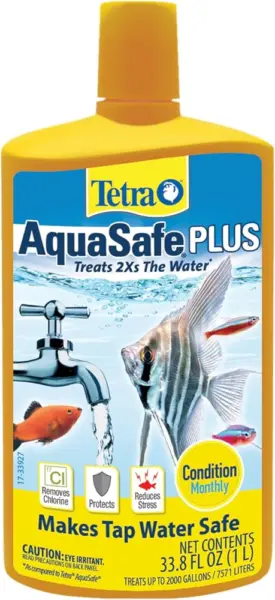
The Best Betta Fish Conditioners, Reviewed
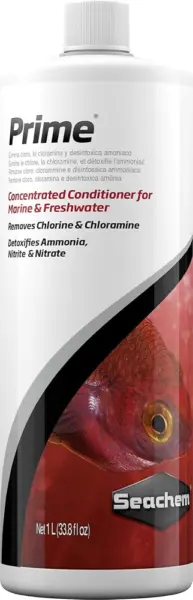
Seachem Prime – Best Overall
Key Features
- Dose: 5 mL per 50 gallons
- Detoxifies: Ammonia, nitrite, heavy metals
- Bottle size: 1 liter
- Emergency dose: 5x for ammonia or nitrite
- Price: Premium
One capful of Prime, five milliliters, treats 50 gallons. In a five-gallon betta tank you need a tenth of that, and the bottle gives you no easy way to measure it, which is the first thing to solve if you buy this one. We keep a plastic syringe in the cabinet for exactly that reason, and it turns an awkward bottle into a simple one.
The fuss is worth it. Prime is the most capable conditioner in this group and our default recommendation for bettas: it removes chlorine and chloramine immediately, binds heavy metals, and detoxifies ammonia and nitrite at the concentrations found in tap water. Ammonia is the number that ruins a small tank, and Prime’s label allows a 5x dose in an ammonia or nitrite emergency. That is a stopgap that buys you the hours to do a water change instead of watching a betta go quiet on the bottom.
A liter of it, dosed at five milliliters per 50 gallons, covers years of weekly changes for a single betta, so the bottle stops being something you shop for. Nothing else here is dosed that thinly. That is why we put up with the measuring: one purchase, one syringe, and the water question is handled until the fish is old.
The sulfur smell is the trade. It is strong in the bottle and noticeable at the cap, and it fades once the water is dosed, but a tank beside your bed will remind you every week. If that is the one thing you cannot live with, TankFirst is the odor-free route and we would point you there without hesitation.
Pros
- Detoxifies ammonia and nitrite, not just chlorine
- 5x emergency dose for ammonia spikes
- One liter lasts years in a betta tank
- Removes chlorine and chloramine immediately
Cons
- Strong sulfur smell from the bottle
- Cap-sized dose is awkward under 10 gallons
Prime earns our top spot because it is the only conditioner here that also works as an ammonia rescue, and one bottle lasts a betta’s lifetime.
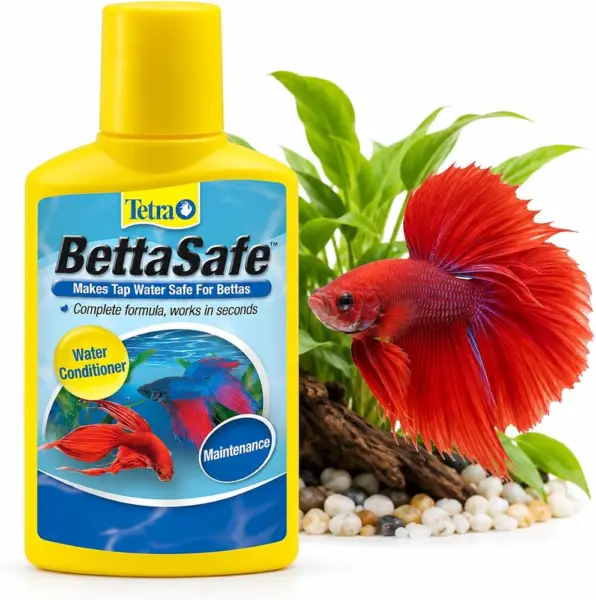
Tetra BettaSafe – Best Betta-Specific Formula
Key Features
- Use: Monthly maintenance
- Action time: Works in seconds
- Bottle size: 1.69 fluid ounces
- Neutralizes: Chlorine, chloramines, ammonia, heavy metals
- Price: Budget
Betta-labeled bottles are mostly a size decision, and Tetra’s is the one we hand to someone setting up a single bowl. It is 1.69 ounces, it neutralizes chlorine, chloramines, ammonia and heavy metals, and the label says it works in seconds. For a first fish, that combination is far easier to get right than a concentrate that needs measuring down to the drop.
The ordinary job is covered as well as the betta-specific one: the same bottle is meant for monthly partial changes and for topping off what evaporates. That last use is the one people forget. Every time you replace a cup of water that has evaporated, you are adding untreated tap water unless you condition it, and a small bottle that lives beside the tank actually gets picked up.
The catch is capacity. It is a bowl bottle, and a 10-gallon tank on a weekly schedule will have you reordering sooner than you would like. Start here for a single betta, and move up to Prime or TankFirst when a second tank appears on the shelf.
Pros
- Purpose-built and sized for one betta
- Covers chlorine, chloramines, ammonia and metals
- Label states it works in seconds
Cons
- Small bottle runs out fast in bigger tanks
For one betta in a bowl, BettaSafe is the simplest bottle here: purpose-built, fast-acting, and it covers chlorine, chloramines and ammonia without a syringe.
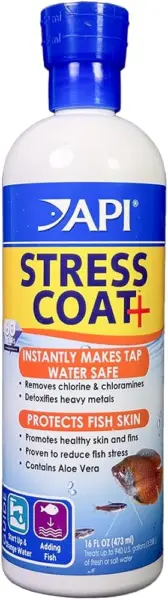
API Stress Coat – Best for Fin Repair
Key Features
- Use: Water changes, new or injured fish
- Bottle size: 16 oz
- Key additive: Aloe vera
- Price: Midrange
Bettas tear fins on plastic plants, on netting, and on the ride home in a bag. Stress Coat is the bottle here built around that: aloe vera, sold as a replacement for the protective slime coat a fish loses when it is handled or picked on, and a label that names sick and injured fish as a reason to dose.
The everyday job is covered too. It removes the chemicals in tap water that harm fish, and the label puts it to work at every water change, whenever new fish go in, and any time a fish is ailing. Sixteen ounces makes it a shelf staple rather than a bowl bottle, so it is the one you keep behind the tank and reach for without thinking.
Where we land: if a betta has torn fins, has just been moved, or shares water with anything nippy, Stress Coat does something the plain conditioners here do not, and that is worth having on the shelf. It is also the bottle we grab after a bad netting, because the aloe is doing the work we want that week.
Pros
- Aloe vera supports slime coat on torn fins
- Useful at water changes, moves and illness
- Large 16-ounce bottle for the shelf
Cons
- Additives a healthy fish does not need
This is our pick for torn fins and stressful moves: it conditions tap water and supports the slime coat in the same dose.
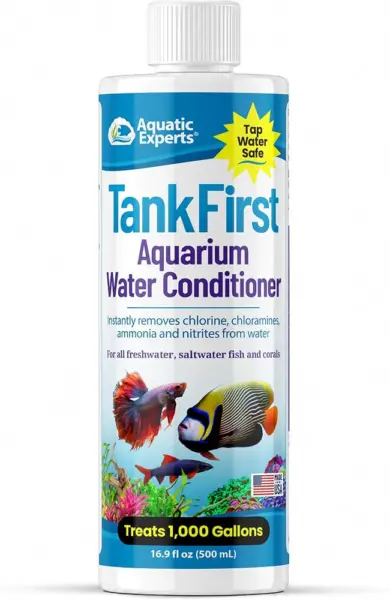
TankFirst Complete – Best for Easy Dosing
Key Features
- Dose: 1 teaspoon per 10 gallons
- Odor: Odor-free formula
- Treats: 1,000 gallons
- Bottle size: 500 mL
- Price: Midrange
If you have ever opened a bottle of concentrated conditioner and recoiled at the sulfur, TankFirst is the bottle to look at. It has no odor at all, and the dose is a teaspoon per 10 gallons, which happens to be the size of betta tank most people end up with. No dropper, no counting, no tenth of a capful.
The 500 mL bottle treats 1,000 gallons, and the label covers freshwater, marine and reef setups, so the same bottle keeps working if a second, very different tank appears in the house. That is a lot of capacity for something you measure with a kitchen spoon, and it is why this is the bottle we recommend to anyone who finds Prime’s smell or its dropper routine off-putting.
Pros
- No sulfur odor at all
- Teaspoon dose matches a 10-gallon tank
Cons
- Awkward to halve for tanks under 10 gallons
We reach for TankFirst when smell or fiddly dosing is the deciding factor: teaspoon measurements, no odor, and years of changes in one bottle.
Tetra AquaSafe Plus – Best for Multiple Tanks
Key Features
- For: Freshwater and marine
- Adds: Vitamins and biopolymers
- Bottle size: 33.8 fluid ounces
- Neutralizes: Chlorine, chloramines, heavy metals
- Price: Midrange
At 33.8 ounces, AquaSafe Plus is as big as anything in this guide. It neutralizes chlorine, chloramines and heavy metals, adds vitamins and biopolymers, and supports the slime coat, which means one bottle covers both the routine dechlorination and the nip-and-scrape duty you would otherwise buy a second product for.
Where it earns its place is a shelf with more than one tank on it. The label sets a monthly rhythm for partial changes and evaporation top-offs, the formula is labeled for freshwater and marine, and a bottle this size does not need replacing mid-season. For a single betta bowl it is more bottle than the job needs, since Prime does more per milliliter and TankFirst is easier to measure.
Freshwater and marine on one label is a genuine convenience if a betta tank and a reef tank share a cabinet, because the slime coat support and the vitamins travel with it. What it does not do is anything for a betta that our top pick does not already do better.
Pros
- Large 33.8-ounce bottle
- Slime coat support built in
- Vitamins and biopolymers added
- Works in freshwater and marine tanks
Cons
- Cloudy water after a large dose
- More bottle than one bowl needs
A sensible buy if you are conditioning water for several tanks: everyday dechlorination plus slime coat support in a bottle that lasts.
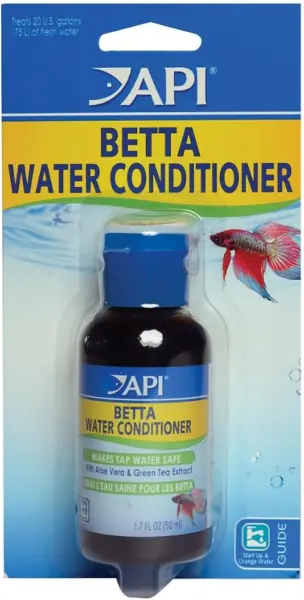
API Betta Conditioner – Best for Budget Bowls
Key Features
- Additives: Aloe vera and green tea
- Bottle size: 1.7 fluid ounces
- Neutralizes: Chlorine, chloramines, ammonia
- Price: Budget
The smallest bottle in this guide, API’s betta formula is aimed squarely at bowls and small tanks: 1.7 ounces, with aloe vera and green tea extract on the label next to the chlorine, chloramine and ammonia neutralizers. It is the bottle that fits in the drawer under a nano tank and does not demand shelf space.
Aloe and green tea are the pitch, framed as reducing inflammation and helping a fish heal, which is the sort of thing worth having in a formula built for a fish living alone in a small volume of water. It is also one of the few bottles here that names ammonia outright, and that matters in a bowl with no filter and no cycle to speak of.
The trade is size: it is a bowl bottle, and a 10-gallon tank will work through it quickly. For one betta in one small setup that is a fair trade, and it is the bottle we keep as a spare for a hospital bowl, where a small, gentle dose is exactly what you want anyway.
Pros
- Names chlorine, chloramines and ammonia
- Aloe vera and green tea extract
- Small bottle stores anywhere
Cons
- 1.7 ounces goes fast in a 10-gallon tank
Our budget pick for a single bowl: aloe and green tea alongside chlorine, chloramine and ammonia coverage in a bottle that fits in a drawer.
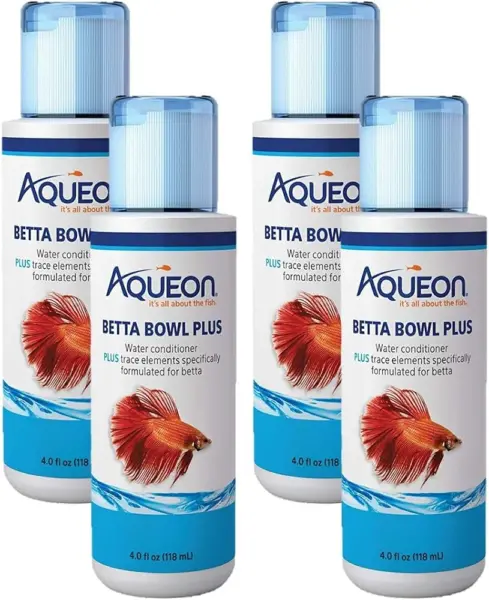
Aqueon Betta Bowl Plus – Best for Unfiltered Bowls
Key Features
- Adds: Trace elements
- Pack: Four 4-ounce bottles
- Designed for: Small bowls, limited filtration
- Price: Midrange
Four four-ounce bottles arrive in this pack, and the first thing to do is check every cap. Caps are the weak point in this format, so look at all four the moment the box lands and make sure each one seals before you put the set away.
What is inside is built for the setup most bettas actually live in: small bowls and tanks where filtration and circulation are limited. It conditions tap water instantly for fish and plants, adds trace elements, and it is one of the few products here sold specifically for betta bowls rather than for a 75-gallon community tank.
The format is the real argument. One bottle per bowl means nobody is carrying a liter jug between shelves, and a spare stays sealed in the cabinet until it is needed. For a household setting up two or three bowls at once, that is a tidier solution than one big bottle and a syringe.
Where it gives ground to our top picks is capability. There is no stated emergency dose for an ammonia spike and the guidance is bowl-shaped rather than precise. For a row of unfiltered bowls with one betta each, we still think the convenience wins; for a filtered 10-gallon with a test kit beside it, Prime is the better tool.
Pros
- Four bottles, one per bowl
- Built for small, unfiltered setups
- Adds trace elements
Cons
- Caps can arrive loose or missing
We recommend the four-pack for a row of unfiltered bowls, where a small bottle per tank beats carrying a jug between them.
How We Tested These Conditioners
We started by reading every label on the shelf and cutting anything that only neutralized chlorine without also binding ammonia or chelating heavy metals, since a conditioner that stops at step one leaves the worst of a neglected tank untouched. From there we filtered by dose rate and cost per gallon treated, dropped dye-heavy formulas, and bought 14 bottles across a range of sizes and price points.
Testing happened where the product actually lives: Tuesday-night water changes on 5- and 10-gallon tanks, a bare-bottom quarantine jar, and a planted setup that gets topped off midweek. We dosed a measured bucket of tap water, then checked free chlorine and ammonia with a liquid test kit at one minute, five minutes, and fifteen. Each bottle got the same treatment for two consecutive water changes, and we logged what the fish did in the 24 hours afterward — clamped fins, appetite, whether a bubble nest got rebuilt — along with fin edge and color over the following weeks.
Dose accuracy got its own pass, since we counted actual drops and capfuls against the label rather than trusting the printed gallonage. We also left each bottle open on the shelf for a month to see whether anything clouded, separated, or turned sulfurous, and we handled the caps weekly to catch seals that seeped, threads that cross-threaded, and lids that arrived loose or missing in the mail — a couple of shipments had soaked through the packaging before we ever got to use them. At the end, we recalculated cost per gallon based on how many water changes a bottle genuinely covered.
How to Choose a Betta Water Conditioner
In a betta tank the volume is small and the margin is thin, so the conditioner has two jobs at once: make tap water safe and buy you time when ammonia starts to climb.
Dechlorination is the floor, not the ceiling
Every bottle here neutralizes chlorine, and the ones worth buying also handle chloramine, the chlorine-and-ammonia compound many utilities switched to because it does not gas off the way chlorine does. That is the trap: a bucket left out overnight loses chlorine, not chloramine, so the old let-it-sit advice fails on modern municipal water. Pull your supplier’s annual water quality report and look for the word chloramine. If it appears, buy a conditioner that names chloramine on the label, and check whether it also claims ammonia, since that is the half of the molecule that hurts.
Match the dose to the water you are changing
Betta keepers change two or three gallons at a time, and conditioner doses are written for 10 or 50. A capful of Prime treats 50 gallons; a teaspoon of TankFirst treats 10. Neither divides cleanly into a 2.5-gallon bowl, and guessing high wastes product while guessing low leaves chlorine in the water. Keep a plastic syringe for the concentrates and a measuring-spoon set for the rest, and dose the volume going into the tank rather than the volume of the tank itself.
Concentration decides how long the bottle lasts
Two bottles on the same shelf can treat wildly different amounts of water. At five milliliters per 50 gallons, a liter of Prime covers years of weekly changes in one betta tank, while a 1.7-ounce betta bottle is a bowl-sized purchase that a 10-gallon tank will drain. Think in months of water changes rather than ounces. A concentrate costs more up front and then drops off your shopping list; a small bottle is easier to store and cheaper to try. Buy for the tanks you have, not the ones you plan to add.
Additives, odor, and cloudy water
Aloe, green tea, vitamins, and biopolymers are sold as slime coat support, and they earn their keep on a fish with torn fins or one that has just been shipped. They do not fix bad water: no conditioner replaces a water change or a cycled filter. The rest is sensory. Concentrated formulas can smell of sulfur, which matters if the tank sits in a bedroom, and cloudy water after a big dose is a known trade on a couple of bottles here, most visible in an unfiltered bowl with no filter floss to clear it.
Frequently Asked Questions
Do I need a betta-specific conditioner, or will any dechlorinator work?
No. A betta is a freshwater fish, and a general conditioner dosed correctly does the same job. Betta-labeled bottles tend to be smaller and sometimes add aloe or botanicals, which is convenience rather than a requirement. Match the dose to the gallons you are changing; that matters far more than the picture on the label.
How often should I use water conditioner?
Every time tap water goes into the tank: water changes, top-offs for evaporation, and the first fill of a new setup. The monthly cadence on some labels describes a water-change schedule, not a limit on dosing. If you top off twice a week, you condition twice a week.
Is it safe to use more conditioner than the bottle says?
Follow the label, with one useful exception: Prime’s instructions allow a 5x dose in an ammonia or nitrite emergency, which is the closest thing here to a rescue protocol. Adding extra out of caution is not a substitute for a water change. If a reading worries you, change water and test again rather than pouring more in.
Will a conditioner fix my pH or clear up an ammonia problem?
No. None of these bottles set pH, and the ammonia binders do not remove ammonia — they hold it in a less toxic form while your filter catches up. pH is a separate question about your source water and what is in the tank. For ammonia, the fix is a water change and a working cycle, with a conditioner buying you the hours to do it.
Final Verdict
Seachem Prime is what we recommend to most betta keepers. It removes chlorine and chloramine, detoxifies ammonia when a small tank swings, and one bottle lasts long enough that it stops being something you shop for. If the sulfur smell is a dealbreaker, or you want to dose with a teaspoon instead of a syringe, TankFirst is the alternative we point people to. And if you keep one betta in a bowl and want a small, purpose-built bottle, Tetra BettaSafe does the job without any measuring rigmarole at all.