This post contains affiliate links. We may earn a small commission when you buy through our links — at no extra cost to you.
A 75-gallon tank demands a heater that holds steady temperature day after day, but many budget options develop cracks or start cooking fish within months. The promise of digital controls and safety shut-offs sounds great on paper, but the real test is whether the heater can survive a year without drama.
This guide focuses on two key requirements: consistent heating across a large water volume and a design that won’t turn your aquarium into a safety hazard. After reviewing dozens of models, the pattern is clear — glass heaters under $30 share a pattern of early failure and occasional catastrophic overheating, while PTC ceramic heaters offer a safer alternative without breaking the bank.
You don’t need to spend a fortune to protect your fish, but you do need to know which material and safety features actually matter. Here’s what separates the keepers from the risks.
Top Picks
Best for Value & Safety
HITOP 400W PTC

Rating: 4.3 ★ | Price: Budget | Wattage: 400W | Control Type: Digital external | Safety Features: Overheat, out-of-water shut-off | Heater Material: PTC ceramic
The HITOP 400W uses a solid ceramic heating element instead of glass, so there’s no risk of cracking or shattering during installation or normal use. The external digital controller lets you set the target temperature to the degree, and the heater holds that setting consistently enough for planted tanks and community fish. It warms a 75-gallon tank quickly — within a few hours in a typical room — and the built-in shutoff prevents overheating.
Longevity varies among units; some may need replacement within a few months, so keeping a backup or buying from a retailer with a flexible return policy is sensible. The temperature sensor readings can also be off by a degree or two compared to a separate thermometer — checking with an independent thermometer during initial setup helps confirm accuracy. These tradeoffs are manageable for most aquarists, especially given the safety advantage over glass alternatives.
This heater suits mainstream aquarists who want dependable heating without worrying about glass breakage or paying a premium for advanced features. Beginners will appreciate the simple digital set-and-forget operation and the peace of mind that comes from a non-glass design. It is not for those who need extreme precision (within half a degree) — the slight accuracy variance means it fits casual to moderately stocked tanks best.
Pros
- Ceramic PTC element eliminates glass breakage risk entirely
- Maintains steady temperature for most planted and community tanks
- Digital controller allows one-degree temperature setting
- Heats a 75-gallon tank quickly — ready within a few hours
Cons
- Unit longevity may be shorter than expected in some cases; worth buying with a flexible return window
- Temperature accuracy can require slight adjustment; a separate thermometer helps confirm readings
The HITOP 400W delivers the peace of mind of a shatter-proof heater with solid temperature control at a budget-friendly price — the right call for any aquarist who values safety and simplicity over sub-degree precision.
Best for Enthusiasts
Fluval E300

Rating: 4.3 ★ | Price: Premium | Wattage: 300W | Control Type: Digital with color display | Safety Features: Dual sensors, auto shut-off | Heater Material: Glass
The Fluval E300 differentiates itself with a color-coded digital display that instantly shows current and target temperature, supported by dual sensors for accuracy. Combined with a 5-year warranty, it offers a level of monitoring and long-term coverage that budget competitors lack. However, this glass heater relies on placement in direct filter outflow to avoid low-flow errors – a requirement that suits tanks with existing strong circulation.
This heater is well-suited for hobbyists who already have a strong circulation setup and appreciate the extended warranty coverage as a safety net for occasional performance variance. The display and simple lever adjustment make daily monitoring straightforward.
Pros
- Color-coded digital display shows current and target temperature with status indicators.
- Simple temperature adjustment lever allows quick setting changes without complex menus.
- 5-year warranty provides extended coverage against early issues.
Cons
- Placement near filter output is necessary to avoid low-flow errors – requires existing strong water circulation.
- Temperature may not reach the set point in some setups; the warranty covers replacement but does not eliminate the variation.
A feature-rich heater with strong warranty support, best for hobbyists who can provide the ideal water flow conditions – not a plug-and-play solution for every 75-gallon tank.
Best for Budget Digital
ZazaFi 300W
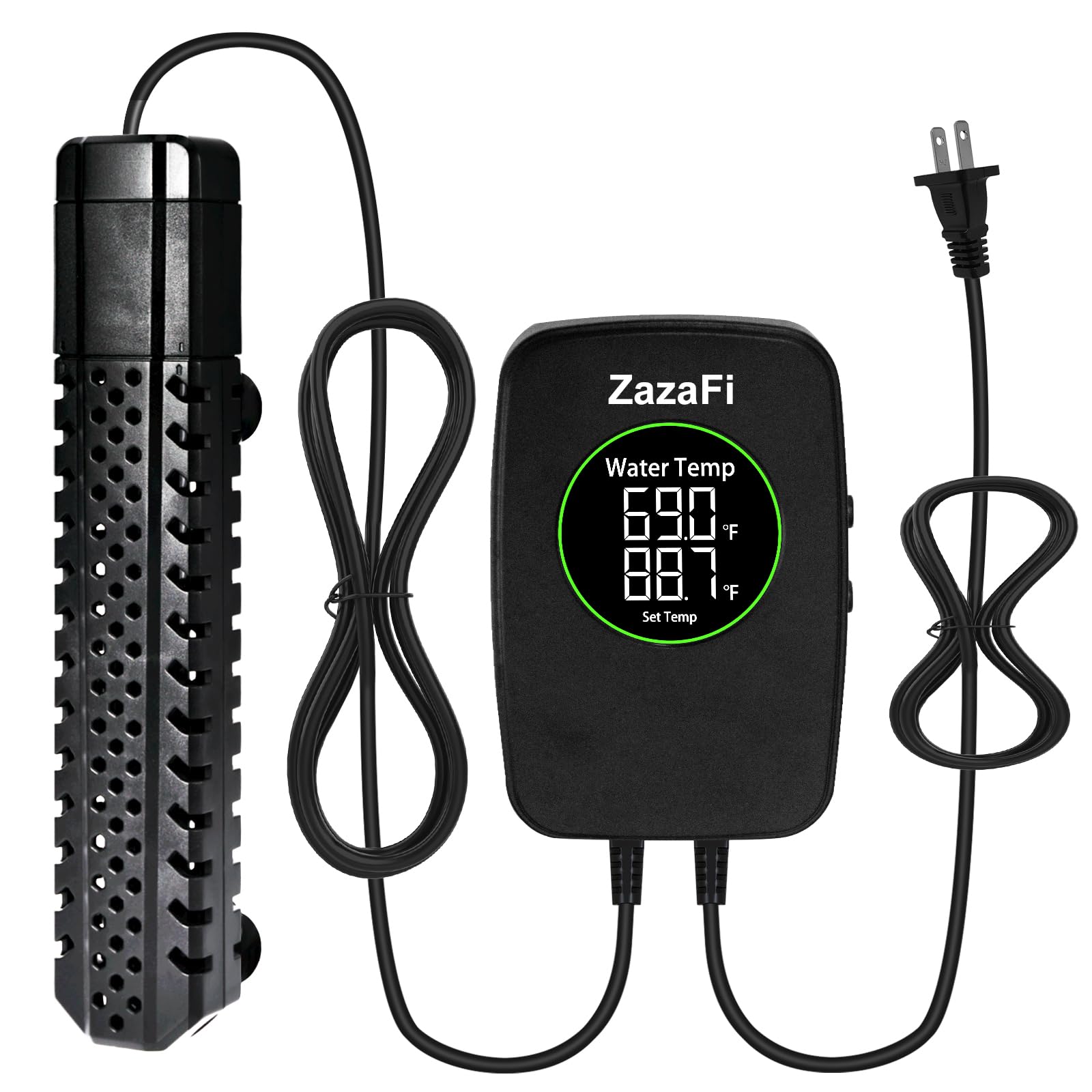
Rating: 4.6 ★ | Price: Mid-Range | Wattage: 300W | Control Type: Digital external | Safety Features: Overheat, out-of-water shut-off | Heater Material: Glass
The ZazaFi 300W heater holds tank temperature within 1°F of the set point, a level of consistency usually found in more expensive digital models. Its overheat and out-of-water shut-off provide reassurance, and the external digital display is easy to read. For a budget-friendly heater, it offers reliable performance out of the box.
This heater is best suited for budget-conscious aquarists who want digital control without the premium price tag. Buyers looking for a heater with a proven multi-year track record may want to wait for more long-term feedback to accumulate. A small number of button breakage reports exist, so gentle handling of the controls is advisable.
Pros
- Maintains tank temperature within 1°F of the set point.
- Works well for 75-gallon tanks according to users.
- Good build quality and easy-to-read external display.
Cons
- Button controls may be prone to breakage over time.
For those who want stable digital heating on a budget, the ZazaFi 300W is a capable option.
Best for High Wattage
AquaMiracle 500W
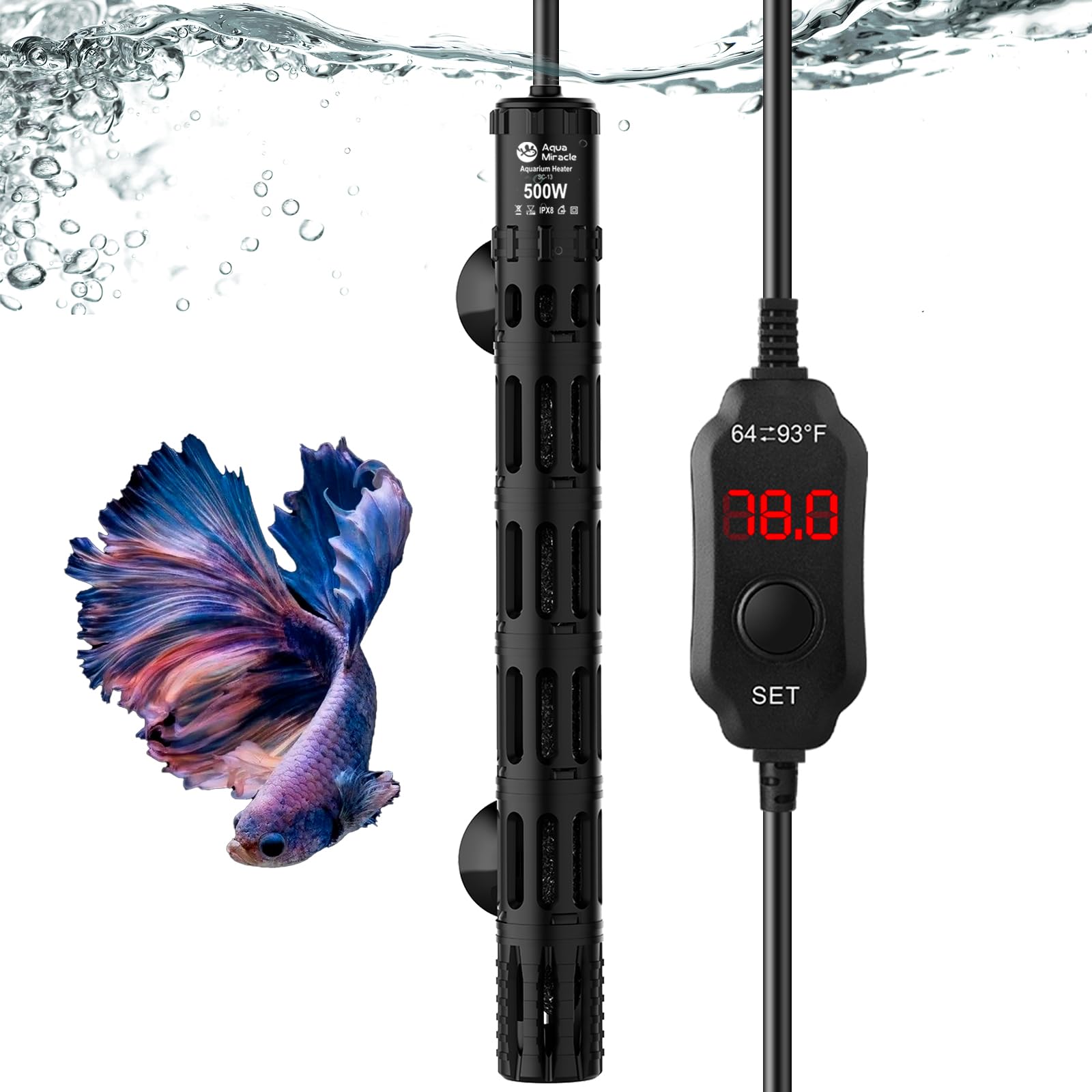
Rating: 4.7 ★ | Price: Budget | Wattage: 500W | Control Type: Digital external with memory | Safety Features: Overheat, dry-run shut-off | Heater Material: Glass
The AquaMiracle 500W delivers the highest wattage-per-dollar in this set, and its memory function restores your temperature setting after a power interruption. Where the top pick uses a shatter-proof PTC ceramic element, this is a glass heater that heats rapidly and includes overheat and dry-run shut-off. It doesn’t match the ceramic heater’s inherent safety, but it offers more brute heating capacity for a lower price.
Budget buyers with a 75-gallon tank get a 500W heater at a price that’s hard to beat, paired with an intuitive digital display and external controller. Long-term durability under continuous use hasn’t been established yet, so pairing it with a flexible return policy is wise.
Pros
- Heats large volumes rapidly, reaching set temperature quickly
- Digital display and external controller simplify temperature setting and monitoring
- Unbeatable wattage-per-dollar for a 500W heater, keeping large tanks warm on a budget
Cons
For a 75-gallon tank on a tight budget, this is the most heating power you’ll get per dollar at this tier.
Best for Beginners on Budget
HANLESHUKA 300W
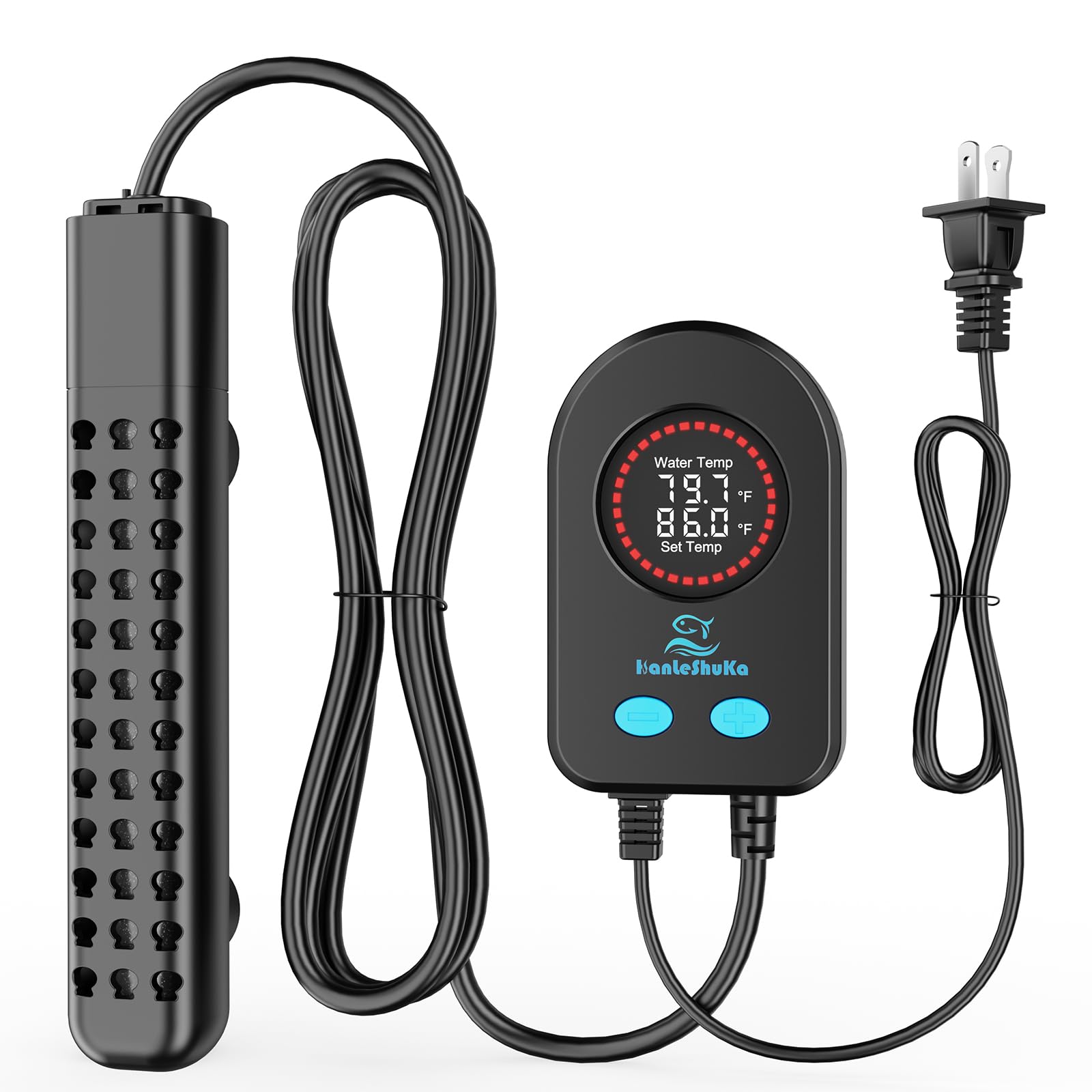
Rating: 4.6 ★ | Price: Budget | Wattage: 300W | Control Type: Digital external | Safety Features: Overheat, out-of-water shut-off | Heater Material: Quartz glass
The HANLESHUKA 300W holds water temperature within a tight 0.5°F range, a level of accuracy that rivals pricier digital models. The explosion-proof quartz glass construction adds a layer of safety over standard glass heaters. Where it differs from top ceramic picks like the HITOP 400W is wattage: this unit is rated for tanks up to about 40 gallons, making it underpowered for 75-gallon primary heating. Initial setup can be puzzling because the printed instructions are sparse, though once the settings are dialed in, the heater runs quietly and consistently.
This heater suits budget-conscious aquarists with medium-sized tanks (40–50 gallons) who value precise temperature control over raw heating power. The learning curve of the setup is manageable for those willing to spend a few extra minutes reading, and the lack of long-term usage data is offset by a price that won’t sting if replacement is needed down the road. For owners of larger tanks, a higher-wattage unit like the HITOP 400W is a more dependable choice.
Pros
- Keeps tank temperature stable within a narrow half-degree range.
- Heats water rapidly for medium-sized aquariums up to 40 gallons.
- Built with shatter-resistant quartz glass for added safety.
Cons
- Initial setup requires extra attention due to unclear printed instructions.
- 300W output limits it to tanks of 40–50 gallons; insufficient as a primary heater for 75 gallons.
For budget-minded owners of 40-gallon tanks who prioritize accurate temperature control, this heater delivers solid initial performance — just account for the learning curve of setup.
Best for Smaller Tanks
Aqueon 200W Preset

Rating: 4.3 ★ | Price: Budget | Wattage: 200W | Control Type: Preset (78°F) | Safety Features: Auto shut-off on overheat | Heater Material: Glass
This preset heater offers simple, no-adjustment operation at 78°F, making it a convenient choice for smaller aquariums or as a backup unit. However, at 200W it lacks the power to reliably maintain temperature in a 75-gallon tank, struggling to reach the set point in cooler rooms. The fixed setting also means you cannot raise the temperature for disease treatment. For tanks under 55 gallons or as a secondary heater, it provides dependable basic heating at a low cost.
Pros
- Simple preset operation at 78°F — no dial to adjust.
- Budget-friendly option for maintaining stable temperature in smaller tanks.
Cons
- In a 75-gallon tank, reaching 78°F may be inconsistent due to insufficient wattage.
- Fixed temperature setting cannot be raised for disease treatment or seasonal adjustments.
Serves best as a backup or for tanks under 55 gallons where 78°F is sufficient.
Best for Smaller Tanks
Marineland 200W

Rating: 4.3 ★ | Price: Mid-Range | Wattage: 200W | Control Type: Click dial | Safety Features: Thermal switch | Heater Material: Glass
Click-dial temperature adjustment and a thermal shutoff switch make the Marineland 200W heater easy to set and safe for smaller aquariums. Rated for tanks up to 55 gallons, it lacks the power to serve as the primary heater for a 75-gallon tank. For its intended range, it offers simple operation with built-in overheat protection.
Pros
- Click-dial adjustment allows precise temperature setting without digital complexity.
- Thermal switch automatically shuts off the heater in case of overheating.
Cons
- Quality control can be inconsistent — some units may require replacement shortly after purchase.
This heater works well for tanks up to 55 gallons where 200W is appropriate, but buyers needing a 75-gallon solution should look for a 300–500W model.
Best for Temporary Setups
AQUANEAT 300W
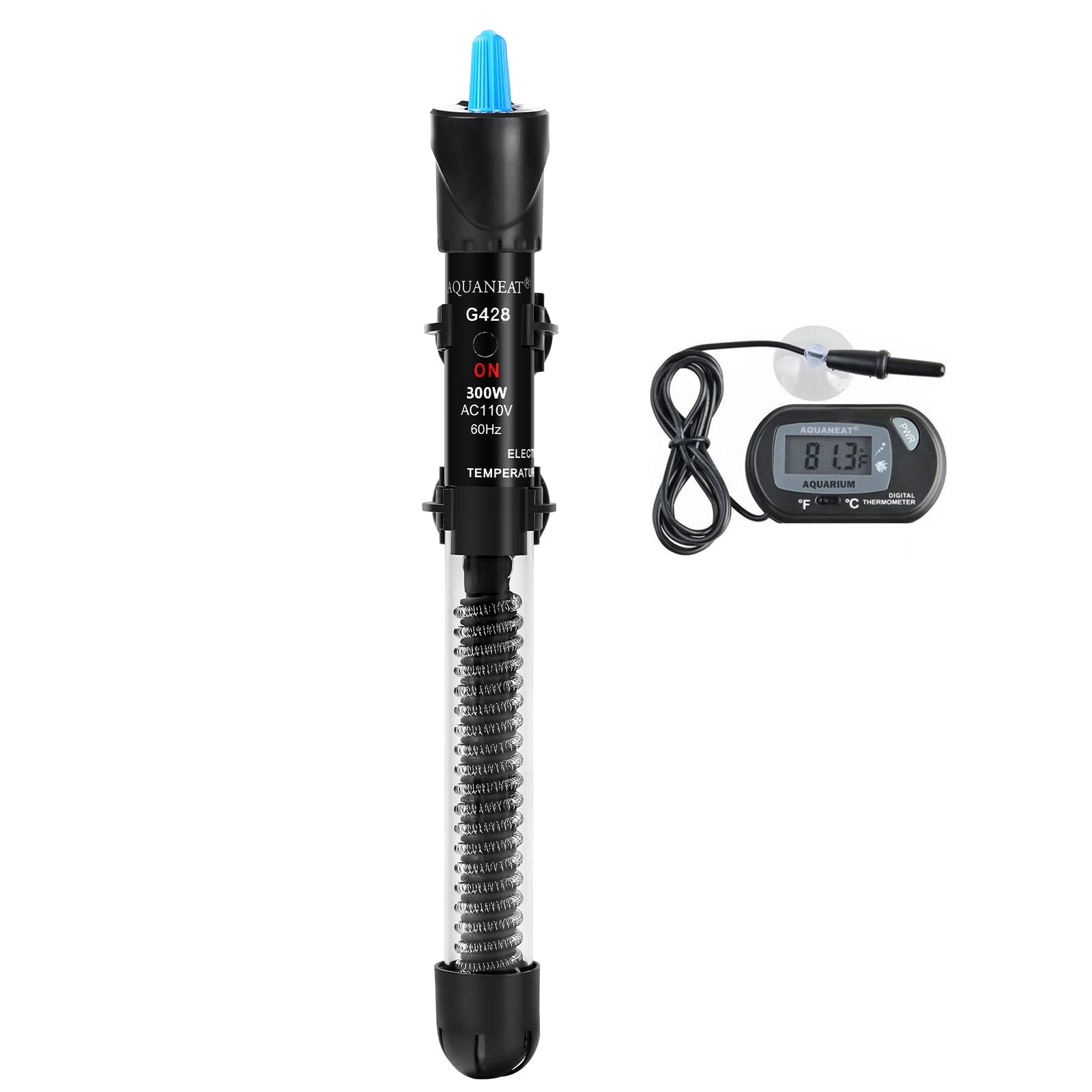
Rating: 4.2 ★ | Price: Budget | Wattage: 300W | Control Type: Top dial | Heater Material: Glass
The AQUANEAT 300W heater is a low-cost option that includes a separate digital thermometer for monitoring. The temperature dial is not accurate—you may need to set it higher than desired to reach the target—and some units can stop heating within the first month of use. This heater fits temporary hospital tanks or very tight budgets where basic heating is acceptable and exact temperature control is not critical.
Pros
- Very affordable and works for basic heating needs
- Includes a separate digital thermometer for independent temperature checks
Cons
- Suction cups may lose grip over time, allowing the heater to shift position
- Numbers printed on the temperature dial can wear off, making future adjustments less precise
Best suited for a temporary hospital tank or when budget leaves no room for a more accurate heater.
Best for Early Adopters
MantaMaze 300W

Rating: 4.5 ★ | Price: Mid-Range | Wattage: 300W | Control Type: Digital external | Safety Features: Overheat, out-of-water shut-off | Heater Material: Glass
The MantaMaze 300W brings effective heating to larger tanks, performing well in 75-gallon setups. Temperature consistency can be off by about 2°F in some units, a detail worth verifying with a separate thermometer. This makes it a better fit for early adopters willing to fine-tune their setup rather than those wanting a heater with a longer user history.
Pros
- Raises water temperature quickly, reducing wait time for tank warm-up.
- Operates effectively in 75-gallon tanks.
Cons
- Temperature reading may differ from actual by about 2°F, requiring a separate thermometer check.
A reasonable entry-level option for those who can monitor temperature manually, but heaters with more consistent performance and broader user feedback are available.
How to Choose
For a 75-gallon tank, matching wattage to tank volume is only half the equation — the material and control accuracy determine whether the heater lasts or becomes a hazard.
Wattage
A 75-gallon tank typically requires 300W to 500W, depending on room temperature and desired water temperature. A 300W heater will work in a heated room but may struggle in a cold basement, running constantly and shortening its lifespan.
Over-speccing to 500W gives headroom for cold climates and reduces the duty cycle, which can improve reliability. Going too large without proper flow may cause temperature spikes near the heater, so position it near filter output.
Temperature Control Type
Dial-based heaters are cheaper but often inaccurate — users report needing to set the dial 2–3°F higher to hit the target. Digital controllers with external displays allow you to see both set and actual temperature without lifting the hood.
The trade-off is that digital heaters rely on a sensor in the probe, which can drift over time. Calibration is possible on some models, but most lack that option. A separate glass thermometer remains the cheapest way to verify accuracy.
Safety Features
Auto shut-off on overheat and out-of-water protection are standard on most digital heaters, but they don’t prevent glass from cracking or plastic from melting. A heater that shuts off when dry might still fail catastrophically if the internal thermostat sticks.
PTC ceramic heaters are inherently safer because the ceramic element self-regulates resistance, reducing current as temperature rises — no mechanical switch to fail. This makes them less prone to cooking fish even if the controller malfunctions.
Heater Material
Glass heaters are the most common but carry a risk of cracking from thermal shock, impact, or internal pressure. Quartz glass is slightly tougher than standard soda-lime glass but still brittle. Plastic housing can melt or soften if the heater runs dry or the temperature exceeds design limits.
PTC ceramic heaters use a solid ceramic core encased in a protective shell — no glass to break. They also transfer heat more evenly, reducing hot spots. The downside is that PTC heaters are less common in high-wattage models, but options like the HITOP 400W fill that gap.
Warranty Length and Brand Track Record
Warranty length is a proxy for manufacturer confidence. A 5-year warranty, like Fluval offers, indicates the brand expects the product to last. Most budget heaters come with only 12 months or no explicit warranty, which aligns with their higher failure rate.
Brand track record matters because heaters with thousands of reviews expose reliability patterns that newer brands hide. Look for consistent feedback on longevity, not just initial satisfaction. If the reviews cluster around early failures, it’s a red flag even with a high average rating.
FAQ
Why does my aquarium heater keep turning on and off too often?
Frequent cycling usually means the heater is oversized for the tank or placed in a high-flow area where it senses rapid temperature changes. Check that the heater is near the filter outflow but not directly in the current. If the tank is in a drafty room, the heater may be struggling to keep up — consider adding insulation or a second smaller heater.
Is it safe to leave an aquarium heater on all the time?
Yes, submersible heaters are designed for continuous operation. They cycle on and off to maintain the set temperature. The risk comes from a stuck-on thermostat or a manufacturing defect, not from normal use. Using a heater with a separate temperature controller or a PTC element reduces the chance of overheating.
How do I calibrate my aquarium heater if the temperature is off?
Most dial heaters cannot be calibrated — you simply adjust the dial until a separate thermometer reads the target. Digital heaters with external controllers sometimes have a calibration mode (check manual). If yours lacks that, you can offset the set point by the measured error. Always verify with a reliable glass thermometer, not the heater’s display.
Can I use a 200W heater for a 75 gallon tank?
Not as the primary heater. 200W is sufficient for tanks up to about 50 gallons in a warm room. In a 75-gallon tank it will run constantly and may never reach 78°F, especially in cooler environments. Use a 300W–500W heater or run two 200W heaters for redundancy.