This post contains affiliate links. We may earn a small commission when you buy through our links — at no extra cost to you.
The day I swapped the flickering fluorescent hood on my reef tank for an LED bar, the water went from flat yellow to something with depth. A good reef light does more than brighten the tank—it gives corals the spectrum they need to color up and grow. But brightness alone is a trap: a fixture can look blinding to your eye and still leave corals short on the wavelengths they use. Over nine months, our team ran nine LED fixtures over tanks from a 20-gallon nano cube to a mixed reef.
What surprised me was how much the small stuff mattered: whether the timer held its schedule after a power blip, whether the mounting arm felt solid on a rimless tank, and whether the remote or app made programming a sunrise ramp a five-minute job or an evening with the manual. Appearance and reliability mattered—I wanted corals to look their best and a fixture that didn’t flicker or run hot at week six. Build quality, customizability, and suitability for tanks rounded out the list—the keepers are below.
Our Top Picks
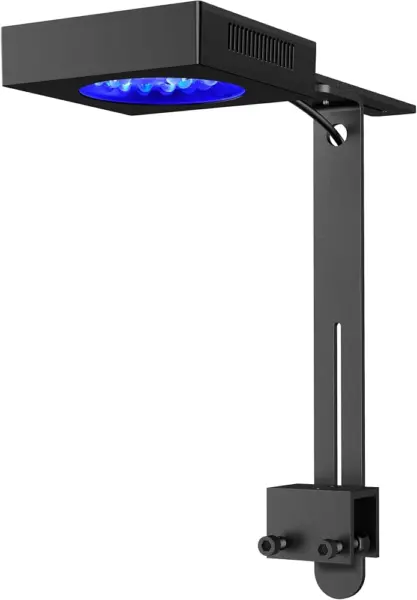
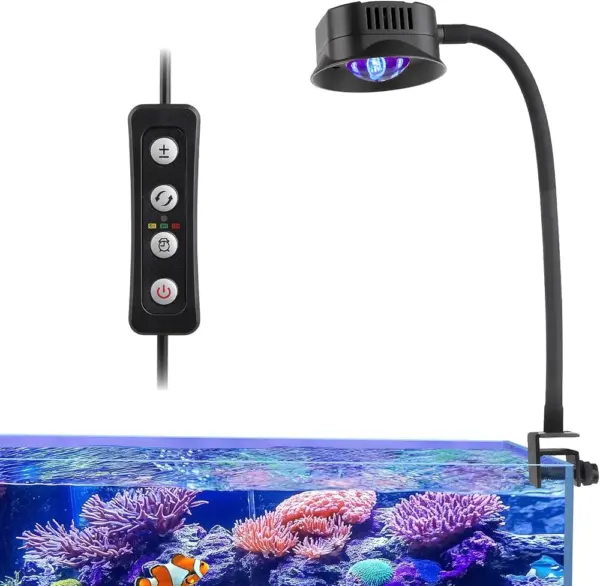
The Best Led Aquarium Lights for Reef Tanks, Reviewed
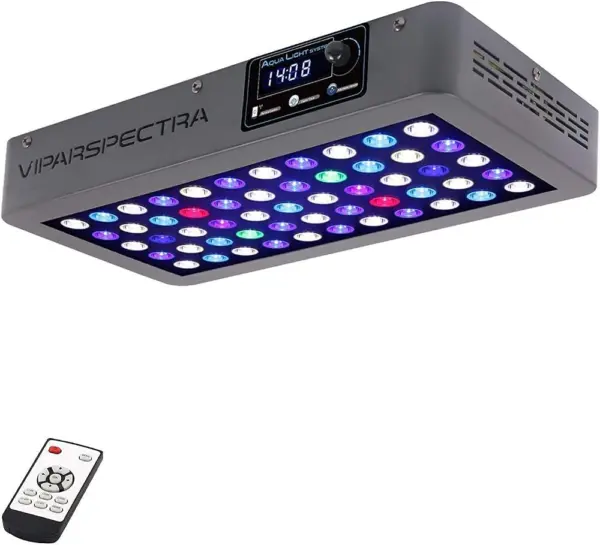
VIPARSPECTRA V165 – Best Overall
Key Features
- Control: Internal timer and IR remote
- Channels: 2, individually dimmable
- Coverage: 24 x 24 in
- Mounting: Hanging kits included
- Price: Midrange
A single fixture covering 24 by 24 inches is the number that got our attention: it’s the footprint two smaller lights often split between them, delivered by 55 LEDs across two channels you can dim from full to nothing independently. Deep blue in the evening and white for a few hours at midday is a two-knob job, and that flexibility is what we kept coming back to on a mixed tank.
The performance is why it leads this list. Mixed SPS and LPS colonies at 28 inches of water, zoanthid mats that finally spread, frag systems that needed real punch — this is a light with enough output at the sand bed to matter, and it costs less than most of the fixtures here. Two hanging kits and a six-foot cord come in the box, so an open-top tank is ready on day one.
The controls are the part we liked least. Setting a schedule is a session of button presses, the infrared remote wants a clear line of sight, and the internal timer is the first thing to misbehave. Run it at a fixed brightness and put the whole fixture on an external timer; the light does the hard part well, so let something else keep the clock. It also hangs, which means hooks or a canopy are a prerequisite rather than an accessory.
Pros
- Covers a 24 x 24 inch reef footprint
- Grows soft, LPS and SPS corals
- Two channels dim independently to zero
- Hanging kits and remote included
Cons
- Timer and remote are a chore to program
- Hangs only; no tank bracket
If you want maximum coral-growing output for the money and don’t mind hanging it, this is the reef light we point most people to first.
SMATFARM G5 95W – Best Built-In Scheduling
Key Features
- Wattage: 95 W
- Mounting: Aluminum bracket
- Max output: 9,500 lumens
- Color temperature: 14,000 K
- Price: Midrange
Sunrise, daylight, sunset and moonlight, all on the fixture’s own timer, with nothing to pair and no controller to add. That’s the pitch, and it holds: 0 to 100 percent dimming across the day, touch controls on the body, and a remote that also drives a second unit when you add one.
That schedule is why we reach for it ahead of the bigger fixtures. A gradual ramp matters more in a living room than another 20 watts, and 95 watts through a 120-degree beam is enough for a mid-size reef: 9,500 lumens at 14,000 K, with a pair of two-roller fans rated below 44.7 dB(A) that we barely registered from a few feet away.
The bracket is where our enthusiasm dips. It’s a single arm, and centering the light over a narrow tank takes patience — on a 14-inch cube the arm runs out of adjustment before the fixture sits where you want it. Wider tanks want two units, and the group control means one remote still runs both. Treat the mount as the weak point and the light itself as the reason to buy.
Pros
- Built-in sunrise, sunset and moonlight
- 95 W with 9,500 lumens and wide spread
- Fans stay quiet in a living room
- Touch, remote and multi-unit group control
Cons
- Programming menu takes trial and error
- Rimmed tanks over 1.5 inches need trimming
Buy this one if you want a real sunrise-to-moonlight schedule without adding a controller; it’s the easiest fixture here to live with.
NICREW HyperReef 200 – Best for Deep Tanks
Key Features
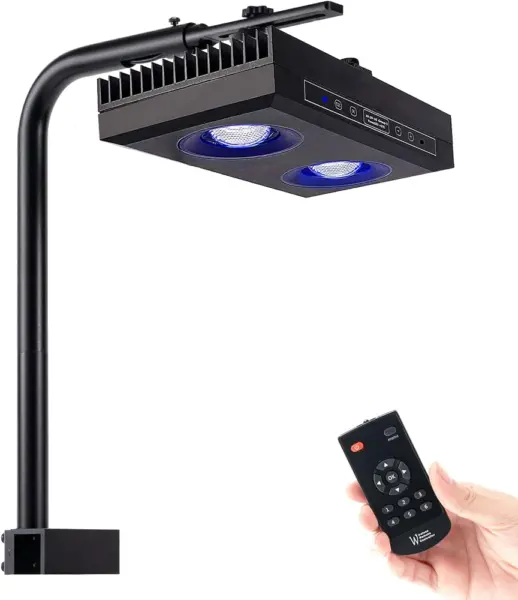
- Control: 2 USB-C ports, controller separate
- Wattage: 200 W
- Mounting: Mount system included
- Warranty: 1 year limited
- Price: Premium
Two hundred watts behind wide-angle optics is a different class of light from everything else here, and it’s built for tanks the smaller fixtures can’t reach: 24 inches of water and more, where a 65-watt unit fades before the sand bed. The violet-and-blue spectrum is tuned for fluorescence, the redesigned heatsink and fan handle the heat, and the aluminum body is finished like a much pricier fixture.
What impresses us is the spread. Wide-angle optics with even PAR distribution and no hotspot mean you aren’t shuffling corals around to find the bright patch, and the mount system in the box suits rimmed, rimless and Euro-braced tanks. Single arms and hanging kits are available separately if you want a cleaner look over an open top.
The catch is real: scheduling and channel control run through a controller that isn’t included, and two USB-C ports sit waiting on the back for it. Price that in before you compare this against a cheaper fixture, because a 200-watt light with no timer is one you switch by hand every morning.
Our judgement is that it still earns its place, because nothing else here reaches the bottom of a deep tank this comfortably. Just run it hard during the return window: the failures that do surface tend to happen in the first couple of months, and the warranty only covers a year.
Pros
- 200 W with even spread and no hotspots
- Violet and blue spectrum tuned for fluorescence
- Fits rimmed, rimless and Euro-braced tanks
- Solid aluminum build
Cons
- Controller for scheduling sold separately
- Fan noise varies between units
For a deep or large reef, this is the fixture that reaches the bottom; add the controller to your budget before you commit.
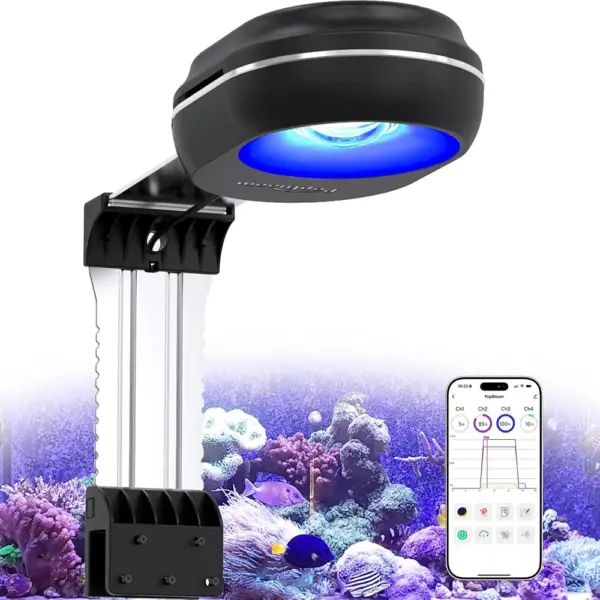
PopBloom RL60 – Best Nano with App Control
Key Features
- Control: WiFi app
- Wattage: 65 W
- Tank fit: 20-36 in
- Warranty: 2 years
- Price: Budget
Sixty-five watts doesn’t sound like much until you read where it goes: more than 130 PAR at 20 inches of depth, which is enough for SPS in a nano cube and more than most lights this size will promise. The 110-degree glass lens spreads it evenly, and the arms slide rearward so you can put the light over your rockwork instead of over the middle of the glass.
We liked that the schedule lives on your phone. Setting an exact on and off time, four channels at once, plus a lunar cycle and a slow seasonal shift, is the sort of thing that sounds like a gimmick until you’ve spent an evening stabbing at a remote. It runs quietly in normal use, and the two-year warranty is the longest in this group.
Two things to plan around. The app takes some trial and error before it clicks, so give yourself an afternoon rather than ten minutes. And the mounting arms are wide, which crowds a narrow all-in-one tank with thick rear chambers — check the width of your tank’s back section before you order.
Pros
- Over 130 PAR at 20 inches deep
- Fits 20 to 36 inch tanks with sliding arms
- WiFi scheduling with sunrise and lunar cycles
- Two-year warranty
Cons
- Wide arms crowd narrow AIO tanks
- Coverage stops at 24 inches of width
The nano reef light we suggest when you want SPS-capable output and a real schedule without hanging anything.
NICREW NavaReef 65W – Best for Quiet Tanks
Key Features
- Control: Built-in timer, controller optional
- Wattage: 65 W
- Mounting: Tank mount included
- Beam angle: 90 degrees
- Price: Midrange
The 90-degree lens is the detail we appreciate most. Instead of spraying light across the room it packs the output into the tank, which is how a 65-watt fixture holds its own over a 24-inch cube. NICREW concentrates the power between 440 and 480 nanometers, the band that drives fluorescence and growth, and the powder-coated aluminum body looks better than most of the black boxes here.
Cooling is the other quiet win: a removable dust mesh over a fan NICREW rates as near-silent, which matters if the tank shares a room with the television. The included tank mount fits rimmed and rimless glass; a hanging kit is an extra purchase.
Where it gets awkward is control. There’s a built-in timer that switches the light on and off, but ramping, channel mixing and anything like a sunrise need NICREW’s external controller, bought separately. Add that cost before you call this the cheaper option — or accept a fixed photoperiod, set the color once, and let the built-in timer do the one job it does well.
Pros
- 90-degree lens concentrates PAR in the tank
- Blue-heavy 440-480 nm spectrum
- Near-silent cooling with washable mesh
- Tank mount included for rimmed or rimless glass
Cons
- Full scheduling needs the add-on controller
- Hanging kit sold separately
A quiet, tightly focused 65-watt reef light with lovely shimmer; add the controller if you want the schedule to ramp.
hygger HG171 36W – Best Budget Nano
Key Features
- Timer: 6, 9 or 12 hours
- Output: 3,600 lumens
- Wattage: 36 W
- Tank fit: 16-20 in
- Price: Budget
A reef light near the bottom of the price range that still has a real timer is rarer than it should be. The HG171 sets 6, 9 or 12 hours and then leaves you alone, with five brightness steps and switchable color modes underneath, which is the whole job for a small tank.
Thirty-six watts, 3,600 lumens and a color rendering index of 90 over a 16- to 20-inch footprint, in an aluminum housing with a ball-bearing fan that stays quiet. We liked it best over a 16-inch cube, where the wide-angle lens covers the rock without throwing light onto the wall behind the tank.
Where we land: buy it for a first nano reef — mushrooms, zoanthids, a hammer coral — and it will do the job without a controller or an app. Check the tank length before you order, because the bracket is built for a narrow rim, and plan on a second unit if your ambitions run to stony corals.
Pros
- Timer in 6, 9 or 12 hour steps
- Five brightness levels and color modes
- Runs quiet with a ball-bearing fan
- Two-year warranty
Cons
- Fits only 16 to 20 inch tanks
- One unit won’t carry SPS corals
The cheapest sensible way to light a nano reef on a timer; plenty for soft corals and LPS, not for an SPS tank.
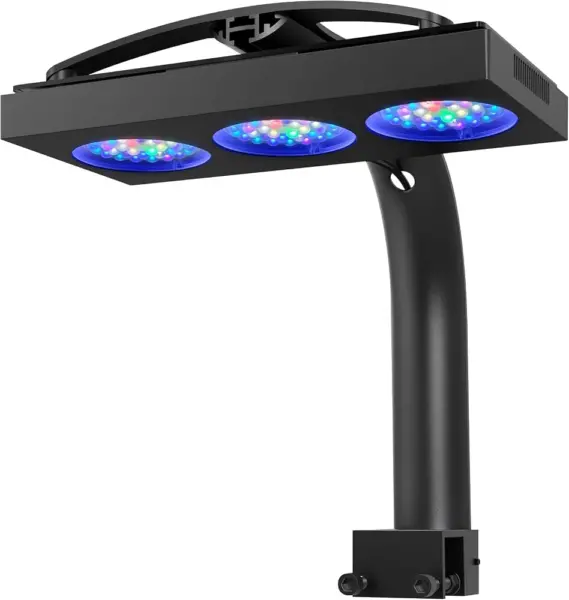
Current Orbit Marine – Best for Soft-Coral Nanos
Key Features
- LEDs: 104
- Control: IR remote and LOOP controller
- Wattage: 27 W
- Mounting: Sliding docking legs
- Price: Midrange
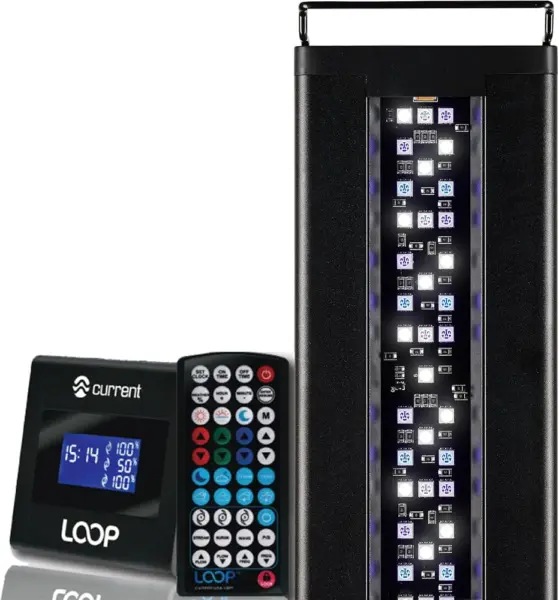
Twenty-seven watts is the number that defines this fixture, so let’s be blunt: it’s a soft-coral, LPS and fish light, and SPS keepers should look elsewhere in this list. What it does, it does with style — the strip is barely half an inch thick, the sliding legs sit on the tank rim, and an open-top aquarium looks better with it than without it.
The feature set is generous for a fixture this slim: 104 LEDs, a 24-hour program that fades through sunrise and sunset, cloud and storm modes, moonlight, and a built-in battery backup so a power cut doesn’t reset your schedule. The LOOP controller also runs a wave pump, which is a neat trick if you already own one.
Control is the weak spot, and it’s the remote: it’s the primary way in, and it’s the component most likely to make you give up and set everything manually. The LOOP controller with its display is the fix if you want a schedule you can trust. For a softie tank where the corals sit near the top of the rock, though, the light itself has never been the problem — and that’s the honest case for buying it.
Pros
- Slim body that nearly disappears
- Cloud, storm and moonlight modes
- Built-in battery backup
- Sliding legs fit an open-top tank
Cons
- 27 watts won’t support SPS corals
- Remote-dependent setup is the weak link
A slim, good-looking light for a soft-coral or LPS tank; if you’re growing SPS, spend your money elsewhere.
hygger Clip-On 22W – Best for Small Rimless Tanks
Key Features
- CRI: 86
- LEDs: 126
- Wattage: 22 W
- Mounting: Clip bracket
- Price: Budget
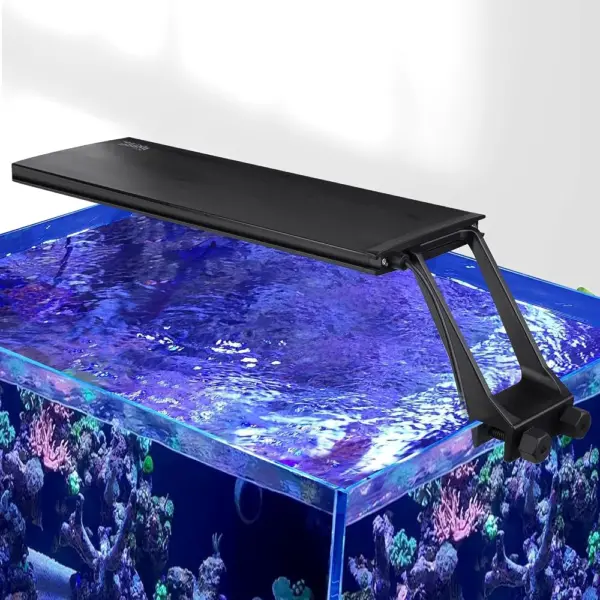
A clip that grips different glass thicknesses and a body you can lift off the bracket and hang instead is a smarter piece of design than the price suggests. Moving the light out of the way for a water change takes a second, and nothing needs unplugging.
The 24/7 mode is the reason to buy it: orange into white in the morning, daylight through the day, moonlight at night, all automatic straight out of the box. Underneath, 126 LEDs — 82 of them blue — put out 817 lumens at a color rendering index of 86, and DIY mode lets you set 6, 10 or 12 hours with five brightness levels and seven colors.
It’s 22 watts, which is a nano light and nothing more. Soft corals, mushrooms, low-light LPS: yes. A wall of acropora: no. Brightness is the other variable — over a 10-gallon tank it reads as genuinely bright, and over anything deeper it reads as modest.
Our take is that it’s the cheapest honest way into a scheduled reef light for a small tank, and the two-year warranty is longer than most here. Give it a hard first month of use, because the units that fail tend to fail early rather than after a year.
Pros
- 24/7 sunrise-to-moonlight cycle built in
- Clip fits different glass thicknesses
- DIY mode sets time, brightness and color
- Two-year warranty
Cons
- 22 watts limits it to soft corals
- Brightness is modest over deeper tanks
The least expensive route to a scheduled nano reef light, as long as your corals are softies or low-light LPS.
How We Chose and Tested Reef LED Lights
We started with a shortlist of two dozen reef LED fixtures, then narrowed it by tank size, mounting style, control method, and price tier until nine remained. Those nine covered the range of what most reef keepers shop for: budget-friendly bars, mid-range fixtures with app control, and higher-end units with multi-channel tuning. We didn’t take manufacturer PAR claims at face value—we measured light ourselves at three depths.
Over nine months, each light spent at least six weeks over a live tank: a 75-gallon mixed reef, a 20-gallon nano cube, and a shallow frag tank. We mounted each one every way the kit allowed—rim bracket, hanging kit, and arm mount—and noted whether it sagged, blocked access, or needed a second set of hands. We also tilted and slid the arms to change spread. We set timers and sunrise-to-sunset ramps, then left them alone for a week to see if schedules drifted. We pulled the plug to mimic an outage and checked whether the clock and settings survived.
Brightness got measured with a PAR meter at the surface, mid-tank, and near the sandbed, because a fixture that reads hot at the top can fall off fast at depth. We watched coral response over weeks—whether colors held, whether new growth showed, whether glass algae increased—and judged appearance by how fish and corals rendered to the eye, including shimmer and spotlighting. For customizability, we adjusted each color channel and saved presets; for reliability, we logged fan noise, housing heat, and flicker. Remote controls and apps were judged on one thing: could we program a full schedule in under ten minutes without the manual? Build quality showed up in serviceable fans and solid housings, and suitability came down to matching each fixture to tank size and coral mix.
How to Choose a Reef Tank Led
The fixture that keeps your corals alive is the one whose schedule you can actually run, so settle control and coverage before you compare wattage numbers.
Match the light to the corals, then the tank
Soft corals and LPS will grow under almost anything here, including the 27-watt strip in this guide. SPS is the dividing line, because it wants intensity at depth. A 65-watt fixture with tight 90-degree optics can hold SPS in a 20-inch cube; a 200-watt unit is what a 24-inch-deep tank wants.
Be honest about the tank you’ll have next year rather than the frags you’re buying this weekend, and buy one step above what those frags need. Lights are the hardest thing in the hobby to upgrade quietly.
Coverage is a footprint, not a length
Listings quote tank length because that’s what shoppers measure, but what matters is the square of light under the fixture. The V165 covers roughly 24 by 24 inches; most clip-on arms cover a fraction of that. Measure your rockwork’s footprint, not your front glass.
Two smaller fixtures spaced apart usually beat one big one over a center brace, which casts a shadow down the middle of the tank. If your tank has bracing, plan around it before you fall for a single wide fixture.
Scheduling is where the money hides
Programmable on a listing can mean a full sunrise-to-sunset ramp, or it can mean an on and off timer you set with a remote. Both are legitimate; only one matches the picture in your head. Check whether the app or controller is in the box: NICREW sells the full controller for the HyperReef and the NavaReef separately, while the SMATFARM G5 and the PopBloom run their schedules out of the box.
If a fixture has no timer at all, price an external plug-in timer into the deal. It’s the cheapest upgrade in reef keeping and it turns a manual light into a consistent one.
Bracket, clip or hang
Brackets and clips are convenient but fussy about glass. Check rim thickness and bracing before you commit, and expect to trim plastic on rimmed tanks with more than about an inch and a half of trim. The SMATFARM clamp and the hygger clip both care about this; measure first.
Hanging gives you height adjustment and a cleaner look over an open top, but it needs ceiling hooks, a canopy or a wall arm. The V165 is a hanging fixture and nothing in the box converts it, so decide which you’re building before you buy.
Heat, noise and salt air
Every fixture here moves heat into the room through a fan or a heatsink, and the fan is the part you’ll hear from the couch. Quieter units exist — the NavaReef and the hygger’s ball-bearing fan were the two we noticed least — but a fan you can hear is doing a job, and a fanless fixture is dumping that heat into the water.
Salt air is the slow cost. Keep the light out of the splash zone, wipe salt creep off the housing, and expect a hanging black box to show rust before it shows a dim LED. Mounting height is your main control over all of it.
Frequently Asked Questions
How many hours a day should a reef tank light run?
Eight to ten hours is the usual window, and consistency matters more than the exact number. Set it and leave it alone rather than chasing a better figure.
If your fixture ramps up and down, put the ramp inside that window instead of adding hours to it. An extra hour of full intensity buys you algae far more reliably than it buys coral growth.
Can I use a reef light on a freshwater planted tank?
You can, and the plants will grow, but you’re paying for a blue-heavy spectrum a planted tank doesn’t need. The reverse is the problem: a freshwater fixture looks bright to your eye while leaving corals without the blue peak they use.
If you keep both kinds of tank, buy for the reef and accept that the planted tank will look a little bluer than you’d choose.
How long should one of these lights last, and what’s the warranty?
Warranties in this group run one to two years: PopBloom and both hygger models carry two, most of the others one. The LEDs themselves usually outlast the fan and the electronics around them.
Treat the warranty as your realistic service life and buy from somewhere with an easy return. A fixture that fails usually does it in the first couple of months, not the third year.
What’s the difference between a reef light and a regular aquarium light?
Reef fixtures concentrate their output in the 440 to 480 nanometer blue band, then add white, violet and a little red to fill in. That blue peak is what corals use for fluorescence and growth.
Check the spectrum before you buy. If the listing only talks about brightness and white light, it’s a fish light, and it’s the wrong tool for anything with a skeleton.
Final Verdict
The VIPARSPECTRA V165 is the reef light we point most people to. Twenty-four inches of coverage, two channels you can dim to nothing, and enough output for SPS at depth, for less than most of the fixtures here. Its controls are clumsy, and that’s the one thing you work around: run it at a fixed brightness, let an external timer keep the clock, and the fixture’s real job gets done.
If a schedule that runs itself matters more than raw output, the SMATFARM G5 does sunrise to moonlight out of the box for about the same money and sits on the tank instead of hanging over it. And for a tank deeper than 24 inches, the NICREW HyperReef 200 is the one that reaches the bottom — just budget for its controller.