This post contains affiliate links. We may earn a small commission when you buy through our links — at no extra cost to you.
Every 125-gallon tank needs a filter that moves at least 375 gallons per hour and holds enough biological media to handle a heavy bioload. Many hobbyists start with budget UV combo units that promise clear water but fail mechanically within months, often leaving a tank without adequate filtration.
The real choice comes down to deciding which trade-offs matter most—proven long-term reliability with straightforward maintenance versus convenience features like a built-in heater. A filter that runs quietly, doesn’t leak, and keeps ammonia at zero for years is worth more than initial savings if you end up replacing it twice.
This guide focuses on canister filters that deliver consistent performance for a 125-gallon aquarium, filtering out the options that cut corners on durability or biological capacity.
Top Picks
Best for Large Tanks, Heavy Bioload
Fluval FX4 Canister
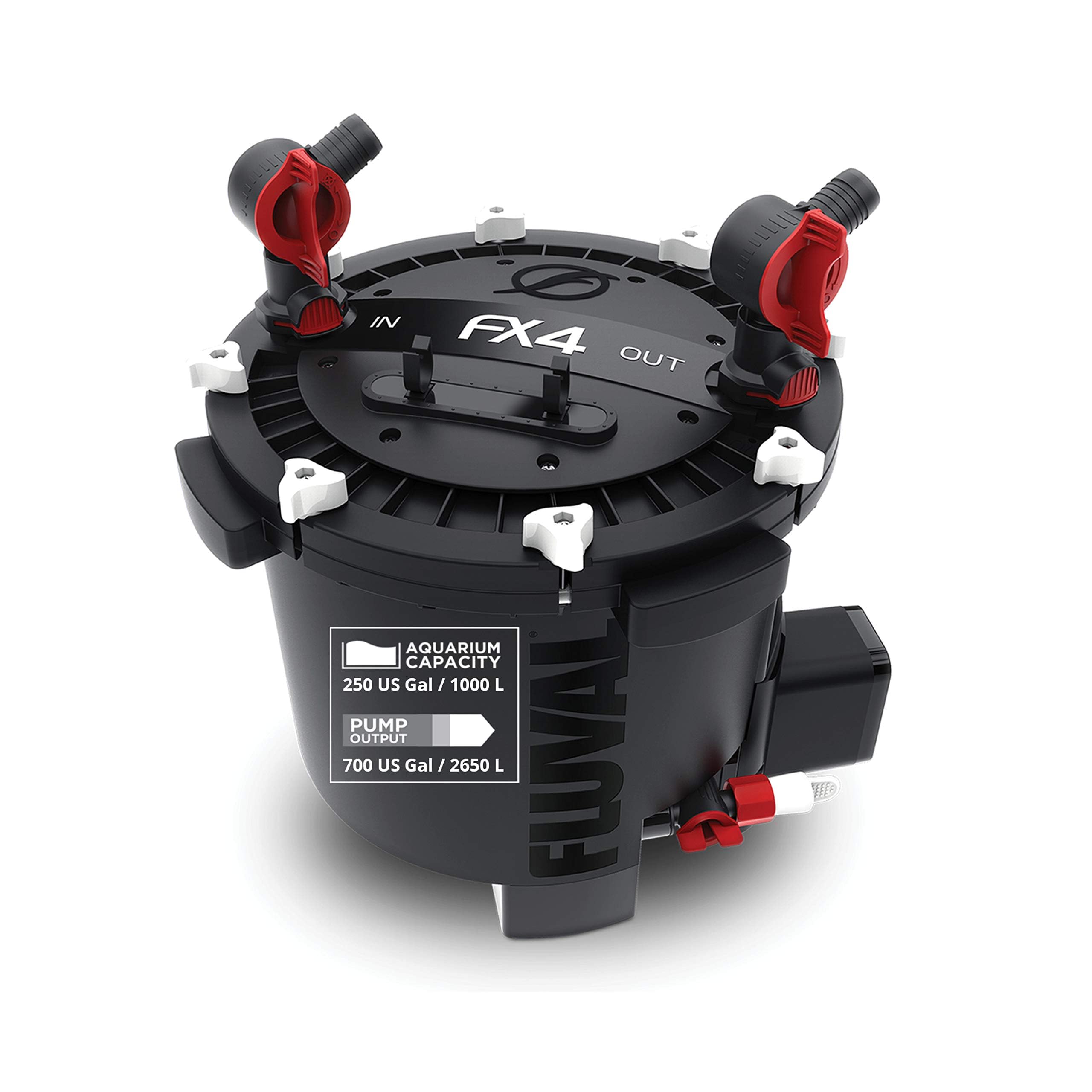
Rating: 4.5 ★ | Price: $$$ | Flow Rate: 700 GPH | Media Stages: 3 large trays | Ease of Maintenance: Drain valve, self-priming | Noise Level: Whisper-quiet
The Fluval FX4 moves 700 gallons per hour through a self-priming canister, clearing waste from tanks up to 250 gallons without the hum most filters produce. In a living room or bedroom, the sound level stays low enough that you’d forget it’s running — a meaningful difference for anyone who keeps their aquarium in a shared space.
The integrated drain valve simplifies water changes: instead of hauling buckets, you attach a hose, open the valve, and let gravity do the work. That convenience comes with a tradeoff during maintenance — the hose connections can be stiff enough that some owners reach for pliers to separate them. A 3-year warranty backs the build, though a small number of units have had the motor stop after about a year of continuous use, so it’s worth noting before committing to a high-flow canister at this price.
This filter suits aquarists running cichlid, goldfish, or other high-bioload setups where mechanical and biological filtration need to keep pace. The premium price and involved hose disconnection make it a poor fit for budget shoppers or anyone looking for a built-in heater — those buyers should consider the OASE BioMaster instead. For long-term owners who value quiet operation and easy water changes, the FX4 delivers predictable performance.
Pros
- 700 GPH flow rate keeps large tanks clear with strong water turnover
- Integrated drain valve cuts water-change time to minutes
- Runs quiet enough for a living room or bedroom placement
Cons
- Hose disconnection during maintenance can be stiff enough to require tools
- Motor stoppage after 9–12 months of continuous use has been noted in some units
For large freshwater tanks with heavy bioloads, the FX4 pairs high flow with genuinely quiet operation and a water-change feature few competitors match — accept the occasional maintenance fuss and the small possibility of early motor wear.
Best for Built-In Heater, Easy Cleaning
OASE BioMaster Thermo 350

Rating: 4.3 ★ | Price: $$$$ | Flow Rate: 350 GPH | Media Stages: 4-stage with Hel-X | Ease of Maintenance: Removable pre-filter | Noise Level: Air purging sometimes
The built-in heater eliminates an in-tank appliance, and the removable pre-filter can be rinsed without opening the main media baskets — both genuine time-savers for regular maintenance. Against the Fluval FX4, you gain a cleaner look and simpler upkeep, but lose some flow rate (350 vs 700 GPH) and gain a noticeable sound: the occasional gurgle of the system purging trapped air.
This filter suits aquarists who prioritize a clutter-free tank and are willing to accept an audible purge cycle every so often — especially relevant in living rooms or offices where equipment visibility matters more than dead silence. The air-intake noise can be a distraction in a quiet bedroom or study, so it’s worth placing the canister in a cabinet or less sensitive area if possible.
Pros
- Built-in heater frees up tank space and eliminates a separate device.
- Removable pre-filter can be cleaned without disturbing biological media.
- Solid construction and well-finished components typical of German design.
Cons
- Operation noise can vary between units; some are quiet, others produce a noticeable hum.
- In quiet rooms, the air-purging gurgle can be a regular distraction.
If you want a heater integrated into the filter loop and value quick pre-filter access, this is a capable choice — just factor in the occasional purging sound that comes with the design.
Best for Mid-Range, Feature-Rich
Aqueon QuietFlow

Rating: 4.3 ★ | Price: $$ | Media Stages: 4-stage + polishing | Ease of Maintenance: Quick-disconnect valves | Noise Level: Whisper-quiet
Unlike the top pick, which prioritizes long-term durability and a 3-year warranty, the Aqueon QuietFlow adds a hang-on polishing unit for extra water clarity. The four stages, housed in three large trays, provide generous mechanical, chemical, and biological filtration that handles heavy bioloads.
This canister suits aquarists who value the polishing unit and whisper-quiet running enough to accept a less established reliability record. The tight-bend tubing requires extra effort during cleaning, and a subset of units may experience motor failure within the first few months — having a backup plan is prudent. For tanks in quiet living spaces where crystal-clear water is the priority, those tradeoffs are manageable.
Pros
- Whisper-quiet operation that won’t disrupt quiet living spaces
- Four-stage filtration with large media trays handles heavy bioloads in 125-gallon tanks
- Quick-disconnect valves and washable media simplify routine maintenance
Cons
- The tight bends in the tubing make thorough cleaning a chore without a flexible brush
- Motor failure may surface in some units after several months, leaving the tank without filtration
If the top pick’s warranty and track record matter less than a dedicated polishing unit and four-stage filtration, the QuietFlow delivers solid value — provided you’re comfortable with occasional maintenance hurdles and the possibility of an early motor issue.
Best for Budget Canister Buyer
Penn-Plax Cascade 1200

Rating: 4.3 ★ | Price: $ | Flow Rate: 315 GPH | Media Stages: 4 stackable baskets | Ease of Maintenance: Quick-disconnect, removable trays | Noise Level: Can get loud over time
The Cascade 1200 offers canister filtration at a mid-range price that’s far more accessible than premium models. Four stackable media trays, push-button priming, and quick-disconnect valves make installation simple, and the 315 GPH flow rate is adequate for tanks up to 150 gallons. Where the top pick provides decade-spanning durability, the Cascade 1200 saves you money upfront but asks you to accept that the pump housing may eventually crack or the motor may grow louder.
This filter fits budget-minded aquarists who can mount it in a fish room or basement where moderate noise isn’t a dealbreaker. Beginners comfortable with the idea of replacing a part after a year or two will find the initial savings worthwhile. If you require silent operation or a maintenance-free lifespan beyond a few years, springing for the top pick is wiser.
Pros
- Mid-range price undercuts most competitors in the 150-gallon canister class
- Quick-disconnect valves and slide-out trays make maintenance straightforward
- Returns water to crystal clarity within hours, even after substrate disturbance
Cons
- Motor hum can become noticeable over time, especially in quiet rooms
- The pump housing can develop cracks after months of use, causing potential leaks
For a large tank on a budget, the Cascade 1200 delivers fast water clarity and straightforward maintenance — just account for the possibility of repair costs down the road.
Best for High-Flow Supplement
TARARIUM Internal 400GPH

Rating: 4.3 ★ | Price: $ | Flow Rate: 400 GPH | Media Stages: 3-stage deep filtration | Ease of Maintenance: Transparent, easy rinse
This 400 GPH internal pump delivers strong circulation at a budget-friendly price, creating noticeable wave action that keeps debris suspended for mechanical removal. At this price, it’s a cost-effective way to add high-volume water movement to a large tank. Unlike canister filters that provide complete biological filtration, this unit is best used as a supplementary water mover — not a standalone filter for a 125-gallon tank.
It suits bare-bottom tanks or aggressively stocked African cichlid setups where high flow is desired. The lack of flow adjustment means it cannot be dialed back for planted tanks or slow-moving species. Some units may stop working within weeks, so buying with a return policy is wise. The transparent housing makes it easy to spot when the sponge needs rinsing, and the included media handles basic mechanical filtration — but you’ll need a separate canister to handle the biological load of a 125-gallon tank.
Pros
- Powerful 400 GPH flow creates strong water movement ideal for high-flow setups.
- Easy to clean — transparent box lets you see when media needs rinsing.
- Budget-friendly way to add high-volume circulation to a large aquarium.
Cons
- Motor may stop working within the first few weeks of use.
- Strong current cannot be reduced — unsuitable for planted tanks or delicate fish.
If you need raw circulation power on a budget and can accept the possibility of early motor shutdown, this internal pump delivers impressive flow for the price.
Best for Turtle Tanks, Low Water
TARARIUM Turtle UV
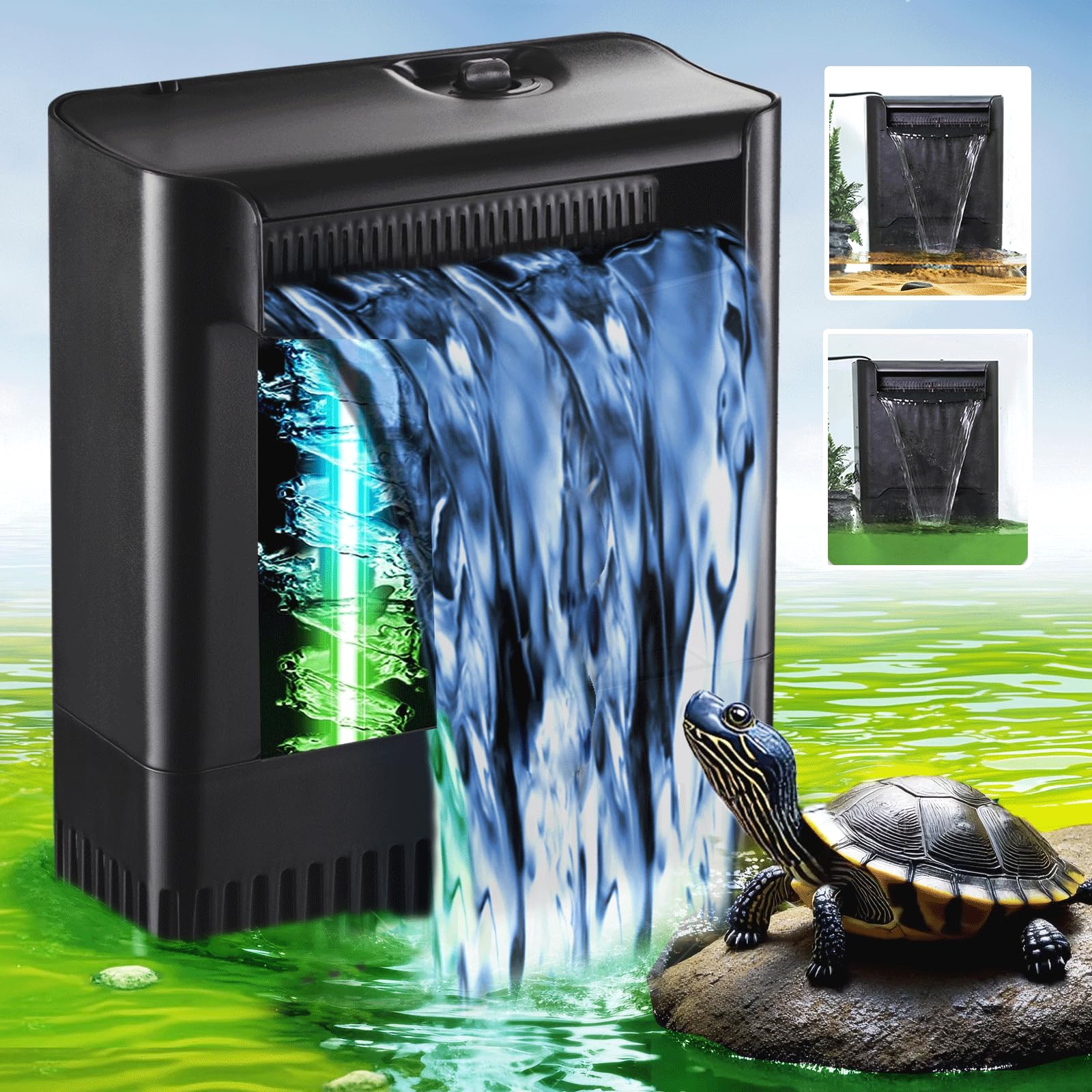
Rating: 4.3 ★ | Price: $$ | Media Stages: UV + ceramic + sponge | Ease of Maintenance: Easy to clean | Noise Level: Quiet
For turtle tanks with moderate waste, this UV filter clears water and cuts odors effectively, with quiet operation and easy cleaning. Its low-water design suits shallow habitats. However, the lid can pop off when bumped, and some units may stop running after a few weeks—making it a specialized tool for turtle keepers rather than a primary filter for 125-gallon fish tanks.
Pros
- Clears turtle tank water and reduces odors effectively.
- Quiet operation and simple cleaning process.
Cons
- Lid may pop off if bumped, requiring careful placement.
- Motor may stop running after a few weeks, so a flexible return window is wise.
Best suited for turtle keepers with moderate bioload who prioritize low-water operation and can accept occasional lid adjustments.
Best for Quick Water Clearing
Marineland Magniflow 360

Rating: 4.1 ★ | Price: $$ | Flow Rate: 360 GPH | Ease of Maintenance: Push-button prime | Noise Level: Often quiet
The Marineland Magniflow 360 uses push-button priming and can clear a 125-gallon tank within a day, offering a fast response to murky water. However, the main seal and valve block can develop leaks over time, and some units may require repairs within the first year. This filter suits aquarists who need immediate clarity and are prepared for periodic maintenance, but not those seeking a hands-off, long-term solution.
Pros
- Clears tank water noticeably within 24 hours.
- Push-button priming simplifies startup and power-outage restart.
Cons
- Some units may require repairs within the first year, making this a short-term rather than long-term option.
Choose this if you need fast water clarity and are comfortable with occasional maintenance, but not for a set-and-forget filter on a 125-gallon tank.
How to Choose
The most important factor for a 125-gallon filter is flow rate: you need at least 375 GPH (3x turnover) to keep waste suspended and biological media oxygenated.
Flow Rate
Higher flow moves more water through the filter per hour, but too much can stress fish or blow substrate around. For a 125-gallon tank, 3–5x turnover (375–625 GPH) is the sweet spot. Canisters rated for 700 GPH work well when throttled back with a valve, but a 300 GPH internal pump won’t circulate enough water for even moderate stocking.
Flow rate also affects how quickly your heater warms the whole tank. A strong current distributes heat evenly, reducing cold spots. If you keep high-flow species like African cichlids, err toward the upper end of that range.
Media Volume and Stages
Biological media is the heart of any filter. A 125-gallon tank needs enough ceramic rings, bio-balls, or sintered glass to host beneficial bacteria that convert ammonia and nitrite. Look for at least 2–3 liters of media volume. Multi-stage filters let you add a polishing sponge or carbon without sacrificing bio space.
Cheaper UV combo filters often skimp on media—they may hold only a thin sponge, leaving you with a clarifier that does little for ammonia. That’s fine as a supplement, but not as the sole filter for a tank this size.
Ease of Maintenance
Quick-disconnect valves let you remove the canister without flipping or spilling hoses. Self-priming pumps restart automatically after a power outage, saving a lot of hassle. A pre-filter that slides out separately allows you to rinse mechanical waste without disturbing the biological media—a big time-saver when cleaning every few weeks.
Noise Level
Noise from a canister filter comes from the pump motor and from air trapped in the lines (gurgling). Magnetically driven pumps are quieter than shaft-driven ones. Air purging issues are more common in filters with poor priming systems or internal heater housings that trap bubbles. If the filter sits in a living room or bedroom, prioritize models with consistent quiet operation.
Over time, debris can cause impeller noise. Regular cleaning of the impeller and shaft prevents grinding sounds.
Durability and Leak Resistance
Leaks typically happen at the O-ring seal on the canister head or at the valve block. Polycarbonate or reinforced ABS housings last longer than thin plastic. A 3-year warranty is a strong indicator of expected lifespan. Filters that crack at the pump housing or develop hairline fractures after a few months are not worth the initial savings.
Keep spare O-rings lubricated with silicone grease. Rubber seals dry out and shrink, especially if the filter is placed near a heat source.
FAQ
Why does my canister filter keep losing prime and making gurgling noises?
Air gets into the system through a loose hose connection, a worn O-ring, or a drop in water level in the tank. Check all hose clamps, lubricate the O-ring, and ensure the intake strainer stays fully submerged. If the noise persists after tightening everything, the pump’s self-priming mechanism may be failing—consider replacing the impeller assembly or the filter itself.
Can I use a submersible UV filter as the main filter on a 125-gallon tank?
No. Submersible UV filters are designed to clarify water by killing algae, not to provide biological filtration. They lack the media volume needed to handle ammonia and nitrite from a 125-gallon tank’s bioload. Use them only as a supplement alongside a proper canister or hang-on-back filter with ample bio media.
How often should I clean the pre-filter on my external canister filter?
Every 2–4 weeks, depending on stocking density. Rinse the pre-filter sponge in tank water (not tap) to remove solid waste without killing beneficial bacteria. A clogged pre-filter reduces flow and starves the biological media of oxygen, leading to ammonia spikes.
Is a 300 GPH canister enough for a heavily stocked 125-gallon aquarium?
No. A heavily stocked tank needs at least 3–5x turnover per hour, which means 375–625 GPH. A 300 GPH canister will struggle to keep waste suspended and oxygen levels high, increasing the risk of ammonia buildup and fish stress. Look for filters rated 500 GPH or higher for heavy bioload.