This post contains affiliate links. We may earn a small commission when you buy through our links — at no extra cost to you.
A heater that dies quietly is a nuisance. A heater that sticks on and keeps heating is a catastrophe — you come downstairs to a tank at 95 degrees and fish you can’t save. That’s the worry behind every tropical setup, and it’s what I check first in a new model: does it hold the temperature it’s set to, and does it actually shut off. It also has to fit behind a filter and stay stuck there.
Over four months, my team and I ran 14 heaters in tanks around our homes, from a 10-gallon quarantine tank to a 75-gallon community setup, and the differences showed up in boring places — a dial that drifts two degrees, a suction cup that lets go in week three. Something first-time buyers don’t hear enough: wattage ratings assume a room near 70 degrees, so a tank in a cold basement needs more heater than the box claims, and two smaller units will save your fish if one fails. The picks below were chosen for steadiness first.
Our Top Picks
The Best Tropical Aquarium Heaters, Reviewed
HiTauing 300W – Best Overall
Key Features
- Control: External digital controller
- Wattage: 300W
- Tank size: 40-75 gallons
- Temperature range: 63-94°F / 17-34°C
- Price: Midrange
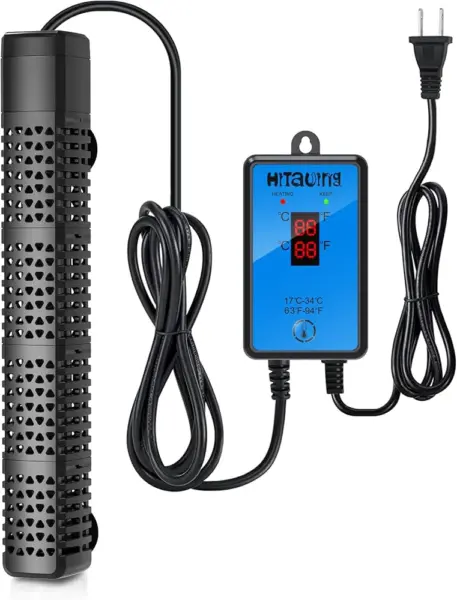
The control unit for this 300W heater lives outside the aquarium, on the end of the cord, and that one decision explains why it leads this list. Setting a tropical tank to 78°F means pressing a button on a display you can read from a chair, with both hands dry. Coming from a dial that has to be squinted at through glass and water, the thing we appreciated was simply knowing what the heater was doing.
The ratings suit a big community tank: 300 watts for 40 to 75 gallons, a 63 to 94°F range, and a water sensor that stops the heat if the tube is exposed or the temperature runs past the set point. That range is more useful than it sounds. Holding 78°F for tetras and corydoras is the easy part; having headroom above 86°F is what lets you treat ich without buying a second heater.
The body is the part to think about before ordering. At nearly 13 inches it is the longest tube here, so it wants a horizontal run along the back glass — in a tall, narrow 45-gallon it will be more visible than you expect. The four-section housing comes apart with clips, which makes wiping algae off the tube a two-minute job at water change time instead of a wrestling match.
The housing is also the part worth watching. It shields the glass, and a section that cracks or works loose leaves the tube exposed to fish, nets and the gravel vac. Check the clips each time you have the heater out, and the rest of the upkeep is a wipe.
Pros
- Sets and reads temperature outside the tank
- 63-94°F range covers ich treatment
- Overheat and out-of-water shutoff
- Four-section housing comes off for cleaning
Cons
- Thirteen-inch tube is a tight fit in tall tanks
- Housing clips can work loose or crack
For a 40-to-75-gallon tropical tank, this is the heater we point people to: you set and read the temperature from outside the water, and the protection circuit covers the mistakes we all make.
HiTauing 200W – Best for 20-40 Gallon Tanks
Key Features
- Length: 8.3 inches
- Control: Digital display, external
- Wattage: 200W
- Tank size: 20-40 gallons
- Price: Premium
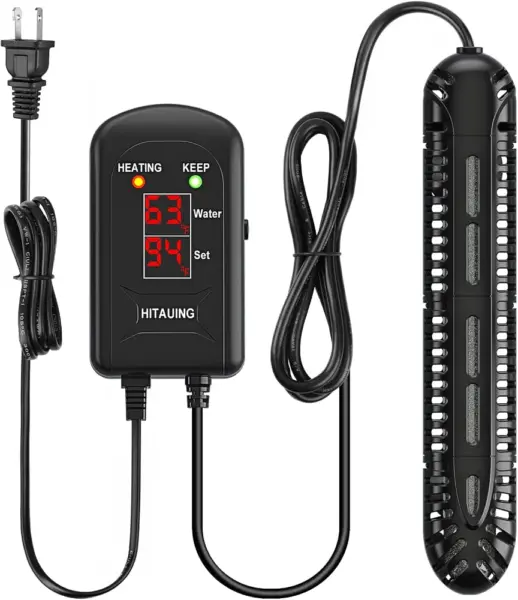
Twenty to forty gallons is where most tropical tanks actually live — a 29-gallon community, a 40 breeder, a 37-gallon column — and this is the HiTauing built for that band. It is 200 watts in an 8.3-inch body, with the controls on the cord rather than a dial in the water.
The display separates the number you set from the number the water is actually at, and that turns out to be the most useful thing about it. A single-number controller always leaves you guessing whether you are looking at the target or the reading. Here, a tank sitting two degrees under its set point is obvious at a glance, which is the earliest warning you get that a heater is losing the plot.
We think this is the right buy for anyone in that 20-to-40-gallon window who wants to stop fiddling. Nudging the set point for a cold snap takes seconds, and the five protection circuits matter more in a small volume, where a stuck thermostat can push the temperature up quickly. It is rated for 20 to 40 gallons and it means it — put 200 watts in a 55 and you will be asking too much of it.
Two practical notes before you order. The controller needs a spot on the glass or the stand, and no suction cup for it comes in the box, so plan that run before the tank is full. And like every glass heater here it will eventually quit; a cheap thermometer at the opposite end of the tank is what tells you it has.
Pros
- Shows set and current temperature separately
- Five protection circuits, controls outside the water
- Compact 8.3-inch body for 20-40 gallon tanks
Cons
- Controller ships without a suction cup
If your tank sits between 20 and 40 gallons, this is the version to buy: the same out-of-tank control as our top pick, in a body that fits a mid-size community.
Fluval M 200W – Best Discreet Pick
Key Features
- Finish: Mirror glass
- Control: Adjustable dial
- Wattage: 200 watts
- Warranty: 3 years
- Price: Premium
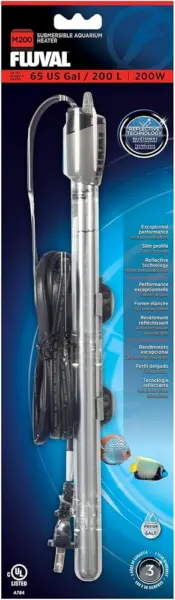
Most heaters are a black tube you learn to look past. The Fluval M’s mirrored glass reflects whatever is around it, and in a planted tank it is the only one here we stopped seeing after a while — a small vanity, but the thing sits at eye level in your living room for years.
Under the finish it is a conventional 200-watt glass heater with a dial on top, and the dial is the reason to pick it over a preset. You can hold a community at 78°F, push a degree or two warmer when something is going around the tank, or back off for a species that prefers cooler water. And the three-year warranty is the longest here by a clear margin, which on a part that lives in water 24 hours a day counts for more than a nicer finish.
Two things to settle before it goes in. The cap is meant to sit at the waterline rather than fully submerged, so plan a mounting height where the top of the tube stays at the surface; laying it flat along the bottom is out. And the warm end is the one to check against your fish: the high seventies and low eighties are comfortable territory, but discus and rams kept at 85°F are asking more than a 200-watt dial heater comfortably gives.
Pros
- Mirror glass nearly disappears in a planted tank
- Three-year warranty, the longest here
- Adjustable dial across community temperatures
- Rated for fresh and salt water
Cons
- Cap must sit at the waterline
- No digital readout of current temperature
Buy the Fluval M when you want a heater that disappears against a planted background, a dial you can set by feel, and three years of cover behind it.
Orlushy 300W – Large Tanks, Adjustable
Key Features
- Length: 11 inches
- Control: Adjustable thermostat
- Wattage: 300W
- Warranty: 1 year
- Price: Midrange
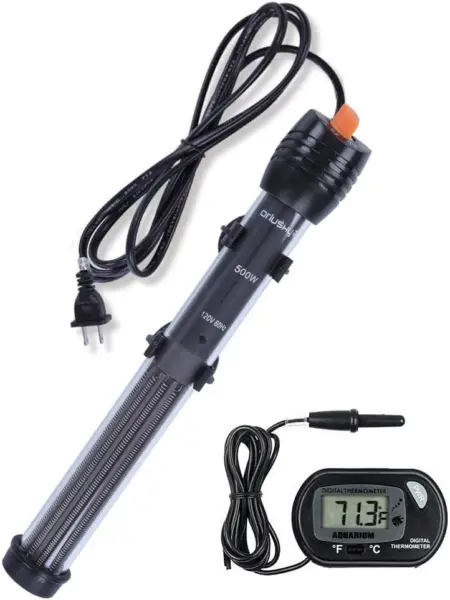
Orlushy builds this heater in six wattages, and every one of them is adjustable rather than preset. That is the appeal of the line: you size it to the tank you have, then set the thermostat yourself instead of accepting a fixed 78°F.
This 300-watt version is an 11-inch tube under a heat-resistant ABS shell, so it reads as a solid, plain object rather than a bare glass stick, and it suits the back wall of a 55 or 75. It heats in steps instead of one long burn, with a light on the body that shows red while it is working and green when it is resting — a status you can read from across a dark room, which a display cannot do.
The number we weigh most heavily after the thermostat is the warranty, and here it is one year against the Fluval’s three. That is the trade: a simple, adjustable heater for a big tank, with a shorter safety net under it. Treat it as a part you will replace rather than repair, and keep a thermometer in the tank to tell you when.
Pros
- Adjustable thermostat, not a fixed preset
- ABS shell covers the glass
- Red and green lights show heating state
Cons
- One-year warranty trails the Fluval’s three
- Eleven-inch body needs horizontal space
For a big tank on a modest budget, the Orlushy gives you a real adjustable thermostat and a shell over the glass, as long as a one-year warranty does not bother you.
hygger 20W Mini – Best for Desktop Betta Tanks
Key Features
- Alarm: Audible fault alarm
- Control: External digital controller
- Wattage: 20W
- Tank size: 1-5 gallons
- Price: Budget
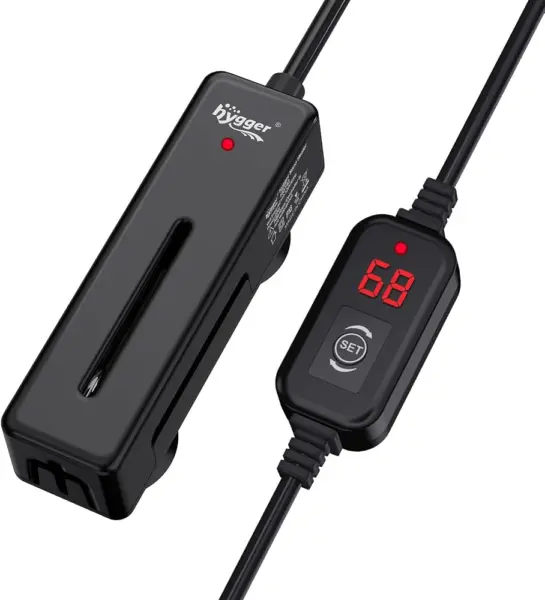
Small tanks evaporate fast. A 3-gallon betta setup can drop below the heater line in a week of dry indoor air, and a glass tube that keeps running out of water is how heaters crack. The hygger answers with a beep: it shuts off when the water level falls too low and tells you it has, which is the most useful feature we found on any nano heater here.
The rest of the package is built for the same sized tank. The 20-watt element is 4 inches long and wrapped in plastic, so a betta cannot wedge itself against hot glass, and the controller sits outside with a digital readout and buttons — you set the temperature without lifting the lid.
The controller is also the catch. On a desktop tank, a second box and a second cord are a real presence on the shelf, and if the whole point of a 3-gallon setup is that it looks tidy, you will notice that every day. And 20 watts is a 1-to-5-gallon tool, full stop; it will not hold a 10-gallon through a cold snap.
What it does well, it does where it matters most, which is the night the water drops and nobody is standing there. Set it once, keep the controller where you can read the number, and let the alarm carry the worrying.
Pros
- Low-water alarm with automatic shutdown
- Adjustable from an external digital controller
- Plastic-wrapped element protects bettas
- Four-inch element tucks into small tanks
Cons
- Twenty watts limits it to 1-5 gallon tanks
- Controller and cord clutter a desktop setup
If your desktop tank holds 1 to 5 gallons, the hygger is the nano heater to buy: adjustable from outside the water, and it beeps before a low water line becomes a cracked tube.
AQUANEAT 25W Mini – Best for Small Betta Tanks
Key Features
- Length: 4.5 inches
- Control: Preset 78°F
- Wattage: 25W
- Tank size: 3-5.5 gallons
- Price: Budget
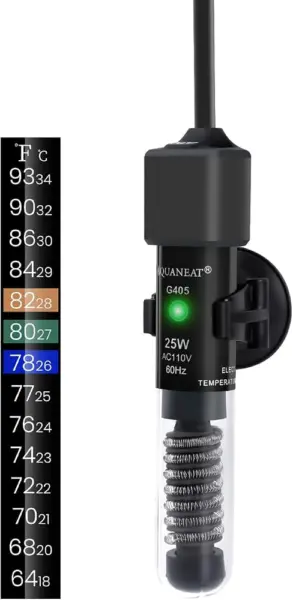
There is no dial, no display and no buttons on the AQUANEAT 25W. It is preset at 78°F, 4.5 inches long, and you stick it to the glass and plug it in. For a 3-to-5.5-gallon betta tank that is not a limitation so much as the whole idea: nothing to set means nothing to knock out of position.
We think that is the right call for a first tank, a quarantine tub or a shelf of small tanks. Most tropical fish want to live at 78°F, and the red-or-green light gives you the daily check without a controller to mount. If you need 80°F for a betta that has been sluggish, this one cannot be tuned — that is the trade.
The mounting is the weak point. The clip that holds the heater to the suction cup works loose over months, and the heater ends up drifting at the surface instead of staying where you put it. Place it low, behind the filter outlet or a plant, so a released heater still sits below the waterline, and push the clip back on at every water change.
The warranty is 30 days, the shortest here by a wide margin. Treat that as part of what you are buying, keep a spare for the quarantine tank, and the little stick-on thermometer in the box becomes the thing you actually trust.
Pros
- Preset 78°F, genuinely plug and play
- 4.5-inch body fits 3-5.5 gallon tanks
- Includes a stick-on thermometer
- Cheapest heater here for a small tank
Cons
- Fixed 78°F leaves no room to adjust
- Thirty-day warranty is the shortest here
The AQUANEAT is the one for a 3-to-5.5-gallon betta tank: preset at 78°F, small enough to hide, and inexpensive enough to keep a spare for quarantine.
How We Tested the Best Aquarium Heaters
We started with a shortlist of roughly 40 heaters sold in the U.S., sorted by wattage range, whether they’re fully submersible, how they mount, and what comes in the box — a guard, spare suction cups, a separate thermometer. From that we bought 14, spread across the wattages that suit 10- to 75-gallon tanks, and ran them for four months in real tanks: a quarantine setup, a planted community tank, and a crowded 75 where the heater has to tuck in behind the filter.
Each one was set to 78 degrees and checked against a separate glass thermometer twice a day for the first two weeks, then weekly after that. We logged drift — a degree or two off is common, but the units that wandered back and forth were the ones we stopped trusting. We also unplugged every heater during water changes, let it sit dry a few minutes, then resubmerged it and watched how fast the temperature climbed back, since that’s the abuse a heater gets in an ordinary month.
Mounting got its own round of poking: we stuck each heater to the rim, then to the back glass behind a filter intake, then bumped it with a net and a gravel vacuum and noted which ones slid down the glass. We measured length and diameter against the tank’s free corner, ran each cord and seal under the tap during monthly cleaning, and checked the glass for condensation after a few weeks underwater. Value came down to whether the box included the small stuff — a guard, spare cups, a dial you can read — and whether the thing held temperature without being babysat.
How to Choose a Tropical Aquarium Heater
The right heater is the one sized for your tank, set to the temperature your fish need, and placed where the filter’s current will spread the warmth.
Match the Wattage to the Tank
The ranges on these heaters cluster around four to five watts per gallon: 25 watts for 3 to 5.5 gallons, 50 for 6 to 15, 200 for 20 to 40, 300 for 40 to 75. Size for your tank’s actual volume and pick a heater rated for the top of it, because a unit working near its limit in a cool room runs constantly and never gets ahead of heat loss through the glass. Oversizing has its own trap: a 300-watt tube in a 20-gallon raises the temperature fast if a thermostat sticks, and a small volume gives you very little time to notice.
Preset or Adjustable
Preset 78°F suits most community tanks — tetras, rasboras, corydoras and bettas all sit close to it, and a heater with nothing to adjust is a heater nobody knocks out of calibration. The case for an adjustable thermostat is narrower but real: raising a tank to 86°F is the standard first move against ich, and discus and rams want the low-to-mid eighties as a baseline. If either sounds like your next six months, pay for a dial or a controller. If not, a preset model removes a decision there is no reason to second-guess.
Where the Controls Sit
A dial on the tube means leaning over the tank with a wet hand, squinting at a scale through glass and water. An external controller puts the number and the buttons outside, which is why we lean toward them for anything above a nano tank: you can check the set point every morning without touching anything. The cost is a second box and a second cord to route, and on a rimless desktop tank that clutter is real. Controller suction cups are not always in the box, so plan where it hangs before the tank is full.
Mounting and Water Flow
A heater warms the water around it, not the whole tank; the filter’s current is what spreads the heat. Mount it near the outflow, on the back or side glass, with the whole tube below the waterline, and keep it out of the substrate and clear of rocks that block flow. Bottom-dwellers matter too — plecos, loaches and turtles rest against a warm tube, so a plastic guard is worth having. Check the mount at every water change, because a cup that lets go overnight can leave a heater half out of the water.
Plan for the Failure
Any heater can fail, and almost none announce it: a thermostat sticks on, a tube cracks, or the thing goes quiet with the light still glowing. The defense is boring and cheap. Keep a separate thermometer at the opposite end of the tank and look at it daily, and keep a spare heater on the shelf. When you drain the tank, unplug the heater and let it cool for ten minutes before it comes out of the water — that habit prevents most cracked tubes.
Frequently Asked Questions
Do I need a heater if my house stays around 70°F?
Yes. Tropical fish want 76 to 80°F, and an open tank in a 70°F room loses heat through the glass and to evaporation, especially overnight. Rooms also swing between a sunny afternoon and the small hours. Float a thermometer in the tank and read it morning and night for a few days; if the number moves at all, you need a heater regardless of what the wall thermostat says.
How long should an aquarium heater last?
Plan on two to five years from a glass heater that runs year-round, and expect the occasional one to go much longer. The warranty is a fair guide to what the maker expects: three years on the Fluval M, one year on most of the others, and 30 days on the smallest here. Keep a spare. Finding a dead heater on a Friday night with no replacement is a fish-loss event, not an inconvenience.
Does a higher-wattage heater cost more to run?
Barely. Running cost follows how much heat the tank loses, not the number printed on the tube — a 300W heater in a 55-gallon runs in shorter bursts than a 100W unit working flat out in the same tank. Size for the tank rather than for the electricity bill. What does cost you is an undersized heater running constantly and still leaving the tank at 74°F in January.
Final Verdict
The HiTauing 300W is the heater we recommend for a 40-to-75-gallon tropical tank. Its controller puts the set point and the actual temperature outside the water, so you know what the tank is doing without rolling up a sleeve, and the 63-to-94°F range leaves room to run an ich treatment. In a 20-to-40-gallon tank, the 200W version of the same heater is the smarter size.
Choose the Fluval M instead if a dial, a mirrored tube and a three-year warranty matter more to you than a digital display. It is the better-looking heater here, and the only one with that much cover behind it.