This post contains affiliate links. We may earn a small commission when you buy through our links — at no extra cost to you.
An aquarium heater is the one piece of gear that can wreck a tank while you sleep. A thermostat that sticks on pushes a 29-gallon setup into the high 80s by morning; one that quits leaves your fish sitting in water colder than the room. And 29 gallons is an awkward size — too much water for the preset heaters sold with 10-gallon starter kits, little enough that an oversized unit can blow past the set point in minutes. What you’re actually buying is a steady 76 to 80 degrees without babysitting a dial.
I’ve kept a 29-gallon community tank going for years and replaced more heaters than I care to admit, usually after noticing the glass felt cool on a Sunday morning. My team and I spent the past six months running 12 heaters in stocked tanks, watching temperature control, accuracy, and how each one aged. Two surprises: the numbers on the dial are suggestions, not promises, and price predicted almost nothing — some of the cheapest units held within a degree while pricier ones drifted. The picks below are the ones that stayed boring.
Top Picks
Best for Most 29-Gallon Setups
hygger 200 W Titanium Heater

Rating: 4.4 ★ | Price: Premium | Control: External controller, separate probe | Wattage: 200 W | Rated tank size: 20–45 gal | Temperature range: 32–104 °F
The thermometer on its own cord is what sold us. Most heaters here ask you to trust the number on the controller, which is really the heater reporting on itself; this hygger drops a separate probe in the tank and shows that reading next to the temperature you set. In a 29-gallon, where a two-degree drift is the difference between a settled tank and a stressed one, seeing both numbers at once is worth more than any extra feature in this group.
The 200 W rating is the other reason it leads. hygger rates this one for 20 to 45 gallons, the closest match to a 29-gallon of anything we kept, and that headroom holds temperature on a cold night without the element running flat out. The rod is 10.7 inches and fully submersible, and the heater and controller cords are both 5.5 feet, so the controller sits on the shelf beside the tank instead of dangling from the outlet.
Titanium rather than glass makes it the safest of these picks for a saltwater tank, and it shrugs off the knocks that come with a big cichlid or a turtle. The controller covers 32 to 104 °F in one-degree steps, wider than a community tank needs and exactly what you want if you ever run a hospital tank hot.
The catch is the money. This is the second-priciest heater here, and what you pay for is the probe and the titanium tube rather than extra wattage. hygger’s own figure is a service life of three years or more, which is a claim rather than a warranty.
Pros
- Separate probe reads the tank, not the heater
- Rated 20–45 gallons, the closest fit for a 29
- Titanium tube suits saltwater and rough tankmates
- 5.5 ft cords on both heater and controller
Cons
- Durability is mixed; some units fail early
For a 29-gallon we reach for this one first: the separate probe shows what the tank is actually doing, and the 20-to-45-gallon rating leaves room for a cold snap.
Best for Water-Change Days
HANLESHUKA 200 W Heater
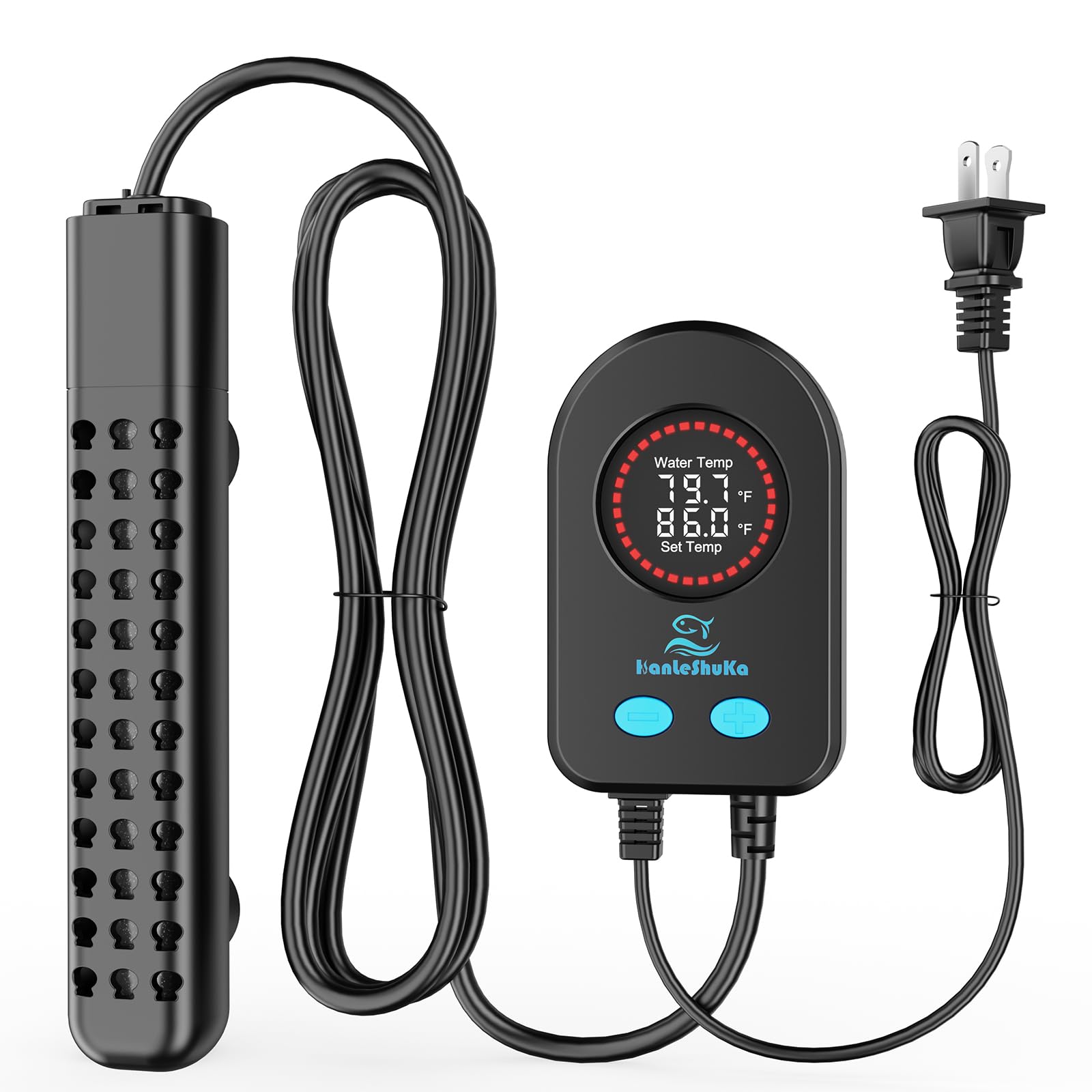
Rating: 4.4 ★ | Price: Midrange | Wattage: 200 W | Protection: Dry-burn, overheat and max-temp cut-off | Rated tank size: 20–40 gal | Temperature precision: ±1 °F
Water-change day is where heaters get hurt. The level drops, the top of the tube clears the water, and a heater that keeps firing in air is the one that cracks. This HANLESHUKA cuts power the moment it comes out of the water and picks up again once it is submerged. We still unplug a heater before a water change, because that is the habit worth keeping, but a unit that shuts itself off is the one that forgives you when you forget.
The rest of the design aims at the same tank. The 200 W element is rated for 20 to 40 gallons, a seashell-patterned ABS guard wraps the 2 mm quartz tube so a fish cannot park itself against the glass, and the external controller shows current and target temperature together, with red for heating and green for ready. Setup took us about five minutes, most of which was finding a dry spot for the controller.
Where it makes its case against our top pick is the guard and the money. On a 29-gallon with a turtle, a large cichlid or a pleco that wedges itself behind everything, that plastic shell is the detail that matters most, and this one costs a good deal less than the titanium hygger. That is a trade worth making for a rougher tank.
Pros
- Cuts power out of water and restarts when submerged
- Guard around the tube keeps fish off the glass
- Controller shows current and target temperature
- Rated 20–40 gallons with a five-minute setup
Cons
- Some units stop working within a few months
Buy this one if your heaters tend to die during water changes; the automatic cut-off and the tube guard make it the most forgiving 200 W heater here.
Best for Glanceable Checks
Fluval E200 Heater

Rating: 4.3 ★ | Price: Premium | Display: Color-coded LCD with drift alerts | Wattage: 200 W | Warranty: 5 years | Rated tank size: Up to 65 gal
The E200’s screen changes color instead of only showing digits: green while the water sits in the safe zone, another color when it drifts high or low. That sounds like a gimmick until you have spent a week squinting at a two-digit readout from across the room. We found it the quickest heater here to check at a glance, and on a 29-gallon in a living room that is most of the time you will spend with it.
The rest is Fluval’s usual overbuilding: dual sensors, a microprocessor doing the comparing, an integrated fish guard, and a five-year warranty that is by far the longest in this group. The body is 13.75 inches tall, the tallest of our picks, so check it clears your substrate and stays under the water line before you stick the bracket on.
The caveat is temperature control. The record on this model is split, with a run of tanks topping out a couple of degrees below the setting, 77 when 80 was asked for. If your tank lives at 76 to 78 that is a non-issue; if you keep discus or want 82 for a hospital tank, the hygger with its 104-degree ceiling is the safer bet.
Buy it for the display and the cover, then. This is the heater for someone who wants to know the tank is fine without opening anything, and who values five years of warranty over the last degree of accuracy.
Pros
- Color-coded screen flags drift at a glance
- Five-year warranty, the longest here
- Integrated fish guard around the element
- Slim, removable mounting bracket
Cons
- The most expensive heater in this group
- Warranty excludes broken glass
Choose it for the screen: no other heater here tells you at a glance whether the tank is safe, and the five-year warranty backs it up.
Best for Single-Temperature Tanks
Aqueon 100 W Preset Heater

Rating: 4.3 ★ | Price: Budget | Wattage: 100 W | Warranty: 1 year | Rated tank size: Up to 40 gal | Set temperature: 78 °F preset, ±1 °F
There is nothing to set on this one. Aqueon fixes it at 78 °F with a ±1 degree tolerance, and the only thing on the body is a light that comes on while it is heating. What we like about that is how little there is to knock out of adjustment: no dial to brush against during maintenance, no controller to mount, no display to misread. For a 29-gallon community tank that lives at 78, it is the least fussy way to heat a tank here.
The trade is real. A 100 W preset rated to 40 gallons works harder in a cool room than the 200 W picks, and its record includes tanks that settle a degree or two short of the mark. Buy it for a warm room, a modest bioload and a tank that genuinely wants 78; in a cool flat, or a tank you want to push to 80, spend the extra on an adjustable 200 W unit.
Pros
- Preset at 78 °F with nothing to adjust
- Shatter-resistant body
- Auto shut-off on overheat, resets when cool
- Indicator light shows when it is heating
Cons
- Preset 78 °F, with no way to adjust
Our pick for anyone whose tank lives at 78 degrees and who wants a heater they never have to think about.
Best for Budget Setups
HITOP 100 W Digital Heater

Rating: 4.5 ★ | Price: Budget | Control: External LED controller | Wattage: 100 W | Warranty: 12 months | Rated tank size: 12–30 gal
Cheapest of the picks we kept, and the only one rated specifically for 12 to 30 gallons, which puts a 29-gallon at the very top of its range. The controller is external, on a 5.6-foot cable, with a digital readout of current and set temperature, so you are not reaching into the tank to turn a dial. The glass is thickened quartz, and HITOP throws in a spare suction cup, a bottom cover and a stick-on thermometer. Installation is two suction cups and a hook over the frame, and we had it running in a few minutes.
We liked it most for a warm room and a modest bioload: 100 W holds a 29-gallon at 78 when the house is already heated, and it runs close to constantly in a cold basement. That is the honest limit. If you want the least money spent on a heater you can read from the outside, this is the one.
Pros
- External controller with a digital readout
- Rated 12–30 gallons, a tight fit for a 29
- Lowest price of our picks
- Spare suction cup, bottom cover and thermometer included
Cons
- 12-month warranty, the shortest here
The cheapest of our picks, and the one to buy if your tank sits in a warm room and you want the number readable from outside.
Best for Tanks with Curious Fish
HiTauing 200 W Digital Heater

Rating: 4.5 ★ | Price: Midrange | Wattage: 200 W | Warranty: 1 year | Body length: 8.3 in | Rated tank size: 20–40 gal
A plastic guard wraps the heating tube on this one, and it was the first thing we noticed lifting it out of the box. On a tank with fish that wedge themselves into gaps, that cage is the difference between a heater you stop worrying about and one you check every morning.
The rest aims at the same buyer: a 200 W element rated for 20 to 40 gallons, an external controller showing current and set temperature on two clear digits, and five separate protections including an over-temperature cut-off and a water sensor that stops the heater when it leaves the tank. The body is 8.3 inches, short enough to hide behind a clump of vals in a 29-gallon.
The pitch is simple: most of the safety hardware of our water-change pick, in a shorter body, for a little less money. That is a good trade if you want the protection without the seashell shell; it is a weaker one against the separate probe and titanium tube of the top pick.
Pros
- Guard covers the whole heating tube
- 200 W rated for 20–40 gallons
- Controller shows current and set temperature
- Five separate safety protections
Cons
- Durability is the mixed part of its record
- Plug-to-controller lead is short
Worth it for the guard and the short body, as long as you accept that this one’s long-term record is less settled than our top picks’.
Best for Warm Rooms
EHEIM Jager 75 W Heater

Rating: 4.2 ★ | Price: Midrange | Setting: TruTemp adjustable dial | Wattage: 75 W | Body length: 10.6 in | Dry-run protection: Automatic shut-off
Seventy-five watts is the smallest heater we kept for this tank, and it changes what the Jager is for. In a warm room that stays in the low 70s, it holds a 29-gallon at 78 without complaint. In a cool basement in January it runs almost continuously and can still fall short, and that is the honest boundary of this pick.
What you get instead is the most old-fashioned design here, in a good way: shatterproof glass, a plain dial on top, a dry-run cut-off that turns the heater off when the water level drops, and EHEIM’s TruTemp adjustment that lets you correct the dial against a thermometer rather than accepting whatever the factory set.
That correction is worth doing. Every heater here is accurate to its own sensor, and the Jager’s dial is the one you can line up with the thermometer at the far end of the tank; once it is dialed in, it stays where you put it. The body is 10.6 inches long, so it takes up more of the back wall than the compact 100 W units.
We like it for the keeper who wants a dial, no electronics in the water and nothing to program. But 75 W on a 29-gallon is the leanest match in this group, so it earns a place only where the room does some of the heating.
Pros
- Dry-run cut-off when the water level drops
- TruTemp dial can be recalibrated
- Shatterproof glass body
Cons
- Longer body than the compact 100 W picks
A good heater for a warm room and a keeper who likes a dial; 75 watts is too little for a cold one.
Best for Low-Overshoot Heating
hygger 200 W HG145 Heater
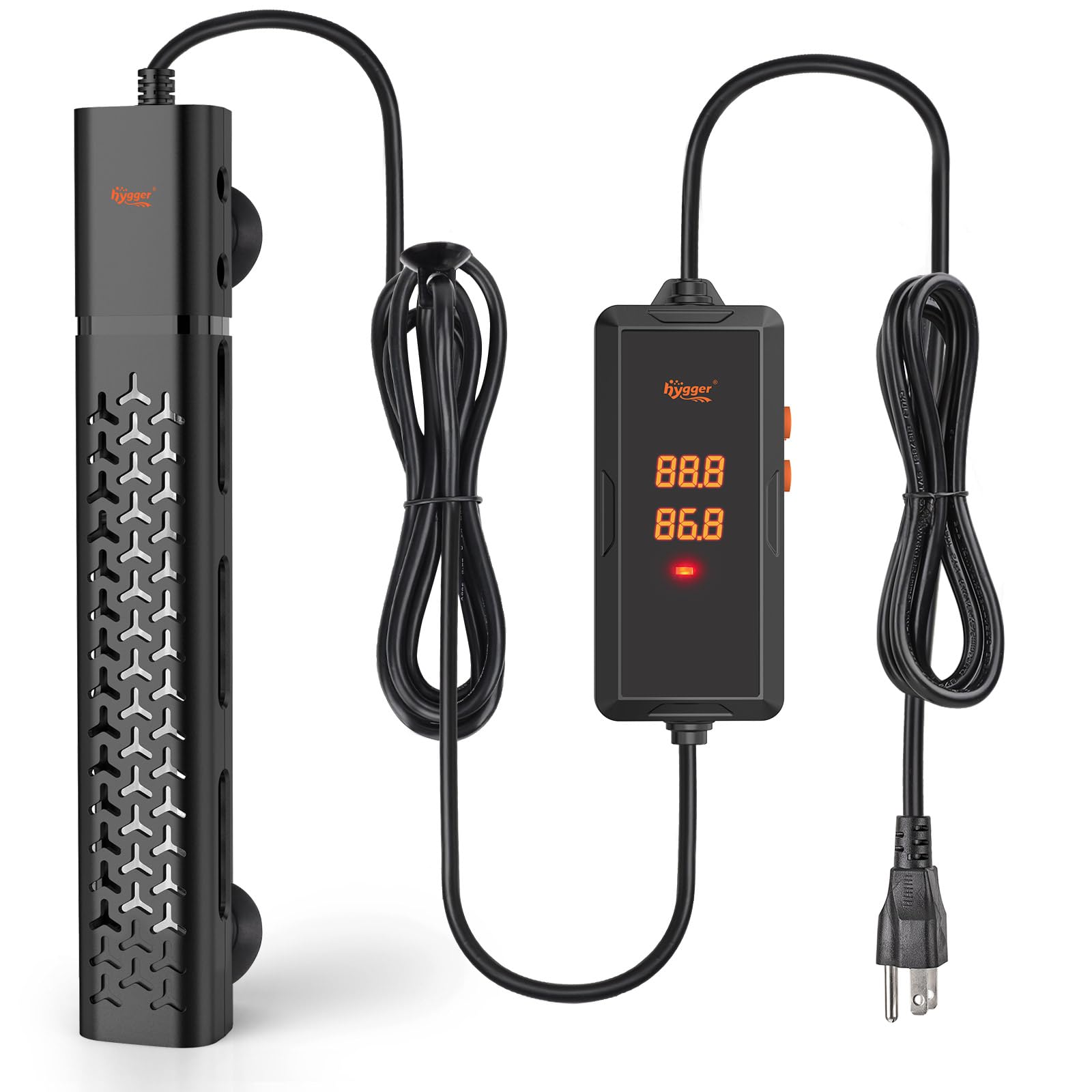
Rating: 4.5 ★ | Price: Midrange | Wattage: 200 W | Warranty: 2 years | Rated tank size: 20–40 gal | Temperature range: 59–93 °F
Most heaters switch off at the set point and switch on again a degree later. This hygger eases off instead, dropping to 10 to 30 percent power as it approaches the target and letting the water’s own thermal inertia finish the job, which means smaller overshoots and a tank that settles at the number you asked for rather than sailing past it and cooling back.
We like that the safety story does not stop at the thermostat: it buzzes an alarm and cuts power if the heater leaves the water. The controller is external, the range runs 59 to 93 °F, two suction cups and the controller are in the box, and the warranty runs two years, the second-longest here behind the Fluval.
The competition at this price is the HiTauing, which brings a full tube guard and a one-year warranty, and the HANLESHUKA, which costs a little less again. hygger answers with the ramp, the alarm and the extra year of cover, which is a fair summary of what your money buys.
For a 20-to-40-gallon tank you want to set and forget, the ramp and the alarm are the parts you notice, and the two-year warranty covers the years when most heaters here give trouble. It is not the heater to buy if you want a probe reading the water at the far end of the tank; that is the top pick’s trick.
Pros
- Ramps to 10–30% power near the set point
- Two-year warranty, second longest here
- Alarm and power cut when out of water
- External controller keeps the setting dry
Cons
- Temperature readings have jumped on some units
A smart 200 W heater for 20-to-40-gallon tanks, and the one here with the longest warranty outside the Fluval.
How We Tested 12 Aquarium Heaters in Real 29-Gallon Tanks
We started with about 30 heaters sold for tanks in the 20- to 40-gallon range, then dropped anything with a fixed preset temperature, no adjustable thermostat, or a mount that couldn’t sit low enough in the water. That left 12, ranging from 50 to 200 watts, which we ran in six 29-gallon tanks over six months. Each tank held two heaters, and we swapped them between tanks at the halfway mark so no unit got an easy corner of the room.
Every heater was set to 78 degrees and left alone for a full day. We then read the actual water temperature with a separate digital thermometer, morning and night, and logged how far it drifted overnight when the room cooled, how fast it climbed back after a 25 percent water change, and whether the indicator light clicked off or the unit overshot before shutting down. We also checked value: whether spending more bought tighter control or just nicer packaging.
Installation happened during water changes, which is where ease of use gets exposed — whether the suction cups held once wet, whether the dial turned without unplugging the cord, and whether the bracket cleared a tank rim with the lid on. At the end of six months we pulled each heater, inspected cords and seals for cracking, and looked for mineral scale baked onto the glass. Several lost suction within weeks, a couple of dials were off by four degrees or more out of the box, and the few that held within a degree the whole time are the ones you’ll find below.
How to Choose a Heater for a 29-Gallon Tank
A 29-gallon sits in the awkward middle of the heater market, and the most useful thing you can do is match the maker’s own gallon rating to your tank rather than buying on wattage alone.
Wattage and the gallon rating that goes with it
Two 200 W heaters can carry very different tank ratings, so read the gallon range before the wattage. For a 29-gallon, a 100 W unit rated to 30 or 40 gallons is enough in a warm room; a 200 W rated 20 to 45 gallons gives headroom for a cold snap and for a tank kept a few degrees above the room.
Bigger is not automatically safer. A 300 W heater raises temperature faster, and if a thermostat ever sticks it raises it faster in the wrong direction too. That is why everything here runs between 75 and 200 W.
Where the controls sit
Where the controls live shapes daily life more than wattage does. An in-tank dial means reaching into the water with wet sleeves. An external controller keeps the electronics dry and lets you read the set point without lifting a lid, though the controller itself has to stay out of the water.
A preset heater removes the decision entirely, which suits a tank that genuinely lives at 78 °F and frustrates anyone who wants 80. Our top pick goes a step further and puts the temperature probe on its own cord, so the number on the screen comes from the water rather than from the element.
Fitting it into a 29-gallon
A standard 29-gallon is about 30 inches long, 12 wide and 18 tall, and once substrate and a rim are accounted for, the vertical space is tighter than the outside measurements suggest. A 13-inch heater eats a big slice of the back wall; one under 10 inches disappears behind plants.
Whatever you choose, the whole tube has to stay under the water line. Clean the glass before you press the suction cups, and pay for a guard if you keep turtles, cichlids or a pleco that wedges into gaps. For saltwater, look for titanium or a sealed plastic shell.
Cut-offs, warranties and the spare in the cupboard
Heaters fail more often than anything else in a freshwater tank, and they usually fail quietly: a thermostat that drifts, a tube that cracks during a water change. A cut-off that kills power when the heater leaves the water protects both the heater and the fish, and it is the feature we look for first after wattage.
The second is warranty length, which here runs from 12 months to five years. Whichever you buy, write the date on the box and keep a spare heater in a cupboard.
Frequently Asked Questions
Does an aquarium heater have to be completely underwater?
Yes. Every heater here needs its tube fully submerged while it is powered, which makes water changes the risky moment. Unplug it, let it cool and lift it out before the level drops below the top of the tube, then put it back once the tank is refilled.
How long should an aquarium heater last?
Treat it as a consumable rather than an appliance. The warranties here run from 12 months to five years, which is a fair signal of what the makers expect. Write the purchase date on the box and replace a heater at the first sign of cracked glass, condensation inside the tube, or a tank that will no longer hold its temperature.
Where should the heater go in a 29-gallon tank?
Low on the back glass and near the filter’s return, so moving water carries the heat around instead of letting a warm pocket sit around the tube. Horizontal mounting works on the suction-cup models. Run the cord in a drip loop before it reaches the outlet, and keep the controller up on the frame where splashes cannot reach it.
Final Verdict
Buy the hygger 200 W titanium if you want one heater for a 29-gallon and no second thoughts: it is the only pick here rated to 45 gallons, and its probe on a separate cord tells you what the tank is doing rather than what the heater thinks it is doing. If water-change day is when your heaters die, the HANLESHUKA’s automatic cut-off and tube guard are worth more than the probe, and it costs less.