This post contains affiliate links. We may earn a small commission when you buy through our links — at no extra cost to you.
A 125-gallon tank is a lot of water to keep steady. A heater that runs a degree or two hot is annoying in a 20-gallon tank; here, it can mean hours of gradual overheating, and one that sticks off leaves you scrambling before a cold snap. I keep a 125-gallon freshwater setup, and the heater is the one piece of equipment I want to be boring. The right one holds your set temperature without constant fiddling, fits where you need it, and doesn’t make you nervous when the room cools.
I’ve learned not to trust the dial until I’ve checked it against a separate thermometer. We put nine heaters built for tanks this size through seven months of everyday use, watching how quickly they came up to temperature, how closely they held it overnight, and whether the controls still felt precise after months of water changes. Reliability and value separated the field more than wattage claims did; some fussy models performed fine but were a pain to live with. The picks below are the ones I’d trust with a big tank.
Our Top Picks
The Best 125 Gallon Aquarium Heaters, Reviewed
Eheim Jager 300W – Best Overall
Key Features
- Wattage: 300 W
- Tank rating: 159–264 gallons
- Heater length: 20 in
- Safety cutoff: Auto-off when the water level drops
- Price: Midrange
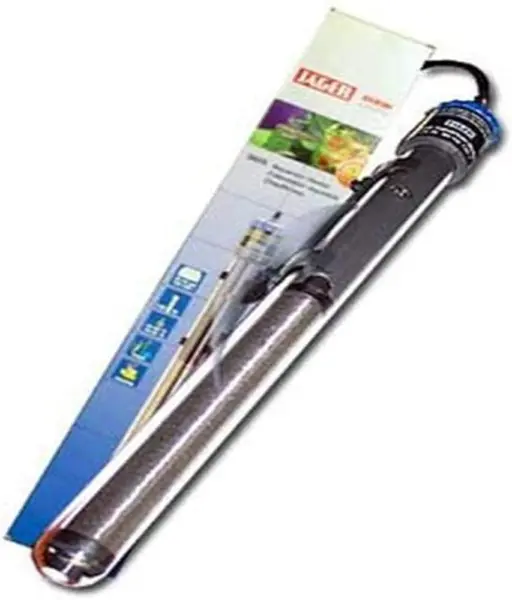
Eheim rates this heater for tanks from 159 to 264 gallons, which reads like the wrong spec for a 125 until you work out what the headroom buys: an element that spends most of its life idling, a thermostat that isn’t pinned wide open in February, and something left in reserve for a cold snap or a sump in the basement. That margin is the main reason it’s our pick. The other is the record behind it — of everything here, this is the one whose reliability runs most consistently positive, across the largest body of experience in the group.
The build is old-school in a way we appreciate: shatter-resistant glass, a thermostat dial on a blue ring you turn by hand, and a thermo-safety control that kills the element if the water level drops below it. On a 125 that last part matters more than it does on a nano tank — a big heater running dry is a lot of glass and a lot of current.
The 20-inch body is the practical catch. A standard 125 is about 21 inches tall, so once you allow for substrate and a rim, the Jager only stands upright in a deep tank; plan on laying it along the back wall, low and horizontal, where it disappears behind the rockwork. Calibration is the other chore — the dial is stiff and the markings are coarse, so you’ll spend an evening nudging it until your own thermometer agrees. Once it’s set, it stays set, and on a tank this size that’s the trade we accept.
Pros
- Rated 159–264 gallons, real headroom for a 125
- Strongest reliability record of these picks
- Cuts power automatically if the water level drops
- Shatter-resistant glass for fresh or marine water
Cons
- No display or external controller
- Won’t reach 85–86°F for warmer setups
For a 125 that has to hold temperature through a cold winter, we trust the Jager’s thermostat and its 159–264 gallon rating more than anything else here.
Aquatop TH-C400 400W – Best Premium Pick
Key Features
- Wattage: 400 W
- Tank rating: Up to 125 gallons
- Body material: Titanium
- Temperature range: 68–92°F
- Price: Premium
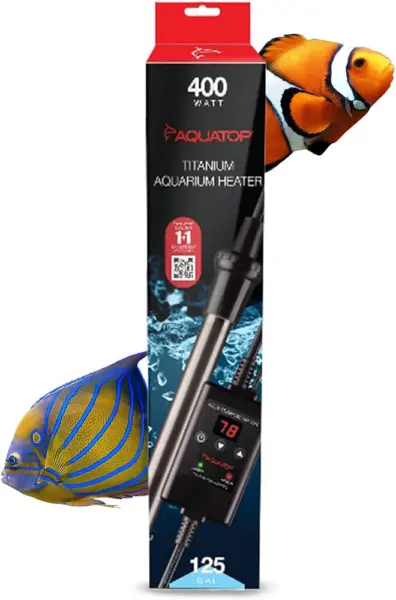
Up to 125 gallons is the whole argument for the TH-C400, and it’s the only heater here that names our tank size as its ceiling rather than sitting somewhere in the middle of its range. Four hundred watts through a titanium body, a digital controller that runs 68 to 92°F, and a heater that weighs just under a pound.
It’s the best-built heater in this group, and the one for a marine 125 — titanium means no glass to chip and nothing to corrode, which is easy to justify in salt water and less obviously worth it in fresh. You’re also paying for the controller: set the temperature and read the tank’s from outside the water, no sleeve rolled up, no drips running down your forearm.
The caveat is the ceiling. Rated to 125 gallons, this one has no headroom for a cold room or an unheated basement — in a normal living room it’s comfortable, and in a 65°F spare room in January it’s working near its limit. For a reef tank in a heated house, that’s a trade we accept without much thought.
Pros
- Titanium body suits saltwater without corrosion worries
- Rated up to 125 gallons, sized for this tank
- External controller sets and reads temp from outside
Cons
- Most expensive heater in this group
The best-built heater here, and the one we point to for a saltwater 125 where glass is the wrong material and a readable controller matters.
AQQA 500W – Best for Cold Rooms
Key Features
- Wattage: 500 W
- Controller: External LED
- Tank rating: 66–135 gallons
- Dry-run cutoff: Cuts at 5 cm out of water
- Price: Midrange
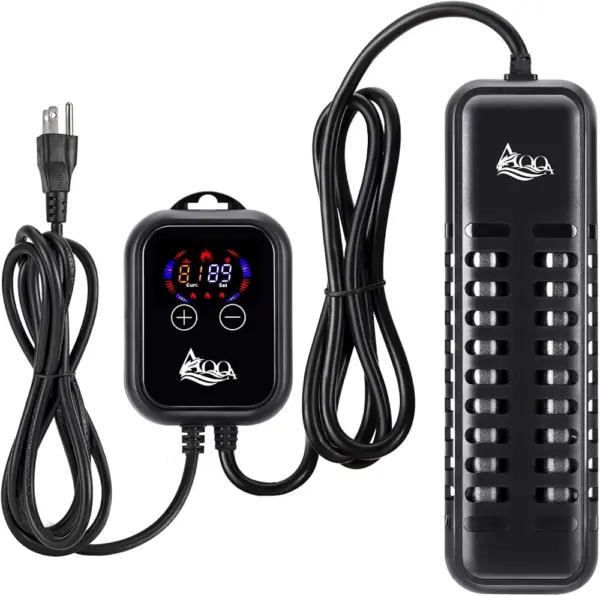
Lift the heater 5 cm out of the water and this AQQA’s controller shows E1 and cuts the element. That’s a sensor doing real work rather than a line on a box, and it’s the kind of thing you only notice the day a water change runs long and the level drops further than you meant it to.
Five hundred watts rated for 66 to 135 gallons makes this our pick for a 125 in a cool room — a basement, a garage, a big open-top system with a sump where heat leaves faster than a smaller heater can replace it. A 125 sits in the middle of its range rather than at the edge, so it has somewhere to go in January without running flat out all night.
The build is honest rather than elegant: quartz glass, silicon carbide heat conduction, and an adjustable hook that lets the controller hang off the tank rim or a stand, so the display sits where you can see it without a bracket kit. Nothing about it feels premium. Nothing about it feels flimsy either.
Pros
- 500 watts rated to 135 gallons, real cold-room headroom
- E1 dry-run code is readable and cuts the element
- External LED controller keeps adjustment out of the tank
Cons
- Heaviest heater here at about three pounds
Five hundred watts rated to 135 gallons makes this the heater for a 125 in a cold room, with a controller that tells you when something is wrong.
hygger 500W Titanium – Best for Accurate Readings
Key Features
- Wattage: 500 W
- Controller: External IC with separate probe
- Tank rating: 60–120 gallons
- Temperature range: 32–104°F
- Price: Premium
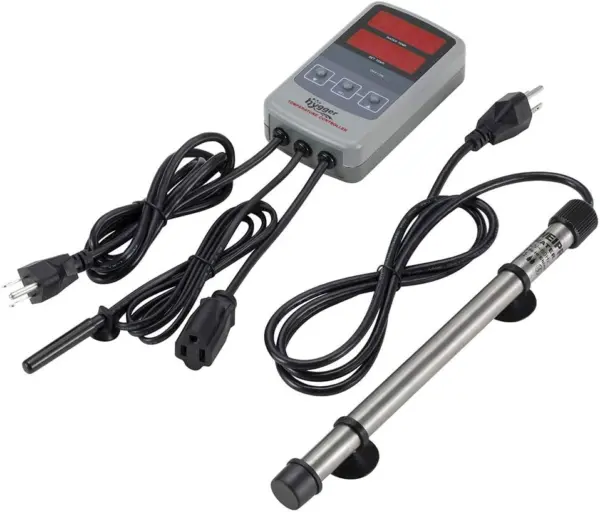
A separate probe on its own 4.4-foot cord is the part of this kit worth caring about: the controller reads the water at the far end of the tank instead of the water touching the heater. On a six-foot 125 those two readings can sit a degree or two apart, and the probe is what tells you which end is cold.
The rest is a 12.3-inch titanium rod, an external IC controller that shows set and actual temperature together on a red LED display, and a range that runs from 32 to 104°F in 1°F steps — the widest here, which matters if you ever need to push a hospital tank toward 86. Heater and controller cords are both 5.5 feet, long enough to reach a controller mounted well clear of the rim.
Titanium plus a real probe for a good deal less than the premium pick is the trade we like here, and the rating is the honest caveat: 60 to 120 gallons puts a 125 just past the top of its range. In a normal living room it holds fine. In a cold one it has nothing left over, and that’s when the AQQA’s extra capacity starts to look like money well spent.
Pros
- Separate probe reads water away from the heater
- Titanium tube handles salt water
- Widest set range here, 32–104°F in 1°F steps
Cons
- Controller can quit inside the first two years
Titanium and a real temperature probe for well under the premium pick — the value choice for a saltwater 125 that doesn’t need headroom.
HiTauing 300W Upgraded – Best for Budget Builds
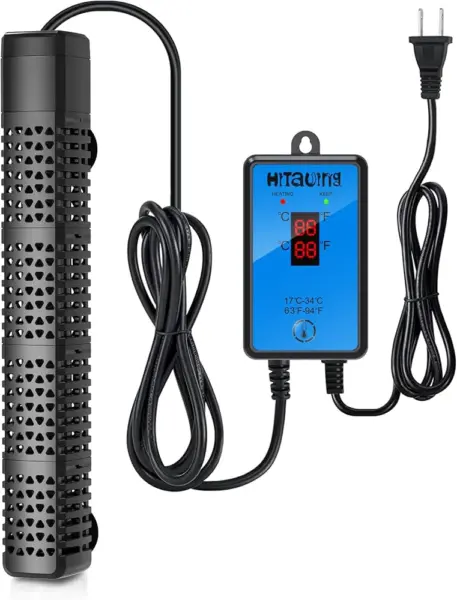
Key Features
- Housing: Removable, four sections
- Wattage: 300 W
- Tank rating: 40–75 gallons
- Temperature range: 63–94°F
- Price: Budget
The housing comes apart in four sections — press the clips, push outward, and the shell slides off the quartz tube. It’s the sort of detail that means nothing until you pull a heater out of a 125 and find it furred with algae and hard-water crust, and it’s the detail that makes a pair of these the cheapest sensible way to heat a tank this size.
At 300 watts and rated 40 to 75 gallons, one of these is not a 125-gallon heater. Two are. One at each end of a six-foot tank, both set to the same temperature, gives you something a single bigger unit can’t: if one quits in February, the other keeps the fish alive until a replacement lands. Two of them come in around the price of our top pick, which is the whole argument.
The controller lives outside the tank with two buttons and an LED readout, the range runs 63–94°F, and a water sensor cuts the element when the body leaves the water. Simplicity is the appeal — no dial to zero in, no calibration to redo, so setup is a set point and a glance at the tank afterward. In a warm room with a lid on, a pair holds a 125 comfortably. In a cold basement, put the money into one of the bigger picks instead.
Pros
- Removable four-section housing makes cleaning easy
- External controller with a simple digital set point
- Two of them cover a 125 for about one premium heater
Cons
- Rated 40–75 gallons, so one is half a 125
Buy two: it’s the budget route to a heated 125, and the only heater here you can strip down and scrub.
MantaMaze 300W – Best for Sump Setups
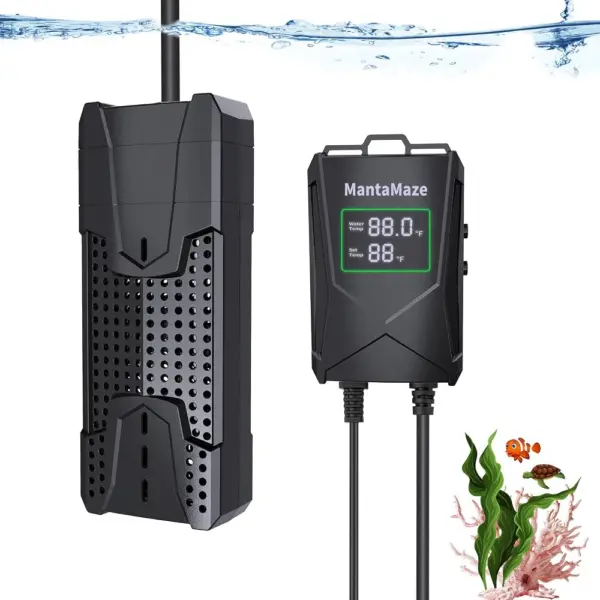
Key Features
- Wattage: 300 W
- Tank rating: 20–80 gallons
- Heating tubes: Two quartz tubes
- Temperature range: 63–94°F
- Price: Budget
Two quartz tubes instead of one: MantaMaze splits its 300 watts across a pair of elements inside a single body, so heat spreads over more surface and no one tube carries the whole load. On a big tank that’s the right shape for a heater to be, and it’s why we’d expect this one to hold up better than a single-element body of the same power.
The controller shows current and preset temperature together on a display you can read from a few feet away, sets in 1°F steps between 63 and 94°F, and remembers its set point through a power cut — a small mercy on a tank with an unreliable breaker. The dry-run cutoff trips when the top of the heater sits 2 inches above the water, and an over-temperature cutoff ends things at 94°F.
We like it best as the sump heater in a 125 system, or as one of a pair, because 20 to 80 gallons is well short of our tank on its own. In that role its readability is what wins: you glance at the tank, you know the water temperature, and you didn’t open anything or put a hand in to find out.
Pros
- Twin quartz tubes spread the heat load
- Large external display readable across the room
- Keeps its set point through a power cut
Cons
- Rated 20–80 gallons, well short of a 125
The most readable display of the budget heaters, which makes it our pick for a sump or the second half of a pair.
How We Tested Heaters for a 125-Gallon Tank
We began by narrowing the field to heaters rated for 100- to 150-gallon tanks, skipping models with vague temperature claims, short cords, or mounting that looked likely to fail. Nine made the cut, and each ran continuously for seven months in a 125-gallon freshwater tank that sees weekly water changes and normal room swings—cooler overnight, warmer by late afternoon. We set every heater to 78°F and checked it against two separate thermometers at opposite ends of the tank, morning and evening, noting the offset between the dial and the actual water temperature.
To judge heating performance, we timed how long each unit took to lift the tank from 72°F to 78°F and how quickly it recovered after a 20 percent water change. We also watched whether the indicator light matched reality, whether the thermostat clicked off cleanly at the set point, and whether the heater stayed put when we cleaned the glass or moved decor. For ease of use, we adjusted settings with wet hands, read the markings from above the tank, and checked whether calibration could be corrected without guesswork. We also noted whether each heater fit behind the rockwork without blocking flow and whether its cord reached the outlet without an extension.
After seven months, we inspected cords, seals, suction cups, and dials for cracking or looseness, and we unplugged and restarted each heater to see whether it returned to the same setting. Build quality and reliability showed up in small ways: a dial that still moved smoothly, a guard that stayed clipped on, a unit that didn’t drift after a water change. We compared those details with what each heater included—mounting hardware, cord length, a guard—to judge value, because the best heater for a 125-gallon tank is one you stop thinking about.
How to Choose a Heater for a 125-Gallon Tank
The number that matters on a heater listing isn’t the wattage — it’s the gallon rating the maker prints beside it, and on a 125 that one line eliminates most of the cheap options.
Shop the gallon rating, not the watts
Two 300-watt heaters can be rated for wildly different tanks, because the gallon figure reflects the element, the housing, and how hard the maker expects the thing to work. In this group, 300-watt units are rated anywhere from 20 to 264 gallons. Read the listing’s own number and plan around it: a heater rated to 75 gallons is a 75-gallon heater in a 125, whatever the wattage says.
Buying above your tank size buys headroom. A heater rated to 260 gallons idles in a 125 and has something left for a cold snap; one rated to 120 is already near its limit in February. The cost of headroom is length, bulk, and money.
Check where the body will physically fit
A 125-gallon tank is about 21 inches tall and 72 inches long, and once you subtract the substrate and the rim you have closer to 18 inches of water to work with. A 20-inch heater doesn’t stand up in that — it lies along the back wall. Shorter bodies of 11 to 13 inches hang vertically in a corner and stay out of the way.
Measure the water height and the clear run along the back before ordering, and remember that a heater mounted high is one that gets exposed the moment you drop the level for a water change.
Decide whether you want the controls outside the tank
Dial-on-the-body heaters are the simplest thing that works: no controller, no cord above the water, nothing to knock off the rim. The cost is that adjustment means reaching into the tank, and the markings are coarse — budget a session with a thermometer to get it calibrated, then leave it alone.
External controllers add a box to mount and a cable to route, but they show the current temperature from across the room and let you change the set point with dry hands. On a tank you’re topping up with a hose every week, we like that. We just wouldn’t take a controller in exchange for an under-rated heater.
Match the material to your water, then check the cutoff
Glass, quartz, and titanium all work in fresh water; for a marine or reef tank, titanium is the safer long-term bet because there’s nothing to chip and nothing to corrode. Whichever you choose, look for a dry-run cutoff — every heater here has one, and they trip at different points, from two inches of exposed body to five centimeters.
Treat that cutoff as a backstop rather than a plan. Unplug the heater before a water change takes the level below it, and let it cool before you lift it out. And if you run a tank above 84°F, check the heater’s top end before you buy: more than one of these runs out of range before 86.
Frequently Asked Questions
Where should the heater go in a 125-gallon tank?
In the flow, not in a corner. Put it near the return or under the outlet so moving water carries heat across six feet of tank; a heater sitting in still water warms its own corner while the far end stays cold.
Mount it low — a few inches off the substrate and well below the lid line — so a water change doesn’t leave the top of it in the air.
How long should an aquarium heater last, and should I keep a spare?
Two to three years is a fair expectation for a heater that runs year-round. Some of these go longer; a few quit inside the first year, and the failures are usually a controller giving out or an element that stops heating while the display still looks fine.
Keep a spare. A spare 300-watt unit costs less than restocking a 125, and it’s the reason a pair of cheaper heaters is a legitimate strategy for a tank this size.
Do I need a heater if the room stays warm?
Almost certainly yes. A 125 in a 70°F room settles near 70°F on its own, and most tropical fish want 76–80°F. Glass walls and evaporation pull heat out all winter, so a warm room leaves you short even before the weather turns.
What a warm room does change is how hard the heater works: it’s the difference between a 300-watt pair cruising and a single 300-watt unit running flat out.
Final Verdict
The Eheim Jager is the heater we put in a 125. Rated for 159 to 264 gallons, it never works hard in our tank, and its reliability record is the strongest of anything here. Accept a 20-inch body lying flat along the back and a dial that takes an evening to zero in, and you get a thermostat that stays where you put it.
If your 125 is marine, or you want the temperature readable without touching the water, the titanium Aquatop earns its premium — just know that 125 gallons is its ceiling, not its midpoint. In a cold room, the AQQA’s 500 watts and 135-gallon rating buy the headroom the others don’t have.