This post contains affiliate links. We may earn a small commission when you buy through our links — at no extra cost to you.
A freshwater tank runs on light: the right spectrum for the right number of hours and plants pearl, colors pop, and the glass stays clear. Get the schedule wrong, or buy a fixture that runs hot, flickers, or dies in six months, and you’re looking at a green carpet of algae and fish gone washed out. Most lights are bright enough on day one — the difference shows up in month four, when a cheap one has lost half its output or its built-in timer has quietly stopped keeping time.
I’ve kept planted tanks for years, and over the past eight months my team has lived with 12 freshwater fixtures across three tanks, from a basement 55-gallon to a nano sitting on a kitchen counter. Here’s what nobody tells a first-time buyer: raw brightness is the least interesting number on the box. A light that dims smoothly to 30 percent is more useful than one that only blasts, and a timer that holds its schedule beats a few extra lumens every time. The picks below earned their place in the water, not on the spec sheet.
Our Top Picks
The Best Freshwater Aquarium Lights, Reviewed
SEAOURA Clip On SR-617 – Best Overall
Key Features
- Wattage: 20 watts
- Tank fit: 12-20 in
- Dimming levels: 10
- Color rendering index: 90
- Price: Midrange
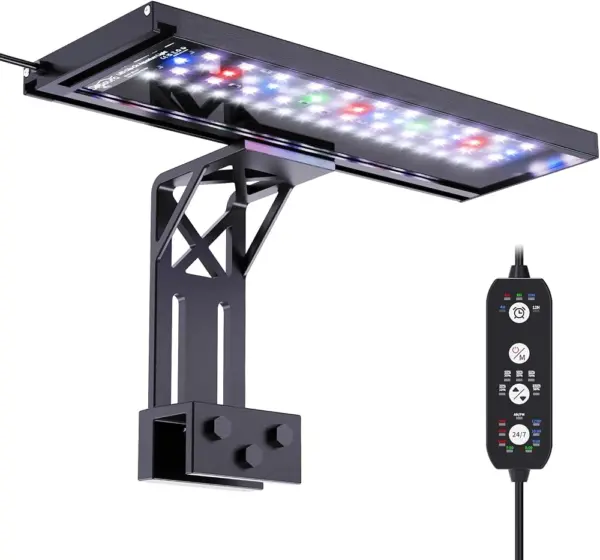
A clip light has one job before it does anything else: hold on and put light where the plants are. The SEAOURA SR-617 does both, which is why it is the fixture we reach for on 10-gallon and nano tanks. The bracket slides and rises, so the bar sits above the water line instead of resting on wet glass, and the casing slides along that bracket to center the light over the tank rather than wherever the clip happened to land.
Output is where it earns the top spot. Twenty watts of full-spectrum light over a small tank is a lot, and the ten dimming levels are what make that useful instead of an algae problem — you can run it low over a betta tank and open it up for a planted cube. You preview a color and intensity before locking it in, the 24/7 cycle walks the tank from orange sunrise to blue moonlight, and five timer settings cover anyone who prefers a plain photoperiod. After a power cut it remembers its schedule and recalculates rather than coming back on at the wrong hour, which is the detail we appreciate most and the one you only notice after the first outage.
The rest holds up: IP68 means a splash or a dunked corner during a water change will not end it, and CRI 90 keeps fish color reading as color rather than a blue cast. The boundary is the plant class — SEAOURA rates this for medium-to-low light growth, so a high-tech carpet tank is the wrong assignment for it. Give it anubias, ferns, moss and a betta, and it settles in as the least fussy light here.
Pros
- Ten dimming levels tame 20 watts over small tanks
- 24/7 sunrise-to-moonlight cycle plus five timers
- IP68 sealing and power-outage memory
- CRI 90 keeps fish and plant colors natural
Cons
- Housing runs warm in still air
We recommend the SR-617 for anyone lighting a 10- to 20-gallon freshwater tank: 20 watts you can dial back, a real 24/7 cycle and sealing that shrugs off splashes.
NICREW C10 Plant Light – Best for Planted Tanks
Key Features
- Dimming: 0-100% per channel
- Wattage: 13 watts
- Tank fit: 18-24 in
- Red wavelength: 665 nm
- Price: Budget
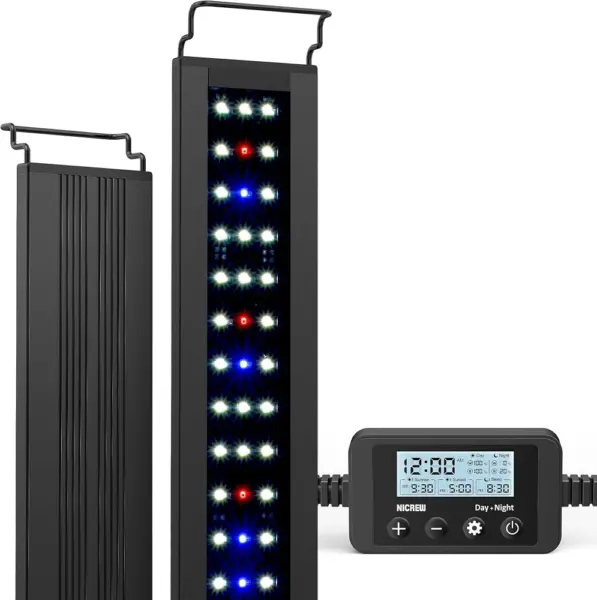
Plenty of bars here call themselves full spectrum without telling you what is in the mix. The NICREW C10 names its chips: 6500K white, 460nm blue and a true 665nm deep red, the wavelength plants drive photosynthesis with. That specificity is the whole reason it takes the planted-tank slot.
What we like even more is the control. White-plus-red and blue dim independently from zero to full, so a warm, red-heavy afternoon and a dim blue evening are two settings rather than a compromise, and the combinations run into the thousands. The built-in day/night cycle ramps up and fades down instead of snapping on, which matters more than it sounds if the tank sits where you eat breakfast. Programming is also among the easiest here: the preprogrammed eight-hour daylight cycle has it running within minutes of unboxing.
Thirteen watts across 18 to 24 inches is modest, and that is the honest limit. On a 20-gallon high with demanding plants, sit the bar close to the water and run both channels near the top of their range; on a 20 long with anubias, java fern and moss it is generous. The aluminum body is thin and light, and against a black rim the whole fixture disappears.
Pros
- True 665nm deep red for plant growth
- White/red and blue dim separately, zero to full
- Ramped day/night cycle, easy first setup
Cons
- Uneven durability; lean on the one-year warranty
For an 18- to 24-inch planted tank, we think the C10’s deep-red spectrum and separate channel dimming make it our planted-tank pick.
hygger 18W 24/7 Light – Best Hands-Off Cycle
Key Features
- Wattage: 18 watts
- Tank fit: 18-24 in
- LED count: 98
- Waterproof: Yes
- Price: Midrange
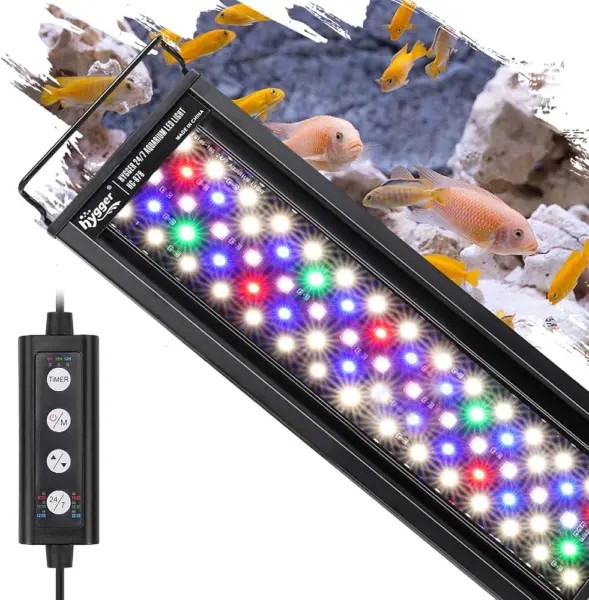
Left alone, the hygger 18W runs a full day for your fish: orange light from six in the morning, full white from eight, moonlight blue from ten at night. That 24/7 mode is why it stays on our shortlist for anyone whose tank lives in a room where nobody wants to remember a switch.
The preset is anchored to those real clock times, which suits a nine-to-five household and not much else — a shift worker gets more from the DIY mode with its six, ten and twelve-hour timers, five brightness steps and seven colors. The detail we appreciate most is the separable adapter: if the power supply dies you replace that instead of the whole bar, a small thing until it is the only thing. Add a two-year warranty, the longest here, and a waterproof rating, and it is the easiest fixture in this group to live with for years.
At 18 watts and 98 LEDs it covers an 18- to 24-inch tank evenly, and the bending brackets let you set the height over a rimmed or rimless top. Pick it up by the housing, not the telescoping legs — those slide straight out of their sockets, and a tank rim is unforgiving.
Pros
- Full orange-to-white-to-blue daily cycle
- Seven colors and five brightness steps in DIY mode
- Replaceable adapter and a two-year warranty
Cons
- Timer steps are 6, 10 or 12 hours only
We recommend the 18W hygger for 18- to 24-inch tanks where nobody wants to think about the light: the day runs itself and the adapter is replaceable.
SEAOURA SR-657 20W – Best for Bright, Deep Tanks
Key Features
- Tank fit: 18-24 in
- Light output: 1,636 lumens
- Dimming levels: 20
- Color rendering index: 92
- Price: Midrange
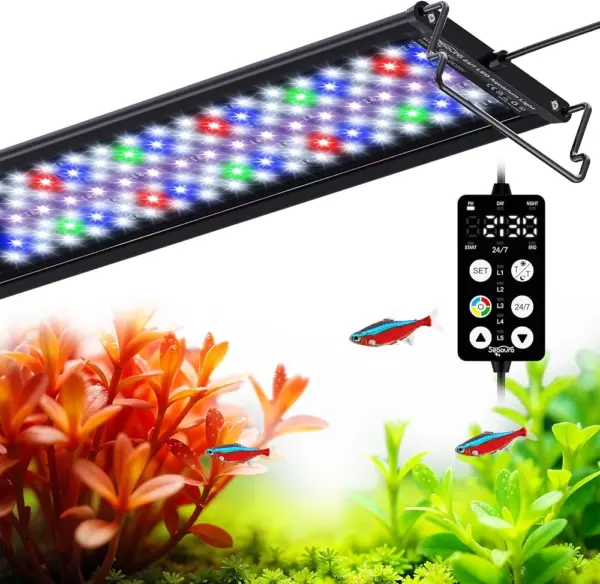
At 1,636 lumens from 126 LEDs, the SR-657 is the brightest fixture in this group, and its slim 16-inch body spreads that across an 18- to 24-inch tank instead of dumping it in the middle. On a 20-gallon high, that headroom is what lights the bottom corners where the moss sits.
You do not have to use all of it. Twenty dimming levels run from a calm evening glow to full daylight, nine colors cover everything from warm white to heavy blue, and the fifteen-minute sunrise and sunset ramps keep the tank from being hit with instant noon. CRI 92 shows in the fish, and after an outage the light returns to its own schedule rather than the hour the power came back. The aluminum housing is barely a third of an inch thick, so it reads as a line above the tank rather than a box on it.
Where it asks something of you is the headroom itself. Twenty watts is a lot of light for low-tech plants, and running it at full for ten hours over a shallow tank is how you end up scraping algae instead of enjoying the tank. Set it low, raise it gradually, and it is the most capable bar here.
Pros
- Most light output in this group
- 20 dimming levels and nine color options
- Holds its schedule through a power cut
Cons
- Rigid presets make custom schedules fiddly
The SR-657 is our pick when a 20-gallon tank needs real depth of light and you will spend an evening setting the schedule.
AQQA 18W LED Light – Best for Splash-Prone Setups
Key Features
- Wattage: 18 watts
- Warranty: 365 days
- Light colors: 9
- Waterproof rating: IP68
- Price: Midrange
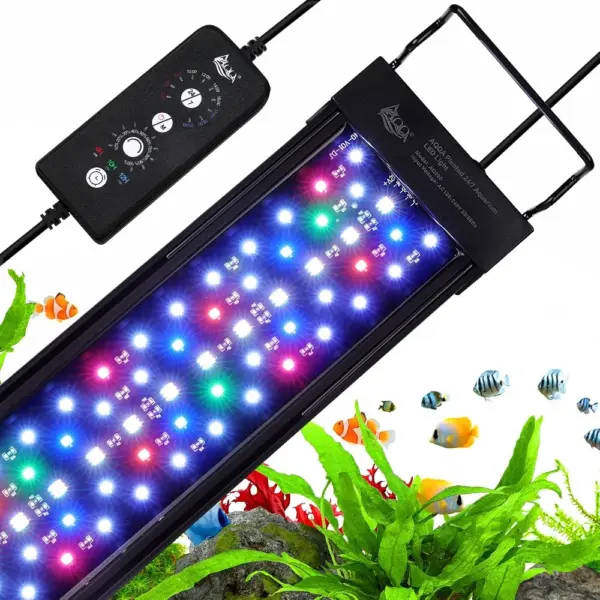
IP68 is worth having if your light lives near splashing — an open top with a bubbler, a turtle dock, a lid you lift with wet hands. The AQQA carries that rating, as does our top pick, and its aluminum housing is the widest and thickest in this group, which is what keeps 18 watts of LEDs cool and lets you clean the bar with a wipe instead of a lecture about water.
The day-to-day is straightforward: a 24/7 mode that walks orange to white to blue, and a DIY side with nine colors, adjustable brightness and your own timer. Setup is among the easier ones here, it holds its settings, and the matte aluminum bar reads as part of the room rather than something clipped onto a tank. The one-year warranty is longer than most of this group offers.
Check the span before you order. AQQA publishes an eight-inch bracket and no tank-length range, so measure your opening rather than assuming it fits the way a 12-20 or 18-24 bar does. Treat the 20-gallon tank as the ceiling, too — there is not much brightness in reserve past that.
Pros
- IP68-rated housing for splash-prone setups
- Widest aluminum body here for heat spreading
- 24/7 mode plus nine DIY colors
Cons
- Not enough punch for tanks much over 20 gallons
We like the AQQA for splash-prone open tops and turtle tanks under 20 gallons, where its IP68 housing and cool aluminum body beat a brighter bar.
Aqueon LED Deluxe Hood – Best for Lidded 20-Inch Tanks
Key Features
- Lighting: Day White LED plus moon glow
- Tank fit: 20 in
- Feeding door: Full length
- Price: Premium
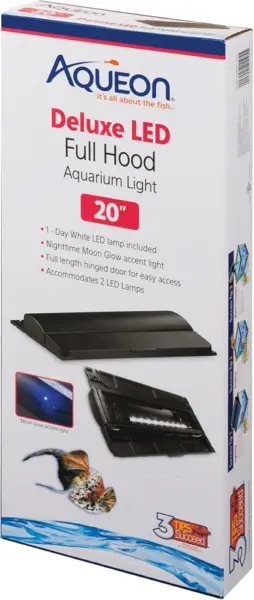
This is a lid that lights your tank, and that is the honest way to read it. If you are hunting a grow light for a planted aquascape, this is not it. If you have a 20-inch tank with an open top, are tired of topping off evaporation and want the light built in, it is the tidiest answer in this group.
The full-length feeding door is the part you will use every day — food in, a floating leaf out, a scraper across the glass, all without lifting the whole lid. The light bar sits above a glass barrier, so splash and condensation never reach the electrics, and the moon glow setting gives a night view without a full white blast. The rear breakouts come out for a filter or heater, though they fight you the first time; for a tank holding a jumper-prone betta, we think that trade is worth it.
As a light it is a single day-white lamp with a spare slot, no dimming and no timer. That is fine over a community tank of tetras and corys and not enough for a high-light planted setup, and the ninety-day cover is the shortest here. As a fitted lid that also happens to light the tank, it is well made and hard to beat.
Pros
- Lid and light in one, with a full-length feeding door
- Glass barrier keeps splash off the electronics
Cons
- Short 90-day warranty
We recommend the Aqueon Deluxe when the goal is a fitted 20-inch lid with usable light, not a plant light.
How We Chose and Tested Freshwater Aquarium Lights
We started with every freshwater fixture we could find that fit standard tank lengths between 12 and 48 inches, filtered out reef-only models and anything with a fixed, non-adjustable output, then cut the list to 12 lights spanning the range a hobbyist actually shops in. Over eight months they ran on a heavily planted 20-gallon in a bright living room, a 55-gallon in a windowless basement fish room, and a nano tank on a kitchen counter that catches morning sun.
Brightness and lighting quality we judged in the water, not on the packaging: we measured output at the substrate and mid-water with a PAR meter, then grew the same three plant species under each fixture for eight weeks, noting whether stems stretched toward the light, whether red plants stayed red, and whether fish color read true instead of blue-cast. Once a month we re-measured to see which lights had quietly dimmed.
Setup got timed with a stopwatch — unboxing, mounting, and programming the timer, solo — and we hung and re-hung every bracket twice to see how the hardware held. Timers ran unattended for the full eight months, and we logged every drifted schedule, missed cycle, and app that dropped its connection. Durability came down to splashes, condensation, and heat: we wiped each lens weekly and checked whether housings ran hot enough to nudge the water temperature.
Value we weighed per inch of tank coverage rather than sticker price, comparing what each fixture cost to light a 36-inch tank well. Reliability was the simplest test of all — does month-eight output look like month-one output, and does the thing still turn on when the timer says it should.
How to Choose a Freshwater Aquarium Light
Two things you can measure today decide most of this purchase: the length of your tank and how deep the water is.
Fit the bar to your tank, then to your rim
Measure the outside length of the tank, not the glass it holds, and compare it with the bracket range. Every bar here extends to a stated span — 12 to 20 inches on our top pick, 18 to 24 on most of the rest — and a fixture that overhangs or falls short leaves dark ends where plants sulk.
The mount decides the rest. A slide-on bracket that lifts the housing above the rim keeps the light off wet glass; a clip is best on thin or rimless glass; a hood replaces the lid entirely and only fits its own footprint.
Match output to depth before you chase watts
Watts per gallon is a crude guide, and depth changes the answer. Twenty watts over a 10-gallon tank is generous — which is why dimming counts as much as output — while 13 watts over a 24-inch tank is fine for anubias, java fern and moss and thin for a deep tank of demanding stems.
Our rule: buy the brightest fixture you can turn down, not the brightest one you can find. Headroom costs nothing to own when the dimmer works, and it lets you raise the light for a photo and lower it for a slow-growing tank.
Read the spectrum, not the slogan
Almost everything here calls itself full spectrum. The useful question is which wavelengths are actually named: 6500K white for daylight, blue around 450 to 460nm, and a deep red around 660 to 665nm, the band plants use hardest.
A high CRI, 90 and up, is the other number worth having, because it keeps fish looking like fish instead of a blue-grey silhouette. If a listing says full spectrum and names no red at all, treat the plant-growth talk as marketing.
Pick a timer you can live with
There are two kinds here. A 24/7 mode runs a fixed orange-to-white-to-blue day, sometimes anchored to real clock times, which suits a household that keeps regular hours. A DIY mode gives you 6, 10 or 12-hour runs with adjustable brightness and color, and it is the one to choose if your evenings start at midnight.
Look for a gradual ramp rather than an instant switch-on, and for memory after a power cut. A fixture that restarts its schedule the moment the power returns will quietly drift your photoperiod by hours.
Pay for year two, not the first week
Failures in this category come from three places: moisture, heat and the power supply. An IP-rated housing, an aluminum body that spreads heat, and an adapter you can replace without scrapping the light are the three things that extend a fixture’s useful life.
Warranty length tells you something about the maker’s own confidence — it runs from 90 days on the hood here to two years on the hygger. Check it before you buy, and keep the receipt either way.
Frequently Asked Questions
How many hours a day should a freshwater aquarium light run?
Start at six to eight hours, which is why the timers on these fixtures begin at six. Add an hour at a time if plants look pale and leggy, and cut back if green algae starts coating the glass.
If your fixture has no timer, put it on an ordinary plug-in outlet timer rather than relying on memory.
Can I use one of these on a saltwater tank?
For a fish-only marine tank, the white output is workable. For corals, no: reef setups need far more intensity and a bluer spectrum than any freshwater fixture here provides.
If a reef is the plan, buy reef lighting and skip this list entirely.
Can I mount one of these under a glass canopy or inside a hood?
It works, with a caveat. Air trapped under a closed lid gets warm and humid, and that moisture is what kills LED boards early.
Keep the bar above the glass where you can. If it has to go inside, use an IP-rated fixture and leave a gap at each end so air can move through.
Final Verdict
Buy the SEAOURA SR-617 if your tank runs 12 to 20 inches and you want the light to handle the day for you: 20 dimmable watts, IP68 sealing, and a 24/7 cycle that survives an outage without losing its place.
If your tank is 18 to 24 inches and plants are the point, switch to the NICREW C10 for its deep-red spectrum and separate channel dimming. And if the real goal is a lid on a 20-inch tank, the Aqueon hood is the practical answer.