This post contains affiliate links. We may earn a small commission when you buy through our links — at no extra cost to you.
An LED fixture does two jobs at once: it gives plants and corals the light they need to grow, and it makes the tank look like something you actually want to stare at after dinner. The problem is that the numbers on the box — wattage, lumens, that vague phrase full spectrum — tell you almost nothing about what reaches the bottom of the glass. I found that out the hard way with a cheap strip that left my java fern pale and my water permanently green. A good light fixes both halves of that: growth you can see, and color that makes the weekly water change feel worth it.
My team and I have spent the past eight months living with 11 different LED lights, on a planted 40-gallon, a nano reef, and a low-tech tank with a single betta, and the pattern was clear pretty quickly. The brightest fixture wasn’t the one the plants liked best, and the priciest one wasn’t the most reliable. What separates the good ones is usually unglamorous: solid mounting, honest color control, and hardware that doesn’t flicker or quit by month three. The picks below are the ones that held up.
Our Top Picks
The Best Led Aquarium Lights, Reviewed
NICREW ClassicLED Plus – Best Overall
Key Features
- Control: Remote, dimmable, 15/30-min ramp
- Wattage: 15 W
- Tank fit: 18 to 24 in
- Color rendering: CRI 91
- Price: Midrange
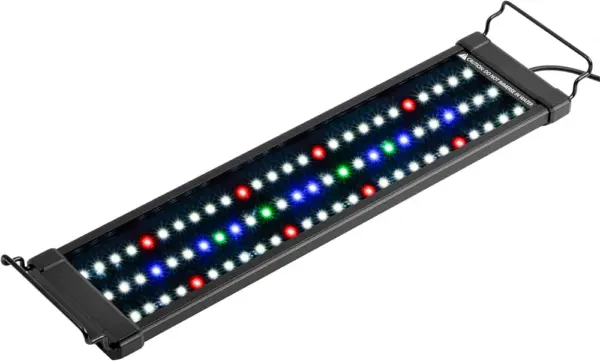
A CRI of 91 is the number that separates the NICREW ClassicLED Plus from the cheaper bars here. It means reds and blues in fish and plants look closer to daylight, and the 660nm red LEDs give planted tanks a wavelength they use. We pay more attention to that than to a raw wattage claim, because a light that washes out color is one you stop wanting to look at.
What seals it for us is the control. The remote gives you two spectrum modes, dimming, and a 15- or 30-minute ramp-up and dim-down, so the tank does not snap from dark to bright. On a planted 20-gallon, that gentle start is the difference between a light you schedule and one you leave off because it startles the fish. The aluminum shell helps spread heat, and the adjustable mounts fit both rimless and framed aquariums.
Fit is the other reason it earns the top spot. The 15W bar is sized for 18- to 24-inch tanks, which covers a standard 20-gallon high and a 10-gallon with the brackets extended. It sits above the water on docking mounts and is not built to get wet, so plan on an open top or a canopy with clearance. For a 10-gallon, the smaller SEAOURA clip-on makes more sense.
The 15W output is also the boundary: treat this as a 20-gallon high light, not a 36-gallon one. If you want the most natural color and a gentle daily transition for a tank in that range, this is the one we point to first. If you need a submersible strip or a nano clip, the other picks here do that job better.
Pros
- High 91 CRI for natural color
- Gentle 15/30-minute sunrise ramp
- Dimmable remote with two spectrum modes
- Fits 18- to 24-inch tanks
Cons
- Some units fail within a year
For a planted 18- to 24-inch tank, this is the light we recommend first: it renders fish color beautifully, ramps gently, and dims far enough to keep algae in check.
hygger Clip-On 24/7 – Best for Nano Planted Tanks
Key Features
- Modes: 24/7 natural and DIY
- Wattage: 14 W
- Tank fit: 12 to 20 in
- Color rendering: CRI 85
- Price: Midrange
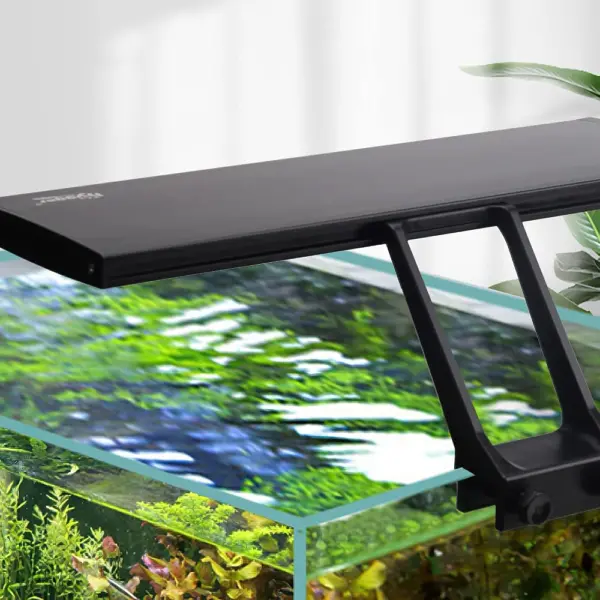
The clip is the first thing we check on a light like this, because a bracket that does not fit the rim is not a bargain at any price. Hygger gets the basics right with a clamp rated for tank walls under 0.9 inch and lengths from 12 to 20 inches. That covers many rimless nanos and standard 10-gallon tanks, which is why it earns a runner-up spot for planted small tanks.
What makes it more than a utility clip-on is the 24/7 natural mode. It moves from orange sunrise to white daylight to blue moonlight on its own, and the DIY mode lets you set 6, 10, or 12 hours with five brightness levels. We like that for a planted nano because the tank gets a routine without a separate timer, and the 85 CRI keeps fish color from looking flat. The 817-lumen output is a good match for a 10-gallon tank.
The two-year warranty is unusually long for this group, and that matters because these lights do not all last alike. The fixture is happiest on a rimless or thin-rimmed tank, and the 12- to 20-inch range overlaps the NICREW at the top end. If your tank is 18 to 20 inches, this gives you a clip-on shape with a full daily cycle; if you have a 24-inch tank, the NICREW covers more length.
Pros
- True 24/7 sunrise-to-moonlight cycle
- Two-year warranty
- Clips onto rimless and thin-rimmed tanks
- Useful 817-lumen output for a 10-gallon tank
Cons
- Clamp may not seat on thick black trim
- Not a high-output fixture for demanding plants
We recommend this clip-on for a 12- to 20-inch nano or rimmed tank when you want a natural sunrise-to-moonlight cycle and a two-year warranty without a full-size fixture.
SEAOURA Clip-On 7-12 – Best for Small Rimless Tanks
Key Features
- Wattage: 12 W
- Tank fit: 7 to 12 in
- Color rendering: CRI 90
- Water resistance: IP68
- Price: Budget
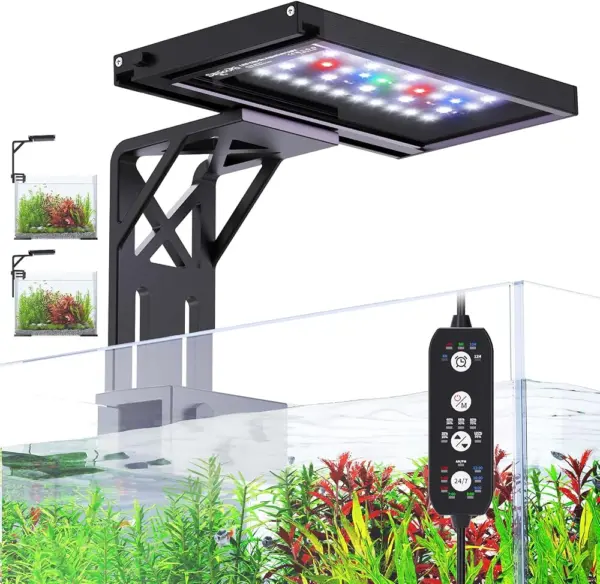
Seven inches is the whole story with the SEAOURA clip-on, and for a nano tank that is exactly the point. The body is the smallest fixture here, so it does not hang over a 7- to 12-inch cube or swallow the scape. We recommend it for a rimless nano cube or a small desktop tank; on a 20-gallon it will look like a spotlight.
The 90 CRI and IP68 rating are the two specs we kept coming back to. The color rendering is close to the NICREW’s 91, so fish and plants still look natural, and the IP68 body means splashes from a filter or a water change are not an immediate disaster. The 24/7 mode gives you a sunrise-to-moonlight cycle, with 10 brightness levels and five timer settings.
The 7- to 12-inch range is a hard ceiling: if your tank is 20 inches, this is not the one. For a small tank, though, it is the most polished clip-on here, with a low-profile body and enough control to set a real daily rhythm. The low-profile shape also makes it easier to keep the light out of your line of sight when you are sitting in front of the tank.
Pros
- High 90 CRI in a small body
- IP68 splash protection
- True 24/7 cycle with five timers
- Low-profile clip for nano tanks
Cons
- Timer programming can be fiddly
For a 7- to 12-inch desktop tank, this is the clip-on we choose: high color rendering, a true 24/7 cycle, and an IP68 body that handles splashes.
AQQA 24/7 LED – Best for Programmable 24/7 Cycles
Key Features
- Control: 24/7 and DIY modes
- Housing: Aluminum
- Wattage: 18 W
- Water resistance: IP68
- Price: Premium
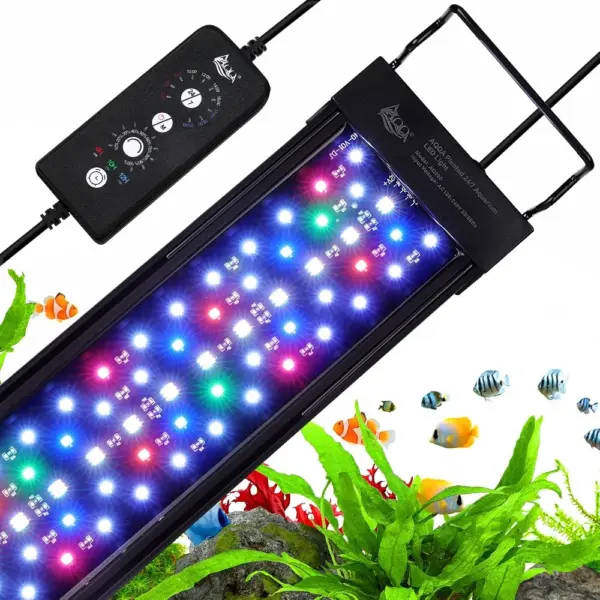
The AQQA’s 24/7 mode is the feature that makes it feel like a small appliance rather than a light bar. You set a sunrise-to-moonlight schedule, and the fixture runs it without a separate timer. We like that for a tank where the light is part of the room, because the transition is softer than a plain on-off switch.
What convinced us to keep it in the roundup is the combination of IP68 sealing and an aluminum body at 18W. The aluminum helps with heat, and the IP68 rating means you can mount it in a humid hood or near splashes without the same worry as a bare plastic bar. The nine colors and DIY mode give you more tuning than the NICREW, and the 365-day warranty is decent for the price. On a small community tank, the output is useful.
The bracket is an 8-inch sliding design, but AQQA does not state a tank-length range, so measure the rim before you order. The programming is the point, and it is also the thing to be honest about: if you want a single switch, this is more fixture than you need. For a small community tank, it is a flexible step up from a simple clip-on.
Pros
- IP68 body with aluminum heat spread
- 24/7 and DIY modes with nine colors
- 365-day warranty
- Useful output for small community tanks
Cons
- Modest output for larger tanks
We like this one for a smaller community tank that needs a set-and-forget 24/7 schedule: the aluminum body and IP68 rating add confidence, though it is not a high-output fixture.
SEAOURA Submersible 15 – Best for Hidden Tank Lighting
Key Features
- Length: 15 in
- Wattage: 9 W
- Mounting: Suction cup, submersible
- Water resistance: IP68
- Price: Budget
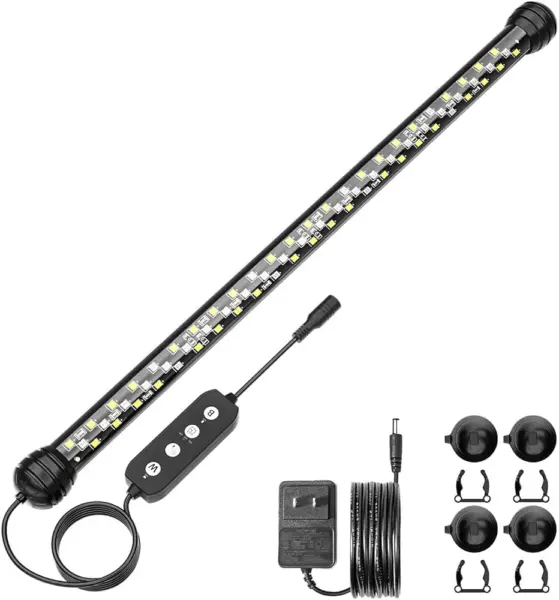
The suction cups are the first thing to deal with on this submersible strip. It is designed to stick to the glass inside the tank, and that mounting is both the appeal and the weak point: when the cups let go, the light ends up floating or sitting against the gravel. If you buy it, plan to secure it under a lid or behind hardscape, and keep spare suction cups on hand.
What makes it worth the fuss is the IP68 body. This is a light you can put fully underwater, which is useful for a quarantine tank, a grow-out tank, or a low scape where a top bar would spoil the look. The 9W output is aimed at a small footprint, and the 24/7 cycle gives you sunrise-to-moonlight without another timer. The color is good, and the three-row layout spreads light along the strip.
We recommend it as a problem-solver. Hiding the light behind a plant or under a lid is the reason to choose it over a clip-on, and the programmable cycle makes a quarantine tank easier to run. The 15-inch length is easy to tuck behind hardscape, and the programmable cycle makes it feel less like a utility strip. For a 15-inch strip, that is a useful set of tricks.
Pros
- Fully submersible IP68 body
- 24/7 cycle in a hidden strip
- Three-row LEDs spread along 15 inches
- Easy to hide behind hardscape
Cons
- Limited output for a main display
If you need a light inside the tank rather than above it, we recommend this submersible strip for a quarantine or grow-out setup.
How We Tested LED Aquarium Lights
We started by pulling together every fixture we could find that was actually sold for freshwater or reef use, then cut the list down by tank size, mounting style, spectrum control, and what came in the box. We ruled out anything with no listed color temperature or no dimming at all, and anything that only fit a rimless tank. That left 11 lights, which we ran for eight months across three tanks: a planted 40-gallon with red and green stem plants, a nano reef, and a low-tech betta setup under a hood.
Brightness and lighting quality got measured, not eyeballed. We took PAR readings at the substrate and just under the surface in each tank so we could see how much light actually reached the bottom, then ran each fixture on an eight-hour timer for weeks to watch how plants and algae responded. For color, we photographed the same red plant and the same fish under every light and compared whether the reds looked red or just orange and washed out. Reliability meant noting flicker on startup, whether timers drifted, and whether any unit dimmed or failed outright over the eight months.
Durability and mounting were the quiet deal-breakers. Every light lived with real splash, condensation under a hood, and a weekly wipe of the lens, and we checked suction cups once a week to see which ones let go after a month and which left residue on the glass. We also weighed value honestly: a fixture that needed a separate timer, mount, or dimmer to be usable did not count as a bargain. The lights that scored best were the ones we stopped thinking about.
How to Choose an Led Aquarium Light
The right aquarium light is the one that fits your tank, suits your plants, and runs on a schedule you can live with; everything else is a detail.
Start with length, rim, and clearance
A light listed for 18 to 24 inches is not 18 to 24 inches of glowing bar; that figure includes the sliding brackets. Measure the tank’s outside length, the rim thickness, and any lid or hood opening before you choose. A clip-on such as the SEAOURA 7-12 needs a thin edge to grab, while the NICREW 18-24 sits on docking mounts and needs clearance above the water. The trap is a tank that matches the length but not the top: a wide black frame can stop a clip from seating, and a hood can block a bar that otherwise fits.
Decide how much control you want
A plain on-off light is fine for a fish-only tank, but a planted tank benefits from dimming and a consistent schedule. A 24/7 mode such as the hygger clip-on’s runs sunrise, daylight, and moonlight on its own, which removes the daily switch-flip. The trade-off is programming: these controllers are not always intuitive, so read the manual before the tank is full. If you already use a smart plug, a dimmable bar without a built-in timer can be the simpler buy; you get a schedule, but not the gradual ramp.
Look at spectrum and CRI, not just watts
Wattage tells you how much power a fixture draws, not how well it covers your tank. For fish color, a high CRI helps; the NICREW’s 91 and the SEAOURA clip-on’s 90 are the strongest figures here. For plants, look for white light plus red and blue, and treat 660nm red as a useful signal rather than decoration.
The trap is assuming a higher-wattage bar automatically grows better plants. A narrow, intense fixture can leave the edges of a wide tank dim, and a modest bar with good spread can look better. Match output to tank depth and footprint, then use dimming to fine-tune.
Match water resistance to where the light sits
Most aquarium lights are designed to sit above the water, and some are explicitly not water-resistant. Keep those clear of splashes and condensation; a canopy can help, but only if it leaves room for the fixture. For a light inside the tank, look for an IP68 rating and a mounting system you trust. The SEAOURA submersible is the pick here for that job, but its suction cups need checking.
The trap is the word waterproof. A splash-resistant bar is not automatically safe to submerge, and a submersible strip is not necessarily the best main display light. Decide whether you need above-water coverage or hidden in-tank light before you buy.
Plan for service life
LED aquarium lights are not a buy-once-forever purchase at this level. Heat, moisture, and controller failures show up across the category, so an aluminum body and a real warranty are worth more than an extra color mode. The hygger clip-on carries two years, and the AQQA lists 365 days; both are useful signals.
The practical move is to keep the receipt, mount the light where it stays dry unless it is rated for submersion, and avoid burying the controller in a sealed hood. If a fixture does fail, support matters as much as the spec sheet.
Frequently Asked Questions
How many hours a day should the aquarium light stay on?
Start at six to eight hours and keep the window consistent with a timer. If algae starts spreading, cut back to six before you change fertilizers or add cleanup crew. A split photoperiod can help some tanks, but consistency matters more than squeezing in extra light.
Why does my aquarium light have a blue mode?
Blue is there for moonlight and for making fish colors pop after the main light goes off. Use it at low intensity for a short evening viewing period, not as a full-night daylight substitute. Fish still need a dark stretch, so let the tank go fully dark overnight.
Can I use a freshwater planted light on a saltwater tank?
Most of these fixtures are sold for freshwater and planted tanks, and their spectrum is tuned for that. If you keep corals, choose a light the maker rates for reef use and check the spectrum and output against the coral type; do not assume a planted bar will do. A fish-only saltwater tank is less demanding, but check the maker’s stated use before buying.
Final Verdict
For most planted community tanks in the 18- to 24-inch range, the NICREW ClassicLED Plus is the light we recommend. It combines the best color rendering in this group with a gentle sunrise ramp and useful dimming, so it looks good and is easy to live with.
If your tank is a 7- to 12-inch nano, choose the SEAOURA clip-on instead; it puts a true 24/7 cycle in a much smaller footprint. For a 12- to 20-inch rimmed tank, the hygger clip-on is the better fit, and the AQQA is the pick for a small community tank that needs more programming.