This post contains affiliate links. We may earn a small commission when you buy through our links — at no extra cost to you.
Most aquarium substrates are designed for planted tanks or shrimp, not goldfish. They can lower pH, release nutrients, or include particles small enough to be swallowed. Goldfish are messy diggers that thrive in neutral water with large, inert gravel.
This guide cuts through the marketing to focus on what actually works: particle size that prevents ingestion, materials that don’t alter water chemistry, and gravel that cleans up without excessive dust. The right substrate keeps your fish safe and your maintenance simple.
Whether you have a single fancy goldfish or a pond-sized tank, the picks here balance safety, appearance, and cost. No plant soils, no painted coatings – just the proven options for a healthy goldfish environment.
Top Picks
Best for Goldfish Tanks
YISZM River Rocks 1/4 in

Rating: 4.6 ★ | Price: Mid-Range | Particle Size: 1/4 inch (6.35mm) | Chemical Inertness: Natural river rock, inert | Cleanliness: Minimal dust | Weight & Depth: 5 lbs per bag
The 1/4-inch particle size is the single most important feature: large enough that goldfish cannot swallow a single stone, eliminating the ingestion risk posed by finer gravels or sands. The smooth, polished surfaces are gentle on goldfish barbels, and the natural earth tones create a convincing streambed look without artificial dyes or sharp edges.
This bag is sized for smaller tanks (10–20 gallons) or as a topper. Goldfish keepers with tanks over 30 gallons will need multiple bags, which drives up the total cost. The rocks are inert — no pH or hardness shifts — and only require a quick rinse to remove dust. Occasional pieces may be slightly larger than 1/4 inch, but remain well within the safe zone for goldfish.
Pros
- 1/4-inch rocks are too large for goldfish to ingest — best-in-class safety
- Smooth, natural river stones that look like a real streambed
- Inert material that won’t alter water chemistry or trap waste
Cons
- Only 5 lbs per bag; larger tanks need multiple bags, raising total cost
- A few stones may be slightly larger than 1/4 inch — still safe but size varies
For goldfish keepers who want the safest possible particle size, this is the straightforward choice — just account for the bag volume if your tank is over 20 gallons.
Best for Goldfish Tanks
Aqua Natural Midnight Pearl

Rating: 4.7 ★ | Price: Budget | Particle Size: 2-4 mm | Chemical Inertness: Natural pebble, inert | Cleanliness: Low dust, easy rinse | Weight & Depth: 10 lbs per bag
The 2-4 mm pebble size is large enough to prevent goldfish from swallowing, yet small enough to allow waste to settle between particles during cleaning. At 10 lbs, this bag provides more substrate for the price than other goldfish-safe options, covering a standard 10-gallon tank bottom with a natural brown speckled look.
Initial cloudiness can occur without thorough rinsing, a minor tradeoff for a gravel that won’t harm fish. It suits goldfish keepers who prioritize safety and value over a perfectly clear first fill, and who want a low-maintenance substrate that doesn’t alter water chemistry.
Pros
- Natural riverbed look that darkens with muted speckles for a realistic scape
- Low dust and easy to rinse, saving setup time
- Inert natural pebble won’t shift pH or hardness
Cons
- Initial cloudiness can appear without thorough rinsing — a rinse-before-use tradeoff
If you need a large volume of goldfish-safe gravel at the lowest per-pound cost and don’t mind a thorough rinse, this is the practical choice.
Best for Goldfish Tanks
Aqua Natural Gold Pearl

Rating: 4.7 ★ | Price: Mid-Range | Particle Size: 2-4 mm | Chemical Inertness: Natural stone, inert | Cleanliness: Can be dusty | Weight & Depth: 10 lbs per bag
The 2-4mm gravel delivers a natural gold glow that brightens the tank without artificial dyes, making it visually distinct from plain brown alternatives. Even after triple washing, some bags may release noticeable dust during setup — a tradeoff for the aesthetic. This gravel suits goldfish keepers who value appearance and are prepared to rinse thoroughly before adding to the tank.
Pros
- Natural gold shimmer brightens the tank without artificial dyes.
- 2-4mm grain size is safe for goldfish — too large to ingest.
Cons
For goldfish keepers who want a golden tank bottom without sacrificing safety, this gravel delivers on looks — just budget extra rinsing time.
Best for Planted Tanks
Aqua Natural Sugar White Sand

Rating: 4.7 ★ | Price: Mid-Range | Particle Size: 0.5-1 mm (fine sand) | Chemical Inertness: Natural quartz, inert | Cleanliness: Clean, easy rinse | Weight & Depth: 10 lbs per bag
This sand delivers a bright white look that enhances planted tanks, and it rinses clean with minimal dust. The fine grain size poses a risk of digestive blockages in goldfish, making it suitable only for small goldfish under close supervision. Some bags may show an off-white or tan tint rather than pure white.
Pros
- Bright white appearance brightens planted aquascapes
- Easy to rinse and clean with little dust
Cons
- Color may appear off-white or tan rather than pure white
This sand is a good choice for planted tanks that need a bright substrate, but goldfish keepers should opt for a larger-particle gravel to avoid ingestion risks.
Best for Planted Tanks
Seachem Flourite Black

Rating: 4.6 ★ | Price: Premium | Particle Size: 1-2 mm | Chemical Inertness: Clay, does not alter pH | Cleanliness: Extremely dusty | Weight & Depth: 15.4 lbs per bag
Seachem Flourite Black’s fractured clay provides a stable root medium for aquarium plants without altering pH, and its deep black color creates striking contrast in planted layouts. However, the heavy dust requires thorough rinsing, and this substrate is best suited for planted tanks without goldfish.
Pros
- Nutrient-rich clay supports healthy plant root development.
- Deep black color provides high contrast for aquascaping.
Cons
- Fine 1-2mm grain may be ingested by goldfish, posing a health risk.
For planted tank enthusiasts without goldfish, this substrate supports healthy plant growth with a rich black aesthetic.
Best for Decorator Tanks
Aqua Natural Diamond Black

Rating: 4.5 ★ | Price: Mid-Range | Particle Size: 1-2 mm | Chemical Inertness: Natural quartz, inert | Cleanliness: Very dusty | Weight & Depth: 10 lbs per bag
1-2mm black quartz with shimmer adds visual depth to decorator tanks at a mid-range price. But the fine grain is a safety hazard for goldfish, and dust requires thorough rinsing. Skip this for goldfish; it’s better for planted aquascapes without them.
Pros
- Sparkly black finish enhances aquascape contrast.
- Mid-range price for a 10 lb bag of decorative gravel.
Cons
- 1-2mm grain size poses ingestion risk for goldfish.
Only suitable for decorator tanks without goldfish — choose a larger-particle gravel if you have goldfish.
Best for Nano Tanks
FANTIAN Coarse Sand
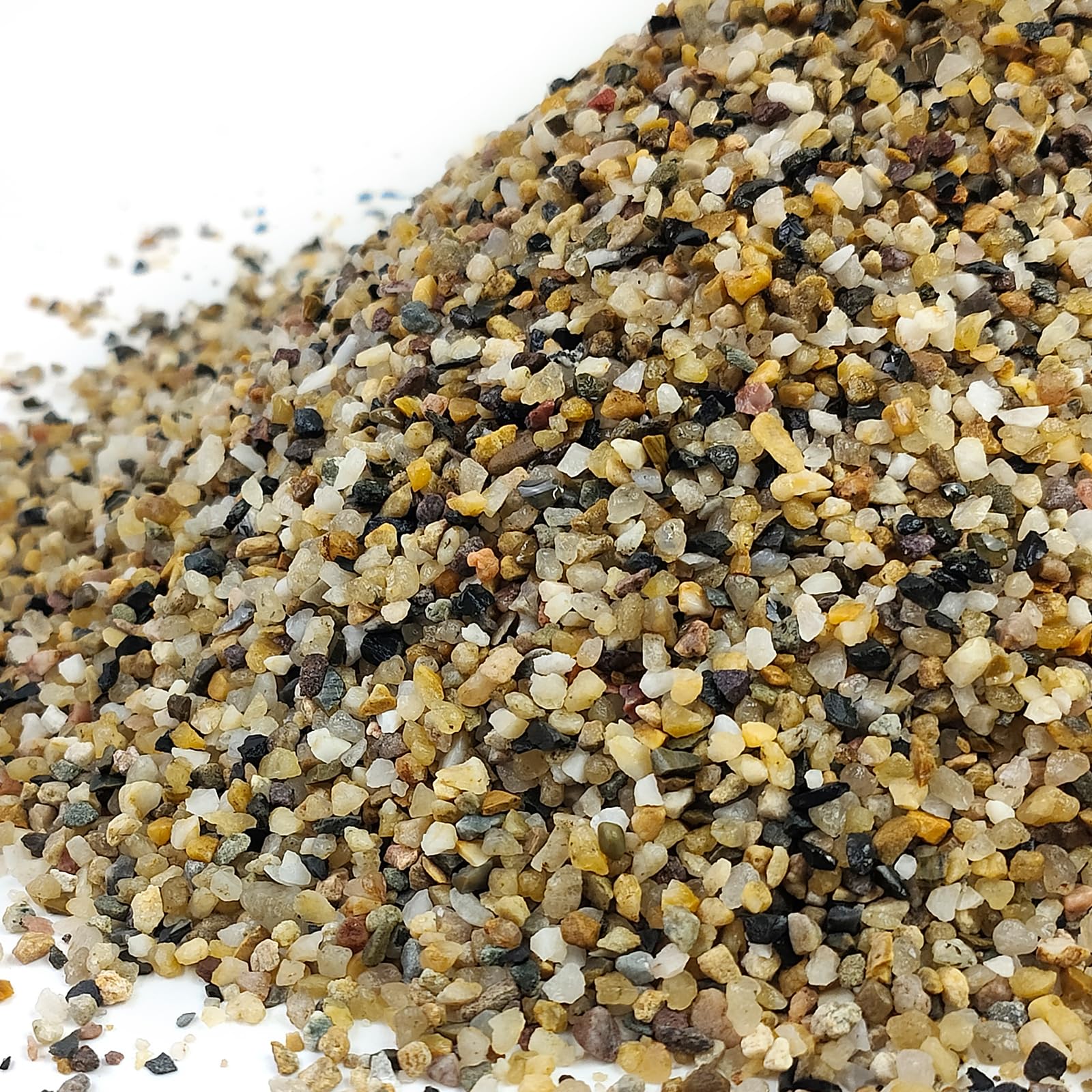
Rating: 4.8 ★ | Price: Budget | Particle Size: 1/16 inch (1-2mm) | Chemical Inertness: Natural river sand, inert | Cleanliness: Easy to clean | Weight & Depth: 2 lbs per bag
The FANTIAN Coarse Sand delivers natural river sand in a 2 lb bag at a low price point, with attractive earth tones that suit small nano tanks or succulent top dressing. The 1–2 mm grains rinse clear quickly and are easy to work with for craft use. However, the bag is too small for any goldfish tank, and the grain size—while labeled coarse—can still be swallowed by goldfish, posing an ingestion risk. This sand is impractical for goldfish setups but works well for dedicated nano tanks or non-aquatic projects.
Pros
- Natural earthy colors suit nano tanks and top dressing
- Rinses clean with minimal effort
Cons
- 2 lb bag is insufficient for any goldfish tank; grain size can be ingested by goldfish
A fine choice for small nano tanks, succulent top dressing, or craft projects—but not for goldfish tanks due to insufficient volume and ingestion risk.
How to Choose
The single most important decision is particle size — goldfish will swallow anything that fits in their mouth, and fine sand or small gravel can cause fatal blockages.
Particle Size
Goldfish are opportunistic feeders that sift through substrate looking for food. Anything smaller than about 2mm risks being ingested and causing intestinal impaction. For adult goldfish, 2-4mm gravel is the minimum safe size; 1/4 inch (6mm) is even better.
Fine sand under 1mm is especially dangerous because it can pack in the digestive tract. Even if your goldfish is small now, they grow quickly. Choosing a larger particle from the start saves you from replacing the entire substrate later.
Chemical Inertness
Goldfish prefer neutral to slightly alkaline water (pH 7.0–8.0). Many planted-tank substrates contain peat, clay, or fertilizers that lower pH or release ammonia. These can stress goldfish and interfere with biological filtration.
Stick to inert materials like natural river gravel, quartz, or plain clay pebbles that do not alter water chemistry. Avoid any product labeled for ‘planted aquariums’ unless it explicitly states it does not affect pH.
Cleanliness
Dust and cloudiness are common complaints because manufacturers often don’t rinse thoroughly. Even ‘pre-washed’ substrates can release fine particles that take days to settle and may clog filters. Plan to rinse every bag at least 3-4 times in a bucket until the water runs clear.
Products with very fine grains or porous surfaces (like clay) tend to be dustiest. A clean substrate means less work after setup and clearer water for your fish. If you see ‘can be dusty’ in reviews, expect extra effort.
Weight & Depth
Goldfish dig and root around, so you need enough weight to stay put. A 2-3 inch layer is standard for a goldfish tank. A 10-pound bag typically covers about 1-2 square feet at that depth. Larger tanks or deeper beds require multiple bags.
Lightweight substrates (like perlite or some soil mixes) float when disturbed — avoid those. Heavy gravel stays in place even when goldfish dig. Check the weight per bag and calculate how many you need before buying.
FAQ
What size gravel is safe for goldfish to prevent swallowing?
Choose gravel that is at least 2mm in diameter. 2-4mm is the standard safe range for most goldfish. For larger adult fish, 1/4 inch (6mm) river rocks are even safer. Anything smaller than 1mm, like fine sand or dust, can be swallowed and cause internal blockages.
Can I use sand in a goldfish tank without risking impaction?
Fine sand under 1mm is risky because goldfish naturally sift substrate. Even coarse sand (1-2mm) can be ingested. If you prefer sand, limit it to tanks with very small goldfish and remove it once they grow. Most keepers find gravel easier and safer.
Why does my new substrate keep clouding the water even after rinsing?
Some substrates, especially clay or fine gravel, release tiny particles that take multiple rinses to remove. Rinse in a bucket until the water is clear — this can take 5-10 cycles. If cloudiness persists after setup, use a mechanical filter pad and do water changes. Cloudiness is not harmful but it’s unsightly.
Is black sand safe for goldfish?
Black sand itself is safe material-wise (usually natural quartz or basalt). The danger is the fine grain size, not the color. If the sand is under 1mm, it poses the same impaction risk as white sand. For goldfish, choose black gravel with at least 2mm particles instead.