This post contains affiliate links. We may earn a small commission when you buy through our links — at no extra cost to you.
The fastest way to turn a planted tank into an algae farm is to assume any aquarium light will do. Plants need usable light, not just a bright glow; the gap between a tank that pearls and one that sulks comes down to spectrum, spread, intensity, and a reliable timer. I’ve kept java fern under bargain LEDs that made it look plastic and watched an overpowered fixture paint every surface green. A good planted light fixes consistency: enough usable light for photosynthesis, spread evenly, on a schedule I don’t have to remember. Over eight months, my team and I ran 12 different lights on tanks from a 10-gallon nano to a 40-gallon breeder.
Some looked sleek enough to leave on display; others had color channels that made red plants glow—or turned the tank into a disco. We judged value by what came in the box: timer, mounting hardware, adjustable spectrum. A few suction cups gave up early, a useful warning about durability and lifespan. The picks below are the ones that earned a permanent spot above our tanks.
Our Top Picks
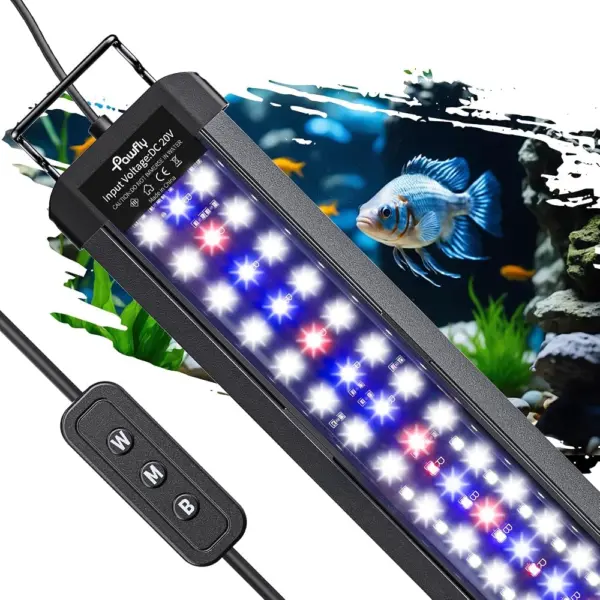
The Best Planted Aquarium Lights, Reviewed
NICREW ClassicLED Plus 21W – Best Overall
Key Features
- CRI: 91
- Timer: Auto on/off with 15 or 30-min ramp
- Spectrum: 6500K white, 450nm blue, 660nm red, green
- Tank fit: 30-36 in
- Price: Midrange
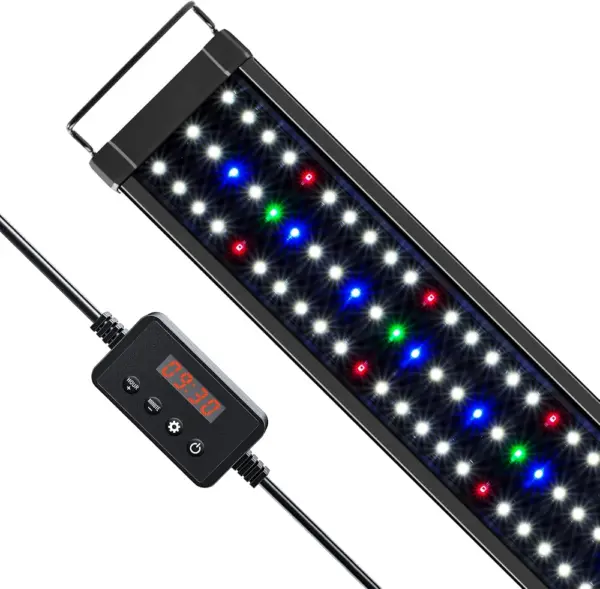
The figure that sold us is 660 — as in 660nm, the deep-red wavelength chlorophyll actually absorbs and the one budget bars usually fake with more white. NICREW pairs it with 6500K white, 450nm blue and a little green, and rates color rendering at 91. Over a planted tank that combination does something you notice on the first evening: the reds in a lotus and the greens of a crypt look the way they do in daylight rather than under a blue cast. Honest color is not a luxury here; it is how you tell whether a plant is thriving or sulking.
The 21W version spans 30 to 36 inches, with docking mounts that slide on both sides to sit on rimless glass or over a frame, and the body is only 1.7 inches deep — low enough to disappear above the waterline instead of hovering over it. An aluminum shell does the heat work, which matters on a covered tank where warm air collects under the lid.
Two controls we kept coming back to: the auto on/off timer and the ramp. You can set the fixture to fade up and down over 15 or 30 minutes, and that changes the tank more than the spec suggests — fish that scatter when a light snaps on settle into a slow sunrise instead. Brightness is adjustable and there are two spectrum modes if you want a bluer evening look, all from the controller rather than an app.
Our reservation is longevity. The complaints that stick are not about color or output; they are about units going dim or quitting, often inside a year. Ours ran without trouble, so we treat this as a risk to price in rather than a reason to skip the light. It is also unsealed, so it belongs above a glass or acrylic lid rather than under a hood where condensation drips. Both are manageable, and neither touches what the light does while it is working.
Pros
- 660nm red and CRI 91 for honest color
- 15- or 30-minute sunrise and sunset ramp
- Sliding mounts fit rimless and framed tanks
- Adjustable brightness and two spectrum modes
Cons
- Longevity is the weak point
Our pick for a 30- to 36-inch planted tank: the most honest color here, a genuine sunrise ramp, and dimming that lets you tune the tank instead of just switching it on.
hygger 14W Full Spectrum – Best Value for Small Tanks
Key Features
- Output: 14W, 834 lumens
- Tank fit: 18-24 in
- Brightness: 5 levels, 100% to 10%
- Light modes: White; white+blue+red; red+blue
- Price: Budget
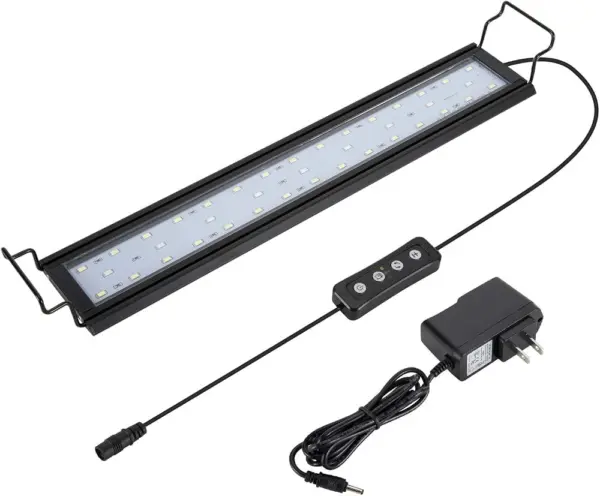
Spending less does not buy you the light at the top of this page, but the gap is narrower than the price difference suggests. This 14W bar pushes 834 lumens from 5730-size LEDs in three modes — all white, white with blue and red, or red and blue — with five brightness steps that go all the way down to 10 percent. It is one of the few cheap fixtures that gives you a real dimmer instead of an on/off switch.
What earns it a place is that dimming. An 18- to 24-inch tank is easy to over-light, and five steps down to 10 percent let you run a low-tech planted tank without a green bloom every time you look at it the wrong way. Two metal brackets extend from each end to hold the bar over the rim, and plastic ones come in the box for tanks where metal would scratch. The aluminum body has a nicer feel than the price implies.
The compromise sits in the spectrum and the electronics. The red channel is not specified at a wavelength the way our top pick’s is, so we treat this as a dependable low-to-medium light rather than a precision plant fixture. The timer also takes a couple of passes before the sequence sticks, and the presets are coarse — the kind of controls you set once and then leave alone. Neither is unusual at this end of the range.
Pros
- Five brightness steps down to 10 percent
- Three switchable color modes
- 834 lumens from a 14W bar
- Metal and plastic brackets both included
Cons
- Early failures turn up; watch the first month
The small-tank value pick: five dimming steps and three color modes on an 18- to 24-inch bar, with a one-year warranty covering the electronics.
SEAOURA Clip-On 24/7 – Best for Nano Tanks
Key Features
- Timers: 5 settings
- Tank fit: 7-12 in
- Intensity: 10 levels
- Waterproof: IP68
- Price: Midrange
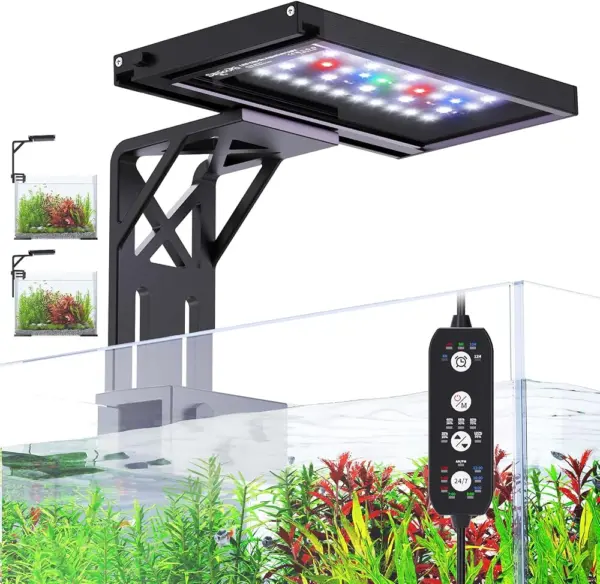
Nano tanks are where most planted lights fall down, not because the light is weak but because there is nowhere to put it. A rimless cube with a filter and a lid has no spare inch of rim, which is why we like the clamp here: it grips the glass wall, the arm adjusts for height, and the casing slides so the strip sits where you want it over a 7- to 12-inch footprint.
The specification is unusually complete for a light this small — ten intensity levels, five timer settings, an IP68 rating — but the detail we appreciated most is the preview function. You can see a color and brightness before you commit it to the 24/7 cycle, instead of finding out what a setting looks like after you have saved it and waited until the next morning. Memory after a power cut is the other one that matters: the fixture picks its schedule back up and recalculates rather than restarting at sunrise.
It will not light a big tank, though. SEAOURA rates it for medium-to-low light plant growth, which fits a strip this size, and the clamp is at its best on a cube or a 10-gallon where one beam covers the footprint. What surprised us is how little the small size costs you in color: the 6500K white and CRI 90 read closer to our top pick than the size gap suggests.
Pros
- Clamp fits rimless and odd rims
- Ten intensity levels and five timers
- Preview colors before saving a setting
- IP68 body with power-loss memory
Cons
- Rated for medium-to-low light plants only
- Covers a small footprint only
Our nano-tank pick: a clamp that clears a rimless rim, ten dimming steps and a sealed body, aimed at the medium-to-low light plants small tanks actually hold.
hygger 42W 24/7 LED – Best for Large Tanks
Key Features
- Timer: 24/7 cycle; 6, 10 or 12 h DIY
- Wattage: 42W
- Tank fit: 48-54 in
- LED count: 215
- Price: Premium
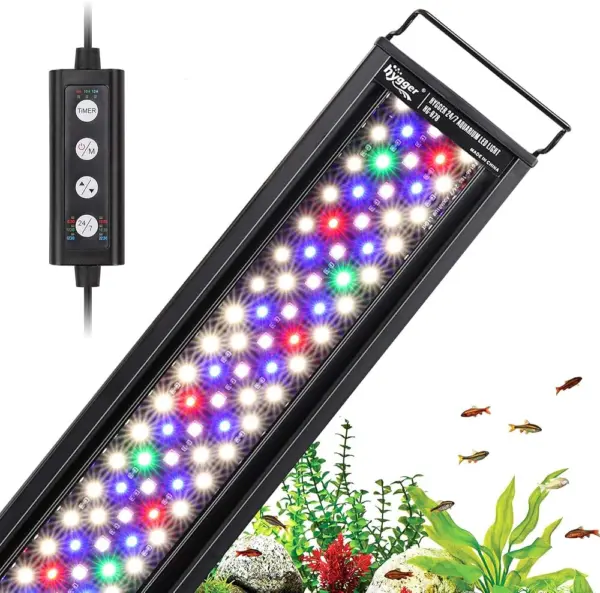
Four feet of water needs a different class of light. The 42W hygger is the fixture in this group built for that job: 215 LEDs, 105 of them white at 6500K, with blue, red, green and RGB filling out the mix, spread over a body that reaches 48 to 54 inches. On a deep tank the extra output is not bragging rights, it is the difference between light that reaches the substrate and light that only reaches the top third.
The default 24/7 cycle is the selling point: warm orange from 6 to about 8am, full white through the day, blue moonlight after 10pm, with nothing to touch. A DIY mode adds 6, 10 or 12-hour timers, five brightness levels and seven colors. Here is the practical catch — that default white stretch runs from roughly 8am to 10pm, a fourteen-hour day. For a planted tank that is a lot of light and a standing invitation to algae, so use the DIY timer and pick a shorter run, or keep the long cycle and dial brightness down.
Two details earned our goodwill. The adapter is separable, so a dead power supply is a replacement part rather than a dead fixture — unusual at this size, and the reason a failure here is not automatically a write-off. The bending extendable bracket also adjusts in length without tools, which makes it easy to level over a rim that is not perfectly straight.
Durability is where it gives ground. A 42W bar runs hotter than a 14W one by definition, and the failures that turn up are board-level: the light goes dim or patchy rather than dying cleanly. The two-year warranty is what makes that palatable, and the replaceable adapter covers the other common failure point. On a four-foot tank with plants that need real intensity, we still take the trade, because the alternative in this group is a shorter bar that leaves one end of the tank dim.
Pros
- 42W across 215 LEDs for 48-54 inches
- Replaceable adapter instead of a dead fixture
- 24/7 cycle plus seven DIY colors
- Two-year warranty
Cons
- Durability is the weak spot
For a 48- to 54-inch tank, this is the bar to fit: 42 watts across 215 LEDs, a replaceable adapter, and a 24/7 cycle you will want to shorten.
Pawfly 11W LED – Best Budget Pick
Key Features
- CRI: 90
- PAR: 55
- Tank fit: 12-18 in
- Brightness: 6 levels, day and night modes
- Price: Budget
Pawfly quotes the numbers most listings hide: PAR 55, 2500 LUX, CRI 90, with 6500K white, 450nm blue and 660nm red on the board. That tells you more than a wattage ever does — this is a low-light fixture, the kind that keeps java fern, anubias and moss happy and will not drive a carpeting plant no matter how long you leave it on. Knowing that before you buy is worth more than another color mode.
What we like is the control at this price. Six intensity levels, with the white-and-red channel and the blue channel adjusted separately, so you can run daylight down to a simmer and keep a little blue for evening viewing. A sliding bracket takes the span from 11.5 to 20 inches to sit over tanks of 12 to 18 inches, and the day and night modes are one button apart. On a 10-gallon quarantine tank or a shrimp cube, it does the job without asking you to think about it.
Two things to know. The board is silicone-sealed and the fixture is FCC-certified, but this is still a splash-resistant bar and not a submersible, so keep it above the waterline and off a hood that drips. And lifespan is the real risk: the ones that fail tend to fail in months rather than years. At this money that is a fair trade, but it is a light you buy expecting to replace it, not one you hand down.
Pros
- Published PAR 55 and CRI 90
- Separate blue and white-red channels
- Day and night modes on one button
- Bracket spans 12 to 18 inch tanks
Cons
- Low output suits low-light plants only
- Short-lived; failures arrive early
The budget pick for a 12- to 18-inch tank: a stated PAR figure, honestly rated color, separate blue control, and a lifespan to treat as short.
AQQA 18W 24/7 LED – Best for Low-Maintenance Tanks
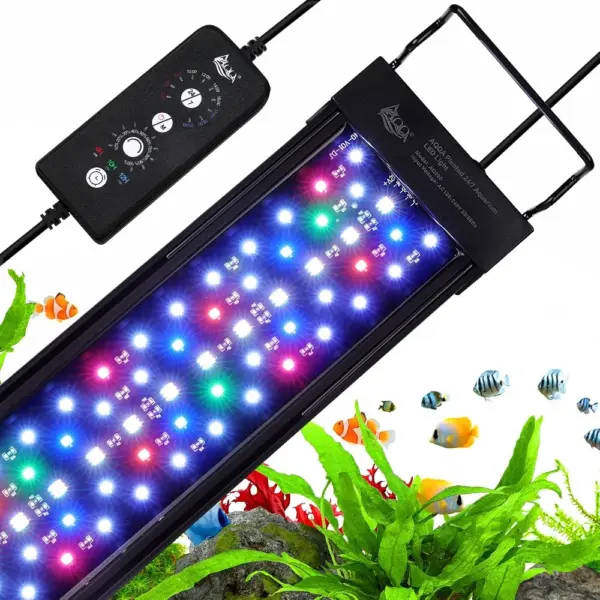
Key Features
- Colors: 9
- Wattage: 18W
- Warranty: 365 days
- Waterproof: IP68
- Price: Midrange
There is a particular pleasure in a light you never touch again. The 24/7 default runs a warm orange sunrise into full spectrum into moonlight, and the DIY mode puts color, brightness and a 6, 10 or 12-hour timer on separate buttons for the days you want to interfere. Nine colors, an IP68 body and a widened aluminum shell that stays cool enough to handle — it is a well-finished object, and the 365-day warranty is the longest cover in this group.
The question we could not answer from the product information is fit. The bracket is 8 inches long and the housing is compact, but the tank-length range is not stated the way it is on every other light here, so measure your tank opening before ordering — the bracket has to reach both rims or the bar sits at an angle and looks wrong. Output is the second consideration: 18W is comfortable over a 20- or 29-gallon and stretched thin over a 36.
Where it lands for us is the tank you do not want to think about: a mid-size setup with a mix of low-light plants, where the cycle does the work and the sealed body shrugs off condensation under a lid. If you want to grow something demanding, the extra watts in our large-tank pick buy more than the extra colors here do.
Pros
- 24/7 cycle with nine colors
- IP68 body in aluminum housing
- 365-day warranty
- Timers and brightness on separate buttons
Cons
- Tank-length range is not stated
- 18W thins out on longer tanks
A set-and-forget 24/7 light in a sealed aluminum body, best on a small or mid-size tank where the daily cycle matters more than raw output.
SEAOURA Submersible 23 in – Best for Hooded Tanks
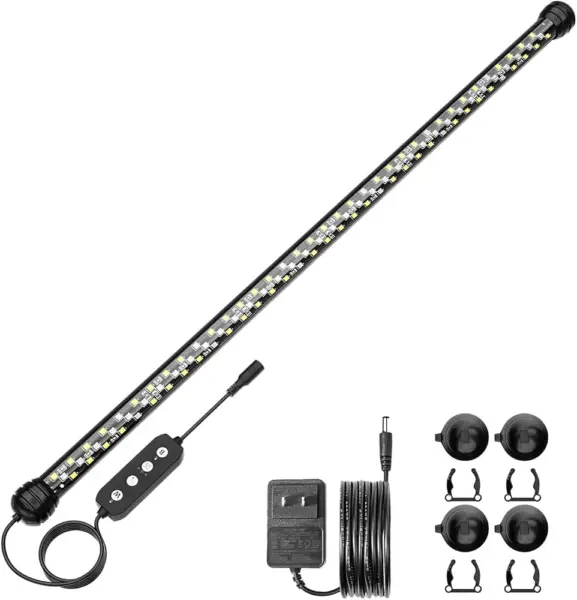
Key Features
- Timer: 6, 10 or 12 h
- Wattage: 12W
- Waterproof: IP68
- Fixture length: 23 in
- Price: Midrange
Some tanks have no top to hang a light over: a full hood, a rim with no flat, a built-in lid. That is the tank this exists for. The 23-inch strip is IP68 rated and runs fully submerged on suction cups, or fixes under the tank cover or behind the glass as hidden atmosphere lighting, with ten brightness levels and a 6, 10 or 12-hour timer that resumes after a power cut.
The mounting is the weak point. Suction cups on submerged glass have a hard life and these let go over time; the fix is either to press them back or to fix the strip under the cover instead of trusting the cups. Plan for that rather than being surprised by it in week three. Programming is also a touch fussy — the settings live on the corded controller, and a plain on/off button would be easier for daily use.
Where we place it is as fill light. A single 12W strip low in the water lights the plants and fish nearest it beautifully and leaves the rest of the column alone, which is fine for a hooded low-light setup and not enough for a demanding aquascape. Buy it to solve a mounting problem, not to grow a carpet.
Pros
- IP68 and fully submersible
- Ten levels with 6, 10 or 12-hour timer
- Memory keeps the schedule after a power cut
- Hides behind or under a hood
Cons
- Suction cups let go over time
- Too little output for a whole tank
The answer when there is no room on top: a sealed 23-inch strip that hides under a hood or behind the tank, best treated as fill light rather than the only fixture.
How We Tested Planted Aquarium Lights
We started with a shortlist of about 30 planted-tank lights recommended in aquarium forums and club threads, then narrowed it by tank-size coverage, mounting style, spectrum control, built-in timers, and price. The final 12 fixtures covered budget and midrange options, clip-on and hanging designs, and models with and without app control. Over eight months, every light spent at least six weeks over a planted tank: a 10-gallon nano with anubias and java fern, a 20-gallon long with pearlweed, and a 40-gallon breeder with dwarf hairgrass. I also moved two fixtures between a low-tech shrimp tank and a CO2-injected tank to see how they handled different light demands.
For lighting quality and brightness, I took PAR readings at the surface, midwater, and substrate, then watched whether lower leaves stayed compact, whether pearlweed pearled after water changes, and where algae showed up first. We compared color options by flipping through each channel and noting whether red plants looked natural or muddy. Appearance got judged from the sofa as well as the tank: visible cords, glare, and how much light spilled into the room. Value came down to what was included—timer, mounting hardware, adjustable spectrum—rather than the sticker alone.
Timers were programmed for a seven-hour photoperiod, then checked after a simulated power interruption to see whether the schedule held. We left suction-cup mounts in place for weeks, noting slips, yellowing, and hard water crust. Durability and lifespan are slower to prove, so we kept every fixture running after the formal test, watching for flicker, dimming, or discolored LEDs. The lights that needed the least fuss—no reset timer, no re-stuck cup, no mystery flicker—are the ones that rose to the top.
How to Choose a Planted Aquarium Light
Length decides which lights you can consider at all; spectrum, dimming and timers only start to matter once a fixture spans your tank.
Fit the fixture to the tank before anything else
Every light here is sold by tank length, and the bracket range is the number that decides whether it fits. A bar that spans 30 to 36 inches covers a 20-gallon long end to end; the same bar over a 24-inch tank hangs past the glass and throws light into the room. Clip-ons trade span for a clamp on the wall, which is the only option on a rimless cube with no free rim.
The figure to trust is the assembled span, not the tube length. A body sold as fitting 18 to 24 inches can be a 17-inch tube that reaches 18.5 inches with its brackets extended — and two shorter bars sometimes cover a long tank more evenly than one short bar centered over it.
Read the spectrum, not the label
Full spectrum is not a standard; it is marketing until wavelengths appear. What a planted tank uses is white around 6500K for the look, red near 660nm for growth and color, and a little blue near 450nm to keep growth compact. Color rendering tells you how honestly the tank reads — at 90 and above, red plants and fish stop looking muddy.
None of that rescues a small fixture on a deep tank. A light that is generous at 12 inches of water is modest at 24, which is why the highest output in this group belongs on the longest, deepest tanks.
Dimming and a timer change more than extra watts
Plants care about the total light they get in a day, and a fixed-output bar gives you one setting: full. Dimming lets you keep a low-tech tank at half power and still run a long enough day, and it is the first thing to look for after fit. Five steps down to 10 percent is enough to be useful; one on/off switch is not.
Timers on these fixtures come as 6, 10 or 12-hour presets, sometimes with a 15- or 30-minute ramp at each end. The ramp earns its place: fish handle a fade-up far better than a snap-on. Where the presets skip the photoperiod you want, a plug-in timer on the outlet solves it.
Plan for moisture, heat and the eventual failure
Only the submersible models are sealed to IP68. The bars are not waterproof, and hanging one under a dripping hood is how you shorten its life — put it above a glass or acrylic lid and let an aluminum body shed heat into open air. Clip brackets have a wall-thickness limit, so measure the glass and trim before you clamp anything.
Then look at the adapter and the warranty. A separable power supply and two years of cover are worth more than another color mode, because power supplies and LED boards are the parts that fail, and early failure is exactly what a warranty is for.
Frequently Asked Questions
Can I use a planted-tank light on a saltwater or reef tank?
No. These are freshwater fixtures built around a 6500K white with red and blue peaks and sized to reach the substrate of a tank roughly 12 to 24 inches deep. A reef needs far more intensity and a blue-dominant spectrum for corals, and a planted bar over a reef leaves both the corals and the color short.
If you keep both kinds of tank, buy for the one you are lighting rather than trying to split the difference with one fixture.
How many hours a day should the aquarium light stay on?
Start at six to seven hours and watch the plants rather than the clock. Slow growth with stems stretching toward the surface means add an hour; a green film on the glass within days of a water change means cut back.
Several fixtures here offer 6, 10 or 12-hour presets, so the choice is often between a short day and a long one — where the presets skip the length you want, put the light on a plug-in timer instead.
How high above the water should the light sit?
As low as the mount allows. Rim brackets on these bars put the tube an inch or two above the waterline and clip-ons sit closer still; every extra inch of height costs light at the substrate, so dim the fixture rather than raising it.
The one exception is a hood or lid that collects condensation: there, keep the fixture above the lid even though it costs you output.
Final Verdict
Buy for your tank’s length first, and the rest of the decision gets simple. At 30 to 36 inches, the NICREW ClassicLED Plus is the light we recommend: true 660nm red, CRI 91, a real sunrise ramp and dimming, with longevity as the known risk.
On an 18- to 24-inch tank the hygger 14W buys you dimming and three modes for a fraction of the money; nano keepers should take the SEAOURA clip-on, and four feet of water needs the 42W hygger’s output. Span is the only requirement that changes the answer outright — everything after it is preference.