This post contains affiliate links. We may earn a small commission when you buy through our links — at no extra cost to you.
Caridina shrimp are not forgiving. A substrate that looks right in the bag can send pH climbing, push KH out of range, or leave the water cloudy for days—and by then the shrimp are already stressed. I learned that the hard way with a crystal red tank that never quite settled. What you actually need is a substrate that holds water parameters steady, gives plants something to root into, and looks good enough that you don’t mind staring at it every day.
Over the past eight months, I’ve run ten different substrates in side-by-side tanks, rinsing each one, planting the same stems, and watching how the water and shrimp responded. The differences showed up fast: some bags clouded every time I topped off, others settled by morning; some kept parameters locked in, others drifted within a week. Appearance mattered too—color and grain size change the whole look of a tank. Below are the ones that earned a permanent spot, whether you’re rescaping a nano cube or setting up your first Caridina tank.
Our Top Picks
The Best Substrate for Caridina Shrimp, Reviewed
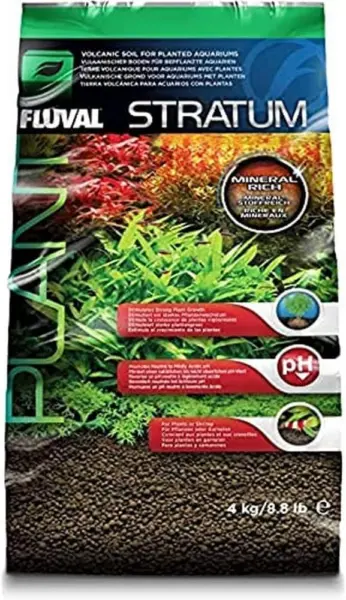
Fluval Plant and Shrimp Stratum – Best Overall
Key Features
- pH target: Neutral to slightly acidic
- Bag weight: 8.8 lb
- Grain form: Granules
- Price: Midrange
For Caridina, the substrate is a water-chemistry decision before it is a decor decision, and this is the bag we reach for first. Fluval builds it to hold a neutral to slightly acidic range, which is where Crystal Reds, Crystal Blacks and the bee shrimp want to live, and in our tanks it stays there between water changes instead of drifting up the way an inert gravel lets it. It covers the plant half of the job too: roots push through the granules without a fight.
Coverage is where the real buying decision sits. On a 10-gallon, plan on two bags if you want a depth you can actually bury a stem in; one bag is a thin layer and not much else. Even at two bags it is the least expensive of the aqua soils here, which matters when a rescape means buying the floor all over again.
The grain is light, and that is the trade-off. Filled gently over a plate it settles with modest dust; come back later and dig, and a slope slumps back toward level. We plant before the tank is full for that reason, and we let rock and wood hold any mound we care about.
The detail that won us over is smaller than that. The gaps between granules give newborn shrimplets somewhere to disappear to, which in a breeding tank is not a bonus feature but the point.
Pros
- Holds a soft, acidic pH range for Caridina
- Porous granules support roots and bacteria
- Grain shelters newborn shrimplets
- Least expensive of the aqua soils here
Cons
- Light granules let slopes flatten over time
We keep coming back to this one for Caridina tanks: it holds soft, acidic water and costs less than the other aqua soils here.
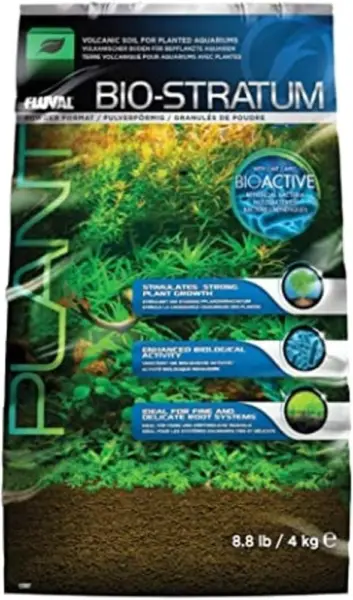
Fluval Bio Stratum – Best for Fine Carpets
Key Features
- Bag weight: 8.8 lb
- Grain size: 1 mm powder granules
- Biological seed: Dormant nitrifying organisms
- Price: Premium
One millimeter is the number that separates this bag from the regular Stratum. The granules are finer, closer to a coarse powder, and that changes what you can plant: fine carpeting species root into it quickly, and delicate stems do not have to shove through pea-sized chunks to get established.
We think it is the better soil for a carefully planted shrimp tank and the worse one for a first tank. Finer grain means more surface for roots and bacteria, but it also means more dust, and this is the dustiest substrate in this group. The first fill takes patience: pour onto a plate, fill slowly, and run filter floss for a day.
The biological side is more than a label. The granules arrive carrying dormant nitrifying organisms that wake on contact with water, and the maker’s claim is that ammonia drops faster in a new tank. We treat that as a head start rather than a substitute for cycling, because shrimp go in after ammonia and nitrite read zero, not before.
What you pay for is the finer grain and the live seed, and you pay plenty, since it is the priciest soil here by a wide margin. In a breeding or show tank that premium is easy to justify. In a first shrimp cube, the standard Stratum does the same job for less.
Pros
- Fine 1 mm granules suit delicate carpeting roots
- Seeded with dormant nitrifying organisms
- Porous structure adds filtration surface
Cons
- Dustier than the standard Stratum at first fill
- The most expensive soil in this group
We think it is worth the premium if you are planting a fine carpet and want a biological head start, as long as you can live with a slow, dusty first fill.
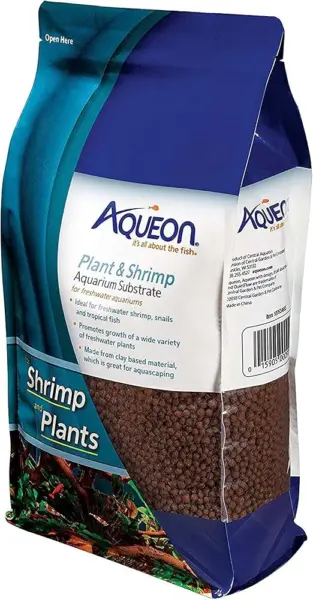
Aqueon Plant and Shrimp Substrate – Best for Nano Tanks
Key Features
- Material: Clay-based aqua soil
- Bag weight: 5 lb
- Pellet shape: Spherical
- Price: Midrange
Five pounds does not sound like much, and for a 20-gallon it is not, but that is not the tank this bag is for. It is for the 5-gallon nano on a desk, where a big soil bag is more substrate than you will ever use and more mess than you want to make on a Sunday.
The material is a clay-based aqua soil pressed into round pellets, and they hold their shape, which is the point. Unlike the softer soils here, they do not crumble into mud when you uproot a stem, so a rescape leaves the tank looking presentable rather than grey. The cost is that round pellets do not lock together: a stem needs wiggling in and sometimes a hand on it while it settles, and a slope needs rock to lean on.
Sizing is the thing we check before ordering. The pellets run smaller than the product photos suggest, and a bag covers a 5-gallon to roughly an inch, so a shrimp floor rather than a deep planted scape. Two bags for a 10-gallon.
Where it earns its place is tidiness. It rinses easily, vacuums without turning into a cloud, and stays put under a sponge filter’s flow. For a first nano shrimp tank, that predictability is worth more than the better slope-holding a coarser grain would give you.
Pros
- Clay pellets hold their shape through rescapes
- Rinses and vacuums without clouding
- One bag suits a 5-gallon nano
Cons
- Pellets run smaller than the photos suggest
- Loose packing makes stem planting fiddly
We pick it for the 5-gallon desk tank: one bag is the right amount and the pellets hold their shape through a rescape.
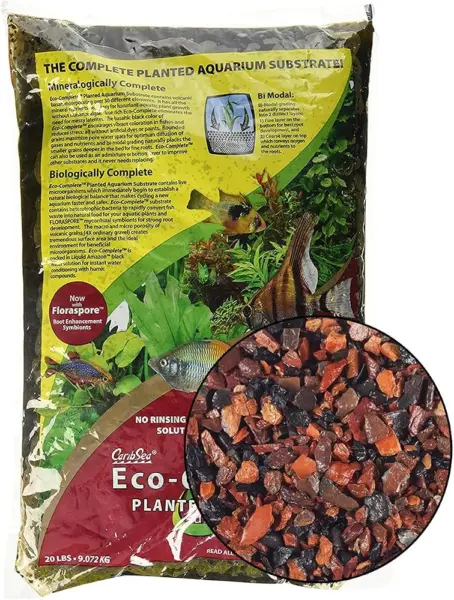
CaribSea Eco-Complete – Best for Big Planted Tanks
Key Features
- Rinse: Do not rinse
- Nutrients: Iron, calcium, magnesium and 25+ elements
- Bag weight: 20 lb
Twenty pounds in one bag makes this the bulk option in this group. That is a 20-gallon footprint at a sensible depth, or a deep bed in a 10, and it is the bag we hand someone setting up a first big Caridina tank without buying the floor twice.
It arrives wet, with a dark slurry of live bacteria you pour in rather than rinse away. Do not rinse it, whatever your instincts say. The water clouds and then clears, usually within a day, and the irregular porous grain takes roots readily.
What it does not do is hold your pH down. Eco-Complete is a nutrient-rich planted substrate, not a buffering soil, so in a Caridina tank you are managing the soft, acidic water yourself with remineralized RO and a test kit. We still choose it for a large tank where enough buffering soil would cost real money, but go in knowing the water is your job, not the gravel’s.
One quirk to plan around: it does not sculpt. Pile it into a slope and it works its way back toward flat, so build your height with rock and wood and let the substrate fill the gaps.
Pros
- One 20 lb bag covers a large tank
- Live bacteria and no rinsing needed
- Porous grain roots plants well
Cons
- No pH buffering for Caridina
- Won’t hold a slope
For a big tank on a tight budget we take the 20 lb bag, as long as you are ready to manage pH and hardness yourself.
Aqua Natural Sugar White Sand – Best for Capping and Borders
Key Features
- Material: Natural sand
- Bag weight: 10 lb
- Grain size: 0.5–1 mm
- Preparation: Triple washed, kiln dried
- Price: Budget
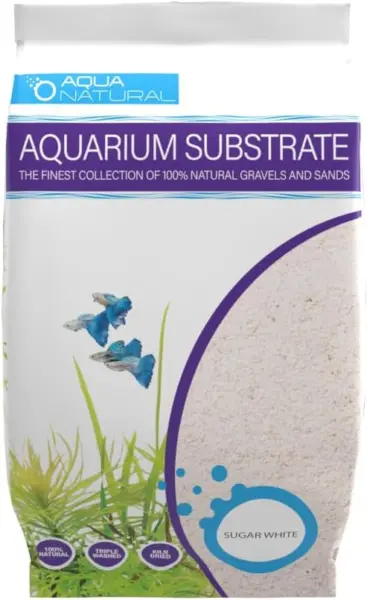
Sugar white is the name; off-white is what arrives. In the bag it reads as a warm ivory, and wet it leans light tan, which is worth knowing before you plan a tank around it and honestly a better backdrop for green plants than a stark white would be.
The grain runs 0.5 to 1 mm with the fines washed out, and that is the part that matters under a sponge filter: it does not billow when flow crosses it, and it does not turn the water to milk the way a cheap sand can. It is triple washed and kiln dried, and a rinse before it goes in is still worthwhile.
We use it as a cap or a border rather than a whole floor for Caridina. It is inert, so it will not move pH or hardness at all, and a thin layer over a buffering soil gives you a bright foreground while the soil underneath keeps doing the chemistry. As the only substrate in the tank it leaves everything to your water.
Buy for footprint, not for the depth you picture. An inch and a half across a 20-long runs about three bags.
Pros
- Tight 0.5–1 mm grain stays put
- Clean, low-cloud setup
- Off-white tone flatters plants and shrimp
Cons
- Not actually white, reads light tan
- Inert, so no buffering for Caridina
We use it as a cap or a border rather than a whole floor: the grain stays put and looks lovely, but it does nothing for your water chemistry.
Aqua Natural Galaxy Bio-Sand – Best for Bio-Active Nano Setups
Key Features
- Dose: 1 lb per gallon
- Bag weight: 5 lb (wet)
- Biological seed: Live nitrifying bacteria
- Price: Budget
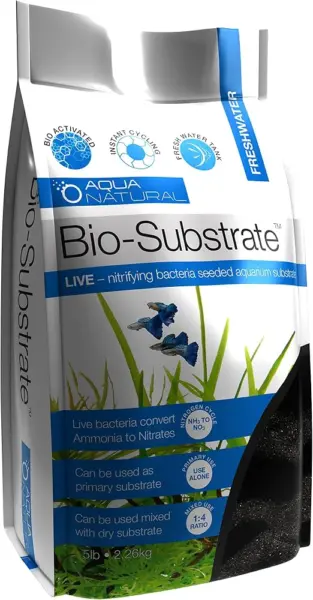
It arrives wet and sealed, and the instruction is blunt: do not rinse. The sand is seeded with live nitrifying bacteria, and rinsing it is rinsing away the thing you bought. We like that trade, because a substrate that shows up alive takes some of the guesswork out of the first few weeks.
The dose is the other half of the story: about a pound per gallon, mixed one part live to four parts dry if you are stretching it across a wider footprint. A 5 lb bag is a 5-gallon job, which is why this one sits in the nano corner of the list rather than under a big colony.
Black sand with a sparkle to it makes red and black Caridina stand out in a way pale substrates do not, and the grain is fine enough for shrimp to sift through. Cloudiness is the gamble: it can clear in hours with a floss change, and it can hang around for a few days.
The limit is chemistry. This is sand, not soil, so it will not pull your water down toward the acidic range Caridina want. Pair it with remineralized RO you are testing, or run it as a bio-active layer under a buffering soil, and it does everything else well.
Pros
- Seeded with live nitrifying bacteria
- Fine black sand shows off shrimp color
- No rinsing before it goes in
Cons
- One 5 lb bag treats about 5 gallons
- No pH buffering
Our pick for a nano tank that wants a live head start: it arrives seeded, looks superb under shrimp, and leaves pH to you.
How We Tested Ten Caridina Substrates
We started by gathering every shrimp-specific substrate we could find—buffering soils, inert gravels, and a few mixed blends—then narrowed the list by grain size, stated buffering behavior, and how well each one held up in reviews from keepers running Caridina tanks. I ruled out anything that arrived as dust or needed a full week of rinsing before it could go into a tank. The final ten went into identical tanks on the same sponge filter and light schedule.
Each bag got rinsed in a white bucket, and I counted how many rounds it took before the water ran clear—some were ready after two, one never stopped shedding fines. After filling, I let each tank settle for 48 hours and checked clarity against a white card, then noted the substrate’s color and whether it stayed put when I disturbed it during planting. I planted the same three stems in every tank and tracked new leaves, root spread, and any melting over the first six weeks—the roots told me pretty quickly which substrates they preferred.
Once the tanks cycled, I added a small group of Caridina shrimp to each and tested pH, KH, and GH weekly for eight months. I logged any swings, noted how often the water turned cloudy or picked up a tint after feeding or top-offs, and watched whether shrimp grazed across the surface or avoided it. The substrates that held steady parameters, stayed clear, and didn’t break down into mud are the ones that made the final list; the ones that clouded, drifted, or looked flat after a few weeks did not.
How to Choose a Substrate for Caridina Shrimp
For Caridina, the substrate is a water-chemistry purchase first and a decoration second, so pick for the water you want and then for the look.
Buffering Soil or Inert Sand?
An active aqua soil does two things an inert sand cannot: it holds pH in the acidic range Caridina need, and it keeps it there between water changes. That is why a buffering soil is the default for a Crystal Red or bee shrimp tank, especially if your tap water is hard. Inert sand and gravel do none of that, so they belong in a Caridina tank only if you are already mixing remineralized RO water to a target and testing for it.
The trap is expecting the soil to do the whole job. It does not; keep testing pH and hardness, and expect the buffering to soften over time as the soil is used up, at which point the top layer gets refreshed rather than the whole scape.
Buy by Footprint, Not by Bag
Roughly a pound per gallon gets you about an inch of depth, so a 5-gallon nano takes one 5 lb bag and a 10-gallon planted at a proper two inches takes two 8.8 lb bags. Buy for the floor you are actually filling, then add a little for the slope you have in mind.
The trap is the product photo: a soil bag looks enormous on screen and covers less floor than you expect once it is wet and settled. Order the second bag with the first and save yourself a week of a half-covered tank.
Grain Size Decides What You Can Plant
Fine grains of around a millimeter or less suit delicate carpeting plants and give bacteria more surface, at the cost of a dustier first fill. Coarser granules and clay pellets hold their structure better and resist turning to mud when you uproot a stem, but round pellets do not lock together, so slopes need rock or wood to lean on.
Plant heavily from day one and go fine, then be patient filling. Rescape often and the pellet earns its place, because a floor that stays presentable through a replant is worth more than a slightly finer texture.
Expect Muddy Water and Plan the Fill
Almost every soil here clouds the water on the first fill; the difference is how long it lasts, not whether it happens. Rinse loose soil in a bucket until the runoff is merely tinted, set a plate or a sheet of bubble wrap on the substrate, and pour onto that. Run filter floss for the first day.
Never rinse a bacteria-seeded substrate, because the live colony is the product. And if the tank is already full and murky, stop stirring it: the water clears faster left alone than chased around with a net.
Frequently Asked Questions
How long does an aqua soil keep buffering, and how do I know when it’s spent?
The buffering fades rather than failing suddenly. Test pH right after a water change and again three or four days later: while the soil is working, the reading holds steady. Once it starts climbing back toward your source water, the bed has given up. Refresh the top inch rather than tearing the scape apart.
Can I put Caridina shrimp in a tank with brand-new soil?
Not straight away. New aqua soil has its own messy opening act, and a shrimp tank is only ready when ammonia and nitrite both read zero on two consecutive days and there is visible biofilm on the glass and wood. Add shrimp to a seasoned filter, not to fresh soil, and drip-acclimate them first.
Does a dark substrate really make Caridina colors look better?
Contrast is what you are buying. Deep reds and blacks read strongly against dark soil or black sand, while a pale, translucent shrimp disappears over light sand. Pick the floor to suit the line you keep, and add a dark background behind the glass, which does as much for shrimp color as the substrate does.
Final Verdict
We start with Fluval’s Plant and Shrimp Stratum. It is the least expensive of the aqua soils here and the one whose water chemistry suits Caridina without extra work, which makes it the right first bag for a Crystal Red or bee shrimp tank.
If you are planting a fine carpet and want the finer granule and the live bacterial seed, the Bio Stratum is the upgrade worth paying for. And if you are already remineralizing RO to a target, Aqua Natural’s Sugar White Sand gives you a bright floor and leaves the chemistry where it belongs, with you.