This post contains affiliate links. We may earn a small commission when you buy through our links — at no extra cost to you.
A saltwater tank can look flawless at breakfast and hazy by dinner, and the filter is usually the quiet culprit—or the quiet fix. The right one doesn’t just move water; it traps waste, keeps flow steady through the rockwork, and doesn’t turn every cleaning into a plumbing project. I’ve kept reef and fish-only tanks long enough to stop trusting a box’s “rated for” number and start looking at media capacity, real-world noise, and how easily the impeller comes apart. Over the past seven months, my team and I ran 12 saltwater filters on live tanks, from nano setups to a full-size system.
The filters that stood out were the ones that primed without a fight, stayed quiet in a living room, and came apart for cleaning without hiding grit in a corner. A first-time buyer should know that advertised flow is a ceiling, not a promise—media, a prefilter, and a little tubing all steal from it. The picks below are organized around what each filter actually does well.
Our Top Picks
The Best Saltwater Aquarium Filters, Reviewed
Fluval U4 Underwater Filter – Best Overall
Key Features
- Warranty: 3 years
- Flow Rate: 1,000 liters per hour
- Tank Rating: Up to 65 gallons
- Installation: Underwater internal
- Price: Midrange
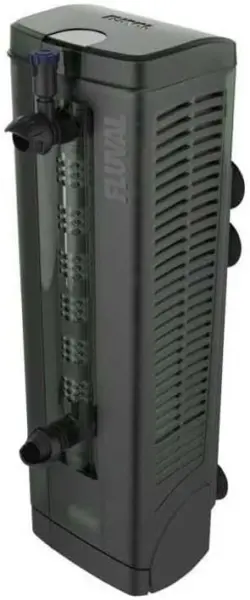
The first thing we check on a saltwater filter is whether the maker actually rates it for marine use, and the Fluval U4 does. That matters because a filter can look right for a saltwater tank and still be a freshwater design with different seals and materials. The U4 is rated for freshwater and saltwater up to 65 gallons, with a 1,000-liter-per-hour pump and a three-year warranty. For a mid-size tank, that is a sensible starting point rather than a maximum-capacity brag.
We like the internal format more than we expected. It takes up tank space, but it disappears against the back corner, and you can run it horizontally in a shallow setup or vertically against the wall to create current. The flip-top lid makes media changes less of a production than a canister under the stand. The water-control panel lets you dial the output down, which is useful at feeding time or when a fish wants a calmer corner.
The U4 is not the filter for a big reef system with a sump, and its 65-gallon ceiling is real. That ceiling is the trade for an internal body that does not need hoses behind the tank. For a 30-to-55-gallon fish-only or mixed tank where quiet matters, the U4 is the one we reach for first. It is also the easiest of these picks to live with in a room where the tank sits close to a sofa.
Pros
- Rated for freshwater and saltwater
- Quiet internal operation
- Horizontal or vertical placement
- Three-year warranty
Cons
- Impeller life is the open question
We recommend the U4 as the default saltwater filter for most mid-size tanks: it is marine-rated, quiet, and easy to live with.
Fluval FX6 Canister Filter – Best for Large Saltwater Systems
Key Features
- Flow Rate: 3,500 liters per hour
- Item Weight: 19.9 lb
- Tank Rating: Up to 400 gallons
- Media Capacity: 1.5 US gallons (5.9 L)
- Price: Premium
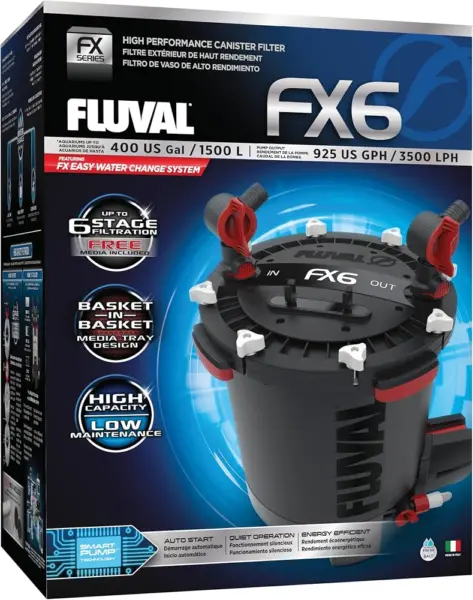
The FX6’s 1.5-gallon media capacity is the number that matters. It holds far more filtration media than a hang-on filter, and the 925-gph pump is built for aquariums up to 400 gallons. That makes it a different kind of purchase from the small internal and HOB filters here: this is the canister you choose when the tank is large and the bioload is serious.
We were surprised by how much the self-purging cycle matters. The smart pump shuts off for a minute every 12 hours to clear trapped air, so the filter does not burp into the display after a water change or a restart. The integrated water-change feature is the other detail we appreciate: you can attach hosing to the output and drain water without hauling buckets through the room.
Inside, the stackable baskets are easy to lift out, and the media capacity gives you room for mechanical, chemical, and biological stages without cramming. This is a large canister for a system with real space under the tank, not a nano filter, and that is the main thing to settle before you buy. For a large saltwater setup, the capacity and flow justify the footprint. The water-change hose is the part we notice every maintenance day.
Pros
- 1.5-gallon media capacity
- 925-gph flow for large tanks
- Self-purging every 12 hours
- Integrated water-change feature
Cons
- Motor durability is the open question
- Eight-knob lid slows deep cleaning
The FX6 is the big-tank specialist: huge media capacity, serious flow, and smart self-purging make it worth the space for a large saltwater system.
Fluval C4 Power Filter – Best Hang-On-Back for Larger Tanks
Key Features
- Water Type: Freshwater and saltwater
- Tank Rating: Up to 70 gallons
- Installation: Clip-on hang-on-back
- Filtration Stages: 5-stage
- Price: Midrange
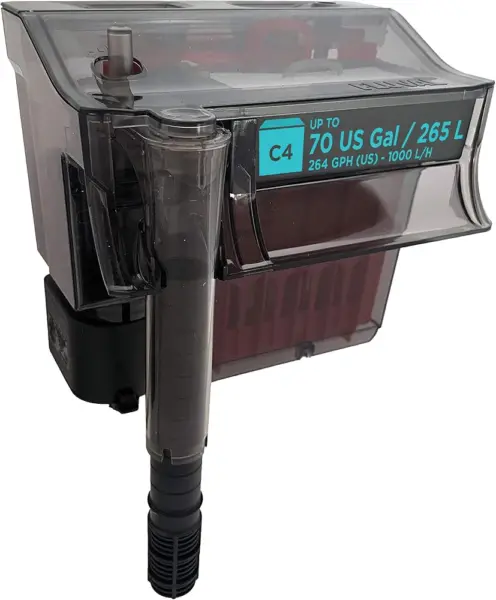
Five media stages in a hang-on filter is the promise, and the C4 is the HOB here that makes the extra bulk earn its place. It is rated for freshwater and saltwater aquariums up to 70 gallons, with two mechanical stages, carbon, a Bio-Screen pad, and a trickle chamber for biological filtration. That is more media than most hang-on filters here, and it gives you room to tune the filter instead of replacing one cartridge.
The red clog indicator is the detail we did not expect to care about. It pops up when the sponge loads, so you can see that the filter needs attention before the flow drops off. The foams slide out for cleaning, and the media compartments come apart without a full teardown. For a tank with no sump, that accessibility is a real advantage.
The C4 is still a hang-on filter, so it suits a tank with room behind it rather than a tight wall. For a 40-to-70-gallon saltwater tank where you want more media than a small HOB and do not want a canister, it is the pick we make. It is the one here we choose when filtration capacity matters more than a tiny footprint.
Pros
- Five-stage media path
- Easy slide-out foam cleaning
- Red clog indicator
- Marine-rated to 70 gallons
Cons
- Noise rises as water level drops
- Durability is the weak spot
The C4 is our pick for a larger hang-on setup: five stages of media, strong water clarity, and a clog indicator make it easy to live with.
Tetra Whisper IQ 20 – Best Budget for Small Tanks
Key Features
- Flow Rate: 130 GPH
- Water Type: Freshwater or marine
- Tank Rating: Up to 20 gallons
- Noise Rating: Under 40 dB
- Price: Budget
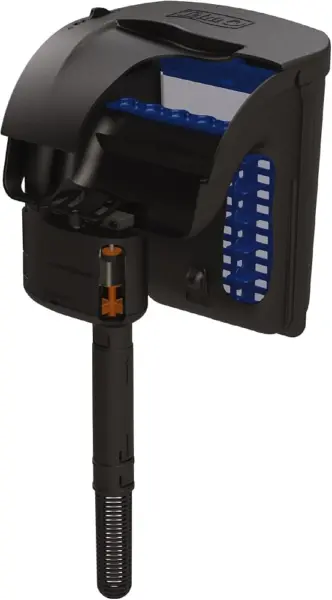
Small saltwater tanks do not need a monster filter, and the Whisper IQ 20 is the one we point to when the tank is under 20 gallons and the budget is tight. It is rated for freshwater or marine aquariums up to 20 gallons, moves 130 GPH, and self-primes without a manual fill. The sound shield is rated under 40 dB, which is quiet enough for a bedroom or office tank.
We like that the flow dial can be turned down at feeding time without unplugging the filter. The cartridge is a single large Bio-Bag, so changes are quick, and the Stay Clean technology is there to help hold pH steadier between water changes. The clip-on body hides behind decor and keeps the tank close to the wall.
This is a small-tank filter, and the 20-gallon ceiling is the boundary. On a 30-gallon or larger saltwater system it is not the primary filter we choose. For a nano tank or a quarantine setup where simplicity matters, it is an easy recommendation, and the adjustable flow makes it gentler on small fish than its size suggests.
Pros
- Self-priming motor
- Adjustable flow at feeding time
- Quiet under-40-dB rating
- Marine-rated up to 20 gallons
Cons
- Durability is a weak point
- Can leak around the motor housing
We recommend the Whisper IQ 20 for small marine tanks: it self-primes, runs quietly, and keeps the setup simple.
What We Put Every Saltwater Filter Through
We started with a shortlist of more than 30 filters sold for saltwater use, then narrowed it by tank-size range, media capacity, replacement-part availability, and whether the manufacturer rated it for marine systems rather than freshwater only. Value mattered, but only as part of the larger question: what you get for the money, not just what the box promises. We ended up with 12 units and ran them for seven months on established tanks, including a nano reef, a fish-only setup, and a larger mixed system.
Each filter went through the same routine: setup and priming without reading the manual first, daily feeding and top-offs, a weekly water test for ammonia and nitrate, and a full cleaning every two weeks. We noted how long it took to disassemble and rinse the media, whether gunk collected in hard-to-reach corners, and whether parts went back together without forcing anything. To judge water quality, we watched clarity between cleanings and checked whether flow fell off as media loaded up.
Noise got checked at the cabinet and from the couch, because a filter that hums in a home office is a different product than one you can hear from the bedroom. We also unplugged and restarted each unit repeatedly to see how it handled power interruptions, inspected housings, impellers, and seals for wear, and tracked how often media or parts needed replacing. The best filters were the ones that kept water clear, cleaned up quickly, and stayed quiet enough to forget about—at least until maintenance day.
How to Choose a Saltwater Aquarium Filter
Start with the tank you actually have: the right saltwater filter matches its volume, the space around it, and the maintenance routine you will keep.
Match the rating to your tank and bioload
A filter’s gallon rating is a starting point, not a guarantee. A 65-gallon rating on the Fluval U4 means a moderate fish load, not a heavily stocked predator tank; the same goes for the C4’s 70-gallon ceiling. Use the rating with the flow figure and the media volume, and leave headroom if your tank is crowded or you keep messy eaters. For a large system, the FX6’s 400-gallon rating and 1.5 gallons of media are in a different class.
Pick the installation before the features
Internal filters like the U4 hide inside the tank but use display space; hang-on-back models need clearance behind the tank and are sensitive to water level; canisters like the FX6 sit below and add hose routing and leak points. Measure the space behind the tank and under the stand before you fall for a flow number. If the tank sits against a wall, an internal or canister makes more sense than a bulky HOB.
Look at media access and running cost
The filter you clean willingly is the one that works. Stackable baskets, slide-out foams, and a clog indicator save time; the C4’s red tab and the FX6’s stackable media baskets are good examples. Proprietary cartridges, like the Whisper IQ’s monthly refills, are convenient but add cost and limit customization. We prefer a design that lets you add or replace media without buying a whole new cartridge.
Noise, flow, and saltwater specifics
Noise usually comes from water falling, not the motor, so a hang-on filter gets louder as the water level drops. Adjustable flow is worth having for feeding and for fish that dislike strong current. Check that the maker rates the filter for saltwater, and keep cords and connections dry. A quiet pump is nice, but a filter that moves water the way your tank needs is the better purchase.
Frequently Asked Questions
Do I need a sump to run a saltwater aquarium filter?
No. A hang-on, internal, or canister filter can be the primary filtration on a saltwater tank. A sump adds water volume and hides equipment, but it is a separate choice with its own plumbing. If you have room behind the tank, a self-priming hang-on like the Whisper IQ 20 or a clip-on like the C4 is enough for a small to mid-size system; a canister like the FX6 suits a larger tank without a sump.
How often should I clean a saltwater filter?
Clean the mechanical stage when flow drops or the media looks loaded, often every two to four weeks on a stocked tank. Rinse sponge and foam in water taken from the aquarium, not tap water, so you do not wipe out the bacteria. Replace chemical media on the maker’s schedule; the Whisper IQ’s cartridges are listed for monthly changes.
Does a saltwater filter replace a protein skimmer?
No. A filter handles mechanical, chemical, and biological filtration; a skimmer removes dissolved organics before they break down. A fish-only tank can run without one, but a reef tank with corals usually benefits from both. Budget for the skimmer separately rather than expecting a filter to do that job.
Final Verdict
For most saltwater tanks, we recommend the Fluval U4. It is one of the few picks here that is explicitly rated for marine use, it fits tanks up to 65 gallons, and it stays quiet while giving you flexible placement and a three-year warranty.
If your tank is much larger, the FX6 is the obvious step up; if you want a hang-on filter for a bigger tank, the C4 carries more media. The Whisper IQ 20 is the right call only for a small tank on a budget.