This post contains affiliate links. We may earn a small commission when you buy through our links — at no extra cost to you.
Aquarium filters are the one piece of gear you hear before you see it. A unit that seems silent in a busy store can turn into a low, rattling grind at 2 a.m. in a bedroom, and the fix is not always buying bigger or fancier. What you actually want is a filter that keeps water clear and waste moving without turning your living room into a white-noise machine — one sized to your tank rather than to the shelf it was sitting on.
Over the past four months, my team and I have run 14 filters on tanks from a 5-gallon shrimp setup to a 75-gallon community tank. The quietest ones had less to do with price than with how the intake, impeller, and water level lined up. Something first-time buyers learn the hard way: most of the noise is not the motor, it is vibration traveling through the glass and the cabinet, which is why two filters with near-identical specs can sound completely different in two different rooms. The picks below are the ones I would keep running next to a bed.
Our Top Picks
The Best Quiet Aquarium Filters, Reviewed
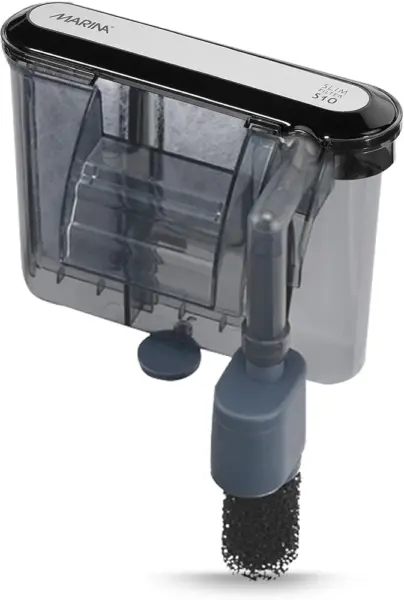
Marina S10 Power Filter – Best Overall
Key Features
- Type: Hang-on-back, self-priming
- Media: Open compartments
- Tank rating: Up to 10 gallons
- Flow control: Adjustable
- Price: Midrange
A ten-gallon tank on a dresser is the hardest test a filter takes, because at night there is nothing else in the room to mask it. Run against the two hang-ons we kept beside it, the Marina S10 was the one that dropped out of the room’s attention. What carried across was water sliding over the lip, not a motor, and that is a different kind of sound — the kind you can sleep through.
We made it the top pick for a less obvious reason than the noise: it does not lock you into cartridges. The body is a slim box with open compartments and a sponge already fitted over the intake, so you can run what came in the box, add floss, or drop in a bag of bio media, and the flow control turns a betta’s tank down to a trickle without shutting the filter off. On a small tank that flexibility is worth more than a higher flow rating.
Self-priming sounds like a brochure line until you have poured tank water down an intake to get a filter started. This one hangs, fills and runs. It also sits tight to the glass, so what it takes is rim space rather than the swimming room an in-tank box would eat.
Ten gallons is the ceiling, and that is the whole trade. Put this on a 20 and the output is a trickle you will be apologising for by August; step up to the Fluval 107 or the hygger sponge instead. What you are buying here is the size most people actually start with, done quietly, with the cheapest media bill of any powered filter on this page — because there is no bill.
Pros
- Motor hum stays out of the room
- Flow dial suits bettas and shrimp
- Open compartments instead of cartridges
- Intake sponge fitted out of the box
Cons
- Rated to 10 gallons only
The one we recommend for a tank you sleep near: up to 10 gallons, slim enough to vanish behind the rim, and it makes a water trickle instead of a motor hum.
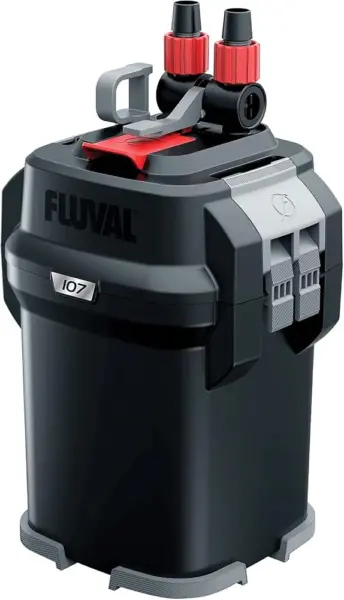
Fluval 107 Canister Filter – Best for Bigger Tanks
Key Features
- Type: External canister
- Flow rate: 550 liters per hour
- Dimensions: 7.5"L x 11.5"W x 7.5"H
- Tank rating: Up to 30 gallons
- Price: Premium
A canister wins the noise argument before it starts: the motor sits in a sealed box on the cabinet floor and the only thing inside the tank is two hoses. The Fluval 107 is the quietest powered filter of this group, close enough to silent that the water return is all that is left to hear, and for a bedroom tank we take it over every hang-on here.
The engineering behind that is mostly about vibration. The feet under the body are substantially enlarged on this model, and if you have ever had a pump turn a wooden stand into a drum, you will understand why that matters more than the decibel claim on the box. Inside, the media stacks in baskets you lift out one at a time, so a rinse does not mean stripping the whole canister, and the pump is rated for tanks up to 30 gallons.
Canisters live or die by their seals, and this one asks for a little discipline. Seat the lid gasket flat, click both hose locks home, and run a finger under the base after each media change; when a canister weeps, it does it at the bottom seam or the hose mounts, and it announces itself early. Do those three checks and it stays dry.
Pros
- Quietest motor of the powered picks
- Sits below the tank, out of sight
- Stacked media baskets rinse one at a time
- Enlarged feet cut cabinet vibration
Cons
- The priciest filter in this group
The quietest motor in this group, and our pick for a 20- to 30-gallon tank with a cabinet to hide a canister. Seat the seals and check them at every clean.
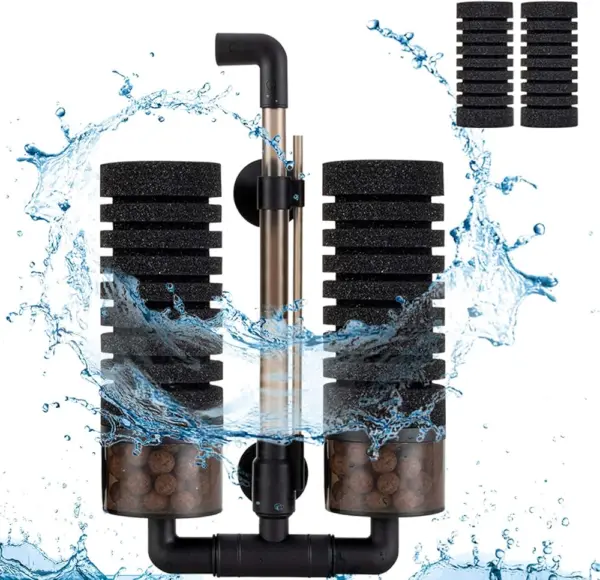
hygger Double Sponge Filter – Best without a Motor
Key Features
- Type: Air-driven sponge
- Includes: Ceramic bio-balls, spare sponges
- Dimensions: 6.3 in wide, 9 to 13 in tall
- Tank rating: 15 to 55 gallons
- Price: Budget
Every powered filter here puts a spinning impeller somewhere in your water, and the impeller is what hums. The hygger sponge does not have one. An air pump sits outside the tank — on a shelf, inside the stand, behind the books — pushes air down a 4 mm line, and the sponge turns that into circulation and biological filtration. Move the pump and you have moved the noise.
The stack is more thought through than most sponges. Sponge on the outside for mechanical filtration, a chamber of ceramic bio-balls in the middle for the bacteria, and spares in the box so a rinsed set goes straight back in while the dirty one soaks. Cleaning is a squeeze in a bucket of tank water, and that is the entire maintenance routine.
Where it earns its place against the hang-ons is tank size. Rated for 15 to 55 gallons, it covers tanks the Marina cannot touch and the Fluval stops short of, and there is nothing inside it to seize. The trade is honest, and we have made it happily: the pump you pair with it decides how quiet your tank is, and a hard-bodied cheap pump will buzz straight through a wooden stand. Set it on a folded towel or hang it, and the sponge itself makes no sound beyond the bubbles.
Pros
- No impeller in the tank to hum
- Covers 15 to 55 gallons
- Ceramic bio-balls inside the sponge
- Spare sponges included
Cons
- Suction cups let go on glass
- Stack separates when bumped
For a 15- to 55-gallon tank, this gets the motor out of the water entirely: a sponge stack and ceramic bio-balls, with a separate air pump doing the work.
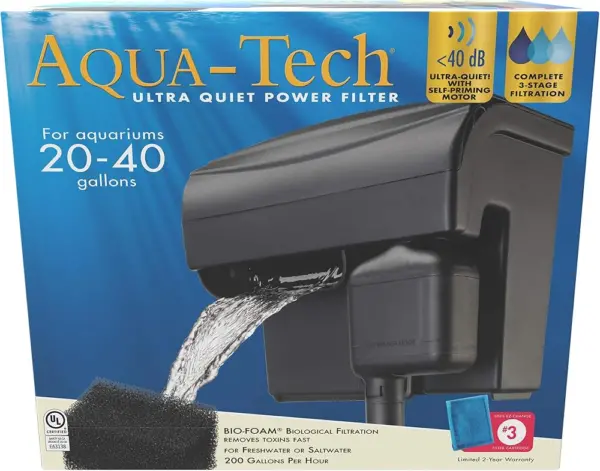
Aqua-Tech Ultra Quiet 20-40 – Best Budget Mid-Size
Key Features
- Dimensions: 9.25 x 6 x 8.5 in
- Filtration: Bio-Foam plus carbon cartridge
- Tank rating: 20 to 40 gallons
- Noise rating: Below 40 dB
- Price: Midrange
Twenty to forty gallons is the awkward middle of the aquarium hobby: too big for the little hang-ons and, for plenty of people, not worth canister money and plumbing. Aqua-Tech’s answer covers that whole band in one body, fits under a standard hood, and is built around the one thing this search is about.
We rate it the value pick of the group, and the reason is the motor mount. The pump is decoupled from the body with dampeners — the same idea as the Fluval’s rubber feet — and Aqua-Tech rates the assembly below 40 dB. That rating is the maker’s, but the design behind it is the part you can trust: isolating a motor from the plastic it is bolted to is how you stop a hum turning into a drone through the furniture. What is left to hear is water, and you control that by keeping the level up near the lip.
Media is a bio-foam block plus a carbon cartridge, cheap to replace and quick to rinse, and there is no priming step — it starts dry. What it does not give you is a flow dial, so plan the tank around a fixed output: fine for danios and barbs in a 30, a lot of current for a long-finned betta in a 20. If you need to dial the current down, the Marina and the TARARIUM both have a control; this one does not.
Pros
- Rated below 40 dB at the motor
- Covers 20 to 40 gallons under a hood
- No priming before the first start
- Bio-foam and carbon are cheap to replace
Cons
- Early motor failures in some units
The budget answer for a 20- to 40-gallon tank: a decoupled motor rated below 40 dB, bio-foam plus carbon, and a hood-friendly body for mid-size money.
TARARIUM 222 GPH Filter – Best for Low-Water Setups
Key Features
- Media: Mesh pad and ceramic bio-balls
- Flow rate: 222 GPH
- Tank rating: 10 to 40 gallons
- Minimum water level: 2 inches
- Price: Midrange
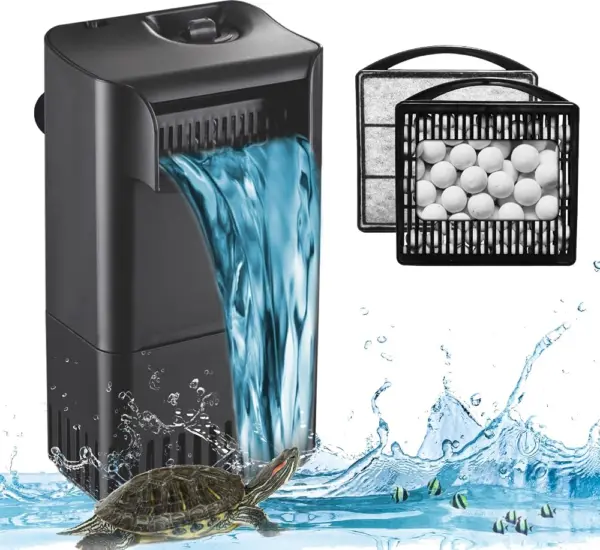
Two inches of water is the number that matters here. Most hang-ons need their intake well submerged and start slurping or lose their prime when the level drops; this one is rated to keep running at a two-inch depth. That is the difference between a filter that works on a turtle tank or a paludarium and one that does not, and it is why it earns a place in a roundup about noise — shallow setups are usually the loudest things in the room.
The rest of the package suits messy tanks. 222 gallons per hour through a double-sided mesh pad and a chamber of ceramic bio-balls, a top lid you lift to reach the media without unhooking anything, and an adjustable flow feeding a waterfall return that aerates as it drops. Fresh or salt, rated from 10 to 40 gallons.
Durability is the weak spot, with some units stopping inside a few months. Rinse the mesh pad often, because a clogged pad makes any pump work harder and thins the waterfall out. Nothing else here handles shallow water at all, which is the reason we put up with the risk.
Pros
- Runs in two inches of water
- Adjustable flow with a waterfall return
- Mesh pad plus ceramic bio-balls
- Quiet for a 10- to 40-gallon tank
Cons
- Short service life in some units
Built for the tanks most filters cannot serve: it runs in two inches of water, so turtle tanks and paludariums get quiet filtration with an adjustable flow.
AQUANEAT Corner Sponge Filter – Best Small-Tank Corner Filter
Key Features
- Type: Air-driven corner filter
- Media: Included filter media
- Dimensions: 4"L x 3.125"W x 3.25" to 6"H
- Tank rating: Up to 20 gallons
- Price: Budget
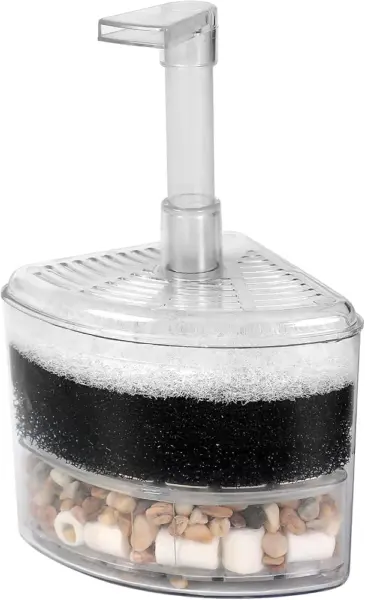
A corner filter takes the one patch of a small tank nothing else wants. In a 10-gallon with a full hood there is nowhere to hang a hang-on, and an in-tank box eats the swimming room; the AQUANEAT unit wedges into the silicone and, once the plants fill in, stops being visible at all.
It is air-driven, so the pump stays outside and the sponge does the work: mechanical filtration on the outside, a media compartment in the middle, and enough surface area for a colony of bacteria on a tank this size. Setup is an airline pushed onto the stem and a pump switched on — nothing to prime, nothing to assemble.
The current it makes is soft, which is the point for a betta, a group of shrimp, or a fry tank where anything stronger ends up pinning fish against the glass. Cleaning is a squeeze in the water you are already siphoning out, and the whole thing goes back in wet.
We reach for the corner sponge when the tank is small, the hood is closed, and the priority is that nothing gets hurt — the sponge cannot pull a shrimp through it, and it cannot hum. It will also run a 20-gallon if you keep up with water changes, though the flow is modest for anything much bigger.
Pros
- Tucks into a corner under a full hood
- Gentle enough for fry, shrimp and bettas
- Comes with media to start
- Nothing to prime or assemble
Cons
- Body is smaller than expected
The best small-tank corner filter here: gentle enough for fry and shrimp, cheap to run, and it fits under a full hood where a hang-on cannot.
Pawfly 3-Pack Sponge Filters – Best for Fry and Shrimp
Key Features
- Size: 2 in D x 4.8 in H
- Type: Air-driven sponge
- Pack size: 3 filters
- Tank rating: 5 to 10 gallons
- Price: Budget
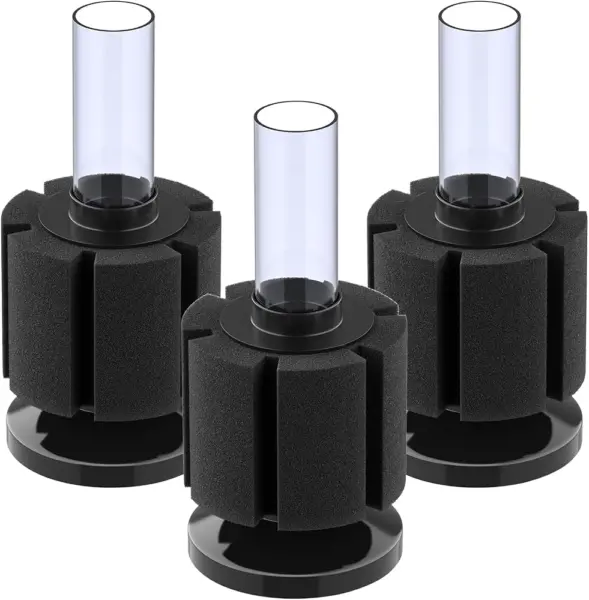
Three sponges and their risers arrive in one box; the air pump that drives them does not. That is the whole product, and it is the right shape for the job: a two-inch sponge on a tube, small enough for a 5-gallon and soft enough that nothing with fins gets pulled into it.
Filtration is mechanical and biological at once — the sponge traps what floats past and hosts the bacteria — so there is no cartridge to buy and nothing to throw away. Rinse one every two to four weeks in water you have taken out of the tank, never under the tap. The bacteria you would kill with chlorinated water are the filter.
They are also the cheapest route to a spare. A seeded sponge kept running in an established tank is instant filtration for a quarantine, fry or hospital tank on the day you need it, which is the argument for buying three rather than one.
What we do not love is the sinking. The sponge has to be worked into the water and squeezed until it is fully soaked, and even then it can drift until it loads up with debris. Weigh it under a rock or tuck it behind a plant and the annoyance is over in a day.
Pros
- Three filters in one box
- Sponge will not pull in fry or shrimp
- No cartridges to buy
- Fits 5- to 10-gallon tanks
Cons
- Needs an air pump you supply
Three fry-safe sponge filters in one box, sized for 5- to 10-gallon tanks: the practical way to run a breeder rack or keep a seeded spare ready.
AQUANEAT Mini Sponge Filter – Best for Bowls and Nanos
Key Features
- Size: 1.5 in D x 3 in H
- Type: Air-driven mini sponge
- Includes: 40 in airline, control valve
- Price: Budget
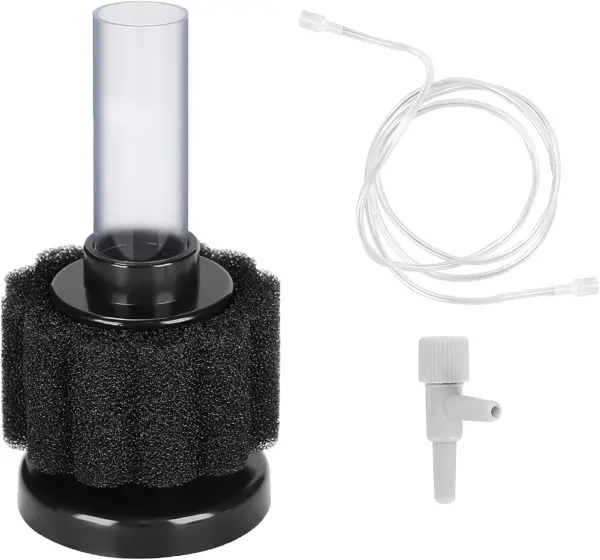
The sponge is an inch and a half across and three inches tall, which is the entire point: in a one- or two-gallon bowl, anything bigger is furniture with a cord.
In the box you get the filter, 40 inches of the narrow airline it needs, and a control valve — and that valve is the part that matters for noise. Air-driven sponges are only as quiet as the air going into them, and being able to pinch the flow down turns a hard rolling boil into a soft fizz a betta can sit under. The pump itself is a separate purchase.
We point people here when the tank is tiny and the current from a normal filter is already too much — the soft sponge will not draw in fins or shrimp, and at the lowest valve setting the sound disappears into the room. Run it wide open and it is a different story: big bubbles, audible from across the room.
Pros
- Control valve tames the bubble noise
- Includes 40 inches of airline
- Small enough for a bowl
- Soft sponge is safe for fins and fry
Cons
- Air pump and standard tubing not included
For bowls and tanks of a gallon or two: a 1.5-inch sponge, 40 inches of airline and a control valve that slows the bubbling to a fizz.
How We Tested 14 Quiet Aquarium Filters
I started with a list of roughly 60 filters sold for freshwater tanks — hang-on-back, canister, internal, and air-driven sponge models — and cut it to 14 by checking tank-size ratings, whether replacement impellers and media were actually in stock, and how much room each unit needed behind or under a tank. Size eliminated more candidates than anything else: a filter that will not fit with the lid and light back on is not a quiet filter, it is a return. We also weighed what came in the box against what it would cost to keep running for a year, since a cheap unit with hard-to-find cartridges rarely stays cheap.
Each filter then ran continuously for at least a week on tanks between 5 and 75 gallons, placed in a bedroom, a living room, and a home office where I was on calls all day. We took decibel readings at three feet in a quiet room, then again at night with the house still, and tracked down the source of any hum — motor, impeller rattle, splashing at the return, or vibration through the cabinet — before re-testing with a foam pad underneath to see whether it went away. Units that grew louder over a month of running, or that needed the impeller reseated to stay quiet, lost ground on reliability.
For filtration quality, we watched how much water moved through the media instead of around it and how quickly visible debris cleared after feeding. We measured output at the return on day one and again after two weeks of no maintenance to see how far flow dropped. Then we timed a full teardown and rinse, counting parts, checking whether media baskets lifted out in one piece, and whether the whole thing fit in a kitchen sink. Canister models got a leak check at every seal after each reassembly.
How to Choose a Quiet Aquarium Filter
The noise in an aquarium almost never comes from the part the marketing talks about; it comes from water falling, air bubbling, or a pump vibrating against furniture.
Work out what you are actually hearing
Filter noise comes from one of three places: the impeller, the water leaving the filter, or the air pump feeding a sponge. They sound different. A worn impeller is a low hum you feel through the stand as much as hear. A water return is a splash or trickle that gets louder as the tank evaporates. An air pump is a buzz that travels through whatever it sits on.
Run the test before you shop: lift the filter body off the rim while it is running. If the hum stops, you have a vibration problem, and a pad or a better mount is cheaper than a new filter. If it does not, the noise is the motor itself.
Match the filter to your water line, not just the tank
Where the water sits decides more than a decibel rating. A hang-on runs quietly only when the outflow is close to the surface; drop the level an inch or two and a quiet filter starts splashing. We keep our own tanks topped up for exactly this reason, and it is the single easiest fix in this whole category.
Corner sponges and canisters do not care about the water line, which makes them the better answer for a rimless tank you do not top off, or a shallow turtle setup. The TARARIUM is the only filter here rated to keep running in two inches of water. Check your usual water level before you choose.
Decide whether you are buying media or a cartridge
A cartridge filter ties you to one brand’s replacement pads and throws away a working colony of bacteria every time you swap one. Open compartments cost a little more up front and much less over a year: a sponge, some floss and a bag of bio media, rinsed rather than replaced.
We weight open media above an extra bit of rated flow, because the media is what keeps the water clear. Look at what a filter accepts before you buy it, not after. The Marina S10 and both Fluval picks here give you room to improvise; the cartridge-only designs do not.
Size the flow, then plan to turn it down
Ratings are quoted at full output, and full output is rarely what a planted tank or a long-finned betta wants. Figure on turning the tank over four to five times an hour, then buy a filter with a flow control and run it below the number on the box. A filter rated for twice your tank and dialled back is quieter than one running flat out.
Turning the flow down costs you surface movement, so keep the outflow near the surface and let the ripples do the oxygenating. If a filter has no adjustment at all, plan the stocking around its fixed output rather than buying it and hoping.
Frequently Asked Questions
Can I switch my filter off at night so I can sleep?
No. The bacteria doing the actual filtering need moving, oxygenated water, and a filter left off for a few hours starts suffocating them. A night off turns into a mini cycle and cloudy water a week later.
Fix the noise instead: top the tank up, put a pad under the pump or the filter body, or move to a filter whose motor sits in a cabinet below the tank.
Is a sponge filter quieter than a hang-on filter?
Only if the air pump has somewhere to live. The sponge has no motor and makes nothing but bubbles, but the pump is a vibrating box that has to sit somewhere. In a closed cabinet it is inaudible; on the shelf beside the tank it is not.
With nowhere to hide the pump, a hang-on-back run near the water line is usually the quieter choice.
Why does my air pump buzz, and what stops it?
Almost always vibration rather than the air itself. Set the pump on a folded towel or hang it from a hook so the case floats, and check the diaphragm, because a hardened one rattles and is a cheap part to replace.
Keep the pump above the water line, or fit a check valve in the airline, so a power cut cannot siphon tank water back into it.
Final Verdict
The Marina S10 is what we hand most people: a ten-gallon tank you can sleep next to, filtered quietly, with media you are not locked into. It is the smallest thing here, and for a bedroom or a desk tank that is the point.
If your tank is bigger, the decision moves. The Fluval 107 for 20 to 30 gallons with a cabinet to hide it, or the hygger sponge if you want the motor out of the water entirely on a tank up to 55 gallons. Nobody needs to hear their aquarium from the next room.