This post contains affiliate links. We may earn a small commission when you buy through our links — at no extra cost to you.
Many saltwater filter buyers find that ‘whisper quiet’ promises don’t hold up after a few months of use. Leaks and pump failures add to the frustration, turning a routine purchase into a recurring expense.
The right filter depends on your tank size and your tolerance for noise and maintenance. A filter rated for a larger tank than yours will run quieter, need less frequent cleaning, and handle the biological load more consistently.
This guide matches the best filters to specific setups, from nano reefs to 250-gallon systems, so you know exactly what to expect before you buy.
Top Picks
Best for 40-70 Gallon
AquaClear 70
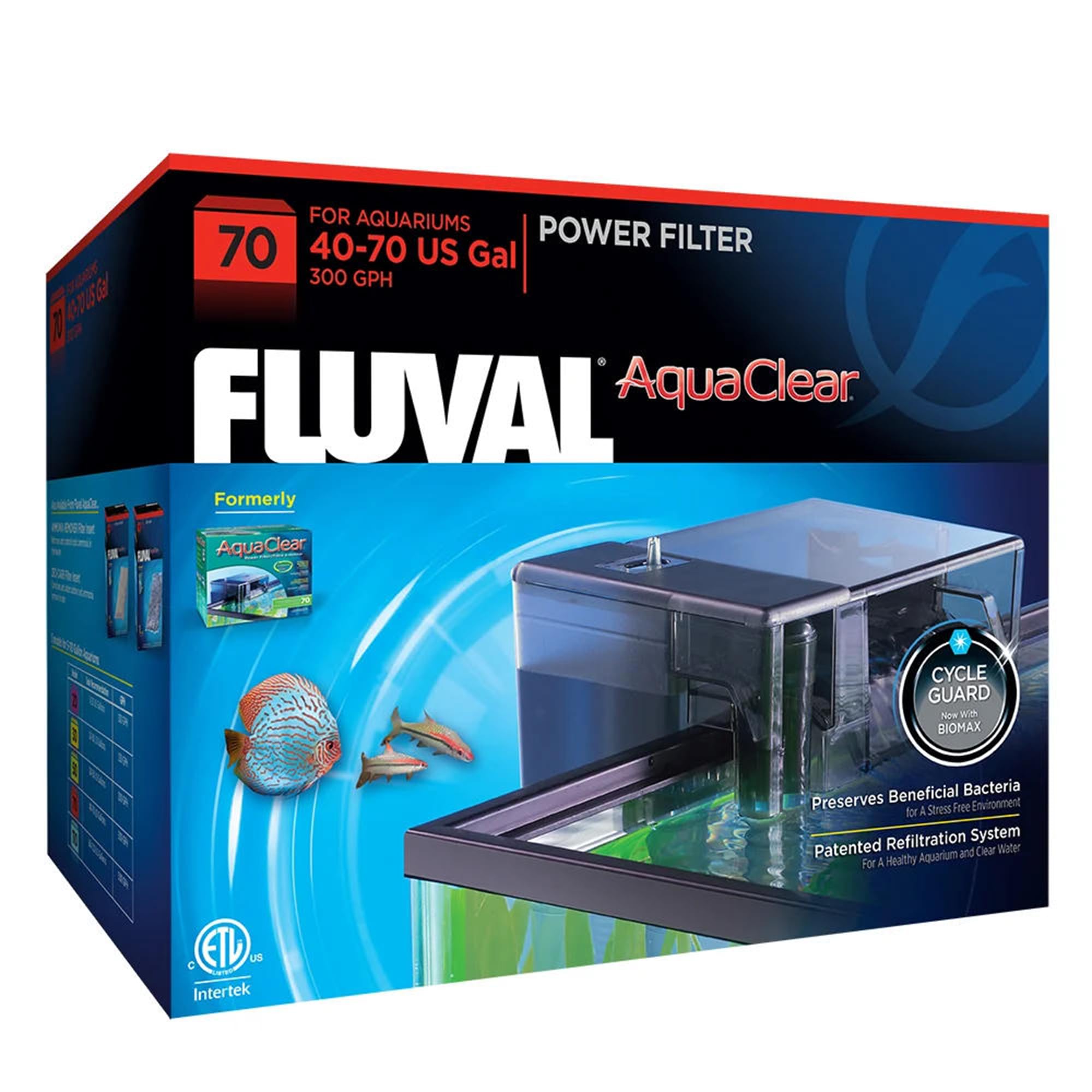
Rating: 4.4 ★ | Price: $$ | Flow Rate: 300 GPH | Media Flexibility: Customizable basket | Noise Level: Quiet overall | Ease of Maintenance: Easy basket access
The AquaClear 70 combines a 300 GPH flow rate with a media basket that holds up to seven times more material than comparable hang-on-back filters. Foam, carbon, and BioMax stages pull out particles, remove dissolved organics, and host nitrifying bacteria — a complete mechanical, chemical, and biological loop for a saltwater tank. Water clarity typically returns within a day of setup, and the spacious basket lets aquarists pack their own media mix without compromising flow.
This filter fits saltwater setups between 40 and 70 gallons where a canister would be overkill. It draws modest wattage and runs quietly enough to fade into background noise, though a slight hum can surface if the tank’s water level drops. Over years of continuous use, the plastic housing can crack or the motor may wear out. A quick inspection of the casing every few months and a spare impeller on hand keeps the risk low.
Pros
- The oversized media basket accommodates custom mechanical, chemical, and biological media for targeted saltwater filtration.
- Clears cloudy water rapidly, with crystal clarity often achieved within 24 hours of installation.
- Runs quietly enough for living spaces, with only minor noise at low water levels.
Cons
- A low hum may become noticeable when the tank’s water level drops below the intake.
- Plastic housing can crack and the motor may fail after extended use, requiring replacement parts.
The AquaClear 70 remains the HOB benchmark for medium saltwater tanks, balancing cavernous media capacity with filtration efficiency that rivals far more expensive canisters.
Best for 29-55 Gallon
Seachem Tidal 55

Rating: 4.5 ★ | Price: $$ | Flow Rate: ~350 GPH | Media Flexibility: Customizable basket | Noise Level: Very quiet | Ease of Maintenance: Easy basket
The Seachem Tidal 55 adds self-priming and a built-in surface skimmer to the familiar customizable media basket layout. Compared to the top pick AquaClear 70, you gain convenience and surface agitation control, but give up some of that model’s decade-long reliability history.
This filter suits medium-tank owners who value quiet operation and want to tweak media without hassle. The surface skimmer can get noisy when water level drops below the intake — worth keeping an eye on in open-top tanks where evaporation is faster.
Pros
- Self-priming pump restarts quickly after power outages without manual intervention
- Removable media basket simplifies swapping sponges, carbon, or biomedia
- Integrated surface skimmer pulls in oily film from the water surface
Cons
- Skimmer intake produces audible gurgling when water level falls below the weir
- Occasional motor noise has been noted in a minority of units over time
The Tidal 55 is a genuine alternative to the AquaClear for anyone who wants self-priming and surface skimming, as long as you keep the water topped up.
Best for Nano Tanks
Marina S10

Rating: 4.4 ★ | Price: $ | Media Flexibility: Cartridge (moddable) | Noise Level: Very quiet | Ease of Maintenance: Easy cartridge
Barely audible and slim enough to disappear on a small tank, the Marina S10 is built for nano setups where space and noise matter most. The self-priming pump and adjustable flow add convenience, and the affordable price makes it a low-risk choice for beginners. For saltwater nano tanks with low bioloads – think shrimp or a single betta – it provides gentle filtration without intruding on the tank interior like internal filters do.
Pros
- Quiet enough for a bedroom – motor noise is negligible during operation.
- Slim profile keeps the tank looking clean and unobstructed.
- Low purchase and maintenance cost for nano tank owners.
Cons
- Flow rate is too weak for any tank larger than 10 gallons or with heavy bioloads – this filter is strictly for nano, low-waste setups.
The Marina S10 earns its place for nano saltwater tanks that demand quiet, compact filtration – just pair it with a small bioload.
Best for Up to 100 Gal
Fluval 407 Canister

Rating: 4.5 ★ | Price: $$$ | Flow Rate: 383 GPH | Media Flexibility: Multiple baskets | Noise Level: Ultra-quiet | Ease of Maintenance: Easy lift-out baskets
Silent operation and lift-out media baskets make this canister a strong choice for saltwater tanks up to 100 gallons where noise is a priority. Flow is powerful enough to keep water clear without disturbing peaceful inhabitants. However, the seal can leak after basket removal, and the motor may stop working within months for some units — a risk worth weighing if you’re after long-term dependability. This filter suits hobbyists who value near-silent performance over absolute reliability and are comfortable performing occasional seal checks.
Pros
- Nearly silent operation, even during peak flow
- Lift-out media baskets simplify cleaning and media swaps
- Strong 383 GPH flow handles tanks up to 100 gallons
Cons
- Seal may leak after maintenance if not reseated carefully
- Motor can stop working within the first several months for some units
If silence is your top priority and you’re willing to keep an eye on the seals, this canister delivers — but the AquaClear 70 remains the safer bet for long-term, trouble-free filtration.
Best for 125-250 Gal
Fluval FX4 Canister
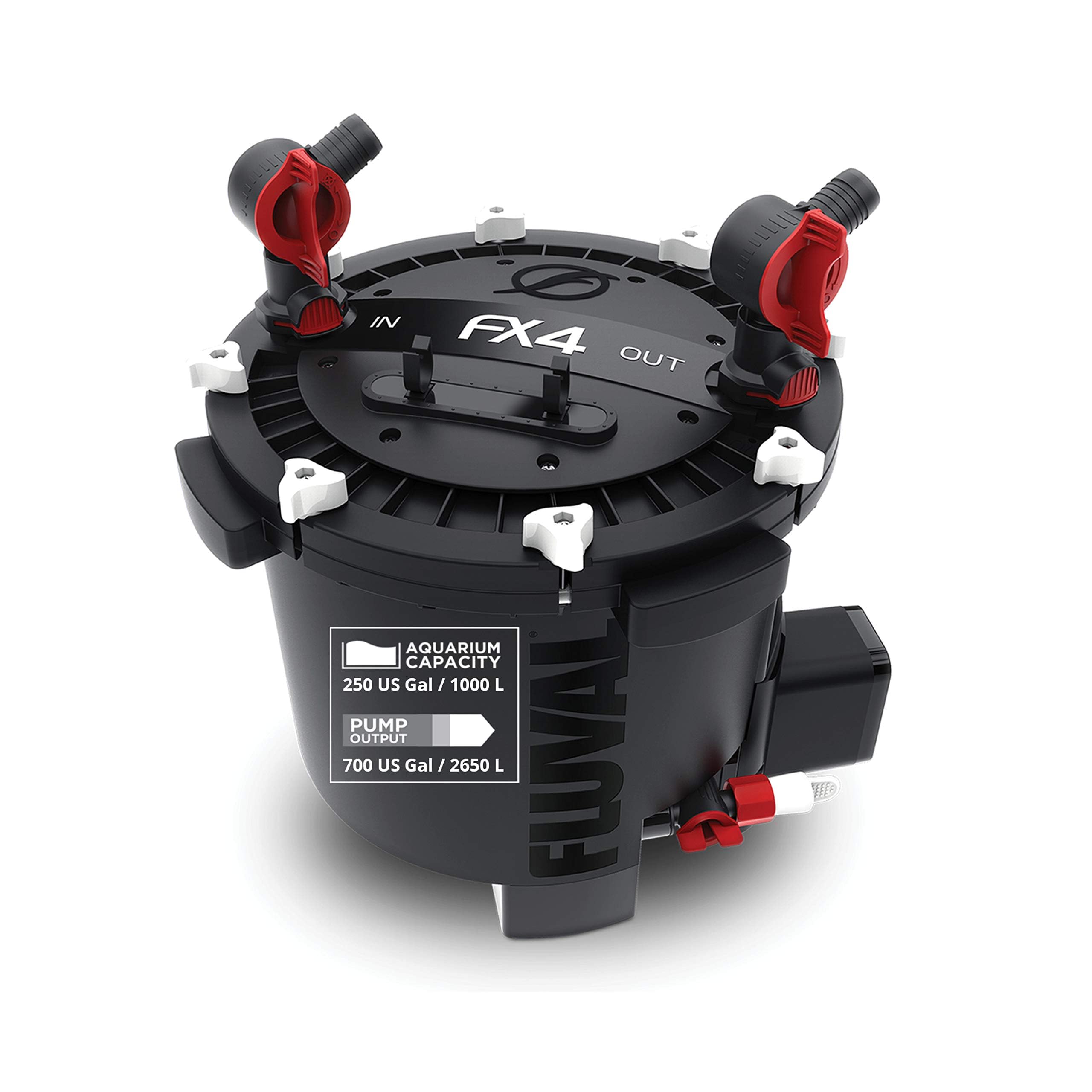
Rating: 4.5 ★ | Price: $$$$ | Flow Rate: 700 GPH | Media Flexibility: Large media volume | Noise Level: Very quiet | Ease of Maintenance: Easy drain valve
The FX4 moves water with authority: 700 GPH and self-priming make it a no-fuss choice for heavily stocked or large saltwater tanks. While not the quietest canister available, the noise level is low enough for most living spaces. The tradeoff for this performance is a substantial footprint that may not clear low cabinets, and occasional pump hiccups after a couple of years have been noted. This is a purpose-built workhorse for owners who prioritize flow and maintenance convenience over compact size or long-term warranty peace of mind.
Pros
- Powerful 700 GPH flow handles heavy bioloads in large tanks
- Self-priming pump and drain valve simplify water changes
- Quiet enough for a living room when properly seated
Cons
- Premium price tag makes it a luxury investment for serious hobbyists
- Large footprint may not fit under smaller aquarium stands
For large tanks where relentless flow and easy maintenance are the priorities, the FX4 fits — just budget for the space and know that long-term pump reliability can vary.
Best for Turtle Tanks
TARARIUM Internal 290

Rating: 4.5 ★ | Price: $$ | Flow Rate: 290 GPH | Media Flexibility: 3-stage media | Noise Level: Quiet | Ease of Maintenance: Easy sponge access
Unlike hang-on-back filters that need deeper water, the TARARIUM Internal 290 works in just 2.6 inches, making it the practical fit for turtle tanks and shallow saltwater refugiums. Its 3-stage bio-filtration keeps water clear, but the sponge clogs faster with heavy waste loads. Some units may stop working within a year, so a backup filter is worth having for long-term setups.
Pros
- Handles water levels as low as 2.6 inches – works where other filters can’t even be submerged.
- Quiet operation for an internal filter – barely audible in most rooms.
- Easy media access simplifies routine cleaning without tools.
Cons
- Motor durability varies – some units may stop functioning after several months of continuous use.
- Sponge clogs quickly with heavy turtle waste, requiring frequent rinsing to maintain flow.
Best for turtle keepers and anyone running a shallow saltwater setup where HOBs can’t go – its limitations are manageable with regular maintenance.
Best for Small-Med Tanks
Marineland Penguin 350

Rating: 4.4 ★ | Price: $ | Flow Rate: 350 GPH | Media Flexibility: Cartridge + Bio-Wheel | Noise Level: Noticeable | Ease of Maintenance: Simple cartridge changes
The Penguin 350 is a cost-effective way to bring wet/dry biological filtration to a small or medium saltwater tank. The Bio-Wheel helps maintain water quality, and setup is quick with simple cartridge changes. The trade-off: noise from the trickle and motor hum will be present in quiet rooms, and some units can develop motor issues within months. This makes it a reasonable choice for a first saltwater tank in a living area, but not one you’d rely on for years without keeping a backup plan.
Pros
- Rotating Bio-Wheel adds consistent biological filtration for healthier water.
- Easy to install and maintain with quick cartridge swaps.
Cons
- Some units may experience motor failure within months of use.
This filter fits best for budget-conscious first-time saltwater owners with smaller tanks who can accept noise and the possibility of early motor replacement.
Best for Large Tanks
Penn-Plax Cascade 1200

Rating: 4.3 ★ | Price: $$$ | Flow Rate: 315 GPH | Media Flexibility: 4 baskets | Noise Level: Quiet | Ease of Maintenance: Stackable baskets
The Cascade 1200 offers four stackable media baskets at a lower price than comparable Fluval canisters, making it an appealing option for saltwater aquariums up to 150 gallons. However, some units have developed cracked housings or seal failures over time, so it’s best suited for hobbyists willing to accept that possibility in exchange for savings.
Pros
- Four stackable media baskets allow customizable filtration for large tanks.
- Quiet operation keeps noise levels low in living spaces.
Cons
- Cracked housings or seal failures can occur over time with some units.
Best for saltwater keepers on a mid-range budget who prioritize media capacity over long-term certainty.
Best for Small Nano
Tetra Whisper 40i

Rating: 4.3 ★ | Price: $ | Flow Rate: 170 GPH | Media Flexibility: Bio-Bag cartridge | Noise Level: Very quiet | Ease of Maintenance: Simple
The Tetra Whisper Internal Filter delivers very quiet, air-driven filtration ideal for small nano tanks, betta habitats, and shrimp setups where gentle flow is key. However, pump reliability can be inconsistent — some units may stop working within a few months, making this filter better suited as a temporary or backup option rather than a long-term primary filter.
Pros
- Operates nearly silently, suitable for quiet rooms or bedrooms.
- Replacement cartridges are inexpensive, keeping maintenance costs low.
Cons
- The internal unit takes up visible space inside the tank, which can be an eyesore in smaller aquascapes.
Choose this for a small, low-bioload nano tank where quiet operation and low upfront cost matter more than long-term durability.
Best for 20-45 Gallon
Tetra Whisper IQ 45

Rating: 4.2 ★ | Price: $ | Flow Rate: 215 GPH | Media Flexibility: Bio-Bag cartridge | Noise Level: Quiet | Ease of Maintenance: Easy setup
Quiet operation and quick water clearing make the Tetra Whisper IQ a tempting budget option for small saltwater tanks up to 45 gallons. However, some units may develop leaks or stop working within months, so it suits temporary setups or buyers prepared for early replacement.
Pros
- Quiet operation keeps noise low – suitable for bedrooms or living areas.
- Quick water clearing and adjustable flow for customized tank conditions.
Cons
- Plastic housing may crack if handled roughly during maintenance.
Best for temporary saltwater setups where low cost and quiet operation matter more than long-term durability.
Best for 1-5 Gallon
NICREW Slim 5G

Rating: 4.2 ★ | Price: $ | Flow Rate: 42 GPH | Media Flexibility: Cartridge (hard to find) | Noise Level: Very quiet | Ease of Maintenance: Easy
This slim HOB filter is nearly silent and costs less than most alternatives, making it a natural fit for nano tanks housing bettas or shrimp. The adjustable flow and low 42 GPH rate suit small water volumes without creating turbulence. However, long-term consistency varies between units, and replacement cartridges are not always stocked by local retailers, which reduces convenience for ongoing maintenance.
Pros
- Extremely quiet operation for nano tanks
- Budget-friendly with adjustable flow
Cons
- Durability can vary between units
- Replacement cartridges may be hard to find in stores
Works well for small freshwater or very small saltwater nano tanks where silence and low cost matter most, provided you can source replacement cartridges or are comfortable swapping media yourself.
Best for 20-50 Gallon
Fluval 50 (AquaClear 50)
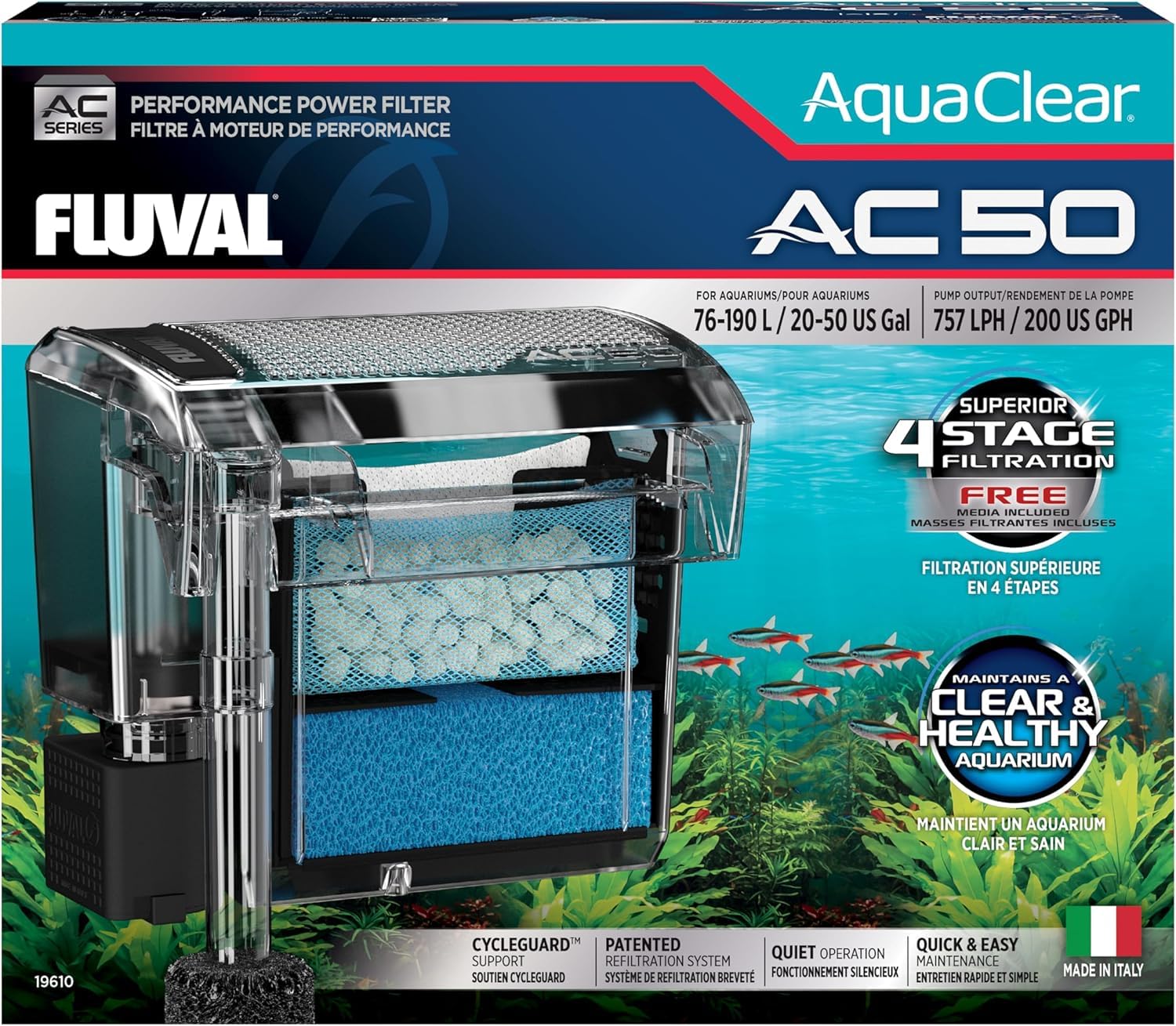
Rating: 4.2 ★ | Price: $$ | Flow Rate: ~200 GPH | Media Flexibility: Customizable basket | Noise Level: Mixed (some loud) | Ease of Maintenance: Easy basket
Delivers the same customizable media basket as the top pick in a smaller form factor for 20-50 gallon tanks, with simple upkeep and good water clarity. Some units have experienced motor noise or early failure, but the lower price makes it a budget-friendly entry point for hobbyists who value media flexibility over rock-solid reliability.
Pros
- Customizable media basket accepts foam, carbon, and BioMax for tailored filtration.
- Easy to clean and maintain with lift-out basket and simple disassembly.
Cons
- Motor hum may be audible in quiet rooms — less of an issue in living areas.
A reasonable option if you prioritize media customization and low upfront cost over long-term dependability.
Best for Green Water
COOSPIDER UV Filter
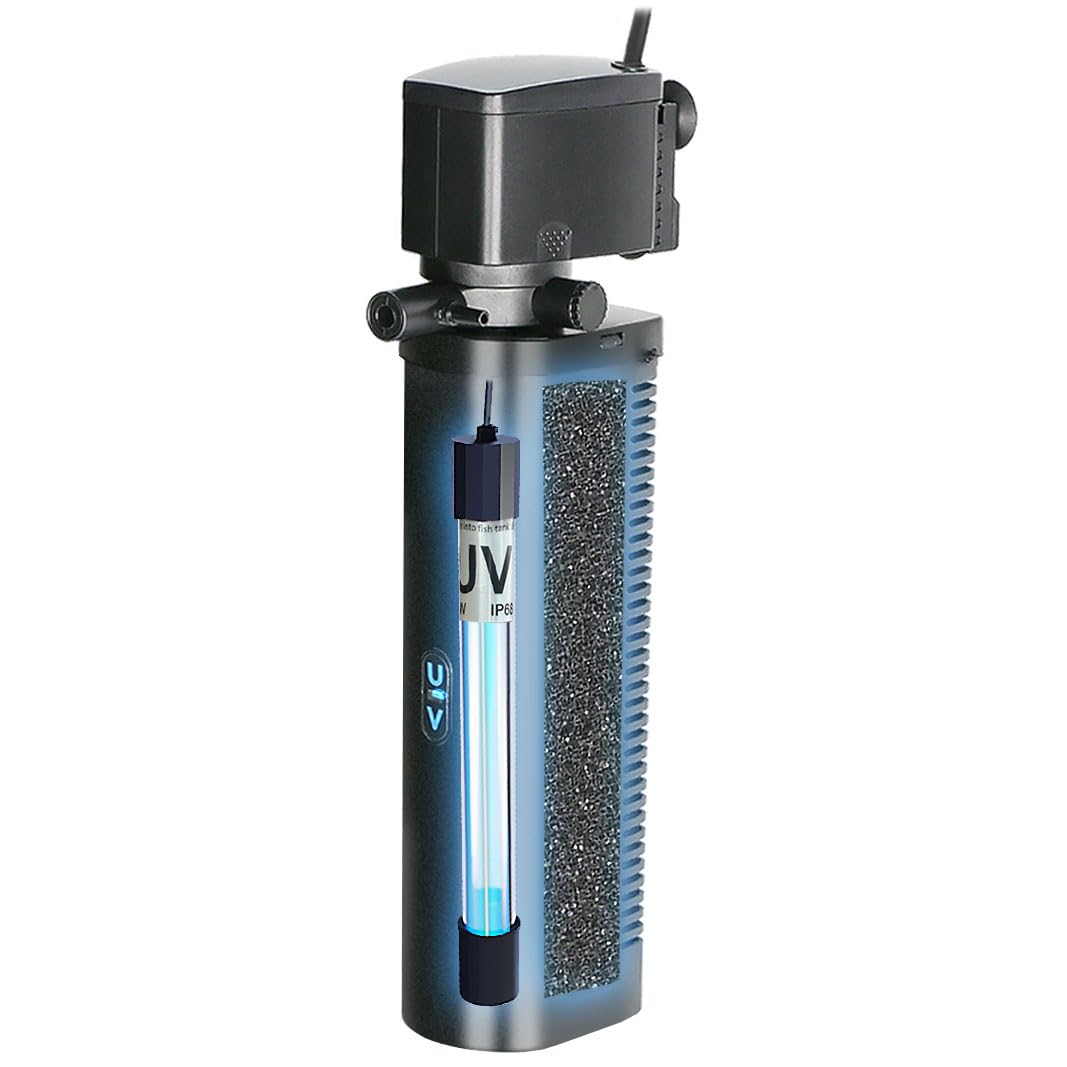
Rating: 4.2 ★ | Price: $ | Flow Rate: 200 GPH | Media Flexibility: UV + sponge | Noise Level: Moderate | Ease of Maintenance: Moderate (UV bulb)
The built-in UV lamp clears green water and algae blooms quickly, making it effective for emergency treatment. Durability can be a concern — bulb shattering and motor stoppages occur, reducing the filter’s lifespan. This filter suits temporary bloom control, not ongoing filtration.
Pros
- Clears green water in days, restoring tank clarity.
- Cost-effective alternative to a separate UV sterilizer.
Cons
- Seal failure can allow water into the UV chamber, posing an electrical concern.
Best as a temporary fix for algae blooms, not a permanent filtration solution.
How to Choose
Always buy a filter rated for a larger tank than yours to ensure adequate turnover and reduce cleaning frequency.
Flow Rate and Tank Volume
The filter’s flow rate, measured in gallons per hour (GPH), determines how often the entire tank volume passes through the media. Saltwater systems benefit from a turnover of 4-6 times the tank volume per hour.
A higher flow rate also creates stronger water movement, which can stress fish in small tanks or blow substrate around. Matching the flow to your tank size and inhabitants prevents dead spots without turning the aquarium into a washing machine.
Filter Media Flexibility
Proprietary cartridge systems lock you into buying specific replacement pads, often at higher long-term cost. Filters with a customizable media basket let you use any combination of foam, ceramic rings, carbon, or bio-media.
This flexibility also allows you to adjust filtration as your tank matures — switch from carbon-heavy chemical filtration to purely biological media once the system cycles. The initial cost difference is usually recovered within the first year of media replacements.
Noise Level
Filter noise comes from two sources: the pump motor and water trickling over the media. Canister filters seal the water path, making them inherently quieter than hang-on-back models that rely on vertical water fall.
HOB filters with large media baskets and a water level above the outlet tend to be quieter, while those that run near empty produce a noticeable gurgle. The same model can sound different depending on the tank’s water level and stand resonance.
Ease of Maintenance
Canister filters with quick-disconnect hoses and lift-out media baskets reduce the mess during cleaning. HOB filters that use a single cartridge are simpler to change, but are more wasteful and cost more per year.
The frequency of maintenance directly affects biological stability. A filter that is difficult to clean often gets neglected, leading to nitrate buildup and reduced water quality. The best filter is one you’ll actually maintain on schedule.
Reliability and Durability
Pump failure is the most common reason for filter replacement. Motors can seize due to calcium deposits or worn impellers, and plastic housings may crack from thermal stress or impact.
Warranty length is a rough indicator of expected lifespan — filters with a 3-year warranty typically have better bearings and seals. Models with high user-reported failure rates within the first year should be avoided in permanent setups.
FAQ
Can I use a freshwater filter in a saltwater tank?
Yes, most modern aquarium filters are made of plastic and can handle saltwater without corrosion. The key is to avoid any models with exposed metal parts in the water path, as saltwater will corrode them quickly. Stick with all-plastic filters or those with titanium or plastic impellers — these are safe for saltwater use.
Why does my new aquarium filter make a loud humming noise?
A humming noise often comes from the impeller vibrating against the housing, usually because of air trapped in the pump or a misaligned impeller. Try tilting the filter to release air bubbles, or check that the impeller shaft is clean and properly seated. If the noise persists after a week, the motor bearings may be defective — contact the manufacturer for a replacement.
How often should I clean a canister filter in a saltwater aquarium?
Every 4 to 8 weeks, depending on bioload and tank size. Over-cleaning can disrupt beneficial bacteria, so never rinse media in tap water — use tank water instead. If nitrate builds up quickly between cleanings, you may need to increase frequency or reduce feeding.
Do I need a UV sterilizer filter for my saltwater tank?
Not for routine filtration. UV sterilizers are useful for clearing green water algae blooms or preventing parasites, but they are unnecessary for biological or mechanical filtration. They also require regular bulb replacement and have a small footprint in the water, so they are best used as a temporary treatment rather than a primary filter.