This post contains affiliate links. We may earn a small commission when you buy through our links — at no extra cost to you.
Discus are notorious for turning their noses up at a new food. Even the most nutrient-packed formula can sit uneaten while your fish hold out for something familiar. Add to that a market full of ‘slow-sinking’ claims that fall apart in the tank, and it’s easy to waste money on food that just doesn’t work.
This guide cuts through the marketing to focus on what discus actually eat and thrive on. Every pick here has proven itself with real fish, from fussy wild-caught specimens to tank-raised breeders. We’ve prioritized consistent palatability, high protein, and minimal water clouding – the factors that matter most for long-term health.
The trade-off you’ll face is between foods that are instantly accepted and those that require a transition period. Some discus will eat a new flake on day one; others need a week of coaxing. Knowing which product matches your fish’s temperament saves time, frustration, and wasted food.
Top Picks
Best for Growth & Color
Hikari Discus Bio-Gold

Rating: 4.6 ★ | Price: $$ | Form: Pellet (disc) | Key Ingredients: Krill, crushed silkworm
Hikari Bio-Gold delivers a 50% protein pellet built around krill and crushed silkworm — ingredients discus recognize from their natural diet. Fish across multiple accounts accept it readily, with even picky specimens coming to the food after a short transition period.
The sinking behavior is not uniform: some pellets drop straight to the bottom, others linger near the surface for a few seconds. In tanks with moderate to strong flow this variation passes without notice. In still-water setups, a few pellets may drift long enough for top-feeding tankmates to intercept them. That’s a minor quirk, not a deficiency — the nutritional profile remains consistent.
For first-time discus keepers looking for a high-protein staple, Bio-Gold offers a predictable baseline. Breeders and hobbyists have also found it supports both growth and color over months of use. The pellet size works for juvenile and adult discus alike.
This food fits best when sinking speed is not a rigid requirement. Those who need either completely floating or uniformly slow-sinking pellets should look at other options. For everyone else, Bio-Gold delivers its core promise: a food discus will eat and thrive on.
Pros
- Discus and angelfish accept this pellet readily, even during food transitions.
- Regular feeding supports visible color improvement and steady growth.
- High protein content (50% min) from krill and silkworm provides a natural nutritional profile.
Cons
- Sinking speed varies between pellets — some float briefly while others sink fast.
Bio-Gold offers a straightforward, high-protein discus food with strong palatability and a long track record — a dependable starting point for new keepers and a consistent supplement for breeders.
Best for Probiotic Flake
Seachem NutriDiet Discus Flakes

Rating: 4.4 ★ | Price: $$ | Form: Flake | Key Ingredients: Fish, squid, earthworm
Large, probiotic-enriched flakes that reduce water clouding and deliver chlorella and earthworm protein for digestive health. Unlike the top pick’s near-universal acceptance, these flakes may require a gradual transition over 5–10 days before some discus take to them.
Best suited for discus keepers who want a varied diet with probiotic benefits and are willing to work through a transition period. The strong garlic odor and variable acceptance mean this is a supplement best used alongside a more reliable staple, not a standalone food.
Pros
- High-quality ingredients with probiotics and chlorella for digestive health and natural coloration.
- Large flake size stays intact, reducing mess and water clouding from uneaten particles.
- Fortified with fish, squid, and earthworm proteins for a varied nutrient profile.
Cons
- Some discus refuse to eat these flakes, especially if accustomed to other foods – acceptance varies by individual.
- Strong garlic or funky odor may be noticeable to owners during feeding, which some find unpleasant.
A good value for its nutrient density, but best as part of a rotation rather than a sole food.
Best for Budget Picky Eaters
Ocean Nutrition Discus Flakes

Rating: 4.5 ★ | Price: $ | Form: Flake | Key Ingredients: Salmon, plankton, algae
At roughly half the price of the top pick, this flake uses salmon, plankton, algae, and garlic to deliver 51.8% protein without artificial colors or preservatives. Even wild discus that have never seen dry food typically accept it after a few days — a rare achievement at this price tier.
The trade-off is flake size variation: larger pieces settle at the top of the jar, while the bottom contains smaller fragments. This is a minor inconvenience — you can stir the jar before feeding — and doesn’t affect palatability. The formula is best for budget-focused keepers or those transitioning fish from live or frozen diets. If you expect instant acceptance or prefer uniform pellets, the slightly pricier top pick may be a better fit.
Pros
- Wild discus and picky fish accept these flakes after a short transition period.
- Clean ingredient list with salmon, plankton, algae, and garlic — no artificial colors or preservatives.
- High protein content (51.8%) at a price that undercuts most competitors.
Cons
- Flake size varies within the jar — larger pieces on top, smaller bits at the bottom.
- Fish unaccustomed to dry flakes may need up to a week to accept this food.
For discus keepers on a budget who can wait a few days for their fish to adjust, this flake delivers natural ingredients and high protein without breaking the bank.
Best for Bulk Supply
Sera Discus Granules (1000ml)
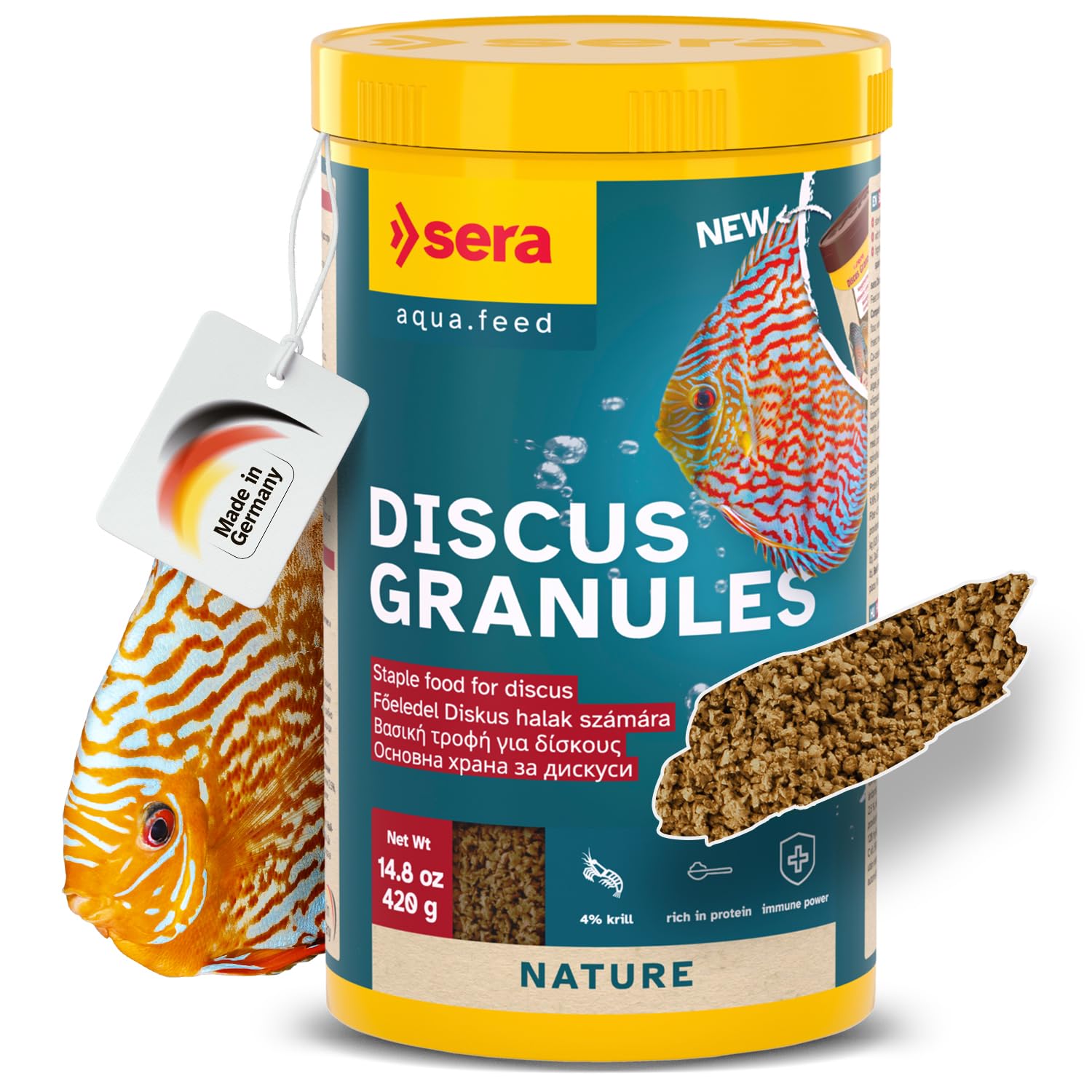
Rating: 4.5 ★ | Price: $$$ | Form: Soft granule | Key Ingredients: Aquatic protein, garlic
Sera’s 1000ml container of soft granules delivers a high-protein diet with garlic and prebiotics, designed for discus keepers who feed frequently. The soft texture ensures easy digestion and high palatability, matching what many breeders report as a reliable daily staple.
This bulk size suits multi-tank setups or breeders that go through food quickly. The granules sink rapidly, making them best for discus that feed at the bottom or mid-water rather than the surface. The premium upfront cost is offset by the volume — less practical for owners of a single fish who want a smaller, cheaper bag.
Pros
- Soft granules are highly palatable and easy to digest
- Large container offers excellent value per meal for multiple discus
- Free from artificial dyes and preservatives
Cons
- Granules sink quickly, limiting use with surface-feeding discus
- Higher upfront cost per bottle compared to smaller jars — less suitable for budget-focused keepers with one or two fish
For discus breeders or multi-tank setups that burn through food quickly, this bulk container offers the best cost-per-feed among soft granules.
Best for Beef Heart Alternative
Xtreme Beef Heart Flakes

Rating: 4.6 ★ | Price: $$ | Form: Flake | Key Ingredients: Beef heart
Beef heart in a flake form that discus and cichlids actively seek out, with the added benefit of minimal water clouding. Unlike homemade beef heart mixes that require freezing and portioning, this flake delivers a high-protein boost with less preparation and cleanup.
Best suited for discus owners who want to supplement growth phases with beef heart protein without the mess of traditional mixes. The 1-ounce bottle is small — frequent feeding of multiple fish will empty it quickly — and the per-ounce cost runs higher than standard flake foods. This is a supplement for targeted growth periods, not a complete daily staple.
Pros
- Discus and cichlids show strong feeding response to these flakes.
- Flake form avoids the water pollution common with homemade beef heart mixes.
- High protein content supports growth and color enhancement in tropical fish.
Cons
- Small 1-ounce bottle can run out quickly when feeding multiple discus daily.
- Per-ounce cost is higher than standard flake options, making regular use pricier.
The simplest way to feed beef heart protein to discus without water quality issues — just keep the small bottle size and supplement-only role in mind.
Best for Community Tanks
Ultra Fresh Excellent Bits

Rating: 4.6 ★ | Price: $ | Form: Pellet (sand-like) | Key Ingredients: Wild sword prawn, akiami shrimp
These micro pellets trigger an intense feeding response in community fish like tetras and rasboras, thanks to the wild sword prawn and probiotic blend that also helps keep water clear. For adult discus keepers, however, the pellet size is a mismatch—each grain is nearly sand-like, making it hard for larger fish to target before it sinks instantly, contradicting the ‘slow sinking’ claim. This product suits discus fry, juveniles, or as a treat for small tankmates in a discus community setup.
Pros
- Wild sword prawn protein triggers eager eating response in small tropical fish.
- Probiotic content supports water clarity and fish health.
Cons
- Pellets are extremely small, making them hard for adult discus to spot and consume before sinking.
- Sinking speed is immediate, not slow as advertised.
Best for community tanks with small fish, discus fry, or as a supplementary treat—not a staple for adult discus.
Best for Natural Ingredients
New Life Spectrum Discus

Rating: 4.4 ★ | Price: $$ | Form: Pellet (1-1.5mm) | Key Ingredients: Whole menhaden, seaweed
This discus pellet features whole menhaden, spirulina, and natural color enhancers without any artificial additives – a clean formulation that discus typically accept. The real-world performance data is less extensive than that of mainstream alternatives, so long-term consistency is less assured. It’s a fine choice for hobbyists who prioritize ingredient quality and are open to experimenting, rather than for those seeking an established daily staple.
Pros
- Natural ingredients with no artificial additives – supports color enhancement.
- High palatability; discus and angelfish eat it readily.
Cons
- Some discus may refuse the pellet, requiring a gradual transition period.
Best used as a supplement or for hobbyists who want to test a clean-ingredient food and can accept some uncertainty in long-term results.
Best for Immune Support
Sera Discus ImmunPro

Rating: 4.6 ★ | Price: $$ | Form: Soft granule | Key Ingredients: Krill, astaxanthin, probiotic
This krill-based soft granule packs Bacillus subtilis probiotics and astaxanthin to support immune health and color. Discus readily accept it, and the clean formula avoids artificial dyes or preservatives. However, the smaller 4-ounce bottle and limited user feedback — the standard Sera Discus Granules have a longer track record — make this better suited as a supplement or for keepers specifically interested in probiotic benefits.
Pros
- Probiotics and astaxanthin support immune health and natural color enhancement
- Soft granules are easy to digest and free of artificial dyes
Cons
- Granules sink quickly, which may be inconvenient in planted tanks with bottom-dwelling fish
For discus keepers who want gut health support without artificial additives, this probiotic granule is a clean supplement when paired with a staple food.
Best for Fry Feeders
Aquatic Foods Micro Granules
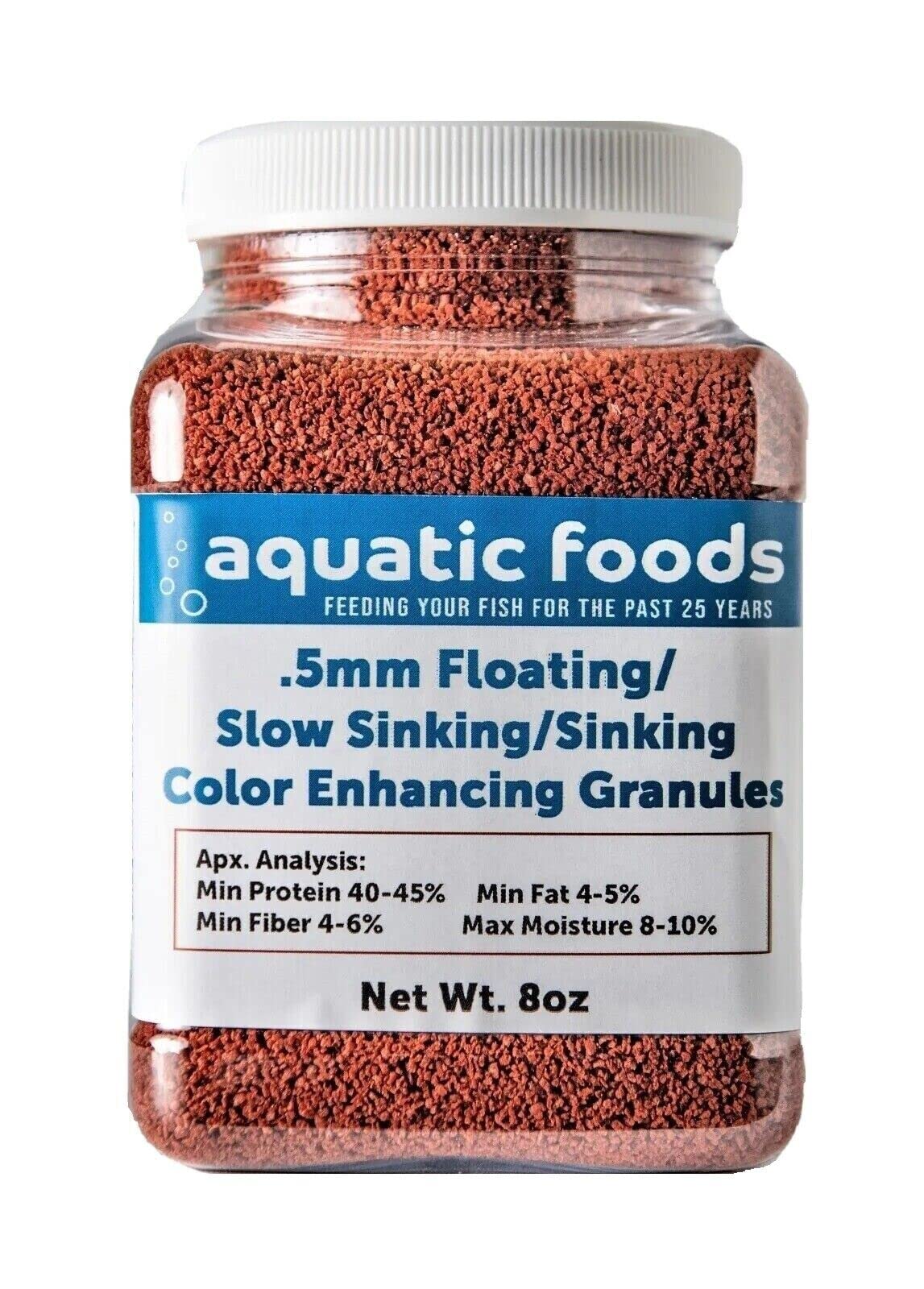
Rating: 4.4 ★ | Price: $$ | Form: Micro granule (0.5mm) | Key Ingredients: Astaxanthin
These 0.5mm micro granules provoke a strong feeding response in small fish, making them a fun option for nano tanks or discus fry. The formulation includes color enhancers like astaxanthin, and the 8 oz jar offers decent value. However, the granules are too small for adult discus to feed on efficiently, and isolated reports note potential filter clogging and water tinting. Best suited for nano fish or fry, not as a staple for full-sized discus.
Pros
- Nano fish show an intense feeding response, actively seeking out more food.
- Cost-effective alternative to premium brands for the 8 oz jar size.
Cons
- Granule size (0.5mm) is too small for adult discus to feed efficiently – better for nano fish or fry.
- May clog filters and tint water red due to inconsistent sinking behavior.
Best for keepers of nano fish or discus fry who want a high-engagement food and are willing to accept the risk of filter maintenance.
Best for Floating Pellets
Aquatic Foods Color Pellets
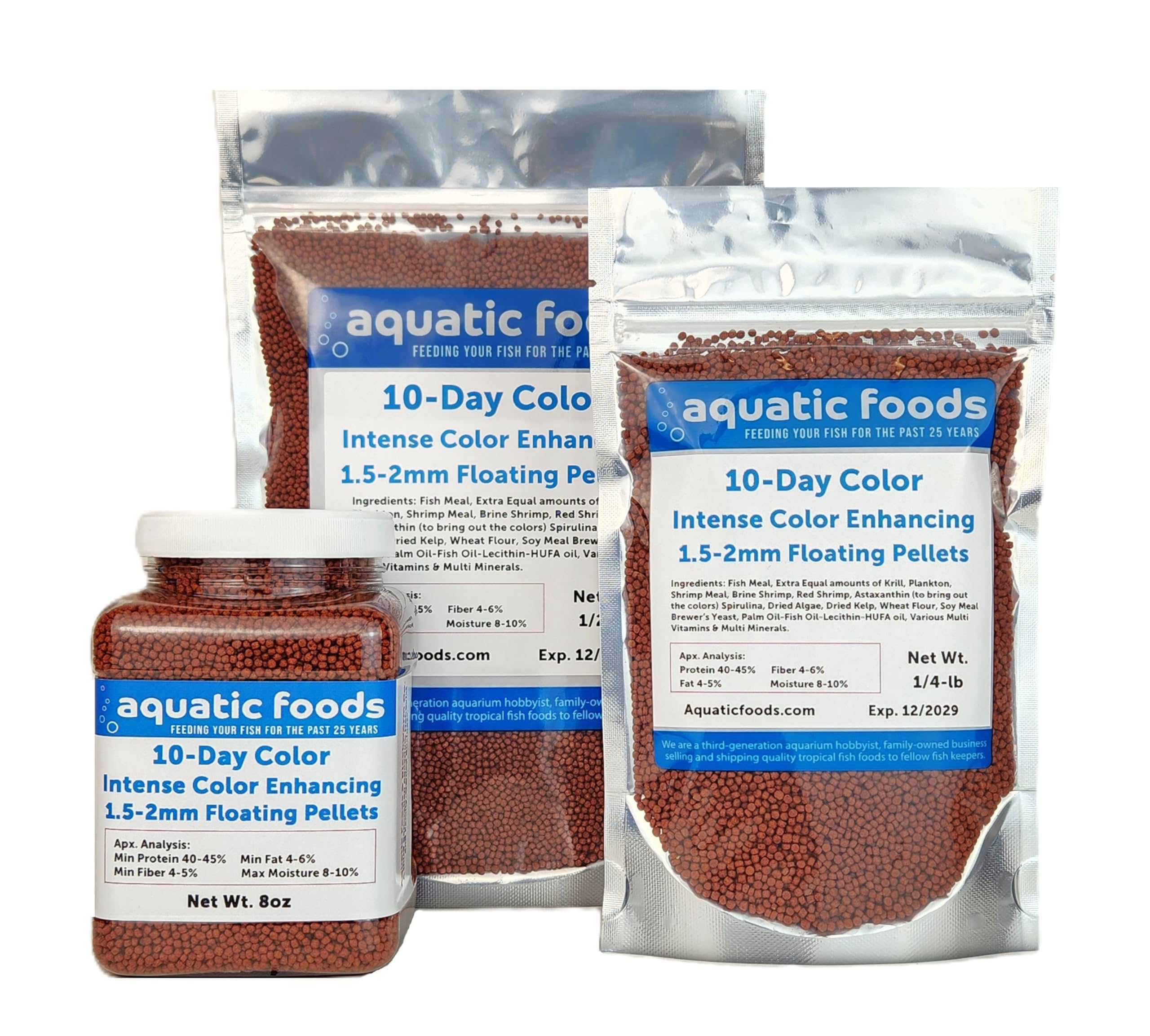
Rating: 4.1 ★ | Price: $ | Form: Floating pellet (1.5-2mm) | Key Ingredients: Astaxanthin, spirulina
These floating pellets are an affordable option for discus that prefer surface feeding, and fish generally take to them well. The inclusion of astaxanthin and spirulina aims to boost color, but visible changes are inconsistent—some fish show no improvement. Floatability can also vary between batches, with some pellets sinking sooner than expected. As a budget-friendly food, it works as a basic staple or supplement, but discus keepers seeking reliable color enhancement or consistent sinking behavior should look to more specialized options.
Pros
- Fish readily accept these floating pellets, making feeding straightforward for surface feeders.
- Budget-friendly price for a small bag, offering an entry-level option for discus keepers.
Cons
- Color enhancement claim may not deliver noticeable results for some fish, despite the added astaxanthin and spirulina.
- Some pellets can sink prematurely, reducing the intended floating duration for surface-feeding fish.
A useful budget fill-in or supplement for discus that enjoy floating pellets, but not a reliable color-enhancing staple.
How to Choose
The single most important insight: discus are notoriously picky, and a food that works for one tank may fail in another – so understanding the trade-offs behind texture, protein, and ingredients is the key to a successful purchase.
Form and Sinking Speed
Flakes float longest and are easiest for surface-feeding discus to spot, but they can also cloud water if not consumed quickly. Pellets and granules sink faster, which encourages bottom foraging but may be missed in planted tanks. The reality is that many ‘slow-sinking’ pellets sink nearly instantly once moisture hits them. If your discus prefers hovering near the top, stick with flakes or floating pellets and feed sparingly to avoid waste.
Protein Content
Discus require at least 45% protein for steady growth and color development. Foods below that threshold often contain fillers that leave fish hungrier and produce more waste. Products like Hikari Bio-Gold (50%) and Ocean Nutrition Discus Flakes (51.8%) hit this range cleanly. Premium blends may push higher, but excess protein can burden filtration if not balanced with digestibility.
Ingredient Quality
Whole fish meals (menhaden, salmon, krill) and natural color enhancers (spirulina, astaxanthin) indicate a food that mimics a discus’s wild diet. Avoid foods where the first ingredient is a grain or plant filler – discus are carnivores and need animal-based protein. Beef heart is a dense protein source but can foul water if not consumed quickly; flakes bypass that mess by removing the grinding step.
Palatability for Picky Discus
Transition is normal. Even the most palatable foods may be refused for the first 5–10 days. Garlic additives (common in many discus foods) can boost appeal, but some fish simply need time to recognize a new texture. The safest bet is to start with a food that has a proven track record with picky eaters, like Ocean Nutrition Flakes, which are frequently cited for winning over wild-caught discus.
Water Clarity Impact
Oily surface films and cloudy water are common complaints with some discus flakes – especially those with high fat content or poor binding. Foods that are ‘designed not to cloud water’ (like Ocean Nutrition) use ingredients that stay suspended without breaking down. If you have a planted tank or strong flow, sinking granules may prevent surface film altogether by bypassing the surface layer.
FAQ
Why does my discus spit out new food and refuse to eat it?
Discus are creatures of habit. They may reject a new texture or taste because it doesn’t match what they were raised on. Give them time: offer the new food in small amounts alongside their current staple for up to two weeks. If they still won’t eat, try a garlic-infused option like Sera Discus Granules, which many fish find irresistible.
Do discus prefer floating or sinking food for best growth?
Neither is universally better; it depends on your fish’s feeding habits and tank layout. Floating foods are easier to monitor and keep water cleaner if eaten quickly. Sinking foods encourage natural foraging and work well in bare-bottom tanks. The best approach is to offer both a flake (for surface feeding) and a granule (for bottom feeding) to cover all bases.
How long does it take for discus to adjust to a new brand of food?
Expect a transition period of 5 to 10 days. Start by mixing 20% new food with 80% old food, then gradually increase the new food’s proportion. Some discus accept new food in two days, others hold out for a week. If after two weeks they still refuse, that brand may not suit their palate – try one of the proven picky-eater options like Ocean Nutrition Flakes.
Can feeding discus flakes cause cloudy water or oily film?
Yes, some flakes release oils or fine particles that cloud water or leave a surface film. This is more common with low-quality flakes that have loose binders or high fat content. To avoid it, choose flakes labeled as ‘non-clouding’ (like Ocean Nutrition) or feed sparingly – only what your discus can eat in two minutes. Sinking granules eliminate this issue entirely.