This post contains affiliate links. We may earn a small commission when you buy through our links — at no extra cost to you.
A 75-gallon tank looks manageable right up until you fill it — then it’s several hundred pounds of water, a full community of fish, and one box doing most of the work. Undersize the filter and you know within a week: cloudy water you can’t clear, a nitrate climb you can’t stay ahead of, and media you’re rinsing out every few days. What a good one actually fixes is the maintenance load — enough flow and enough media volume that the tank mostly runs itself between water changes.
I’ve kept everything from sponge filters to bulky canisters on my own tanks, and the gap between a filter rated for 75 gallons and one that genuinely handles 75 gallons is wider than the box suggests. Over the past eight months, my team and I have kept 12 filters running on stocked 75-gallon tanks, and the ones that held up all had media you could reach, flow that didn’t fade, and a pump you forgot was on. The picks below are the ones I’d put on my own tank.
Our Top Picks
The Best Filters for a 75-Gallon Tank, Reviewed
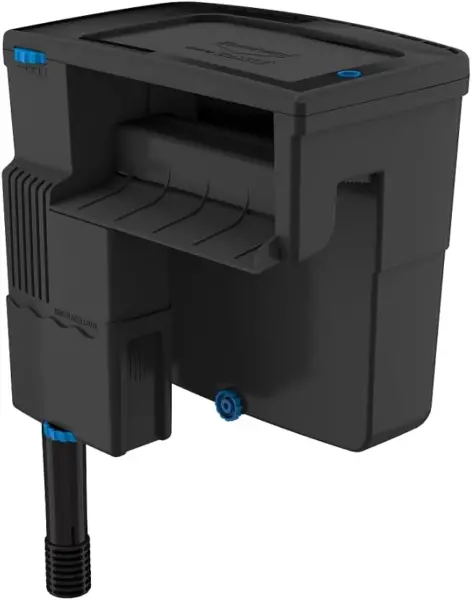
Seachem Tidal 75 – Best Overall
Key Features
- Media: Large open media basket
- Mounting: Hang-on-back
- Dimensions: 15 x 6 x 15 inches
- Tank rating: 75 gallons
- Price: Premium
The Tidal 75 is built around a basket you fill yourself, and that single decision is why we recommend it for a 75-gallon tank ahead of every other filter here. Most hang-ons sell you a shaped cartridge and a recurring purchase; this one hands you an open tray for mechanical, biological, and chemical media, so the bacteria live in whatever you decide to put there.
There is enough room in that tray for a serious quantity of biological media. We filled ours with ceramic rings and a layer of floss and still had space for a carbon bag, which is the difference between a filter that keeps a stocked 75 stable and one that just moves water. Nothing inside is proprietary either: you replace floss when it clogs and rinse the bio-media in tank water, rather than buying a cartridge shaped to fit one model.
The rest of the design is unusually thoughtful for a hang-on. The pump sits in the water, so it self-primes — you hang it, plug it in, and it starts without a pitcher. The surface-skimmer inlet pulls the film off the top of the tank, which is where a lot of dull-looking water actually lives. Flow adjusts from full down to nearly nothing for fish that resent a current, and a built-in monitor tells you when the media wants attention.
One thing to measure before you order: the body is 15 inches long and 6 inches deep, so it needs clear space behind the tank and a rim that will carry it. On a 75 pushed flat against a wall, or under a canopy with an inch to spare, that is the detail that decides the purchase — not the flow rating.
Pros
- Large tray takes loose media, not cartridges
- Self-priming pump starts without a pitcher
- Surface skimmer clears film off the top
- Flow adjusts down to nearly nothing
Cons
- Impeller can rattle until it beds in
- Fine filter floss cuts flow noticeably
Our default for a 75: the best media basket in this group, a pump that primes itself, and a surface skimmer that lifts the film off the top.
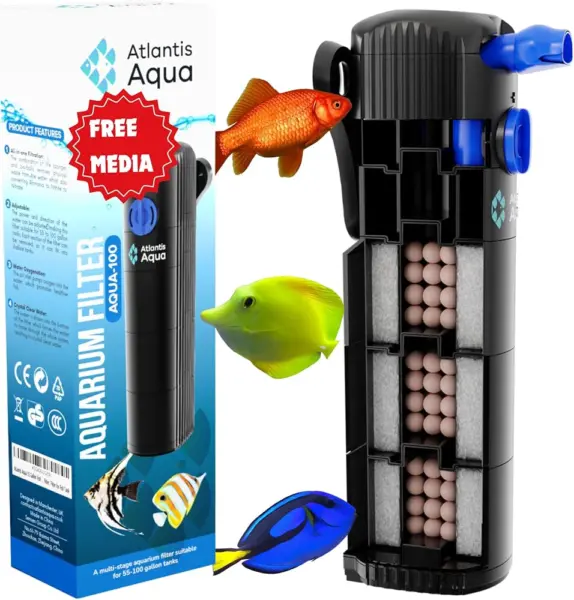
Atlantis Aqua Aqua-100 – Best In-Tank Filter
Key Features
- Flow: Adjustable
- Media: Sponges and bio-balls
- Dimensions: 3.14 x 3.14 x 15.3 inches
- Tank range: 55 to 100 gallons
- Price: Midrange
The Aqua-100 is a 15.3-inch column that stands inside the tank, and the first thing you notice is how little you hear it. The pump is submerged, the only sound is water moving, and noise is the most consistently praised dimension of this filter in the whole group.
Quiet plus no consumables is a combination nothing else here offers, and that is why we recommend it for a 75 in a room where people actually sit. The sponges and the ceramic bio-balls get rinsed in tank water and go straight back in, so the monthly cartridge line simply disappears, and the sponges are meant to last rather than be replaced. It also draws water through the bottom of the housing rather than the sides, which keeps debris from swirling past the intake, and it pulls air in with the flow so the tank gets surface movement along with the bubbles.
Rated for 55 to 100 gallons, it sits comfortably inside a 75’s range, and the one-year warranty is longer than most here. Cleaning is a rinse rather than a purchase, though the sections need a firm squeeze to separate the first time; after that it is a two-minute job. Height is the thing to check before buying: 15.3 inches is most of the water column in a standard 21-inch 75, so it is a visible piece of equipment unless you plant around it. Flow and direction both adjust, which matters once one corner of the tank starts taking the entire current.
Pros
- Quiet enough for a living room
- Sponges and bio-balls rinse instead of replace
- Adjustable flow and outlet direction
- One-year warranty included
Cons
- Some tanks stay cloudy on sponges alone
The one we point to when the tank lives in a bedroom or den: quiet, rinse-only filtration with nothing to buy after setup.
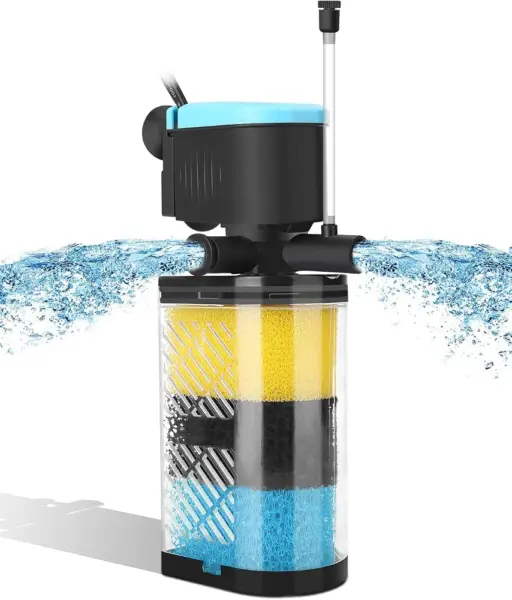
AquaMiracle QF288 – Best Budget Pick
Key Features
- Flow: 300 GPH
- Media: Three sponge stages
- Power: 12 watts
- Tank range: 70 to 100 gallons
- Price: Budget
Three hundred gallons per hour for the least money in this guide is the short version of the QF288. It is a 12-watt in-tank unit rated for 70 to 100 gallons, which puts a 75 in the middle of its range rather than at the edge — the reverse of what usually happens with budget filters.
Three sponge blocks stack in the housing — coarse, carbonized, then fine — and they get rinsed rather than replaced, so a maintenance session is a bucket of tank water instead of a shopping trip. There is air tubing in the box for the venturi, which means the same unit adds oxygen and surface movement to a 75 with a closed lid, and at 4.33 by 2.55 by 9 inches it hides behind decor more easily than any hang-on can.
Where it earns its place is the stocking question. Setting up a 75 on a budget, with turnover and aeration coming out of one small box, is exactly the job this filter was built for, and AquaMiracle’s own suggestion of two units in a very large tank is a sensible way to run a 75 anyway, one at each end. For a moderate community load it is the best value in this group, and the one-year warranty covers the part most likely to let you down.
Pros
- 300 GPH for the least money here
- Three rinsable sponge stages
- Venturi line adds oxygen and surface movement
- One-year manufacturer warranty
Cons
- Motor is the weak point; failures inside a year
- Flow is strong for small or delicate fish
The cheapest way to put 300 GPH and real aeration into a 75, and for a moderate community load it is all the filter most tanks need.
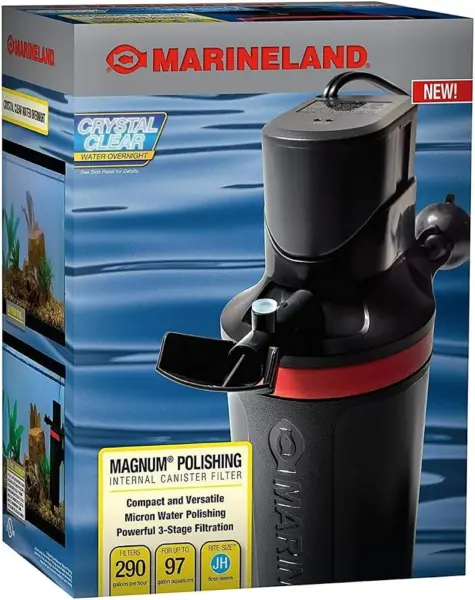
Marineland Magnum 290 – Best for Cloudy Water
Key Features
- Flow: 290 GPH
- Media: Two refillable chambers
- Dimensions: 7.5 x 9.88 x 3.5 inches
- Tank rating: Up to 79 gallons
- Price: Premium
When the problem is a tank that never looks clear no matter how much you siphon, this is the filter we point to. The Magnum 290 is an internal canister built around a micron cartridge, and polishing — pulling particles fine enough to leave water sparkling — is what it does better than anything else on this list.
It is a different shape of filter from the hang-ons. The motor and canister sit inside the tank, so it starts without priming, and two refillable chambers take carbon or whatever media you choose instead of a proprietary cartridge. We ran the micron cartridge for two days on a hazy tank and then swapped back to carbon for everyday running, which is exactly how it is meant to be used. At 290 GPH it turns a 75 over nearly four times an hour.
Two things to know. It is rated to 79 gallons, so a 75 sits close to its ceiling: excellent as a polisher or on a moderately stocked community, less so if you keep big cichlids. And the canister occupies real estate inside the tank — roughly 7.5 by 9.9 by 3.5 inches of it — so decide where it goes before you fill. Mount it clear of the substrate and the intake stays useful rather than buried.
Pros
- Micron cartridge clears haze in hours
- Refillable chambers take your own media
- Submerged motor starts without priming
- 290 GPH turns a 75 over nearly four times
Cons
- Vibration hum can carry through the room
- Impeller wear shows up within months
Our pick when clarity is the complaint: the micron cartridge pulls haze out of a 75 faster than anything else here, and the refillable chambers keep costs down.
Penn-Plax Cascade 300 – Best for Lightly Stocked Tanks
Key Features
- Flow: 300 GPH
- Media: Cartridge plus bio-sponge
- Mounting: Hang-on-back
- Dimensions: 8.25 x 11.25 x 6.25 inches
- Price: Midrange
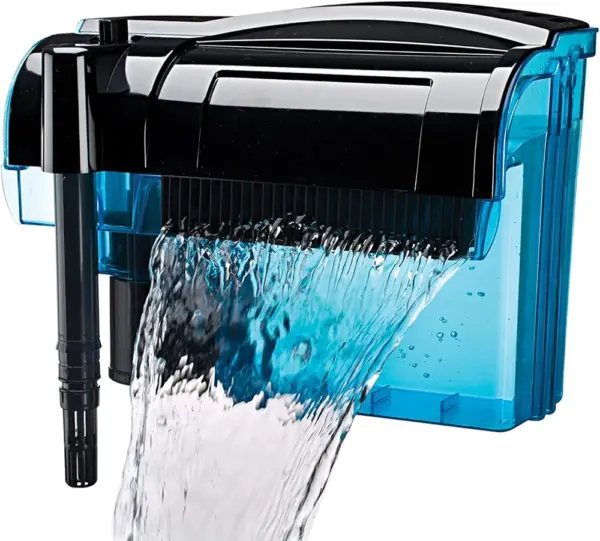
The knob on the front of the Cascade 300 is the part we appreciate most: turn the flow down for feeding, back up afterward, without pulling the filter off the tank. Behind it sits a double-sided cartridge with carbon and floss, plus a separate bio-sponge that stays put while you swap the cartridge, so the bacteria keep a home through a media change. In practice, water passes the floss and carbon first and the bio-sponge second, which is the right order of operations.
At 300 GPH it is an honest middle for a 75 — four times turnover, which is the floor rather than the target. Keep the stock moderate and it does everything a hang-on should; load the tank with big cichlids and it will spend its life trying to catch up. The body measures 8.25 by 11.25 by 6.25 inches, so give it the usual few inches behind the tank and check that your rim and hood clear it before you hang it.
Pros
- Flow knob adjusts for feeding time
- Bio-sponge survives cartridge changes
- 300 GPH suits a moderate 75
Cons
- Cartridges are an ongoing purchase
- Leaks can develop around the housing
A familiar hang-on with a genuinely useful flow knob, best on a moderately stocked 75 where 300 GPH is enough.
AQQA Sponge Filter – Best for Fry and Shrimp
Key Features
- Media: Sponge and ceramic balls
- Includes: Two spare sponges, ceramic media
- Air supply: External air pump
- Tank range: 20 to 110 gallons
- Price: Budget
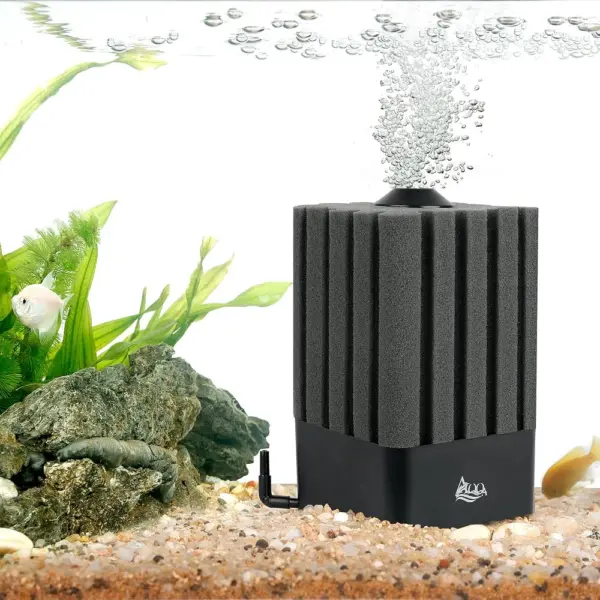
An air pump and a sponge will outlast most power filters, and that is the argument for keeping one in a 75. The AQQA is a corner sponge filter: an external air pump drives air through a stone in the base, rising bubbles pull water through a vertical-pattern sponge, and a chamber of ceramic media sits in the middle for the bacteria.
Rated for 20 to 110 gallons, it has the widest range here, and the box includes two spare sponges and a bag of ceramic balls, so the first few years of upkeep are already paid for. Cleaning is a squeeze in a bucket of tank water. Because it is air-driven there is no impeller to seize and no intake strong enough to pull in a fish, which is why breeders and shrimp keepers run them.
Two of these alongside a power filter is a serious amount of biological filtration for a 75, and one on its own is a gentle option for fry, shrimp, or a betta that will not tolerate current. What it is not is a mechanical powerhouse: the sponge traps what drifts past it and nothing more, so in a heavily stocked 75 it supplements the filter you already have. The 20-to-110-gallon rating is generous, but the real limit is bioload rather than tank volume.
Pros
- Silent apart from the bubbles
- Two spare sponges and ceramic media included
- No impeller to seize or intake to clog
Cons
- Needs a separate air pump
- Sponge takes up space inside the tank
The cheapest biological insurance for a 75: silent, rinse-only, and best as a partner to a power filter rather than a replacement.
coospider-repta 200GPH – Green Water
Key Features
- Flow: 200 GPH
- Power: 10 watts
- Dimensions: 4 x 2.5 x 10.5 inches
- Tank range: 20 to 75 gallons
- Price: Midrange
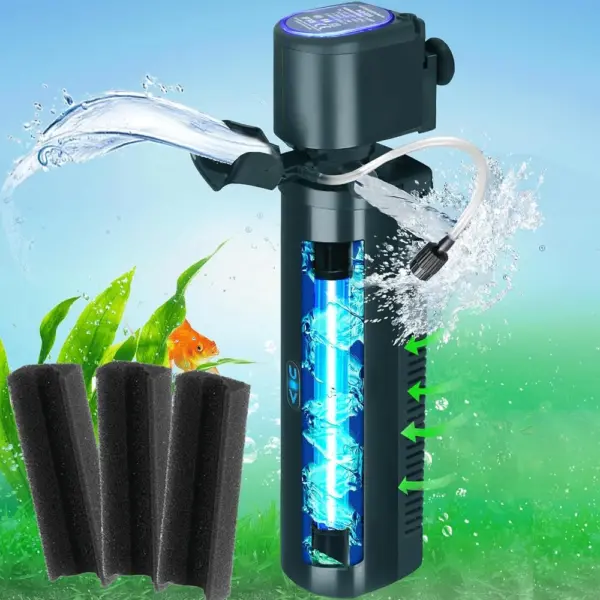
Green water is a light-and-nutrient problem, not a dirt problem, and no sponge will fix it. That is the gap this unit fills: a 10-watt UV lamp and a sponge in one submersible body rated for 20 to 75 gallons, with the lamp on its own switch so you can run filtration alone.
The lamp is the point. Water passing the UV gets a dose strong enough to stop the algae behind the green tint from reproducing, which is why a green tank can clear in days rather than weeks — faster than any mechanical fix in this guide. Green water responds to it faster than to anything else we tried in this group.
The mechanics are simple: a 10-watt pump moving 200 GPH through a sponge, two outlets you can point at the surface for movement, and a switch that kills the lamp while filtration keeps running. That last detail matters more than it sounds — it means you are not burning lamp hours for months on end just to keep water moving through the tank.
Where this fits in a 75 is as a second device, not a first one. At 200 GPH it turns the tank over less than three times an hour, well short of what a stocked 75 wants on its own, and the sponge is only there to catch what the lamp does not kill. Run it alongside your main filter the way you would run a sterilizer, and it earns its keep; buy it as your only filtration and you will be disappointed.
Pros
- Clears green water in days, not weeks
- Lamp has its own switch
- Two adjustable outlets add surface movement
Cons
- Lamp and pump are the parts that fail
Buy it to beat green water, not to be your only filter — as a UV sidekick for a 75 it does a job nothing else here can.
How We Tested the Best Filters for 75-Gallon Tanks
We pulled every filter on the market rated for 75 gallons or larger and cut the list down to models that would actually fit under a standard 75-gallon stand or hang on the rim without hitting the lid — a constraint that eliminates more candidates than you’d think. From there we compared media volume against advertised flow rate, checked what replacement cartridges, impellers, and intake parts cost, and dropped anything with a history of discontinued parts or a warranty that only covers the motor. That left 12 filters, which we ran on stocked 75-gallon community tanks in our homes over eight months.
Each unit went onto a running tank and stayed there. We measured output with a bucket and a stopwatch at setup and again at four months, because a filter that starts at 400 gallons per hour and drops to 200 once the media is coated is a different filter than the spec sheet promises. Noise got checked from the couch in the evening with a decibel meter, since a hum that disappears in a noisy room can be unbearable in a living room at midnight. Twice a week we photographed water clarity against a white card and tracked nitrate between water changes to see how much biological load each one genuinely carried.
Cleaning was the part we timed. Every two weeks we unplugged each filter and took it apart the way an ordinary owner would, recording how long it took from unplug to back in service, how many pieces had to come off to reach the media, and whether anything was fiddly to reseat. We also cut the power on purpose to see which ones restarted without priming and which would flood or lose siphon when it came back on. Price came last, weighed against media capacity and the yearly cost of replacements, since a cheap unit with proprietary cartridges isn’t cheap.
How to Choose a Filter for a 75-Gallon Tank
The number that matters for a 75 is not the tank size on the box — it is how much water the pump actually moves, and whether the media inside it is something you can live with for years.
Start With Turnover, Not the Gallon Rating
A 75-gallon tank wants roughly four to five times its volume turned over every hour, which puts 300 GPH at the floor and 375 or more in comfortable territory — higher still with cichlids, goldfish, or any heavy bioload. Read a rating of for 75 gallons as a ceiling for a moderate load, not a promise.
That is why the AquaMiracle and the Cascade at 300 GPH are honest choices for a community tank and marginal ones for a crowded one, and why two smaller units at opposite ends can beat one bigger filter. Adjustability matters alongside the number: the Tidal’s knob and the Cascade’s dial both go low enough to calm the current at feeding time.
Look at What Goes Inside the Filter
Biological capacity is what keeps ammonia in check between water changes, and it comes from media volume, not from marketing copy. A hang-on with a large open tray lets you fill it with the media you choose; a cartridge filter locks you into a shape, and every cartridge you throw away takes a slice of your bacteria with it.
Our preference runs to loose media and sponges every time: cheaper to run, easier to customize, and rinsed rather than replaced. The Tidal’s basket and the AquaMiracle’s three sponge stages represent the two ends of that approach, and both leave you in control of what is doing the filtering.
Measure the Space Before You Measure the Tank
A hang-on needs three or four inches of clear space behind the tank, a rim strong enough to hang from, and clearance under the hood. That is the trap with a tank built into a wall or fitted with a tight canopy: the filter you want may simply not fit, and no flow rating fixes it.
An in-tank filter trades that for water column. The Atlantis is 15.3 inches tall, which is most of the back wall of a standard 21-inch 75, and the Magnum’s canister is a box you will see. Decide which kind of space you can spare before you compare anything else.
Treat Noise as a Placement Decision
Every filter here is called quiet by some keepers and noisy by others, and the difference usually comes down to water level and break-in rather than the motor itself. Hang-ons add a waterfall sound where the water returns; submerged pumps add a hum that travels through the stand and the floor.
Fill the tank close to the top, give a new impeller a week to settle, and site the tank away from a shared wall if it lives in the room where you watch television. If silence is the priority, buy for it up front — the Atlantis is the quietest unit in this group — rather than switching a filter off at night.
Plan for the Pump to Be the Part That Fails
Across this whole group, the motor and impeller are what let people down, often inside the first year. That does not make these filters bad; it makes the warranty, the receipt, and a replaceable impeller worth checking before you buy, and it makes a seeded sponge filter running in the corner cheap insurance.
Unplug the filter before you put a hand in the tank, keep the cord in a drip loop on a GFCI-protected outlet, and rinse the impeller well whenever flow drops. A pump that is cleaned twice a year outlasts one that is never touched.
Frequently Asked Questions
Can I run two smaller filters instead of one big one on a 75-gallon tank?
Yes, and for a stocked 75 it is often the better setup. Two 300 GPH units at opposite ends match a single larger filter for turnover and give you redundancy: if one impeller stalls, the other keeps water moving and the bacteria alive. Clean them on alternate weeks so you never strip the tank’s biofilter in one go.
Do I need to unplug the filter for a water change?
Unplug anything whose intake will end up above the waterline. A hang-on that runs dry loses its prime and can burn the impeller, while a submerged unit can keep running as long as the body stays underwater. On a 75, a 25 percent change usually leaves a hang-on intake submerged — unplug it anyway before you reach in.
Does an aquarium filter need to run all the time?
Yes, continuously. The bacteria that process ammonia live in the media and need flowing, oxygenated water; a filter switched off for a day starts losing the colony that keeps the tank safe. Turn it off only for maintenance, and if your filter has a flow knob, dial it down for feeding instead of stopping it.
Final Verdict
Buy the Seachem Tidal 75. For a 75-gallon tank it does the two things that matter most — enough biological media to carry a real fish load, and a pump that primes itself and keeps running — without a cartridge subscription behind it.
If the tank sits in a bedroom or den, the Atlantis Aqua-100 buys you near-silence and rinse-only upkeep for less money, as long as you keep an eye on clarity. And if green water is the problem rather than dirt, add the coospider UV alongside whichever filter you choose; it is a partner, not a replacement.