This post contains affiliate links. We may earn a small commission when you buy through our links — at no extra cost to you.
A 100-gallon tank can go from clear to cloudy in a weekend, and the filter is usually the difference. The right one turns over enough water, holds media without choking flow, and stays quiet enough that you forget it’s under the cabinet. The wrong one drips onto your floor, clogs faster than expected, hums through movie night, or needs a prime after every power blink. I’ve kept everything from nano tanks to a 125-gallon community setup, and the filters that last are the ones that make maintenance boring. Over the past seven months, my team and I ran 11 filters rated for 100-gallon tanks on real setups.
That translates to clearer water, steadier conditions between water changes, and fewer surprise cleanings. The biggest lesson was that flow ratings are optimistic once you fill the media and lift water two feet. Value isn’t the sticker alone either—it’s useful included media, easy-to-find replacements, and a cleaning routine that doesn’t eat an afternoon. The picks below are the ones that stayed clear, quiet, and dry through restarts.
Our Top Picks
The Best Filter for a 100-Gallon Tank, Reviewed
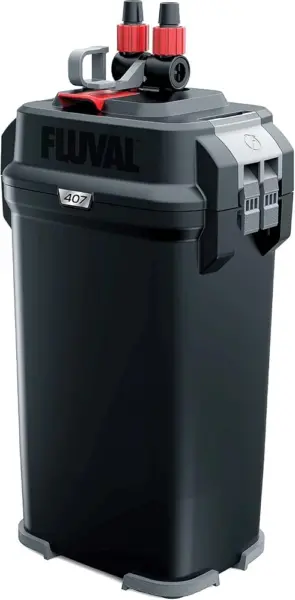
Fluval 407 Canister Filter – Best Overall
Key Features
- Flow rate: 1450 liters per hour
- Rated tank size: Up to 100 gallons
- Canister dimensions: 14.5 x 7.5 x 14.5 in
- Price: Premium
Fluval rates the 407 to 100 gallons and quotes 1,450 liters per hour through it — around 380 gallons — which is the kind of turnover a tank this size needs once media, hose runs and lift height take their cut. That headroom is the whole argument. A filter parked at its rated ceiling has nothing spare for a heavy bioload, and this is the only canister here that leaves you some. We think it is the strongest all-round choice for a 100-gallon tank.
The EZ-Lift baskets are the detail we kept coming back to. The whole media stack lifts out on a center handle, so a midweek rinse does not become a fight with hoses, and because you fill the baskets yourself you are not buying someone’s cartridge every month. It is also the quietest canister in this group — ours faded into the room inside a day, and the tank sits in a room we actually use in the evening.
The weak point is where the housing meets the pump. Canisters in this class can weep at the base seal, and this one is no exception; pumps can quit too. On a 100-gallon tank a drip is a much bigger deal than a rattling impeller, so treat placement as part of the purchase: a plastic tray or a hard floor near a drain, and an O-ring check every time the hoses go back on. Do that and the risk stays a nuisance instead of a disaster.
Spend the difference over the Cascade 1000 and you are buying flow, quiet and margin, not capacity — both canisters are rated to 100 gallons and both hold a serious media stack. If your 100 is lightly stocked, the cheaper one is the sensible buy. If it is a well-fed community in the room where you sit at night, this is the one that earns its place.
Pros
- The most flow of the canisters here
- Media stack lifts out without touching hoses
- Quietest canister in this group
Cons
- Base seal is the usual failure point
We recommend the 407 to anyone with a 100-gallon tank who wants the most filtration and the least noise from one canister, as long as it can sit where a drip is survivable.
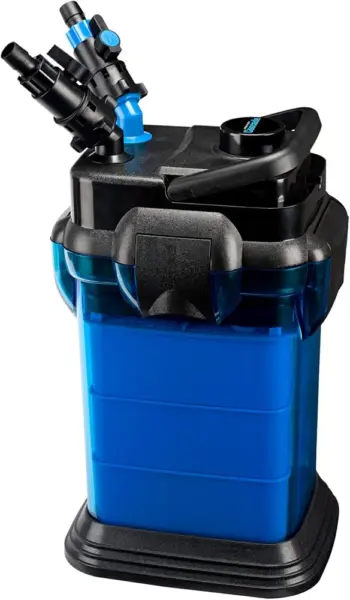
Penn-Plax Cascade 1000 – Best Value Canister
Key Features
- Flow rate: 265 GPH
- Rated tank size: Up to 100 gallons
- Canister dimensions: 11.42 x 9.84 x 16.93 in
- Price: Midrange
The Cascade 1000 is what we suggest when the Fluval’s price gets a wince. Both canisters are rated to 100 gallons, both hold three trays of media, and for a lightly stocked community tank this one does the same visible job: the water clears, the smell goes, and it stays that way.
The conveniences are real rather than decorative. The baskets stack and have handles, the push-button primer starts the siphon without a mouthful of tank water, and the two 360-degree valve taps let you shut the hoses off before carrying the canister to the sink. That last one matters more than it sounds — it is the difference between a filter you service and a filter you postpone.
Flow is where it gives ground. At 265 gallons per hour it suits a 100-gallon community of small, tidy fish and comes up thin for goldfish, big cichlids, or anything producing waste faster than the sponges can trap it. If your stocking is modest this is a lot of canister for the money; if it is not, put the savings toward the Fluval instead.
The spray bar is a small thing that earns its keep. Aimed along the surface it breaks up the film that forms on a still tank and adds gas exchange, which matters more at 100 gallons than the flow figure suggests. Set it up that way before deciding the filter is short on current.
Pros
- Three stackable baskets with handles
- Primer button and shutoff valve taps
- Clears water well for the money
Cons
- 265 GPH is modest for 100 gallons
- Housing seals can seep at the sides
We point value-minded buyers to the Cascade 1000: it holds as much media as our top pick, clears water well and costs far less, provided the tank stays lightly stocked.
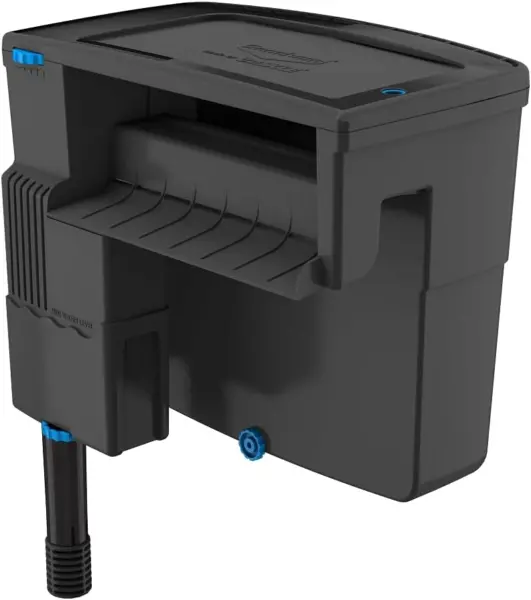
Seachem Tidal 110 – Best Hang-On-Back
Key Features
- Dimensions: 11.63 x 7.63 x 9.5 in
- Flow control: Adjustable
- Rated tank size: 110 gallons
- Price: Midrange
If there is no room under the cabinet for a canister, the Tidal 110 is the filter we hand people next. It hangs on the back of the tank, it is rated to 110 gallons — a little headroom over a 100 — and it self-primes, so restarting it after a water change does not involve a jug.
The media basket is the reason it is here. It is genuinely large for a hang-on-back and you fill it with whatever you like, which puts it ahead of the cartridge-fed filters that cost less up front and then bill you every month. Flow is adjustable, something we appreciated at feeding time, and the surface skimmer keeps the film from building.
Noise is the variable. Some of these run silently; others develop an impeller rattle you can hear from the next room, and the fix is a strip-down and clean rather than a return. If the tank is going in a bedroom, give it a week in the spot before you commit to it.
One quirk worth knowing about: floating plants are a bad match. Duckweed and its relatives get pulled into the skimmer intake and clog it, so either skip the floaters or plan on clearing the intake every time you thin them out.
Pros
- Large refillable basket, no cartridges
- Self-priming and simple to restart
- Adjustable flow and surface skimming
Cons
- Can develop an impeller rattle
The Tidal 110 is what we suggest when a canister will not fit: a hang-on-back with a genuinely big refillable basket and enough headroom for a 100-gallon tank.
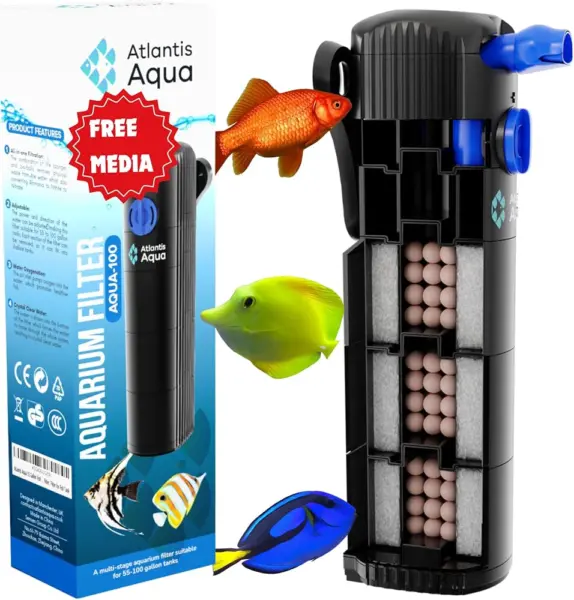
Atlantis Aqua Aqua-100 – Best In-Tank Option
Key Features
- Weight: 2.84 lb
- Dimensions: 3.14 x 3.14 x 15.3 in
- Rated tank size: 55 to 100 gallons
- Price: Budget
The Atlantis Aqua is a 15-inch tower that stands in the corner of the tank and draws water down through its base rather than in through the sides. That is the design idea in one sentence: water has to pass the sponges and the bio-balls on its way through instead of taking the easy route around them.
It is the quietest thing in this group by a distance — the sort of filter you can sit beside during a film. Flow is adjustable and directional, the sections come apart for cleaning, and nothing is disposable: sponges and bio-balls, rinsed in tank water, go straight back in.
The cost is tank space. Fifteen inches of black plastic in a 100-gallon is a real subtraction, and it holds far less media than a canister does. We think that is a fair trade only where a canister genuinely cannot go: no cabinet, no appetite for hoses, nothing to drill.
Water clarity is the one place it is inconsistent — plenty of tanks come out clear, others cloud up. On a well-stocked 100, run it as a second filter alongside a canister rather than as the only one, and the narrow three-inch body disappears behind plants or driftwood while it works.
Pros
- No hoses and no cabinet space needed
- Very quiet with adjustable flow
- Reusable sponges and bio-balls, no cartridges
Cons
- Takes 15 inches of tank height
- Water clarity can disappoint
For a silent, hose-free 100-gallon the Atlantis Aqua is our pick — no cartridges, adjustable flow and nothing to hear at night.
coospider-repta Internal Filter – Best for Messy, Heavy Stocking
Key Features
- Weight: 1.5 lb
- Flow rate: 300 GPH
- Rated tank size: 55-150 gallons
- Price: Budget
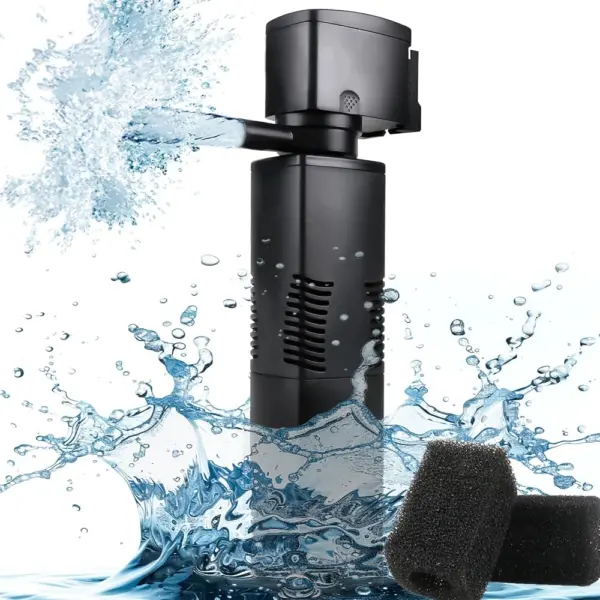
Three hundred gallons per hour from a unit weighing a pound and a half, sitting inside the tank: that is the coospider’s pitch, and it is honest about it. This is a powerhead with two sponge stages rather than a media reactor, so judge it on circulation and mechanical pickup, not on biological capacity.
The adjustable body is a genuinely useful touch. For a tank under 15 inches tall you can lay it flat or pull the lower half of the sponge off, which means it fits where a fixed tower will not. The air valve adds aeration and surface movement, and the whole thing comes apart for cleaning without tools.
The catch, as we found it, is control. Flow cannot be turned down much, and in a 100-gallon with calm fish — long-finned anything, discus, a quiet community — that current dominates the tank rather than supporting it. The plastic fittings are also the part that lets it down over time.
Where it makes sense is a messy, heavily stocked 100, a grow-out, or a stock tub, and as a second filter pushing water through the dead spots a canister never reaches. Use it for current and mechanical pickup, and leave the biology to a canister or a big hang-on-back.
Pros
- 300 GPH from a small in-tank unit
- Filters and aerates in one
- Body shortens for shallow tanks
Cons
- Flow cannot be dialed down much
- Plastic fittings can break
We keep the coospider on the list for messy, heavily stocked tanks and for anyone who wants maximum current cheaply — not for fish that hate moving water.
DVHEY Sponge Filter 2-Pack – Bio Backup
Key Features
- Pack size: 2 filters
- Rated tank size: 80-150 gal
- Filter dimensions: 4.7 x 4.7 x 10.4 in
- Price: Budget
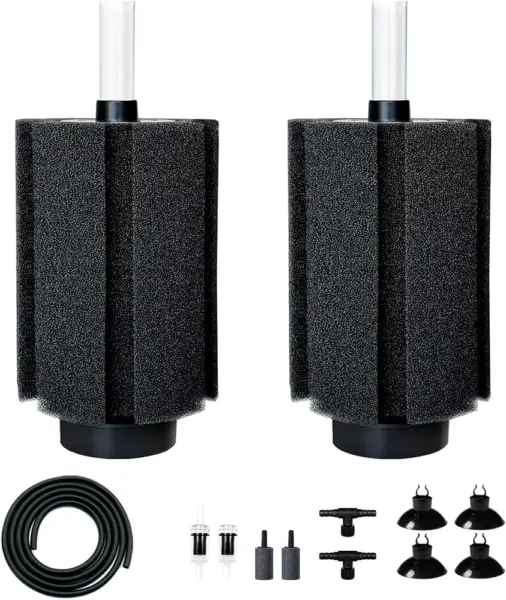
The box is more generous than you expect at this price: two large sponge filters, a bag of ceramic media balls, eight feet of airline, four suction cups, two check valves and two air stones. The air pump is not included, and that is the one thing to settle before you order.
For a 100-gallon these are biological support, not the whole filtration system. We treat a pair like this as the safety net on a big tank: one at each end, seeded with the ceramic media, quietly doing the ammonia work while the canister handles the debris. It is the simplest redundancy you can add — if the canister dies, the tank does not.
Two quirks. The sponges float until they are fully waterlogged, so squeeze them through in a bucket of tank water before they go in. And the supplied airline can slip off the fittings, so push it on hard or add a clip; a check valve at the pump end protects you either way.
Running cost is the quiet win: no cartridges, no pads, just a rinse in water you have siphoned out during a water change. On a tank this size, that adds up to real money over a year without anything extra to buy.
Pros
- Two large sponges for both ends
- Comes with airline, stones and check valves
- No cartridges to keep buying
Cons
- Needs a separate air pump
- Sponges float until waterlogged
We treat the DVHEY pair as biological insurance on a 100-gallon rather than the only filter, and two large sponges with media and airline make that an easy yes.
How We Tested 100-Gallon Tank Filters
I started with filters rated for 100-gallon tanks from brands I already trust and cross-checked current owner reviews for repeated complaints about leaks, dead impellers, and weak flow. I ruled out models with hard-to-source media or canisters too small to hold a useful amount of filtration, then narrowed by price, footprint, and whether the intake and return fit a standard cabinet. That left 11 units, which we rotated through two 100-gallon tanks and one 125-gallon system over seven months.
Each filter went through the same rhythm: a Saturday morning water change, a midweek feeding check, and a quiet-hour listen from the couch after the house settled. We measured return flow with a bucket and stopwatch after the media was loaded and again at six weeks, watched whether the spray bar still reached the far end, and noted any dead spots. We lined the cabinet with paper towels before startup and after every cleaning to catch drips, then inspected seals, hose connections, and the impeller housing for wear. A watt meter tracked power draw, and we unplugged each unit to see how easily it restarted.
During cleanings, we timed how long it took to lift out the trays, rinse the media, and reseat the lid; counted how much sludge collected in the first stage; and noted whether media needed replacing or just rinsing. Twice a week we checked water clarity against a white card and logged ammonia and nitrite levels. At the end, we added up replacement media and parts costs and compared what came in the box.
How to Choose a Filter for a 100-Gallon Tank
At 100 gallons the filter’s real job is turnover and media volume, and the gallon figure printed on the box tells you less about either than the marketing suggests.
Turnover is the number that matters
A filter has to move the whole tank volume several times an hour to keep waste in suspension where the media can reach it. On a 100-gallon tank that means looking past the gallon rating to the flow figure, and being skeptical of anything rated to exactly 100 gallons: at that ceiling, media loading and hose height eat whatever margin was left. The Fluval 407 quotes 1,450 liters per hour; the Cascade 1000 quotes 265 gallons per hour. Both claim 100 gallons. They are not the same filter.
If your tank is heavily stocked, or holds goldfish, cichlids or turtles, aim well above the rating or plan on running two filters. The gallon number is a marketing ceiling, not a comfortable working range.
Canister, hang-on-back, or in-tank
Canisters win on media volume and keep everything out of sight, but they need cabinet space, hose runs, and a willingness to carry a heavy box to the sink. Hang-on-backs are cheaper and simpler, and a big one like the Tidal 110 will carry a 100-gallon tank, but you need clearance behind the glass and they are the noisiest type once an impeller gets grumpy.
In-tank filters need no hoses and no cabinet, and the Atlantis Aqua proves they can run near-silent. They pay for it with tank space and a smaller media load, which bites hardest on exactly the tank size you are shopping for.
Buy for the media, not the cartridges
A filter is a box for holding media. The ones worth buying let you fill that box with foam, ceramic rings or a bag of carbon rather than locking you into a proprietary cartridge that costs money every month and gets thrown away with the bacteria still on it.
Check what ships in the box, too. Some arrive with a full media set, some with a starter amount, and reusable sponges outlast pads by a wide margin. Over a few years on a big tank, that difference is the second price of the filter.
Match the current to your fish
More flow is not automatically better. Long-finned fish, discus and anything from still water will spend the day being shoved around by a pump doing exactly what it advertises. The coospider’s 300 gallons per hour is thrilling in a messy cichlid tank and miserable in a quiet community.
Look for adjustable flow, and check where the outlet points before blaming the filter. Aim it along the surface or into a rock and the tank settles without losing circulation.
Noise, seals, and where it lives
Two things decide whether you keep a filter for years: how loud it runs and what happens when a seal goes. Canisters can weep where the housing meets the pump, hang-on-backs rattle when air reaches the impeller, and air-driven sponges gurgle. None of that rules out a type, but it should shape where you put it.
Set any canister on a tray or a hard floor near a drain, keep a spare O-ring, and check the seal every time you reconnect the hoses. A 100-gallon tank holds a lot of water, and the filter is the piece most likely to let it out.
Frequently Asked Questions
Do I need a separate air pump for a sponge filter?
Yes. Sponge filters are air-driven: a pump pushes bubbles up the lift tube and that upward flow pulls tank water through the sponge. No pump, no filtration, however large the sponge looks in the listing.
Buy a pump rated for the depth of your tank and put a check valve in the line so water cannot siphon back when it stops. The DVHEY kit includes airline, stones and check valves, but not the pump.
Can I run two smaller filters instead of one big one on a 100-gallon tank?
Yes, and a lot of big tanks run better that way. Two units at opposite ends even out circulation and leave you a spare if one fails, which is the difference between a bad afternoon and a dead tank.
The usual pairing is a canister for mechanical and biological load plus a sponge or two for backup. Run both from the start so the second filter is cycled before you need it.
Does cleaning the filter wipe out the beneficial bacteria?
Not if you rinse the media in water you took out of the tank during a water change. Tap water and a hot rinse are what knock the colony back; tank water and a gentle squeeze are fine.
Clean half the media at a time and never replace every sponge in one go, so there is always a seeded surface left behind to restart the cycle.
Final Verdict
Our default for a 100-gallon tank is the Fluval 407: the most flow, the quietest pump and the easiest media access in this group, with a base seal that deserves a tray under it. It is the filter that leaves you room to stock the tank properly.
If the budget is tighter and the fish are calm, the Cascade 1000 does the same visible work for far less. If there is no cabinet behind the tank, hang the Tidal 110 on the back and stop worrying about hoses.