This post contains affiliate links. We may earn a small commission when you buy through our links — at no extra cost to you.
Filter manufacturers often advertise flow rates based on empty chambers—but once you add media, real-world flow drops significantly. A filter rated for 100 gallons may struggle to keep a 75-gallon tank clear. This guide cuts through the numbers to focus on what actually works.
Canister filters offer higher media capacity and quieter operation than hang-on-backs, but require more maintenance and careful sealing. Hang-on-backs are simpler but trade off noise and media space. Internal filters can help with polishing or turtle tanks but rarely suffice as primary filtration.
Choosing the right filter means matching flow rate, filter type, and durability to your specific setup—whether that’s a planted community tank, a cichlid bioload, or a turtle habitat. The picks below reflect real use, not marketing specs.
Top Picks
Best for Quiet High-Flow
Fluval 407 Canister

Rating: 4.5 ★ | Price: Premium | Flow Rate: 383 GPH | Filter Type: Canister
The Fluval 407 pushes 383 GPH of water with a noise profile that stays unobtrusive even in a living room setting, and the EZ-Lift baskets let you swap media without disconnecting hoses. Real-world throughput is sufficient to keep a 75-gallon tank clear, though actual flow drops once media loads up — normal for any canister.
This is the right pick for aquarists who don’t mind spending a few minutes on preventive maintenance — specifically lubricating the o-ring and ensuring the clamp is fully seated during setup. Those who can’t tolerate any chance of water on the floor should look elsewhere, as seal leaks have occurred when assembly is rushed. Motor durability has also been noted as a point of variance, so buying from a retailer with a good return policy is wise.
Pros
- Operates quietly enough for a living room or bedroom
- Keeps water crystal clear with three-stack media setup
- Media baskets pop out easily without tools for quick cleaning
Cons
- Motor longevity can vary between units; some have needed replacement within months
- Premium price sits above many canisters with similar flow ratings
Best for aquarists who prioritize quiet, high-flow filtration and are comfortable with periodic o-ring maintenance.
Best for Budget Canister
Penn-Plax Cascade 1000

Rating: 4.3 ★ | Price: Mid-Range | Flow Rate: 265 GPH | Filter Type: Canister
The Cascade 1000 matches the top pick’s ability to maintain clear water in a 75-gallon tank, but trades higher flow and brand consistency for a significantly lower price. Setup is quick with push-button priming and stacked media baskets, and the pump runs quietly enough for most living rooms. However, build quality can vary — some units may develop cracks or pump failures, so buying with a flexible return window is advisable. For beginners or those on a tight budget, this tradeoff is often worth the savings.
Pros
- Quiet operation for an external filter
- Easy push-button priming and straightforward assembly
- Costs roughly half the price of premium canisters with similar filtration quality
Cons
- In very quiet rooms, the pump may produce a faint hum or occasional rattle — less noticeable in a living area
The Cascade 1000 is the right call for budget-focused aquarists who prioritize low upfront cost and straightforward operation over absolute long-term consistency.
Best for Heavy Bioloads
Fluval FX4 Canister
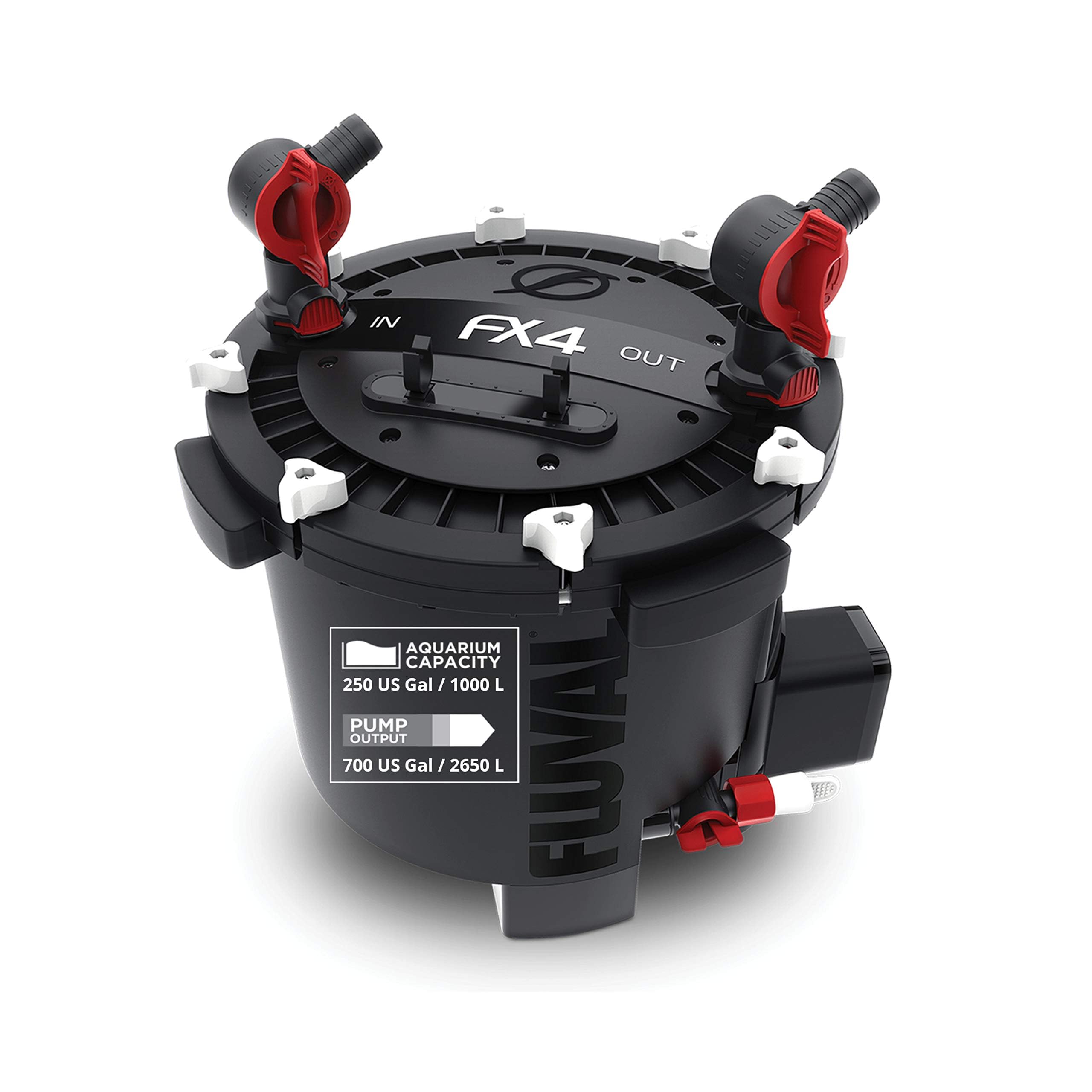
Rating: 4.5 ★ | Price: Luxury | Flow Rate: 700 GPH | Filter Type: Canister
The FX4 delivers 700 GPH flow and a full gallon of media capacity, making it the go-to choice for cichlid or turtle tanks with heavy bioloads. That raw power comes with a larger footprint – the canister may not fit under standard stands, and motor consistency has shown variation across units. This filter is best suited for aquarists who prioritize flow over space savings and are comfortable with occasional maintenance surprises.
Pros
- Extremely powerful flow for large, heavily stocked tanks
- Quiet operation even at high flow rates
- Self-priming pump simplifies startup
Cons
- Bulky dimensions may not fit under standard cabinet stands
- Motor reliability can vary – some units may lose prime or require early attention
The FX4 is the right call for large, heavily stocked tanks where maximum flow and media volume are non-negotiable – just confirm your stand has room.
Best for High-Capacity Hob
Seachem Tidal 110

Rating: 4.4 ★ | Price: Mid-Range | Flow Rate: ~400 GPH | Filter Type: Hang-on-Back
The Tidal 110’s large removable media tray rivals canisters, while its self-priming pump restarts after cleaning without manual filling. Flow is adjustable for planted tanks and delicate fish. This HOB suits hobbyists who value media volume and convenience over near-silent operation—impeller or skimmer noise may be present. The integrated skimmer clears surface film but can trap small fish or shrimp, so it’s best for larger inhabitants.
Pros
- Removable media tray fits extensive custom media alongside included sponges.
- Self-priming pump allows lift-out basket cleaning without restart issues.
- Adjustable flow rate accommodates delicate fish or planted CO2 setups.
Cons
- In quiet rooms, impeller rattling or skimmer air noise may be noticeable.
- Surface skimmer intake can trap small fish or shrimp.
A strong HOB option for those prioritizing media capacity and easy maintenance, with clear tradeoffs in noise and intake safety.
Best for Turtle Tanks
TARARIUM Turtle Filter

Rating: 4.3 ★ | Price: Budget | Flow Rate: 290 GPH | Filter Type: Internal/Submersible
This filter runs quietly and keeps turtle tanks clean by handling waste effectively, even at water levels as low as 2.6 inches. Flow is adjustable, and disassembly for cleaning is quick. The main trade-off comes from the suction cups: they can lose grip over time, so the filter may fall off glass if not secured with additional methods.
Best suited for turtle setups where low water level is a requirement and the owner is willing to mount the filter with extra support (e.g., zip ties or a custom bracket). It is not designed as a primary filter for a 75-gallon fish tank – the flow (290 GPH) and intended use case don’t match the higher circulation needs of a standard community or cichlid aquarium.
Pros
- Operates in very low water (2.6 inches) – ideal for turtle tanks with partial water changes
- Quiet operation and quick disassembly for cleaning
- Adjustable flow rate lets you dial down current for smaller turtles
Cons
- Suction cups may lose grip over time, potentially causing the filter to fall off the glass
- Some units may experience motor stoppage within months of use
A capable, quiet filter for turtle keepers who work around the weak suction cups – skip this if you need a full-flow solution for a 75-gallon fish tank.
Best for Small Tanks
TARARIUM Internal Filter

Rating: 4.5 ★ | Price: Budget | Flow Rate: 290 GPH | Filter Type: Internal/Submersible
This submersible filter runs quietly and makes media changes simple thanks to the top-lid access. At 290 GPH, it handles waste well in tanks under 40 gallons but lacks the flow needed as a primary filter for a 75-gallon setup. Some units have experienced motor issues, so it’s most practical as a supplementary filter or for smaller turtle tanks.
Pros
- Near-silent operation when fully submerged.
- Easy media access via top lid simplifies cleaning.
Cons
- Insufficient flow as a standalone filter for a 75-gallon tank.
A budget-friendly option for a 20–40 gallon turtle tank or as a supplemental filter in larger aquariums where primary filtration is already handled.
Best for Entry-Level Hob
Aqueon QuietFlow 75

Rating: 4.2 ★ | Price: Budget | Filter Type: Hang-on-Back
The QuietFlow 75 is simple to set up and moves water effectively, keeping cartridge costs low. However, the motor may stop working within the first year, and the audible water flow and pump hum will be noticeable in quiet rooms. This makes it a reasonable fit for hobbyists who prefer an entry-level filter they can replace annually, or for temporary quarantine tanks.
Pros
- Quick assembly and easy cartridge changes
- Good water movement for its price tier
Cons
- Motor may stop working within the first year
A budget-friendly HOB for beginners who don’t mind replacing the filter annually, or for temporary setups where long-term reliability isn’t critical.
Best for Turtle Tanks
Coospider Internal Filter

Rating: 4.3 ★ | Price: Budget | Flow Rate: 300 GPH | Filter Type: Internal/Submersible
This internal filter provides strong flow and quiet operation at a budget price. The 300 GPH output and venturi create substantial water movement, but the current is not adjustable and can stress small fish. Motor longevity may not support long-term use, so it suits turtle tanks or temporary high-flow applications rather than as a primary filter for a 75-gallon community tank.
Pros
- Delivers strong water movement for its compact size
- Runs quietly when fully submerged
Cons
- Flow output is fixed with no adjustment for different tank inhabitants
A cost-effective option for turtle tanks or as a secondary pump, but not intended for continuous use as a primary filter in a 75-gallon community aquarium.
Best for Supplemental Use
AquaMiracle Internal

Rating: 4.2 ★ | Price: Budget | Flow Rate: 300 GPH | Filter Type: Internal/Submersible
This filter is budget-friendly and easy to clean, with three-stage sponge media that rinses out quickly. Motor reliability can be inconsistent – some units may cease operation within weeks. That makes it a practical option only as a supplemental filter or for small tanks where losing filtration is less critical.
Pros
- Sponge media rinses clean with minimal effort
- Very low price for a functional three-stage filter
Cons
- Motor can cease operation within weeks of use
Use this as a backup or for a small quarantine tank – not as the sole filter on a 75-gallon setup.
Best for Water Polishing
Marineland Magnum Polishing

Rating: 4.1 ★ | Price: Mid-Range | Flow Rate: 290 GPH | Filter Type: Internal Canister
This internal canister excels at removing fine particles, producing crystal-clear water after a polishing session. Noise rises as the micron cartridge loads up, and continuous daily use can shorten its lifespan. It works best as a supplemental tool for periodic clarity boosts rather than the primary filter for a 75-gallon setup.
Pros
- Removes fine particles quickly for noticeably clearer water
- Runs quietly when the cartridge is clean
Cons
- Gets noticeably louder as the cartridge loads up with debris
Keep this on hand for weekly or post-water-change polishing sessions to get sparkly water without relying on it as a daily filter.
Best for Budget Uv Canister
PONDFORSE Canister
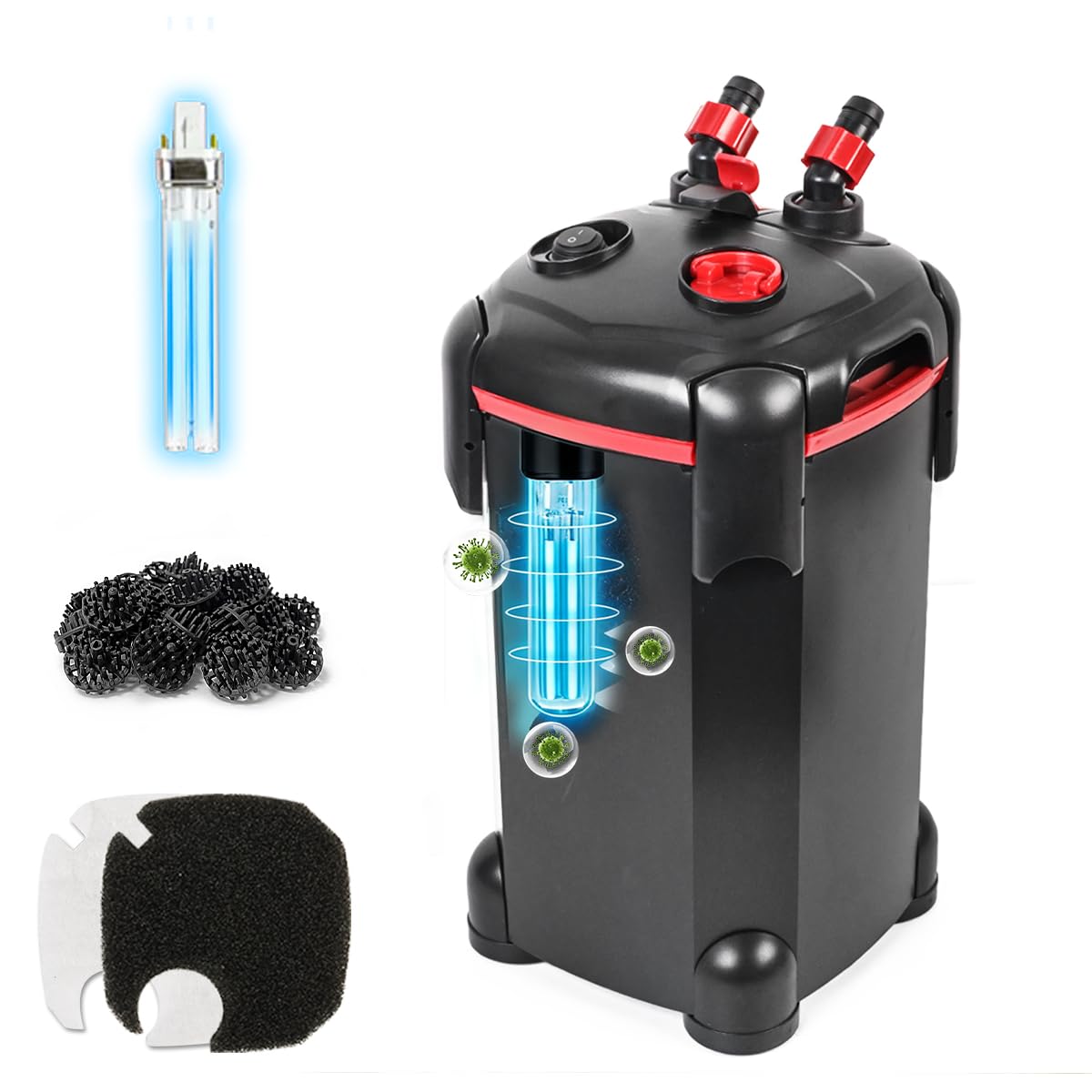
Rating: 4.1 ★ | Price: Budget | Flow Rate: 264 GPH | Filter Type: Canister
Quiet operation and easy setup at a budget price — a tempting canister for 75-gallon tanks, but best reserved for temporary use or as a secondary filter.
Pros
- Quiet operation with vibration-dampening rubber feet.
- Beginner-friendly priming simplifies first-time setup.
Cons
- May lose prime over time; UV bulb has been noted to fail within a couple of months and may not be replaceable.
A fitting choice for temporary setups or hobbyists on a tight budget who can monitor performance closely.
Best for Maintenance Ease
Marineland Magniflow

Rating: 4.1 ★ | Price: Premium | Flow Rate: 360 GPH | Filter Type: Canister
The quick-release valve block on the Marineland Magniflow delivers truly spill-free filter maintenance. Yet premature motor wear has been noted in some units, making this a high-risk choice for a 75-gallon tank despite the premium price.
Pros
- Quick-release valve block for spill-free cleaning.
- Runs quietly when properly assembled.
Cons
- Seal leaks can occur, requiring periodic o-ring inspection.
Worth considering only for Marineland loyalists who value the quick-release convenience and are prepared to manage seal and motor upkeep.
How to Choose
Real-world flow rates are often 30-50% lower than advertised due to filter media resistance, so always size up one tier for adequate turnover.
Flow Rate (GPH)
Aim for 5-10 times the tank volume per hour—so 375 to 750 GPH for a 75-gallon tank. That target applies to the filter’s output with media installed, not the empty pump rating. A filter rated at 400 GPH may deliver only 250-300 GPH once loaded with sponges, ceramic rings, and carbon.
Overestimating flow leads to insufficient turnover, cloudiness, and ammonia spikes. Underestimating flow creates a strong current that can stress small fish or uproot plants. Match the filter’s real-world output to your bioload: heavy stockers like cichlids or turtles need the upper end of that range.
Filter Type
Canister filters sit outside the tank, offer the largest media volume, and are quietest when sealed properly. They require hose connections and regular o-ring lubrication to prevent leaks. Hang-on-back filters install over the rim and are easier to maintain, but their media capacity is limited and noise from falling water can be noticeable.
Internal/submersible filters sit inside the tank and take up space, but work well for turtle tanks with low water levels or as supplementary polishing units. For a 75-gallon primary filter, a canister or a high-capacity HOB like the Seachem Tidal 110 is the practical choice.
Ease of Maintenance
Quick-release valves on canisters let you disconnect the filter without shutting off hoses—a major time saver. Media baskets that lift out individually (like the Fluval 407’s EZ-Lift) allow you to replace or rinse media without emptying the entire canister. HOB filters typically require pulling out a cartridge or basket, which is quicker but often messier.
Self-priming filters automatically expel air and start pumping after maintenance, avoiding the need to manually fill the canister. Models without self-priming can be frustrating to restart after cleaning, especially if the motor loses prime.
Noise Level
Canister filters are inherently quieter because the pump is submerged and vibrations are dampened by the cabinet. The main noise source from a canister is air trapped in the impeller—which usually clears after priming. HOB filters produce water falling back into the tank and occasional rattling from the impeller housing.
Internal filters can be silent when fully submerged, but any exposed parts create splashing. For living spaces, a canister like the Fluval 407 is a safer bet; if you must use a HOB, place it on a foam pad and ensure the water level is high enough to minimize the waterfall sound.
Media Capacity and Flexibility
More media space means you can run larger quantities of biological media (ceramic rings, bio-balls) and tailor chemical media (carbon, phosphate removers) to your water chemistry. Canisters with multiple baskets let you layer mechanical (sponge), chemical (carbon), and biological media independently.
HOB filters often force you into proprietary cartridges that combine media, limiting flexibility. If you want to customize your filtration—for example, adding extra ceramic media for a heavily stocked tank—a canister with stackable baskets is the way to go.
FAQ
How many GPH do I need for a 75 gallon aquarium?
Target 5-10 times the tank volume per hour, so 375 to 750 GPH of real-world flow. Since media reduces pump output by 30-50%, choose a filter rated for 500-900 GPH empty. For a standard community tank, around 400 GPH actual flow works; for cichlids or turtles, aim for 600 GPH or more.
Canister filter vs HOB for a 75 gallon planted tank?
A canister is often better for planted tanks because it doesn’t disturb the water surface as much, preserving CO2 levels. Canisters also offer more media space for biological filtration and can be placed lower for quieter operation. A high-capacity HOB like the Seachem Tidal 110 can work if you adjust the flow downward to avoid uprooting plants.
Why does my aquarium filter make rattling noise after a few weeks?
Rattling usually comes from trapped air in the impeller chamber or a dirty impeller. For canisters, tilt the filter to release air pockets; for HOBs, check the impeller shaft for debris and clean it. If the noise persists, the impeller or bearing may be worn—replacements are often cheap. Do not ignore it, as prolonged rattling can damage the motor.
Is a UV filter necessary for a 75 gallon freshwater tank?
No, a UV clarifier is only needed to control persistent algae blooms, not for day-to-day filtration. It does not remove ammonia, nitrite, or solid waste. If you have green water, a UV can clear it within days, but it should supplement a canister or HOB—not replace it. For most freshwater setups, skip the UV and invest in better mechanical/biological filtration.