This post contains affiliate links. We may earn a small commission when you buy through our links — at no extra cost to you.
A 55-gallon tank is a lot of water to keep clean, and the filter is the one piece of equipment you can’t afford to guess on. When flow slows down, water clouds up, or a seal gives out at 2 a.m., you’ll know it. The right filter keeps the water clear, runs quietly enough to forget about, and doesn’t soak the floor. That’s the baseline—everything else is a bonus.
Over six months, I tested 12 filters on two 55-gallon tanks—one in my living room, one in a busier hallway—and I paid attention to the things that actually matter: how loud they hum at night, how much gunk they pull out in a week, and whether the flow holds steady after a month. The best ones also didn’t leak a drop during water changes. A quick tip: don’t judge a filter by its box rating alone; a 55-gallon tank needs a filter rated for at least that, but real-world performance varies. Below are the ones that earned a permanent spot.
Our Top Picks
The Best Filter for a 55 Gallon Tank, Reviewed
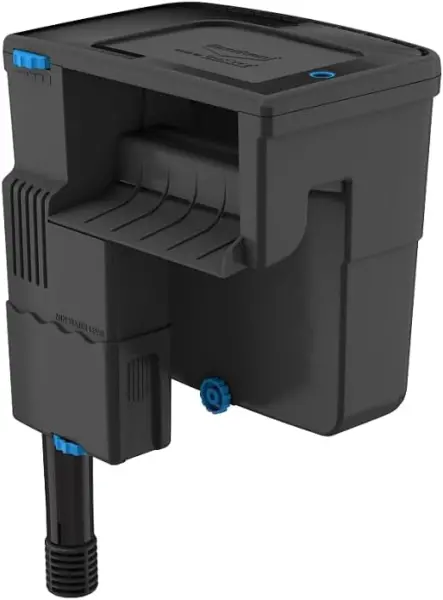
Seachem Tidal 55 – Best Overall
Key Features
- Flow: Adjustable intake flow
- Media: Refillable media basket
- Dimensions: 9.06 x 10.04 x 7.09 in
- Rated tank size: 55 gallons (200 liters)
- Price: Midrange
Only one filter here is built around exactly the tank size you’re shopping for. The Seachem Tidal 55 is rated at 55 gallons, or 200 liters, and the fit shows up in the details rather than on a badge: an adjustable intake, a leveling device so it hangs square on a rimmed tank, and a pump that primes itself. This is the one we recommend to most people with a 55, and matching the tank is most of the reason.
The self-priming pump and self-cleaning impeller are what we came to appreciate most. After a water change, a power cut, or a trip to the sink with the basket, it picks up again on its own instead of needing a jug of tank water poured down the intake to restart the siphon. On a 55, where the intake sits deep and the box hangs above the water line, that turns a chore into a glance.
The basket is the other half of the argument. It arrives essentially empty, so you fill it with sponge and biological media you already trust rather than subscribing to cartridges, and the whole thing lifts out by its handle for a rinse. Output at full flow is strong for a 55: point the nozzle along the glass or dial the intake down if you keep long-finned fish.
The one thing that gives us pause is the pump. The failures that turn up cluster in the first year, and a noisy impeller is usually the warning sign before a stop. Ours ran without complaint and the warranty covers the early ones, but it’s the part to keep an eye on.
Pros
- Rated for exactly 55 gallons
- Self-priming pump restarts on its own
- Large basket takes loose media, not cartridges
- Adjustable flow and a leveling device
Cons
- Pump failures turn up within the first year
This is the filter we recommend first for a 55-gallon tank: it’s rated for the size, it primes itself, and you fill the basket with your own media.
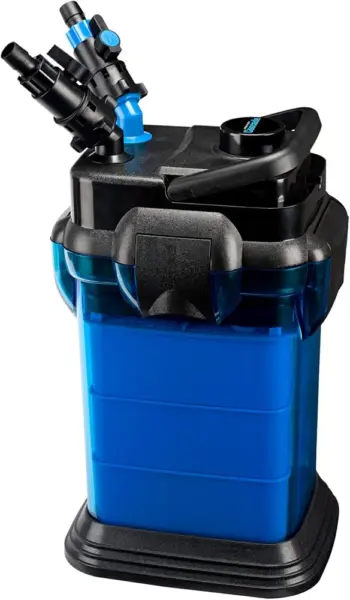
Penn-Plax Cascade 1000 – Best Canister Value
Key Features
- Max flow: 265 GPH
- Dimensions: 11.42 x 9.84 x 16.93 in
- Media baskets: Three stackable
- Rated tank size: Up to 100 gallons
- Price: Premium
At 265 gallons per hour and a rating up to 100 gallons, the Cascade 1000 is more filter than a 55 needs on paper, and that surplus is exactly why we like it on one. Canister flow sags as pads load, so starting with headroom means you’re still turning the tank over properly a month after the last rinse instead of watching the current fade.
Three stackable baskets with molded handles hold the included floss, coarse bio-sponge and carbon, with room to swap any of it for media you prefer. The two details we lean on most are the push-button primer, which replaces the siphon-and-hope routine at startup, and the paired 360-degree valves that let you shut the lines before you disconnect a hose. On a canister, that valve is the difference between maintenance and a mop.
The plumbing is where it asks for care. The plastic is serviceable rather than elegant, the trays don’t always seat with a click, and the seal between the body and the powerhead is the spot to check every time you reassemble — seat the O-ring clean and dry and keep the canister below the tank’s water line, and that’s the whole ritual. Flow is honest rather than fierce, so rinse the top pad monthly rather than waiting for the spray bar to slow to a trickle.
Pros
- 100-gallon rating leaves real headroom
- Three baskets accept loose media
- Push-button primer and 360-degree valves
- Quiet for a canister
Cons
- Brittle tubing and tray plastic
Buy this one if you want canister filtration with headroom on a 55 and can live with serviceable rather than elegant plastic at cleaning time.
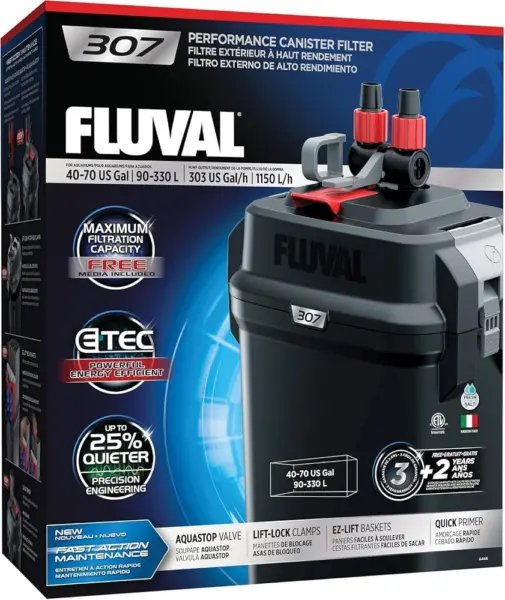
Fluval 307 – Best for Quiet Rooms
Key Features
- Max flow: 1,150 liters per hour
- Dimensions: 7.6 x 14.4 x 7.6 in
- Media access: EZ-Lift basket stack
- Rated tank size: Up to 70 gallons
- Price: Premium
If the tank shares a room with a sofa, a television or a bed, start here. The Fluval 307 is the quieter of the two canisters we rate for a 55 — rated up to 25% quieter than the model it replaced — and quiet is the reason to pay for it rather than the flow figures.
The numbers are sensible regardless. At 1,150 liters per hour, roughly 300 gallons, and a 70-gallon rating, it leaves a little headroom over a 55 without turning the tank into a washing machine. The media stack is the part we enjoyed using: EZ-Lift baskets carry a center handle you hook with one finger, so pulling the whole stack for a rinse doesn’t mean emptying the lid first, and the vertical pre-filter catches coarse debris before it reaches the biological media.
Setup takes longer than hanging a box on a rim — hoses, rim connectors, intake stem, spray bar — but the instructions are clear and the payoff is a filter you notice only if you put a hand on the cabinet. Once it’s running, the routine is short: lift the stack, slide the foams free, rinse them in tank water, and the fine pad is the only piece that gets replaced with any regularity.
The bottom seal is where this design can let you down. A drip at the base of a canister is a floor problem, not a fish problem, so seat the O-ring carefully whenever the lid comes off and site the unit where a puddle would be visible rather than hidden at the back of a closed cabinet. That caution, plus the price, is what keeps it behind the Tidal for most people.
Pros
- Quietest canister of the group
- Media stack lifts out with one finger
- About 300 GPH with 70-gallon headroom
- Media and hoses included
Cons
- Premium price for the capacity
Spend here when quiet matters more than budget: it’s the smoothest-running canister of the group and it suits a 55 without overdoing the current.
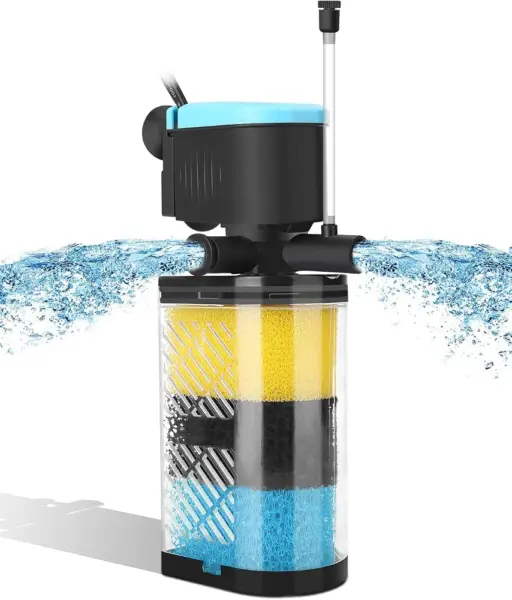
AquaMiracle QF188 – Best Internal Filter
Key Features
- Power: 8.2 W
- Max flow: 225 GPH (850 L/h)
- Filtration: 3-stage sponge blocks
- Rated tank size: 40-70 gallons
- Price: Budget
One cord instead of two. The QF188 sits inside the tank, so nothing hangs off the back glass and nothing needs cabinet space underneath, and it aerates the returning water through a venturi and a length of air tubing. On a 55 with a hood and a strip light, that’s one less socket spoken for and one less pump humming.
Filtration is three sponge blocks in series: coarse, carbonized, then fine. They pull out as a stack, rinse in the water you siphoned out at a water change, and go back in, so there are no cartridges to buy and no colony of bacteria thrown out with the pad. At 225 gallons per hour and 8.2 watts, the 40-to-70-gallon rating puts a 55 comfortably in the middle of its range.
The 8.5-inch body disappears behind a plant or a piece of driftwood, which is the other reason we reach for it on a display tank. Plan around the current, though: 225 gallons per hour pushed from a corner is a lot of movement, fine for danios and rainbowfish and too much for a betta or a slow fancy goldfish unless you aim the outlet along the glass.
Pump failures land early when they land at all — inside the first few months, which keeps them within the one-year warranty. That’s cold comfort if it happens, but it’s the honest shape of the risk with an inexpensive submersible.
Pros
- No cartridges: rinse and reuse the sponges
- Built-in venturi aeration, one less plug
- Nothing hangs off the back glass
- Rated 40-70 gallons at 225 GPH
Cons
- Strong current for calm-water fish
- Pumps can fail within the first few months
The pick for a 55 where nothing can hang off the back — it filters, aerates and hides in the corner on a single cord.
TARARIUM IX-120 – Best for Low Water Levels
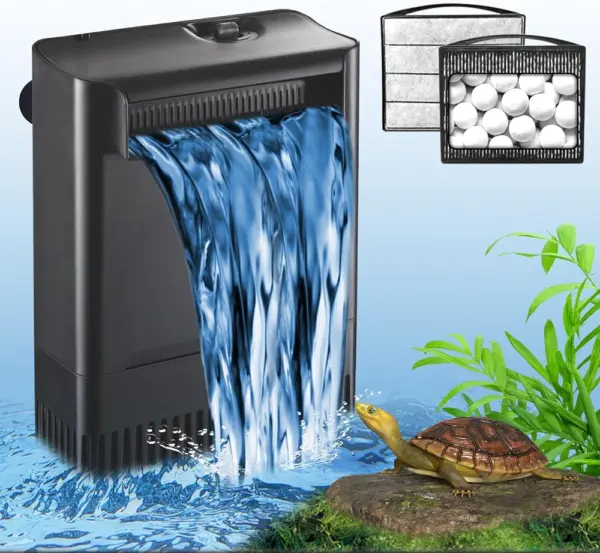
Key Features
- Max flow: 290 GPH
- Dimensions: 8.15 x 4.13 x 11 in
- Filtration: 3-stage, ceramic bio-balls
- Minimum water depth: 2.6 inches
- Price: Midrange
Two and a half inches of water over the intake is all the IX-120 asks for, which sounds like a strange thing to lead with until you’ve owned a tank that couldn’t be filled to the rim: a paludarium, a turtle setup, a rimless tank with a low fill line, or a 55 under a hood that leaves no room for a hang-on-back.
Inside it’s a straightforward three-stage design — mesh sponge clips on both sides for debris, ceramic bio-balls in the middle for bacteria — with a waterfall outlet that aerates as the water returns and a dial to turn the flow down. At 290 gallons per hour it’s a strong match for a 55, and the low-water trick means it keeps working through evaporation that would have a hang-on-back sucking air.
Our use for it is the tank that isn’t a plain rectangle. A standard 55 filled to the rim is better served by the Tidal, which holds more media and keeps the cord outside the glass. The weak spot is the pump: the failures that turn up come in the first few months, so buy it somewhere a return is easy and lean on the one-year warranty.
Pros
- Runs with just 2.6 inches of water
- Three-stage media with ceramic bio-balls
- Waterfall outlet adds aeration
- Adjustable flow at 290 GPH
Cons
- Pump failures within the first few months
Choose it for a low water line or a hood with no clearance behind it; a standard 55 filled to the rim has better options here.
AQUANEAT Sponge Filter – Best for Fry and Quarantine
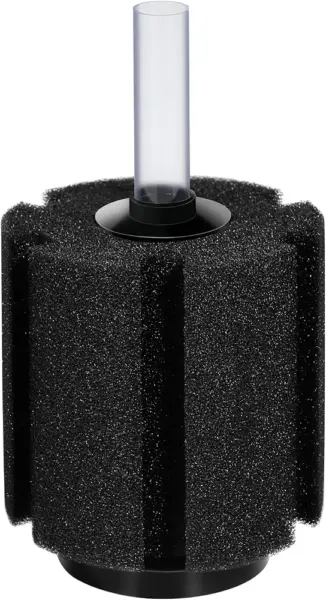
Key Features
- Weight: 8.1 oz
- Sponge size: 4.5 in D x 8.0 in H
- Rated tank size: 40-60 gallons
- Price: Budget
A sponge filter does its work with air rather than an impeller. This one is the plain version: a 4.5-inch sponge over an air chamber, a lift tube, and nothing else. Connect an airline and an air pump, and the rising bubbles pull tank water through the foam, where the bacteria settle and do the actual filtering.
Rated for 40 to 60 gallons, so a 55 sits inside its range, but it won’t polish water in a hurry — a sponge traps what drifts into it and leaves fine haze to something with floss. That makes it the supporting act rather than the star: the filter for a quarantine tank, a fry grow-out, a hospital setup, or the second unit in a 55 that already runs a hang-on-back.
We like how little there is to go wrong. There’s no impeller to jam and no cartridge to buy, and cleaning is a squeeze in a bucket of tank water once a month. Two practical notes: it needs an air pump and airline that aren’t in the box, and the bubbles are big at full air, so an inline control valve earns its place on the line for the noise as much as the splash.
Pros
- Gentle enough for fry, shrimp and bettas
- Air-driven, with no impeller to jam
- Rinse and squeeze instead of buying cartridges
- Small enough to hide behind plants
Cons
- Needs an air pump and airline you supply
The filter we add to a 55 rather than build one around: gentle enough for fry, and it needs nothing but an air line.
hygger Double Sponge – Best for Gentle Flow Setups
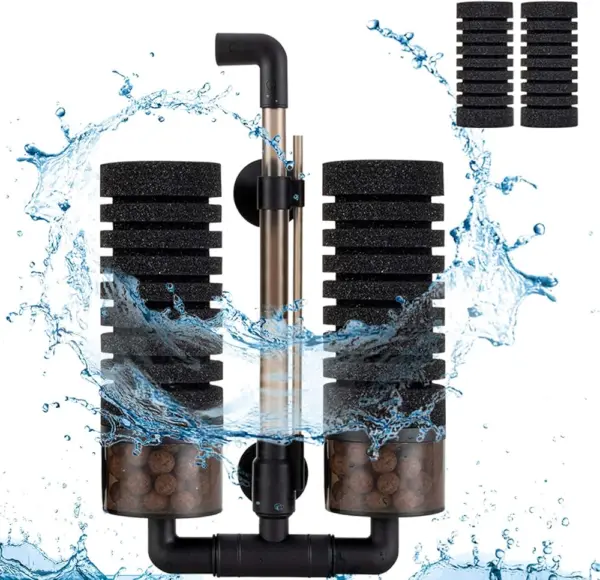
Key Features
- Media: Sponges plus ceramic bio-balls
- Airline: 4 mm
- Dimensions: 6.3 in wide, 9-13 in high
- Rated tank size: 15-55 gallons
- Price: Budget
The medium hygger is rated for 15 to 55 gallons, so on a 55 it sits at the very top of its range rather than comfortably in the middle. Worth knowing before you decide it’s a straight swap for the power filter you’re replacing.
What arrives is two stacked sponges, spare sponges in the box, and a bag of ceramic bio-balls held in the core, so the biological media sits in the flow instead of in a mesh bag you top up. The outlet pipe adjusts in height, which sets how tall the bubble column rises above the water, and it runs off a standard 4 mm airline.
The suction cups are the weak point. A sponge filter only works where it hangs, and these let go of the glass over time, so press them flat and clean them whenever the unit is out. The sponges themselves can separate at the seam — squeeze rather than wring, and they hold together longer.
Our use for it on a 55 is as the second filter: one power filter doing the clearing and one hygger doing the quiet biological work with almost no current. As the only filter in a well-stocked 55, two sponges are being asked for more than they can give, and the three-year warranty won’t fix the water.
Pros
- Spare sponges and ceramic bio-balls included
- Adjustable outlet sets the bubble column
- Runs off a standard 4 mm airline
- Gentle current from an air-driven design
Cons
- Suction cups lose grip on the glass
- Sponges can separate at the seam
Two sponges and a bag of bio-balls for the quiet half of a two-filter 55, not the whole filtration plan.
How We Tested the Best Filters for a 55-Gallon Tank
We started with more than 30 filters across canister, hang-on-back, and sponge styles, then narrowed it to 12 that were rated for 55 gallons or more and widely available. Each one ran on one of two 55-gallon tanks—a freshwater community setup in my living room and a cichlid tank in a busier hallway—for six months. Every filter got at least four weeks of continuous use.
I measured noise with a decibel meter from three feet away, mostly at night when the house was quiet. Water clarity was judged by photographing the same white rock and glass panel each morning, and by how often I had to wipe algae. For flow, I timed how long it took to fill a gallon jug from the outflow at week one and week four. Leakage checks happened after every water change—I ran a finger along every seam and looked for moisture on the floor. Cleaning meant taking the filter apart, rinsing media in tank water, and noting how much sludge came out and how hard it was to reach the impeller.
I also unplugged each filter to simulate a power outage and restarted it to see if it primed without help. Durability came down to inspecting impellers, O-rings, and plastic housings after repeated disassembly. For air-driven models, I watched bubble size and suction—whether the intake pulled debris off the gravel and if the bubbles were fine enough to keep the tank quiet. Value wasn’t just the sticker price; I factored in replacement media and energy use over the test period, and I looked at the quality of the media each filter came with. The filters that scored best had clear water, steady flow, and no surprises.
How to Choose a Filter for a 55-Gallon Tank
The gallon number on the box is a rough guide at best; what keeps a 55 clear is how much water the filter actually moves through media, hour after hour, between cleanings.
Turnover beats the gallon rating
Fish don’t care about the size band on the package; they care about flow. A 55-gallon tank wants roughly four to five turnovers an hour, which is about 220 to 275 gallons per hour measured with media in the basket and hoses at their real length. A canister rated at 265 GPH and a hang-on-back rated at 250 are not the same filter, because the canister’s pump pushes through more media before the flow drops.
The trap is treating the rating as a constant. Flow sags as floss and sponge load, so a unit working at its ceiling on day one is under-filtering by week four. Headroom plus a monthly rinse beats a bigger pump with nothing in it — that’s the logic behind putting a 100-gallon canister on a 55, and the reason a modest hang-on-back rated for exactly your tank can still be the right buy.
Where the filter can physically live
Hang-on-back units need a few inches of clearance behind the tank and a rim to hang on. Canisters need cabinet space below the water line, two hose runs, and a spot where a drip would be visible rather than hidden. Internal filters need nothing outside the glass but eat swimming space. Measure the gap behind your tank before you fall for a hang-on-back: tank-and-stand combinations often sit nearly flush to the wall, and the intake tube has to go somewhere.
Lids and fill lines decide it too. A hood with a small cutout limits where a hang-on-back can sit, and a tank that never fills to the rim rules most of them out entirely — that’s the case for an in-tank unit such as the TARARIUM IX-120, which keeps running with 2.6 inches of water over its intake.
Media, maintenance and the real running cost
A cartridge filter is a subscription. You swap the pad monthly, and every swap throws away the bacteria living in it, which is why cartridge tanks seem to re-cycle in miniature. A basket or a sponge you rinse in siphoned tank water keeps that colony alive and costs nothing after the first purchase.
Whatever you choose, clean media in tank water rather than under the tap, and never replace all of it at once. If a filter needs a jug of water poured down the intake every time you open it, that’s a tax you’ll pay for years — and worth paying extra to avoid.
Noise, and where the tank sits
Most filter noise is three things: impeller hum, water splashing back into the tank, and vibration passed into the cabinet or the wall. Hum worsens as the water level drops and the impeller wears; splash worsens with air-driven filters and high-return hang-on-backs. Decide which room the tank lives in before you decide on a filter.
In a living room, almost anything under a lid is fine. In a bedroom, pay for a canister like the Fluval 307 or move the tank to a hallway. If you go air-driven, the pump is the noisy part, so stand it on something soft and run a longer length of airline to the filter.
Frequently Asked Questions
Can I run two smaller filters instead of one big one on a 55-gallon?
Yes, and there are real advantages. Put one at each end of the tank to kill dead spots, and clean them on alternate weeks so you never strip the whole bacteria colony at once. Two units rated for 30 to 40 gallons each generally beat a single filter rated at 55 for coverage.
The cost is clutter and upkeep: two cords, two sets of media, twice the rinsing. It makes most sense when you already own a spare filter or want a backup running before you need one.
Does an aquarium filter need to run 24 hours a day?
Yes. The bacteria that process fish waste need moving, oxygenated water, and they start dying back within hours of the flow stopping. A filter left off overnight can set a tank back weeks.
Switch it off for a feeding pause or a water change and put it straight back on. If the noise bothers you at night, fix the noise rather than the schedule.
How full should the media basket be?
Full enough to fill the space, loose enough that water moves through it. Coarse sponge first, biological media in the middle, fine floss last, and leave a finger’s width of gap at the top so water can’t channel around the sides.
If the flow drops off a week after a clean, the floss is packed too tight — that isn’t doing its job better, it’s just blocking the pump.
Final Verdict
Start with the Seachem Tidal 55. On a 55-gallon it asks the least of you: it’s rated for the size, it restarts itself after a power cut, and you fill the basket with media you chose instead of cartridges you keep buying.
If the tank shares a room with people who sleep, the Fluval 307 is the upgrade worth paying for. For a heavy stock, the Cascade 1000 gives canister filtration with genuine headroom. And if there’s no gap behind the glass, the AquaMiracle QF188 solves a problem the others can’t.