This post contains affiliate links. We may earn a small commission when you buy through our links — at no extra cost to you.
Cloudy water rarely arrives all at once. It creeps in over a week or two — a haze at feeding time, a film on the glass, a smell when you lift the lid — and by then the filter has been losing ground for a while. A 40-gallon tank is unforgiving that way: the number on the box is a minimum, not a target, and most 40-gallon setups want a filter rated for 50 to 70 gallons. Get that part right and your weekends go back to watching fish instead of chasing algae.
After eight months and 12 filters on 40-gallon tanks, I can tell you the differences show up fast: water clarity between changes, the hum at night, how much of a chore the weekly rinse becomes, whether the impeller still starts quietly in month seven. Nothing here is built for a 200-gallon show tank. These are picks for someone doing their own water changes in a spare room or a family room, and the right one for your setup is somewhere below.
Our Top Picks
The Best Filters for a 40 Gallon Tank, Reviewed
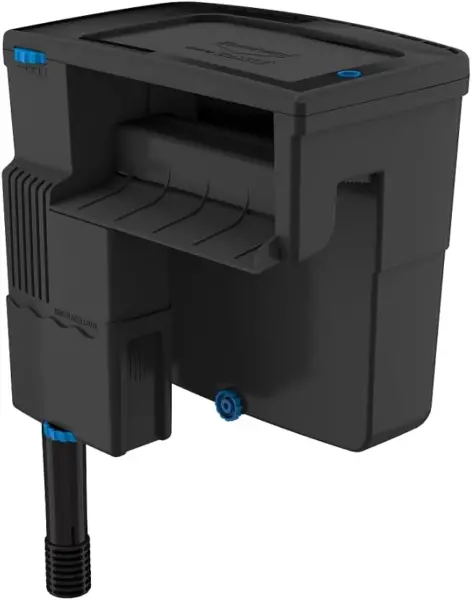
Seachem Tidal 75 – Best Overall
Key Features
- Media: Large loose-media basket
- Flow control: Adjustable
- Rated tank size: 75 gallons
- Surface skimmer: Built in
- Price: Premium
Two features on the Tidal 75 do work that a plain filter box leaves to you: a surface skimmer that pulls the film off the top of the water, and a maintenance monitor that tells you when the media wants rinsing. Under a lid and a light, that film builds up quickly, and skimming it away is the difference between water that looks clean and water that looks still.
That is most of why this is our pick for a 40-gallon. It is rated to 75 gallons, well past what the tank needs, and the flow adjusts from full down to almost nothing, so the headroom never turns into a washing machine for long-finned fish. Set up on a 40, it has capacity in reserve rather than running flat out — and this is the one filter here where the extra size buys media volume rather than just current.
The media basket is the part we kept coming back to. There is no cartridge to buy: you fill it with whatever floss and biological media you prefer, rinse the lot in tank water, and put it back, which keeps the bacteria where they belong. Setup needs no plumbing and no priming, and the basket lifts out for cleaning without the motor losing its pull.
What you give up is space and quiet. The body is listed at six inches deep and fifteen inches tall, which is a lot of real estate behind a 40 if the stand sits against the wall, and the impeller can rattle for the first few days before it settles. Measure the gap before you order, then keep the water level high — that one habit is what keeps this filter quiet.
Pros
- Adjustable flow from full to a trickle
- Built-in surface skimmer clears film
- Large basket takes loose media, no cartridges
- Maintenance monitor prompts a rinse
Cons
- Big body needs rear clearance
- Can rattle until the impeller settles
This is our pick for a stocked 40-gallon: dial the flow to suit the fish, skim the surface, and never buy a cartridge again.
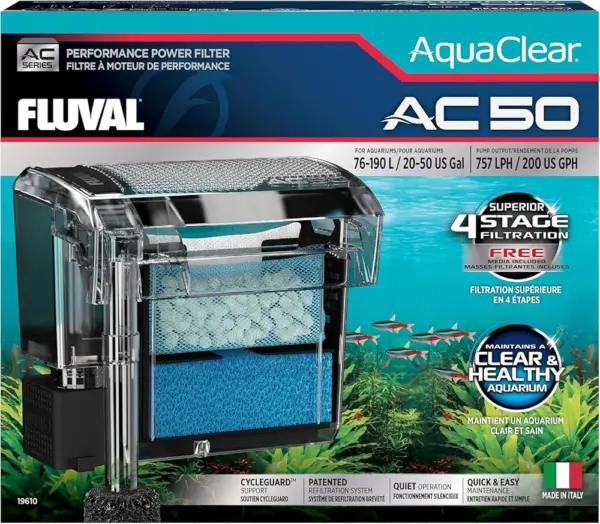
Fluval AquaClear 50 – Best for Custom Media
Key Features
- Warranty: 2 years
- Installation: Hang on back
- Media included: Foam, carbon, BioMax
- Rated tank size: 20–50 gallons
- Price: Premium
If the top pick’s outlay is the sticking point, the AquaClear 50 gets you most of the same cartridge-free idea for less. It is rated for 20 to 50 gallons, arrives with foam, activated carbon and BioMax already stacked in the basket, and the media volume is listed at up to seven times that of a comparable cartridge filter. On a 40 that margin shows: there is room for a proper biological layer and floss on top of it.
The foam block is the part that earns its keep. Squeeze it out in a bucket of tank water every couple of weeks, put it back, and the colony survives; only the carbon goes on a replacement schedule. We liked being able to buy a bag of loose media rather than a stack of brand-name pads, and the two-year guarantee is the longest cover in this group short of Aqueon’s lifetime terms.
Two things to know. It hums — not a rattle, more a low pump note you notice in a quiet room — and it gets louder as the level drops below the outflow lip. The other is the motor: failures in this line tend to arrive within the first few months, which is precisely when the guarantee is still in force, so buy it somewhere that handles returns without a fight.
Pros
- Reusable foam keeps its bacteria
- Up to seven times the media volume
- Two-year guarantee on the motor
- Quick setup with no priming hassle
Cons
- Audible hum in a quiet room
We recommend it to anyone who wants a big reusable media stack and the reassurance of a two-year guarantee on the motor.
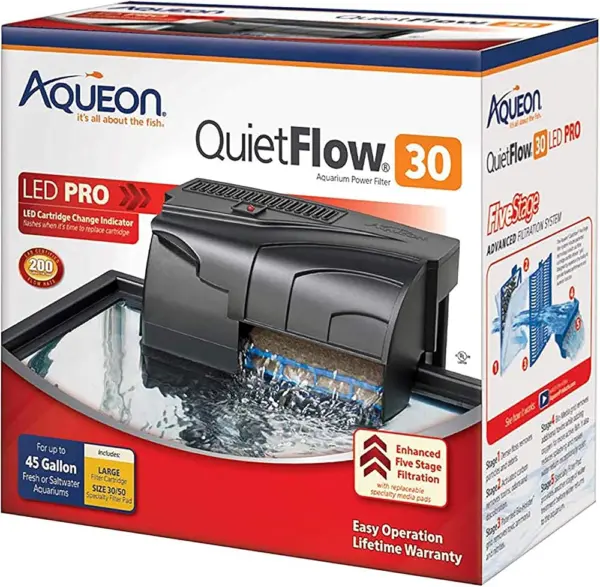
Aqueon QuietFlow 30 LED PRO – Best Cartridge Filter
Key Features
- Priming: Self-priming
- Warranty: Limited lifetime
- Cartridge alert: LED indicator
- Rated tank size: Up to 45 gallons
- Price: Midrange
A small light on the front of the QuietFlow 30 flashes when the cartridge clogs. It sounds like a gimmick until you have spent a week wondering why the outflow slowed and then found a matted pad in the box. Monitoring actual water level is a better trigger than a calendar reminder, and it is the sort of detail that quietly removes a chore from the hobby.
The rest of the design is sensible in the same understated way. The pump sits inside the housing rather than hanging off the back, which damps noise and takes a seal out of the water’s path. It self-primes, so a power cut or a cleaning session does not leave you sucking on a tube to restart it. Aqueon rates it to 45 gallons, which leaves a 40 a little headroom rather than running it at the ceiling.
Put together, it is the friendliest cartridge filter to live with on a 40-gallon, and the one we suggest when someone wants a filter they never have to think about. The trade is the cartridge habit: that pad is your entire mechanical stage, so a fresh one every month is the price of the simplicity.
Noise is the other variable, and it varies between units rather than between settings. Ours was a low hum with a splash over it, but a bad impeller or a loose lid announces itself as a rattle. If that happens in the first week, swap the unit rather than living with it — the limited lifetime warranty exists for exactly that.
Pros
- LED tells you when the cartridge clogs
- Self-primes after power cuts
- Internal pump damps noise and leaks
- Rated to 45 gallons for headroom
Cons
- Monthly cartridges are a standing cost
- No reusable-media option as stocked
For anyone who wants to drop in a cartridge and forget it, this is the easiest 40-gallon filter we handled.
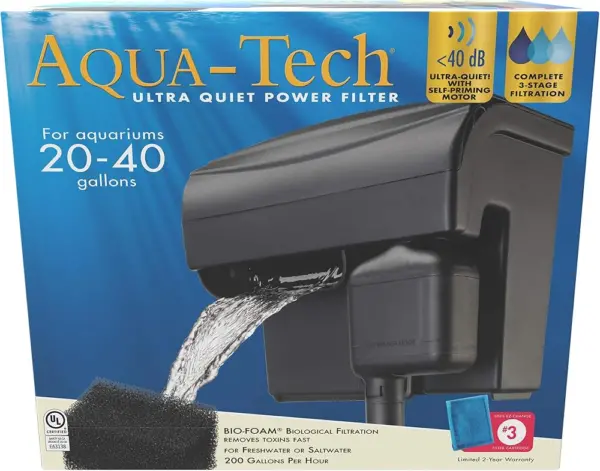
Aqua-Tech Ultra Quiet 20–40 – Best Budget Hang-On-Back
Key Features
- Media: Bio-Foam plus cartridge
- Turnover: 5 times per hour
- Noise rating: Under 40 dB
- Rated tank size: 20–40 gallons
- Price: Budget
The box says under 40 decibels, and the number is worth reading carefully. It describes a decoupled motor in a housing with dampeners, not a promise about your living room. What we noticed is that nearly all the noise is water — the splash of the outflow — and it settles to a murmur once the level sits near the lip.
Its figures suit a 40 rather than merely tolerating one. Aqua-Tech rates it for 20 to 40 gallons at five full turnovers an hour, which is the right ballpark for a tank that size, and the body is shaped to sit under a standard hood or canopy instead of propping it up. That last detail matters more than it sounds: a filter that lifts the lid leaves a gap for evaporation, for jumpers, and for noise.
Filtration is a molded cartridge with activated carbon sitting in front of a bio-foam block. The foam is the useful half, holding bacteria between cartridge changes, and the cartridge lifts out easily for a rinse. Cleaning is a two-minute job rather than a project, and the water clears quickly after one.
What it does not give you is any way to turn the flow down, and on a 40 with small or long-finned fish that is the thing we minded. It is also why this is our budget pick rather than the overall one. For a community of barbs, danios or corydoras, the fixed flow is fine, and the low outlay is the whole reason to buy it.
Pros
- Five turnovers an hour on a 40
- Fits under standard hoods and canopies
- Below 40 dB with the water topped up
- Bio-foam holds bacteria between cartridges
Cons
- No flow adjustment at all
- Outflow slows as the cartridge loads
The budget hang-on-back we are happiest to recommend: hood-friendly, genuinely quiet, and rated at five turnovers an hour.
Marineland Penguin 200 – Best Wet/dry Bio-Wheel
Key Features
- Cartridge: Rite-Size, sold separately
- Flow rate: 200 GPH
- Rated tank size: Up to 40 gallons
- Biological media: Rotating Bio-Wheel
- Price: Midrange
The Bio-Wheel is the whole idea. Water spills over a rotating wheel of ridged plastic, and the bacteria living on it get oxygen from the air as well as the water — a wet/dry setup inside a hang-on-back body. The practical upshot is a biological colony that does not go down the drain when you change a cartridge, which is the weak point of every pad-based filter on this page.
At 200 gallons per hour and rated to 40 gallons, that design clears water fast and keeps clearing it, and the tank stays sparkling in the way that makes you stop noticing the equipment. It is the classic answer to this exact question, and if the motors matched the wheel, it would be fighting for the top of this list instead of sitting in the middle of it.
The motor is the caveat, and it fails early when it fails — inside the first month rather than after a slow decline. Buy this one from somewhere that takes returns without an argument, and register the warranty the day it arrives. Otherwise it is simple to own: a Rite-Size cartridge swapped monthly, a wheel you leave alone, and 2.3 pounds hanging off the back of the tank.
Pros
- Wet/dry Bio-Wheel keeps bacteria alive
- 200 GPH clears a 40 quickly
- Simple monthly cartridge change
Cons
- Motors can stop within the first month
- Clatters when the water level drops
Buy it for the Bio-Wheel: the wet/dry biology is the best idea here, even if the motor record keeps it off the top step.
Tetra Whisper 200 Internal – Best Internal Filter
Key Features
- Mounting: Clips inside the tank
- Flow rate: Up to 200 GPH
- Wall clearance: 1 inch
- Rated tank size: 20–40 gallons
- Price: Budget
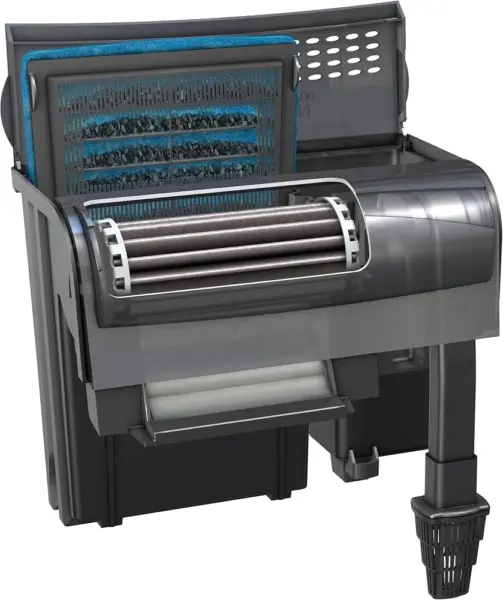
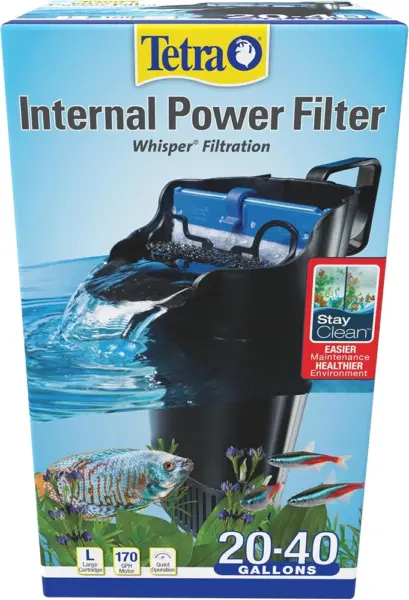
Some tanks cannot take a hang-on-back: a hood that sits flush, a stand pushed right up against the wall, a turtle setup where the back panel is already busy with a dock and a cord. The Whisper 200 clips to the inside glass and lets the tank sit an inch from the plaster, which is the tightest rear clearance in this roundup.
It moves up to 200 gallons per hour through a large BioBag cartridge, with an adjustable clip so you can set the height for a high or low water level — worth using, because an in-tank filter that rides too high is both conspicuous and noisy. Tucked behind décor it disappears, which is the point, but it is taking up a corner of swimming space that a hang-on-back would have left alone.
For a 40-gallon with a hood and no rear access, this is the pick, and the pump note is genuinely low — the water is louder than the motor. The trade is that corner of tank space and a cartridge you replace rather than rinse, plus the same short-motor-life risk that runs through this whole category.
One practical note. The suction cups are the weak point on this design; when they let go, the whole unit slides down the glass. Press them onto clean glass, and check them at every water change — it takes a second and saves you finding the filter lying on its side against the substrate.
Pros
- Lets the tank sit one inch from the wall
- Up to 200 GPH through a large cartridge
- Quiet pump note under the splash
- Adjustable clip for water level
Cons
- Uses up space inside the tank
- Suction cups can let go
Our choice when the tank has to sit an inch from the wall or under a hood — space inside the tank is what you trade for it.
Tetra Whisper PF40 – Simple, Cheap Filtration
Key Features
- Stages: 3-stage filtration
- Cartridge: Large Bio-Bag
- Dimensions: 5.38 x 8 x 7.9 inches
- Rated tank size: Up to 40 gallons
- Price: Budget
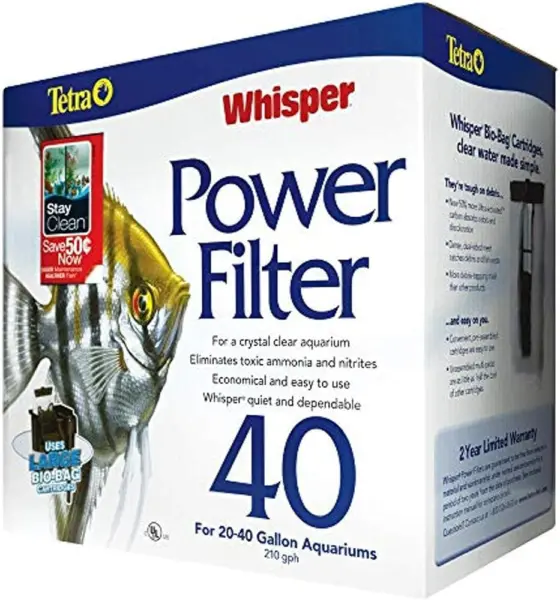
The PF40 is the plainest filter in this roundup, and that is the pitch. A three-stage box the size of a paperback: dual-sided mesh for debris, activated carbon for odor and discoloration, and a bio-foam block for bacteria. No dials, no indicator light, no basket to fill. If you want to spend your attention on fish rather than equipment, that counts for something.
It is rated to 40 gallons exactly, so there is no headroom — a heavily stocked tank will have you changing the cartridge more often than the monthly schedule. What we appreciated is how little fuss the whole thing is. Assembly takes about a minute, the cartridge lifts out without tools, and the body is small enough to tuck behind a tank that sits close to a wall.
The Bio-Bag is where the running cost lives: one a month, with no rinsing and reusing the way you can with foam. That is the trade for the simple body, and on a 40 in a living room we think it is a fair one. As a first filter, or a replacement for a tank that has been running the same old box for years, it does the job with nothing to learn.
Pros
- Three stages in a very small body
- Assembly takes about a minute
- Cartridges swap without tools
Cons
- No flow control at all
- Pump hum is audible in a quiet room
The plainest filter here, and that is the appeal: three stages, a small body, and nothing to adjust.
Hygger Double Sponge Filter – Best for Shrimp and Fry
Key Features
- Sponges: 2 plus 2 spares
- Air pump: Required, not included
- Includes: Ceramic media balls
- Rated tank volume: 40 gallons
- Price: Budget
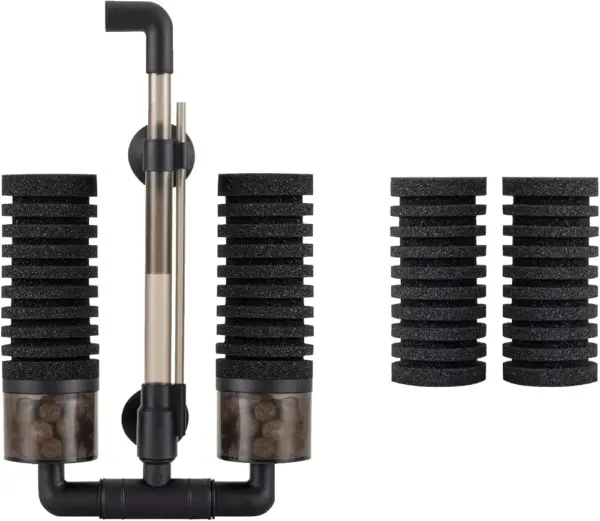
Read the package list before you order: this is the sponge, a bag of ceramic media and two spare sponges, not the air pump that drives it. Add a pump and a length of airline and the total still lands at the bottom of this group, but it is a two-part purchase, and the pump’s drone becomes part of the filter’s noise.
What arrives is a double sponge — two fine 60 ppi cylinders around a media chamber — plus suction cups and the spare pair. Because the flow comes from rising air rather than an impeller, there is nothing to break, nothing to prime and nothing to jam. The fine foam polishes water well, and the whole thing comes apart by hand for rinsing.
It is listed for a 40-gallon tank volume, but a sponge’s turnover is gentler than that number suggests. On a lightly stocked 40 with a betta, or in a breeding or grow-out tank, that is exactly right: no intake to trap fry, no current to fight. On a heavily stocked community tank we would want it as a second filter rather than the only one.
The suction cups are the recurring weak point — when they let go, the whole assembly tumbles down the glass. Mount it low, or let it rest on the substrate and skip the cups entirely. And expect bubbles: the noise here is air breaking at the surface, which some people find restful and others find maddening after a week.
Pros
- Gentle air-driven flow suits fry and shrimp
- Spare sponges and ceramic media included
- No impeller to wear out
Cons
- Air pump sold separately
- Suction cups let go
A gentle sponge filter for fry and shrimp, as long as you supply the air pump and do not ask it to carry a whole 40 alone.
How We Tested 12 Filters on 40-Gallon Tanks
We started with a list of roughly 30 filters sold for tanks in the 30-to-50-gallon range, then cut anything rated under 200 gallons per hour, anything that only accepted drop-in cartridges you replace rather than rinse, and anything too wide to sit behind a standard 36-inch stand. Twelve filters made the cut. Each one went onto a 40-gallon tank — a breeder and a tall, stocked the same way with a small school of tetras and one bristlenose — and each ran for at least eight weeks.
Testing happened on the schedule a real tank keeps. We fed twice a day, did 25 percent water changes on Saturday mornings, and read ammonia, nitrite, and nitrate before and after each change to see how well the media was actually processing waste. Clarity got checked by photographing a white card at the back of the tank on the same day each week and comparing the haze. Once the house quieted down for the evening, we took a decibel reading from three feet away — that’s the number that decides whether a filter can live in a bedroom.
On cleaning days we timed how long one person needed to cut the flow, lift out the media, rinse it in a bucket of tank water, and get everything running again; anything past 15 minutes got marked down hard. We also unplugged and restarted every unit weekly to see if it re-primed on its own, and we logged impeller rattle, seepage, and hairline cracks as the months piled up. Value was a final-math question: what the replacement media costs over a year, and whether the housing felt like it would survive being moved twice.
How to Choose a Filter for a 40-Gallon Tank
At 40 gallons the box stops being the interesting part — what separates these filters is the motor you cannot see and the media you will be buying for it every month.
Flow: aim for four to five tank turnovers an hour
A 40-gallon tank wants roughly 160 to 200 gallons per hour moving through the filter, which is four to five full turnovers. Treat the rating on the box as a ceiling rather than a promise: flow drops as the cartridge or sponge loads up, so a filter rated at exactly the tank size is running at the edge of its capacity from the day you set it up.
That is why we lean toward a filter with headroom and a flow dial. The Seachem Tidal 75 is rated for a tank nearly twice this size and adjusts from full down to a trickle, so the extra capacity buys media volume instead of a current. The Aqua-Tech is the opposite bet: rated at five turnovers, with no adjustment at all. Neither approach is wrong — they suit different fish.
Cartridges, foam, or a basket you fill yourself
A cartridge filter is a subscription. You buy a pad or a bag every month, and when you throw it away you throw away most of the bacteria colony with it. A foam block or a loose-media basket costs more up front and almost nothing after that: you squeeze the foam in a bucket of tank water, put it back, and the colony survives.
The trap is cleaning. Rinsing media under the tap kills the bacteria you are trying to keep, and swapping a cartridge and rinsing the foam in the same week restarts your cycle. Decide honestly which routine you will keep up with. If the answer is a fresh pad once a month and nothing else, buy a cartridge filter and stop feeling bad about it.
Hang-on-back, in-tank, or sponge
Most 40-gallon tanks run a hang-on-back, and it earns that: the media is easy to reach and the tank keeps its floor. It does need rear clearance, and that is where listings mislead. A compact body still hangs behind the tank, so measure the gap between glass and wall, and think about whether a hood sits flush against the filter.
If the stand is against the wall or the hood leaves no room, an internal filter clips to the glass and lets the tank sit an inch away — the Tetra Whisper 200 is the one here built around that. A sponge filter is the third route: air-driven, gentle, and ideal for fry and shrimp, but it needs an air pump you supply, and as the only filtration on a stocked 40 we would want more.
Noise, motors, and the six-month question
Nearly every complaint in this category traces back to one part: the impeller. When a filter dies young, it usually stops outright in the first weeks rather than fading, which is why the warranty matters more than the spec sheet. The AquaClear 50 and the Aqua-Tech carry two-year cover; the Aqueon backs its pump with a limited lifetime warranty.
Separate the two noises before you buy. Motor hum is the pump; water noise is the outflow, and it rises the moment the level drops below the lip. A filter that seems loud is often just a tank that needs topping up. Rinse the impeller at every water change, keep the level high, and buy from somewhere that takes returns without an argument.
Frequently Asked Questions
Can a filter be too big for a 40-gallon tank?
Oversizing is fine as long as you can turn the flow down. A filter rated for 60 or 75 gallons gives you more media volume and a margin for a heavy bioload, and you dial the output to suit the fish. It stops being fine when the rating is high and there is no adjustment — a big fixed pump on a 40 will push around anything with long fins.
So check one thing before you buy bigger: whether the model has a flow control. The Tidal’s dial is the reason it works this way on a 40.
Should I switch the filter off at feeding time?
For a few minutes, yes — it stops flakes being pulled straight into the media. Keep it brief. The bacteria in the filter need flowing, oxygenated water, and a filter left off for an hour or more starts to stagnate.
If you feed floating food every day, a model with a flow dial is easier than reaching for the plug. Turn the output down, feed, and turn it back up.
Can I move my old filter media into a new filter?
Yes, and it is the fastest way to skip a cycle. Run the old media in the new filter for two to three weeks, or squeeze the old sponge into the tank, then make the swap. Rinse it in tank water, never under the tap.
If you are changing filter types altogether, run both for a month when the tank allows it — two filters sharing the load is cheaper than a tank of new fish.
Final Verdict
Our pick for a 40-gallon is the Seachem Tidal 75. You get more filtration than the tank needs, a dial that keeps that from becoming a problem, a surface skimmer, and a basket you fill once and rinse instead of rebuying. That combination is what makes a stocked 40 easier to live with.
If cartridges suit you better than a media basket, the Aqueon QuietFlow 30 LED PRO is the one we hand to friends: it self-primes, it tells you when the pad is clogged, and it is the least fussy monthly change here. And if the tank has to sit an inch from the wall, nothing on this list beats the internal Tetra.