This post contains affiliate links. We may earn a small commission when you buy through our links — at no extra cost to you.
Aquarium sponge filters come in three distinct flavors: standalone air-driven units, replacement foam for HOB filters, and intake pre-filter sponges. Each serves a different purpose, and picking the wrong one means wasted money or poor filtration. This guide breaks down the key differences so you can match the right sponge to your tank and filter setup without guesswork.
The top performers in each category are laid out below to help you zero in on what works for your specific situation. Whether you need a complete filter for a breeding tank, a replacement pad for an AquaClear, or a pre-filter to protect shrimp fry, the best choice depends on your equipment and goals.
Top Picks
Best for Breeding, Fry, Shrimp
AQUANEAT Large Sponge

Rating: 4.7 ★ | Price: $ | Type: Standalone sponge | Tank Size: Up to 60 gal
The AQUANEAT Large Sponge filter pairs an open-pore sponge with a weighted base to trap debris and grow beneficial bacteria. The foam retains its shape after repeated squeezes, and the included tubing and check valve get you running in minutes. This design keeps fry and shrimp safe from intake currents while providing enough flow for tanks up to 60 gallons.
This filter suits aquarists running breeding tanks, shrimp setups, or general freshwater communities in the 20–60 gallon range. The larger bubbles create audible splashing – fine in a living room or garage, but less ideal for a quiet bedroom. Beginners will appreciate the simple setup and easy weekly cleaning: just rinse the sponge in tank water.
Pros
- Traps solid waste and supports biofiltration for tanks up to 60 gallons.
- Durable sponge that holds its shape through many cleaning cycles.
- Low cost for the performance it delivers – one of the best values in this category.
Cons
- In quiet rooms, the larger bubbles produce noticeable splashing noise.
- In tanks under 10 gallons, the filter’s footprint can be intrusive.
For medium to large freshwater tanks, this is the sponge filter to grab – it does its job without fuss or a high price tag.
Best for Hob Filter Owners
AquaClear 50 Foam Inserts

Rating: 4.8 ★ | Price: $ | Type: Replacement foam | Tank Size: Up to 50 gal
These foam inserts are sized specifically for the AquaClear 50 HOB filter, avoiding the guesswork of cut-to-fit alternatives. The OEM material handles both mechanical and biological filtration evenly over months of cleaning cycles. The catch is that this is a replacement media, not a standalone sponge filter — it requires the AquaClear 50 power filter to work. For owners of that exact model, it’s the straightforward, well-matched replacement that maintains performance without fuss.
Pros
- Precise fit eliminates trimming or adjustment
- Dual mechanical and biological filtration in one foam
- Material holds shape through multiple cleanings
Cons
- Only works with AquaClear 50 HOB filters — not a standalone sponge filter
For AquaClear 50 filter owners, this foam set is the straightforward, budget-friendly replacement that does exactly what it should.
Best for Nano Tanks, Bettas
Pawfly 3-Pack Mini

Rating: 4.6 ★ | Price: $ | Type: Standalone sponge | Tank Size: Up to 10 gal
The Pawfly three-pack delivers unbeatable value for hobbyists managing several small tanks — each sponge filter fits neatly in 2.5 to 5-gallon setups for bettas, shrimp, or fry. No complex assembly — just attach an air pump and drop it in. The compact size means they don’t handle tanks above 5 gallons well, and the bubble noise can be noticeable in very quiet rooms. For budget-minded aquarists who prioritize quantity over single-tank capacity, this is a practical way to set up multiple nano tanks without overspending.
Pros
- Three filters for the price of one — budget-friendly for multiple small tanks.
- Compact size fits comfortably in 2.5 to 5-gallon nano tanks.
- Simple to set up and clean with no moving parts.
Cons
- Each filter is best suited for tanks up to 5 gallons; larger tanks may need a bigger unit.
For aquarists running multiple nano tanks on a budget, this three-pack offers the best cost-per-filter value — just keep it in small, non-critical setups.
Best for Fry, Shrimp Protection
HUYAYA Pre-Filter 4-Pack

Rating: 4.5 ★ | Price: $ | Type: Pre-filter sponge | Tank Size: Up to 10 gal
This four-pack fits intake tubes up to 1 inch, making it compatible with most HOB and canister filters. The sponges effectively catch debris and protect shrimp and fry, but the dense foam captures particles so efficiently that it may need rinsing weekly in heavily stocked tanks. Best for aquarists who prioritize intake protection and don’t mind a regular cleaning routine.
Pros
- Traps debris and protects fry from being sucked into filter intakes.
- Budget-friendly four-pack offers good value for multiple filters or replacements.
Cons
- Dense foam may clog within a week in tanks with heavy waste, requiring more frequent cleaning than typical pre-filters.
A functional pre-filter pack for those who can manage minor fit adjustments and regular cleaning – ideal for dedicated hobbyists.
Best for Large Tanks 40-80
ALEGI Bio Sponge Kit 40-80
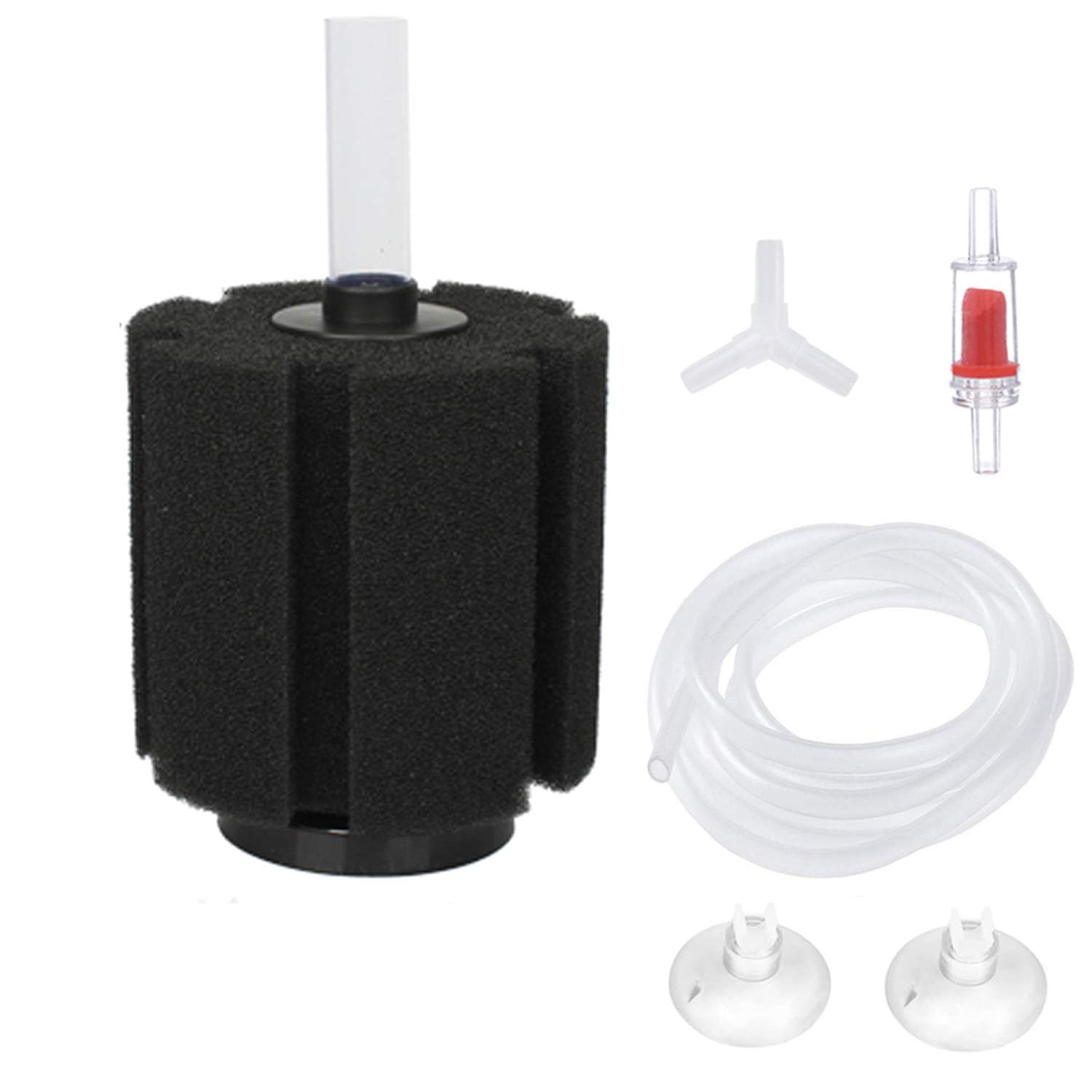
Rating: 4.6 ★ | Price: $$ | Type: Standalone sponge | Tank Size: 40-80 gal
The ALEGI kit bundles everything needed to run a sponge filter—airline, check valve, Y-connector, and suction cups—so you avoid separate purchases. For tanks between 40 and 80 gallons, the sponge provides enough surface area for biological filtration. This all-in-one approach suits aquarists who want a quick setup for breeding or fry tanks, but the included check valve may arrive non-functional and the sponge can lose shape under sustained heavy bioload. Compared to the top pick with thousands of reviews, this kit offers a complete package with a tradeoff in accessory consistency.
Pros
- Works well for larger tanks
- Easy to set up and maintain
- Good value for the kit
Cons
- The sponge may lose its shape under heavy use over time.
For aquarists who want a complete sponge filter package for a 40-80 gallon tank, this kit offers convenience without needing additional parts.
Best for Multiple Large Tanks
Aquapapa 3-Pack Large

Rating: 4.7 ★ | Price: $$ | Type: Standalone sponge | Tank Size: Up to 60 gal
Each sponge in this three-pack handles tanks up to 60 gallons, making it a budget-friendly solution for breeders or high-bioload setups like goldfish tanks. The top pick offers proven single-filter reliability, but this pack covers multiple tanks at a lower per-filter cost—though you may need to add a weight to keep the sponges submerged. Best for keepers running several large aquariums who don’t mind a small DIY fix; less suitable for nano tanks under 10 gallons where the sponge size feels oversized.
Pros
- Three large filters at a per-unit cost that’s hard to match.
- Handles high-bioload tanks like goldfish setups effectively.
- Simple to set up and clean with included accessories.
Cons
- The sponge size is bulky; in nano tanks it may be overly large.
A cost-effective choice for large-tank setups where minor DIY is acceptable, but skip if you need a grab-and-go filter for small aquariums.
Best for Large Hob Filters
AquaClear 110 Foam Insert

Rating: 4.8 ★ | Price: $$ | Type: Replacement foam | Tank Size: Up to 110 gal
This OEM replacement foam for AquaClear 110 filters delivers strong mechanical and biological filtration with durable construction that lasts through multiple washes. The foam is coarser than older versions, reducing fine particle capture – a tradeoff acceptable for large tank owners who prioritize longevity over polishing. Slightly higher price for a single piece, but a practical choice for those wanting a direct OEM replacement.
Pros
- Strong mechanical and biological filtration for large tanks
- High-quality materials withstand repeated cleaning
Cons
- Coarser foam texture may allow more fine particles through compared to older versions
Best suited for AquaClear 110 owners who value durability and OEM fit over fine polishing – for those needing finer filtration, consider adding a separate polishing pad.
Best for Diy Filter Projects
ALEGI Cut-to-Size Foam 20×20

Rating: 4.7 ★ | Price: $ | Type: Cut-to-size sheet | Tank Size: Custom sizes
The ALEGI 20×20 inch foam sheet is a cost-effective way to create custom filter pads for HOB, canister, or pond pre-filters – just cut with scissors. The 20 PPI foam handles mechanical and biological filtration. However, after vacuum expansion, the thickness may measure less than the advertised 1 inch, so it works best when exact thickness isn’t critical. This sheet suits DIY aquarists who value flexibility over drop-in convenience.
Pros
- Cut-to-size sheet fits any filter shape with simple trimming.
- Provides both mechanical and biological filtration for various setups.
Cons
- Requires cutting to size – not a drop-in replacement for a specific filter model.
Best for DIY projects where cutability and value outweigh the need for precise thickness.
Best for Custom Filter Pads
Hipanda Foam Sponges 9×9

Rating: 4.6 ★ | Price: $ | Type: Cut-to-size sheet | Tank Size: Custom sizes
These cut-to-size foam sheets clean well and trap debris effectively, making them a solid option for customizing filter trays, pond pre-filters, or even non-aquarium uses like pop filters. The foam quality holds up through rinsing and reuse. The catch: the thickness may measure slightly less than the advertised inch after the foam expands — that matters if you need a precise fit without compression. For DIYers who can adapt by stacking or trimming, this is a cost-effective way to get usable filter media without buying pre-cut pads.
Pros
- Traps debris well during cleaning cycles
- Foam holds its shape and rinses clean for reuse
Cons
- Thickness can fall short of 1 inch after expansion — worth measuring before final installation
Best for aquarists who are comfortable cutting and layering foam to account for thickness variance — not a drop-in replacement if exact dimensions are required.
Best for Cascade 300 Owners
Penn-Plax Cascade 300 Sponge
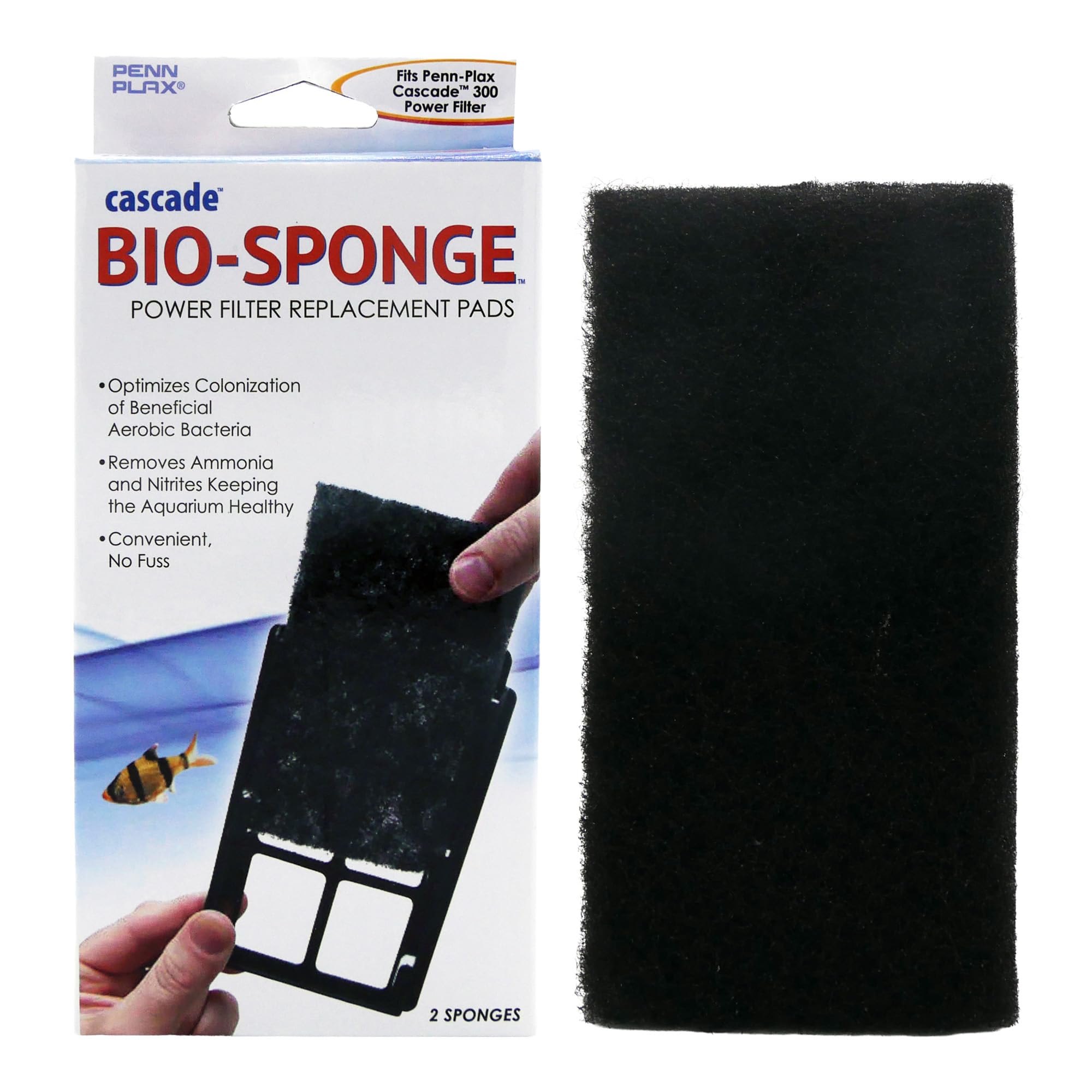
Rating: 4.7 ★ | Price: $ | Type: Replacement foam | Tank Size: Cascade 300
This two-pack delivers effective filtration for Cascade 300 owners, with a secure fit and easy rinse-and-reuse maintenance. The foam is purpose-built for this filter, so it won’t work in other brands without modification, and occasional size discrepancies mean it’s wise to confirm fit before final assembly.
Pros
- Effective mechanical and biological filtration keeps water clear.
- Durable foam holds up well to repeated cleaning.
Cons
- Size may vary slightly between units, requiring fit confirmation.
For Cascade 300 filter owners, this sponge offers an affordable OEM-quality replacement that works as intended — a straightforward choice.
Best for Nano Filter Intakes
Fluval Edge Pre-Filter

Rating: 4.6 ★ | Price: $ | Type: Pre-filter sponge | Tank Size: Small intakes ≤1/2"
This Fluval Edge pre-filter sponge protects fry, shrimp, and small fish from being sucked into the filter, making it a solid choice for nano tanks with delicate species. Its small inner diameter limits compatibility to intake tubes 1/2 inch or smaller, and the sponge may restrict flow if not cleaned regularly — a tradeoff that suits tanks where gentle flow is desired over high turnover.
Pros
- Effective at preventing small fish and shrimp from entering the filter intake
- Fits securely on Fluval Edge and similar narrow intake tubes
Cons
- Inner diameter is too small for standard 1-inch intake tubes
An inexpensive lifeline for tiny fish and shrimp, but only suitable for small intakes.
Best for Corner Nano Tanks
AQUANEAT Corner Sponge

Rating: 4.6 ★ | Price: $ | Type: Standalone sponge (corner) | Tank Size: Up to 10 gal
The quarter-cylinder shape tucks into a corner, freeing up floor space in nano tanks under 10 gallons. The sponge provides mechanical straining and ample surface area for beneficial bacteria. However, the unit can float up unless it is weighted down or fully saturated, and the bubble noise may be intrusive in a bedroom or office. For a betta tank or shrimp setup where gentle flow and a space-saving footprint are priorities, the filter gets the job done.
Pros
- Fits snugly into tank corners, leaving more open swimming area.
- Dense foam traps debris and hosts beneficial bacteria for balanced filtration.
Cons
- May float to the surface unless weighted or thoroughly soaked before use.
- Large bubble output creates noise that can be irritating in quiet spaces.
For nano tanks where corner space is at a premium and some bubble noise is tolerable, this filter provides a budget-friendly solution.
How to Choose
The most important factor is matching the sponge type to your filtration goal: standalone, replacement, or pre-filter.
Filter Type and Function
Standalone sponge filters use an air pump to pull water through the foam, providing both mechanical and biological filtration. They are ideal for breeding tanks, fry, and shrimp because the gentle flow and large surface area prevent small creatures from being sucked in.
Replacement foam pads are designed for specific HOB filters like AquaClear or Cascade. They fit into the filter tray and must be the correct size to avoid unfiltered water bypass. Pre-filter sponges slip over the intake tube to catch debris before it reaches the main filter, extending cartridge life.
Tank Size Compatibility
Each sponge has a recommended tank volume range that corresponds to its foam volume and surface area. Using an undersized sponge in a large tank results in incomplete water turnover, while an oversized sponge in a nano tank can take up too much floor space and create excessive flow.
For standalone filters, the general rule is that the sponge height should be at least half the tank depth to ensure adequate water contact. Pre-filter sponges are sized by intake tube diameter, not tank volume, so measure your intake before buying.
Pore Density and Foam Quality
Pores per inch (PPI) determine the balance between mechanical and biological filtration. Higher PPI (e.g., 30) traps finer particles but clogs faster, while lower PPI (e.g., 20) allows better water flow and supports more bacteria but lets small particles pass.
For betta and shrimp tanks, a medium PPI around 20-30 works well—fine enough to keep water clear without restricting flow. Very coarse foam (10 PPI) is better for heavy waste loads like goldfish, but may need a mechanical pre-filter to catch solids.
Included Accessories
Standalone sponge kits typically include airline tubing, a check valve to prevent back siphon, and a control valve for adjusting flow. These extra parts save you a trip to the store and ensure the filter works out of the box.
However, the quality of accessories varies. Some kits include thin tubing or flimsy check valves that may fail over time. If you plan to run multiple filters, ensure the included Y-connectors match your air pump output.
Cleaning and Reusability
Proper cleaning extends sponge life indefinitely. Rinse in dechlorinated water or old tank water—never tap water, as chlorine kills beneficial bacteria. Squeeze gently until the water runs mostly clear; aggressive scrubbing tears the foam.
Pre-filter sponges need more frequent cleaning (every 1-2 weeks) because they catch large debris. Standalone sponges can go longer between cleanings (3-4 weeks) if the bioload is low. A vacuum-sealed sponge must be soaked in warm water for several hours to regain its full thickness before use.
FAQ
Why does my sponge filter float to the top of the tank?
Many sponge filters are buoyant when new, especially if the foam is vacuum-sealed. Soak the sponge in warm water for 2-4 hours before use. If it still floats, add a small weight like a ceramic ring or a stainless steel nut inside the center tube to keep it submerged.
How long should I soak a vacuum-sealed aquarium sponge filter?
Soak the sponge in warm dechlorinated water for at least 2-3 hours. If the foam remains compressed, leave it overnight. Never use hot tap water, as it can damage the foam structure. A fully expanded sponge ensures maximum surface area for biological filtration.
Can I use a sponge pre-filter on any hang-on-back filter?
Only if the intake tube diameter matches the pre-filter’s inner hole. Most pre-filter sponges fit tubes up to 0.8-1 inch. For larger intakes, look for a pre-filter designed specifically for that diameter, or use a cut-to-size foam sheet wrapped around the tube and secured with a zip tie.
What PPI (pores per inch) is best for a betta tank sponge filter?
A medium pore density of 20-30 PPI is ideal for betta tanks. It provides gentle flow, good biological filtration, and traps enough debris to keep the water clear without clogging too quickly. Lower PPI (10-15) is too coarse and may allow waste to pass, while higher PPI (40+) restricts flow too much.