This post contains affiliate links. We may earn a small commission when you buy through our links — at no extra cost to you.
Many shrimp keepers buy a hang-on-back or canister filter expecting reliable filtration, only to find the motor dies within months or the current shreds their colony. These problems stem from designs intended for larger fish, not delicate invertebrates.
Sponge filters avoid these issues entirely: no moving parts to fail, and the soft sponge won’t trap shrimplets. They are also cheap, quiet, and easy to clean—just squeeze and rinse.
This guide breaks down which filter types work for shrimp tanks at different sizes, so you can pick the one that matches your setup without overpaying for complexity or risking your colony.
Top Picks
Best for Nano Shrimp Tanks
AQUANEAT Corner Sponge

Rating: 4.7 ★ | Price: $ | Type: Sponge (air-driven) | Media Capacity: Sponge, external | Noise: Low | Shrimp Safe: Yes
The AQUANEAT Corner Sponge is purpose-built for shrimp and betta tanks. Its compact corner shape saves space while providing gentle sponge filtration that won’t harm delicate shrimp or fry. Unlike cylindrical sponge filters that take up more tank space, this design fits neatly into small tanks. The included accessory set — airline tubing, valves, suction cups — means you only need an air pump to get started.
Best suited for nano tanks between 5 and 10 gallons, this filter may feel bulky in tanks smaller than 5 gallons. The bubbles it produces can be large and noisy without an airstone insert, but adding one is a simple fix. For first-time aquarium owners with a small shrimp colony or betta, this is a simple, easy-to-use filter at a budget-friendly price that includes all accessories except an air pump.
Pros
- Specifically designed for shrimp and betta tanks – safe and gentle
- Great value with complete set of accessories
- Compact corner shape saves space and looks tidy
Cons
- Size may be too large for very small tanks under 5 gallons
- Bubbles can be large and noisy without an airstone insert
If you keep shrimp in a 5–10 gallon tank, this filter covers all the basics with minimal fuss — just add an air pump.
Best for Large Shrimp Tanks
AQUANEAT Large Sponge Filter

Rating: 4.7 ★ | Price: $ | Type: Sponge (air-driven) | Media Capacity: Large sponge, easy clean | Noise: Low | Shrimp Safe: Yes
Unlike compact corner filters, this larger sponge accommodates tanks up to 60 gallons and handles heavier bioloads without compromising fry safety. The air-driven design provides mechanical and biological filtration, and the soft foam won’t trap small shrimp or newly hatched fry.
For shrimp keepers with large tanks, breeding projects, or a need for simple, budget-friendly filtration, it’s a practical choice. The 8-inch height and 4.5-inch diameter take up noticeable space — best suited to tanks 20 gallons and up where it won’t dominate the aquascape. An airstone (not included) tames the large bubbles and reduces noise, a small tweak for the otherwise quiet operation.
Pros
- Handles heavy bioloads in tanks up to 60 gallons with strong biological and mechanical filtration
- Safe for fry, shrimp, and delicate fish — soft sponge won’t trap small creatures
- Excellent value for a filter that lasts — budget-friendly and effective
Cons
- Bubble size can be large without an airstone, leading to noise and less efficient oxygenation
- Dimensions (4.5" D x 8" H) take up significant tank real estate — not ideal for tanks under 20 gallons
For budget-conscious shrimp breeders or anyone running a larger community tank, this is a pragmatic, low-maintenance workhorse that gets the job done. Pair it with an airstone and a 20-gallon-plus tank to avoid the one real compromise: its size.
Best for Multiple Nano Tanks
Pawfly 3-Pack Sponge

Rating: 4.6 ★ | Price: $ | Type: Sponge (air-driven) | Media Capacity: Small sponge, easy clean | Noise: Low | Shrimp Safe: Yes
Three filters for the price of one, each about $2.20, makes this multi-pack ideal for hobbyists running multiple nano tanks. Unlike the all-in-one corner sponge kit, this is a bare-bones value pack that keeps per-unit cost extremely low. The sponge design provides gentle, shrimp-safe filtration with simple setup.
The compact size limits each filter to tanks 5 gallons and under — pushing beyond that calls for additional filtration. This suits small-scale shrimp keeping, backup filtration, or breeding projects where you need several functional units without a significant investment.
Pros
- Three filters for under $7 in total, each costing roughly $2.20.
- Gentle flow that won’t suck up shrimp or stress bettas.
- No complicated parts; rinse and reuse in minutes.
Cons
- Bubble noise level varies with air pump — may be intrusive in quiet rooms.
- Compact size limits suitability to 5 gallons or less; larger tanks require additional filtration.
When stocking a shrimp rack or breeding setup on a budget, this three-pack keeps costs low while doing the job for each small tank — just treat them as single-tank solutions.
Best for Shrimp-Friendly Hob
Seachem Tidal 35

Rating: 4.5 ★ | Price: $$ | Type: HOB | Flow Rate: 90–450 GPH | Media Capacity: Large media basket | Noise: Quiet | Shrimp Safe: With intake sponge
Adjustable flow allows this HOB to be dialed down to shrimp-safe levels when paired with a pre-filter sponge — a capability most HOBs lack. It also brings self-priming and a surface skimmer, which the top pick sponge filter doesn’t offer. The tradeoff is the need for a modification and a slightly more involved setup.
This filter suits shrimp keepers who prefer the convenience of a hang-on-back but are comfortable adding a sponge to protect tiny inhabitants. Some units have experienced motor issues, so buying with a flexible return window is wise. The surface skimmer can be finicky in certain tank arrangements, but for those who want adjustable flow and self-priming in a HOB, this is a workable option.
Pros
- Flow can be turned down to shrimp-safe levels with a pre-filter sponge
- Self-primes after power outages, no manual restart needed
- Operates quietly for a HOB filter
Cons
- Surface skimmer may not pull effectively in all tank layouts
A capable HOB for shrimp tanks when modified, offering adjustable flow and self-priming that are hard to find in this category.
Best for Planted Shrimp Tanks
Fluval 107 Canister

Rating: 4.5 ★ | Price: $$$ | Type: Canister | Flow Rate: 145 GPH | Media Capacity: EZ-lift baskets | Noise: Ultra-quiet | Shrimp Safe: With spray bar
The Fluval 107 delivers near-silent operation and generous media volume for high-tech planted shrimp tanks. Motor reliability may vary, and the premium price and size make it overkill for nano shrimp setups under 10 gallons.
Pros
- Ultra-quiet operation lets you place the filter near your tank without noise distraction.
- Well-organized media baskets simplify filter maintenance.
Cons
- Seal leakage can occur after maintenance or power outages, requiring careful re-seating of the gasket.
Best for shrimp keepers running a CO2-injected planted tank up to 30 gallons who want silent filtration and are comfortable with canister maintenance.
Best for Large Freshwater Tanks
Marineland Penguin 350

Rating: 4.4 ★ | Price: $$ | Type: HOB with Bio-Wheel | Flow Rate: 350 GPH | Media Capacity: Proprietary cartridges | Noise: Loud | Shrimp Safe: No
The 350 GPH flow and Bio-Wheel deliver clear water quickly, well-suited for large tanks with robust fish. However, the strong current can harm shrimp, and motor reliability has been noted as inconsistent. Better suited for cichlid or goldfish tanks.
Pros
- Bio-Wheel provides strong mechanical and biological filtration for visibly cleaner water.
- Easy to set up and replace cartridges with minimal effort.
Cons
- In quiet rooms, the motor hum and water splash can be noticeable — less of an issue in active living spaces.
A solid choice for large freshwater tanks where high flow and low cost are priorities, but not the filter for shrimp keepers or those needing silent operation.
Best for Temporary Tanks
Tetra Whisper Internal
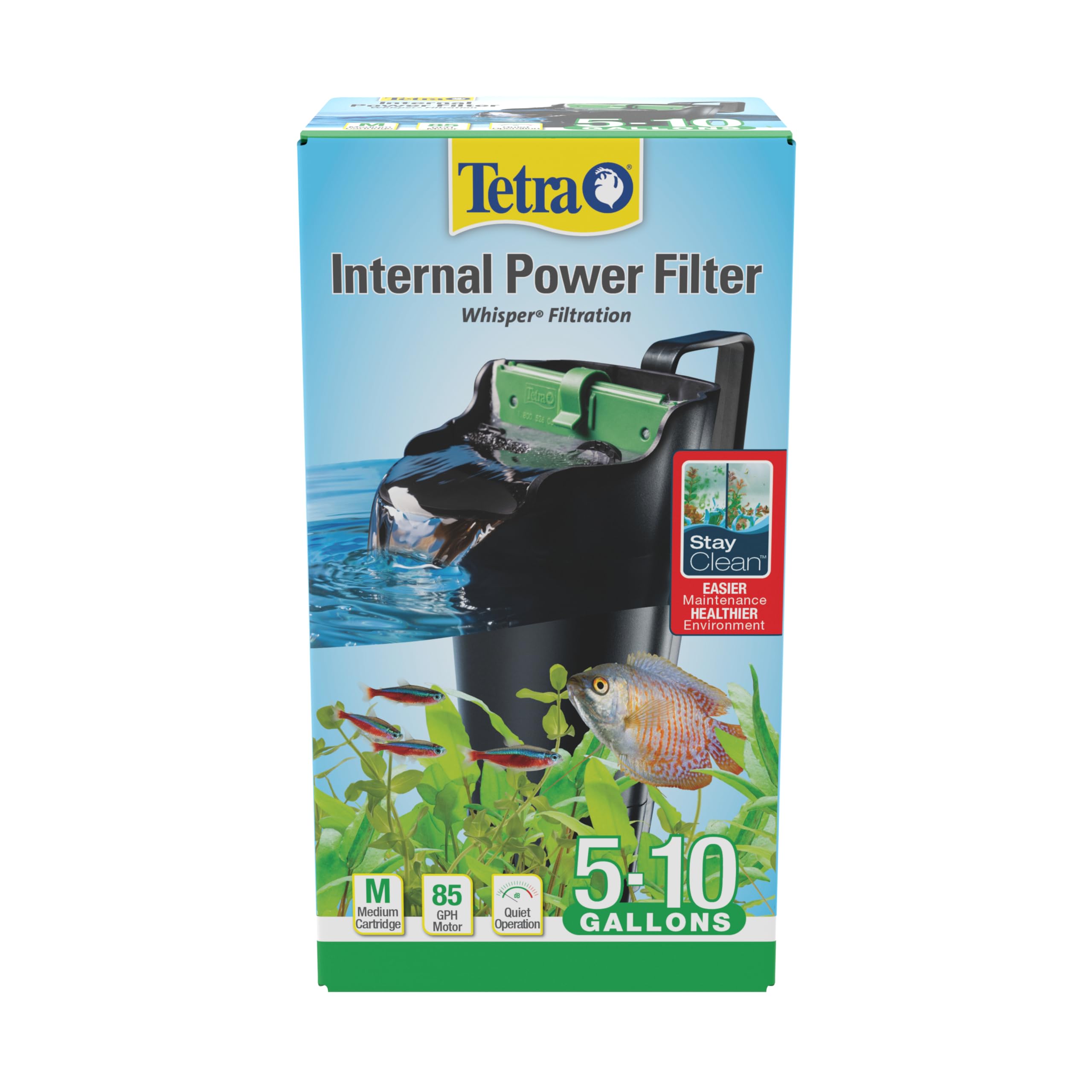
Rating: 4.3 ★ | Price: $ | Type: Internal | Flow Rate: 80 GPH | Media Capacity: Bio-Bag cartridges | Noise: Quiet | Shrimp Safe: No
This filter runs quietly and clears water quickly in 5–10 gallon tanks, making it a solid option for quarantine or temporary setups. However, its motor can stop working within months, and the strong intake isn’t shrimp-safe. For long-term shrimp keeping, a sponge filter like the top pick is the better call.
Pros
- Very quiet operation – one of the quietest internal filters available.
- Effective water clarity in small tanks at a budget price.
Cons
- Motor durability is a concern — may stop working within months, making it unsuitable for long-term or shrimp setups.
Best reserved for temporary tanks where silence matters and replacement is acceptable; not a fit for shrimp or any setup needing long-term reliability.
Best for Temporary Setups
Tetra Whisper IQ 20

Rating: 4.2 ★ | Price: $ | Type: HOB | Flow Rate: 130 GPH | Media Capacity: Cartridges | Noise: Quiet | Shrimp Safe: No
This budget HOB is quiet and simple to set up, making it a reasonable pick for temporary tanks or setups where occasional motor stoppage and water leaks from the motor box are acceptable trade-offs. However, the non-adjustable flow is too strong for shrimp, and the unit is best reserved for non-critical applications where replacement is easy.
Pros
- Operates quietly for a hang-on-back filter
- Simple assembly and self-priming design
Cons
- Water can leak from the motor box in some setups
Worth considering only for temporary tanks or as a backup where leaks and motor stoppage are acceptable trade-offs.
How to Choose
The single most important factor for a shrimp tank filter is gentleness and safety for shrimplets, which makes sponge filters the default choice for most setups.
Filter Type
Sponge filters use an air pump to draw water through a coarse sponge. They provide mechanical and biological filtration with zero risk of sucking in shrimp or fry. HOBs and canisters create stronger currents and often require intake modifications to be safe.
For shrimp tanks under 20 gallons, a sponge filter is almost always the right choice. For larger tanks or planted setups with CO2, a canister with a spray bar can work, but it costs more and carries leak risk.
Flow Rate and Adjustability
Shrimp prefer gentle, slow-moving water — high flow stresses them and can sweep away food. Adjustable flow is a must if you choose an HOB or canister. Models like the Seachem Tidal allow you to dial down the output to a safe level.
Sponge filters have no built-in flow control, but the bubble size and air pump strength determine the current. A simple valve on the airline lets you reduce flow if needed.
Media Capacity and Maintenance
Sponge filters use a single foam block that acts as both mechanical and biological media. Cleaning is straightforward: squeeze the sponge in tank water. HOBs and canisters use replaceable cartridges or baskets, which can be more expensive over time.
A larger media surface means more beneficial bacteria, but for a shrimp tank, a standard sponge surface is sufficient. Avoid filters that require frequent cartridge changes — they disrupt the biological cycle.
Noise Level
Sponge filters produce only the sound of bubbling water, which many find relaxing. Air pumps vary in noise, but they can be placed on a soft surface or in a cabinet to dampen vibration.
HOBs generate motor hum and water splash noise, especially as they age. Canister filters are generally the quietest powered option, but they cost significantly more.
Shrimp Safety
The intake is the main danger. Sponge filters are inherently safe because the sponge blocks entry. HOBs and canisters need a fine pre-filter sponge over the intake to prevent shrimplets from being sucked in.
Even with a pre-filter, the flow from an unadjustable HOB can be too strong for dwarf shrimp. Adjustable-flow models or spray bars can reduce the current to a shrimp-safe level.
FAQ
Can I use a hang-on-back filter for a shrimp tank?
Yes, but only if the flow is adjustable and you add a pre-filter sponge over the intake. Even then, the current may be too strong for dwarf shrimp. The Seachem Tidal 35 is the most reliable HOB for this use because its flow can be dialed down to a gentle trickle.
Why does my aquarium filter keep stopping after a few months?
Many budget HOBs and internal filters use low-quality motors that burn out quickly. The Tetra Whisper series and Marineland Penguin have high failure rates. Sponge filters have no motor — they only need an air pump, which is far more durable and easily replaced.
How do I shrimp-proof my filter intake?
Attach a fine foam pre-filter sponge over the intake tube. These are cheap and widely available. They prevent shrimplets from being sucked in while still allowing water flow. For HOBs, ensure the pre-filter is tight and cleaned regularly to maintain flow.
Is a canister filter overkill for a shrimp tank?
For most shrimp tanks, yes. Canisters are expensive, heavy, and risk leaks. They only make sense for larger planted tanks (30+ gallons) where you need high flow and CO2 distribution. A sponge filter is simpler, safer, and cheaper for the majority of shrimp setups.