This post contains affiliate links. We may earn a small commission when you buy through our links — at no extra cost to you.
Many filters labeled for 10-gallon tanks actually push flow rates best suited for 20-gallon setups – creating a torrent that stresses bettas, shrimp, and other delicate fish. Adjustable flow or non-motorized sponge designs often solve this mismatch.
The market offers sponge, HOB, internal, canister, and undergravel options, each with trade-offs in noise, media cost, and maintenance frequency. Some require separate air pumps; others need regular cartridge replacements that add up.
This guide matches each filter type to specific tank inhabitants and living situations, whether you’re breeding fry, keeping a planted display, or setting up a quiet bedroom tank.
Top Picks
Best for Betta and Shrimp
AQUANEAT Bio Sponge (20Gal)

Rating: 4.7 ★ | Price: $ | Filtration Type: Sponge | Media Cost: Reusable sponge | Physical Footprint: 3"D x 6.5"H
This sponge filter delivers the slow, safe water movement that bettas, shrimp, and fry need to thrive. Its open-cell foam traps debris while hosting beneficial bacteria, and cleaning is as simple as squeezing the sponge in tank water. The only sound comes from the air pump you supply, making it one of the quietest filtration options for a 10-gallon setup.
Best suited for keepers who prioritize gentle flow over high turnover — breeding tanks, shrimp colonies, and betta habitats are the natural home for this filter. One tradeoff: it requires a separate air pump (not included). Also, the bubbles can be noticeably large and splashy unless you add a small air stone inside the sponge, a tweak that costs under a dollar and takes seconds.
Pros
- Gentle flow safe for bettas, shrimp, and fry
- Simple maintenance — just squeeze the sponge in tank water
- Very affordable entry point for a reliable sponge filter
Cons
- Bubbles can be large and noisy without an air stone modification
- Sponge material may need replacement after a year of use
For gentle, low-cost filtration in a 10-gallon tank with delicate inhabitants, this sponge filter is the clear choice — just plan on buying an air pump and a small air stone.
Best for Quiet Small Tanks
Marina S10 Power Filter

Rating: 4.4 ★ | Price: $$ | Filtration Type: HOB | Flow Rate: Adjustable up to 10 gal | Media Cost: Disposable cartridges | Physical Footprint: Slim
Marina’s internal pump design keeps noise to a whisper, and the adjustable flow lets you dial in gentle currents for bettas or shrimp. Most HOBs for this size rattle or roar; this one stays unobtrusive in a bedroom or office. The slim profile also reduces clutter on the tank rim, fitting neatly below a standard 10-gallon hood.
Best for owners who want mechanical and chemical filtration with minimal noise but prefer the convenience of disposable cartridges. Replacement cartridges add ongoing cost — using reusable media is possible if you modify the chamber. The filter self-primes after power outages, saving the hassle of manual restart.
Pros
- Very quiet operation thanks to internal pump design.
- Adjustable flow control allows fine-tuning for low-current fish.
- Slim profile minimizes tank rim clutter.
Cons
- Replacement cartridges add ongoing cost — reusable media can be substituted.
- After extended use, some units may develop a vibration or hum in very quiet rooms.
For small tanks where silence is a priority, this HOB delivers on its promise.
Best for Multiple Nano Tanks
AQUANEAT 3-Pack Sponge

Rating: 4.7 ★ | Price: $ | Filtration Type: Sponge | Media Cost: Reusable sponge | Physical Footprint: 2"D x 4.75"H
The AQUANEAT three-pack delivers outstanding economy for anyone managing multiple small tanks or breeding setups. Each sponge filter provides gentle mechanical and biological filtration suitable for up to 10 gallons, with a fine-pore sponge that protects fry and shrimp from strong currents. For a single 10-gallon tank, you get two spares at no extra cost — a practical hedge against unexpected filter failure.
This set suits keepers who already own an air pump and want spare filters for quick cycling or quarantine tanks. The internal chamber is snug — you may need to trim the center tube to fit an air stone for finer bubbles, and the dense sponge can clog faster than coarser alternatives in heavily stocked tanks. Not for those seeking a complete drop-in kit or a polished display look.
Pros
- Three filters for the price of one starter kit — exceptional value for multi-tank setups.
- Gentle flow and fine sponge are ideal for bettas, shrimp, and fry in 5–10 gallon tanks.
- Sponge rinses clean quickly under tap water, simplifying maintenance.
Cons
- Chamber is too small for an air stone without cutting the center tube — a minor DIY modification.
- Fine-pore sponge may require more frequent cleaning than coarser sponge filters in messy tanks.
For budget-focused aquarists running multiple small tanks or breeding setups, this three-pack offers undeniable value — just budget an extra few minutes for the air stone mod if you prefer finer bubbles.
Best for Premium Water Quality
Fluval 107 Canister

Rating: 4.5 ★ | Price: $$$ | Filtration Type: Canister | Flow Rate: 145 GPH | Media Cost: Reusable baskets | Physical Footprint: External
The Fluval 107 delivers whisper-quiet operation and three-stage filtration that keeps planted tanks stable and crystal clear. Its large media capacity and adjustable flow give you control that HOBs can’t match. For a 10-gallon, however, the filtration power far exceeds what’s needed – you’re paying a premium for headroom you won’t fully use. The tradeoff is worth it only if silence and pristine water quality are non-negotiable, and you’re comfortable maintaining O-ring seals to avoid the occasional leakage that has been noted in some units.
This filter fits the enthusiast who wants the best possible water quality and near-silent operation, or anyone running a high-tech planted tank where CO2 stability matters. Beginners may find the canister setup and priming process more involved than a simple hang-on-back, and the ongoing media expense is higher. If leakage occurs, it can cause water damage, so seal checks are part of ownership.
Pros
- Exceptionally quiet – barely audible even in a living room
- Removable media baskets simplify cleaning and media swaps
- Large media volume supports stable biological filtration for sensitive setups
Cons
- Higher upfront and ongoing media cost than HOB options for a 10-gallon tank
- Seals need periodic checking – some units have developed leaks over time
If you prize silence and filtration quality over budget and simplicity, the Fluval 107 delivers – just be prepared for the cost and seal maintenance it demands.
Best for Budget Silent Setups
Tetra Whisper Internal 10
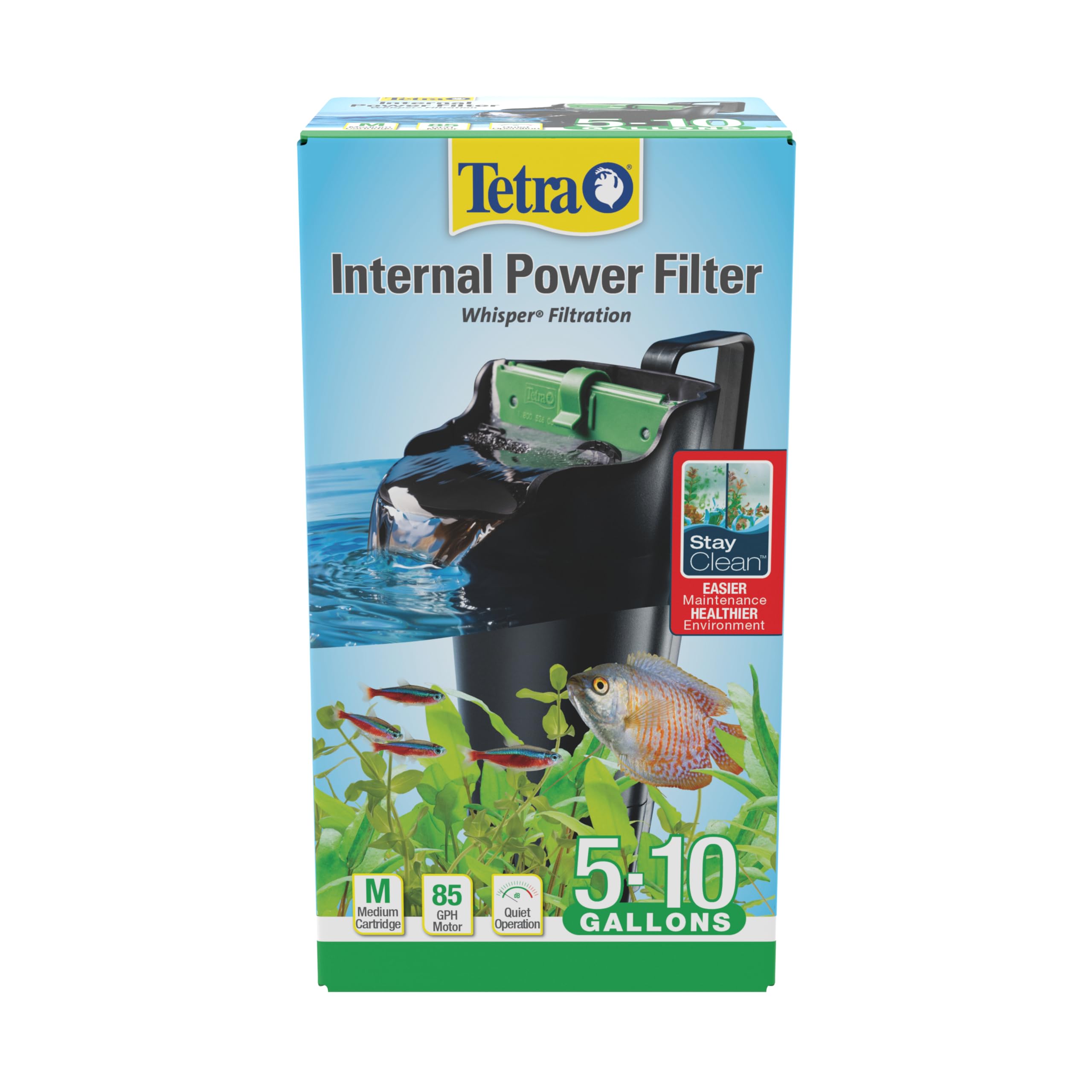
Rating: 4.3 ★ | Price: $ | Filtration Type: Internal | Flow Rate: 80 GPH | Media Cost: Disposable cartridges | Physical Footprint: Compact
The submerged motor eliminates vibration noise entirely, making this one of the quietest options for a 10-gallon tank — suitable for bedrooms or offices where constant hum would be distracting. The tradeoff is limited durability; some units may need replacement within a year, so this filter suits low-risk setups such as quarantine tanks or lightly stocked aquariums where a sudden stoppage isn’t critical.
Pros
- Near-silent operation thanks to fully submerged motor
- Keeps water clear with mechanical and chemical filtration
- Easy to clean – no tools needed for routine maintenance
Cons
- Bulky interior footprint reduces swimming space in a 10-gallon
- Some units may stop working within months, requiring replacement
A quiet, budget-friendly filter for small tanks, best when you accept it may not last beyond a year — ideal for temporary or low-bioload setups.
Best for Old-School Biological
Penn-Plax Undergravel 10
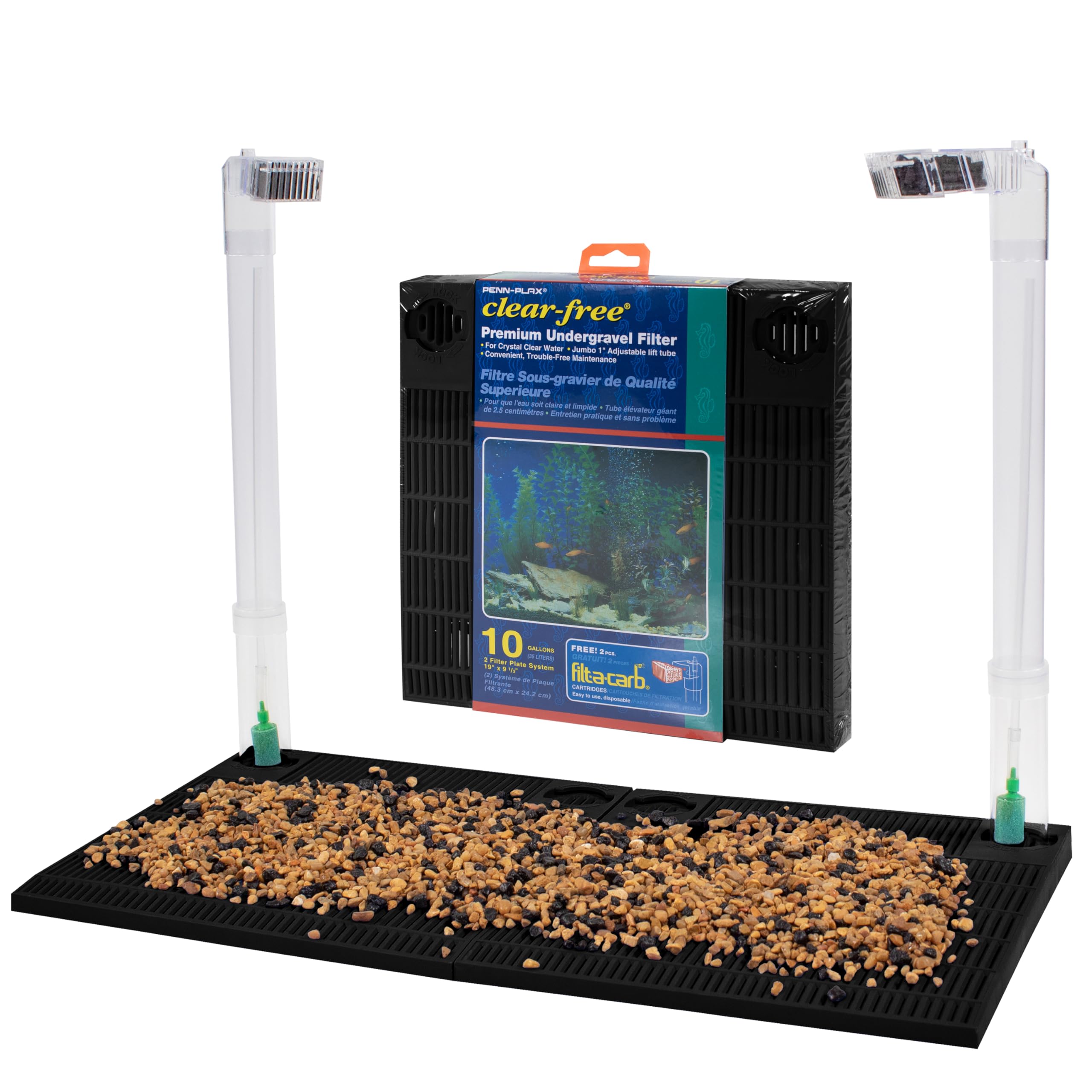
Rating: 4.4 ★ | Price: $ | Filtration Type: Undergravel | Media Cost: Carbon cartridges | Physical Footprint: 2 plates
This undergravel filter keeps the tank nearly equipment-free once installed, relying on the gravel bed as biological media. It works best with a power head or strong air pump to circulate water, and the two 9.5” plates cover a 10-gallon footprint neatly. The tradeoff: it’s primarily biological filtration, so don’t expect heavy mechanical polishing. It suits hobbyists who value long-term biological stability over quick particle removal, especially in brackish or saltwater setups where surface agitation is welcome.
Pros
- Effective biological filtration when paired with a power head or strong air pump.
- Simple assembly and installation process.
- Low maintenance once established — reduces frequency of full tank cleanings.
Cons
- Plates and lift tubes may arrive cracked or broken in shipping — worth inspecting immediately.
- Requires specific gravel depth and size; fine sand or shallow substrate won’t work.
A solid choice if you prefer old-school biological filtration and are comfortable setting up proper gravel depth and an air pump — just be prepared to check for shipping damage on arrival.
Best for Complete Starter Kit
AQUANEAT Sponge Kit

Rating: 4.7 ★ | Price: $ | Filtration Type: Sponge | Media Cost: Reusable sponge | Physical Footprint: 2"D x 4.75"H
Everything except the air pump is included – tubing, valves, suction cups – simplifying setup for a 10-gallon tank. The sponge filtration is gentle, suitable for bettas and shrimp. Basic tubing and large bubble size (noisy without air stone mod) are tradeoffs. Still, a budget-friendly entry into sponge filters.
Pros
- Includes all airline components – tubing, check valve, control valve, and suction cups – no extra purchases needed.
- Gentle mechanical and biological filtration for small tanks at a very low price.
Cons
- In a quiet room, the larger bubbles can create noticeable surface disturbance – less of an issue in a living area or with an air stone mod.
Best suited for first-time sponge filter users or as a backup kit for a nano tank where gentle flow and low cost are priorities.
Best for Adjustable Flow Hob
Tetra Whisper IQ 20

Rating: 4.2 ★ | Price: $$ | Filtration Type: HOB | Flow Rate: 130 GPH adjustable | Media Cost: Disposable cartridges | Physical Footprint: Standard
This HOB filter keeps water clear and runs quietly for a hang-on-back, with self-priming and adjustable flow that suit 10-20 gallon tanks. Assembly is straightforward. However, some units may develop leaks or stop working within the first year, so it’s best suited for aquarists who monitor their equipment regularly and have a backup plan.
Pros
- Quiet operation for a HOB – sound shield reduces motor noise.
- Easy to assemble and install right out of the box.
Cons
- Some units may experience leakage or cease functioning over time – worth purchasing with a flexible return window.
A good option if you want a quiet HOB for a 10-20 gallon tank and are comfortable with occasional maintenance checks or keeping a backup filter on hand.
Best for Strong Flow Current
Aqua-Tech Ultra Quiet

Rating: 4.3 ★ | Price: $$ | Filtration Type: HOB | Flow Rate: ~100-200 GPH | Media Cost: Bio-Foam + carbon | Physical Footprint: Standard
The Aqua-Tech delivers strong water movement that keeps tanks clean, and its price is budget-friendly. However, the flow cannot be adjusted, which can create too much current for smaller setups or delicate fish. Some units may have reliability concerns over time, making it a choice for keepers who need high flow and accept the potential for inconsistencies.
Pros
- Strong water flow effectively moves debris and keeps the tank clean.
- Budget-friendly price for a hang-on-back filter with decent filtration capacity.
Cons
- Flow rate is not adjustable and can be too strong for tanks with calm fish or smaller aquariums.
Best suited for 10-gallon tanks stocked with active fish that thrive in current, rather than community tanks with bettas or shrimp.
Best for Auto-Restart Feature
Aqueon QuietFlow 10 PRO

Rating: 4.2 ★ | Price: $$ | Filtration Type: HOB | Flow Rate: For up to 20 gal | Media Cost: Disposable cartridges | Physical Footprint: Standard
The Aqueon QuietFlow 10 PRO brings self-priming capability and automatic restart after power loss, along with an LED indicator that signals when to swap the cartridge – practical additions for a hang-on-back filter. Motor and vibration noise can be noticeable, and some units may experience durability concerns within the first year. It fits best for small tanks where filter failure is less catastrophic and noise isn’t a critical factor.
Pros
- Self-priming and auto-restart keep the filter running after power outages.
- LED cartridge change indicator helps maintain filtration performance without guesswork.
Cons
- Motor noise can be noticeable in quiet spaces – placement on a stable surface helps.
Worth considering for a 10-gallon tank if you need auto-restart and can accept some noise and shorter lifespan.
Best for Budget Internal
NICREW Internal Filter

Rating: 4.2 ★ | Price: $ | Filtration Type: Internal | Flow Rate: 53 GPH | Media Cost: Carbon included | Physical Footprint: Compact
The NICREW Internal Filter packs a modest 53 GPH into a compact body that slips into smaller tanks without taking up much space. Its simple submersible design and budget price make it an easy grab-and-go setup. However, the flow is fixed and can create a strong current—fine for tetras or danios that like moving water, but unsuitable for bettas, shrimp, or any fish that prefer calm conditions. Noise from the air intake and waterfall may be noticeable in quiet rooms. While it handles mechanical, chemical, and biological filtration for the price, the Tetra Whisper Internal offers quieter operation and more consistent performance for a similar cost.
Pros
- Compact footprint fits unobtrusively in tanks as small as 5 gallons
- Budget-friendly price for a complete submersible filter unit
Cons
- Non-adjustable flow creates a current too strong for delicate fish like bettas or shrimp
A decent choice for a 10-gallon tank stocked with active fish that enjoy a steady current—not the right fit for shrimp, bettas, or anyone who needs a gentle flow.
Best for Custom Media Capacity
AquaClear 30 HOB
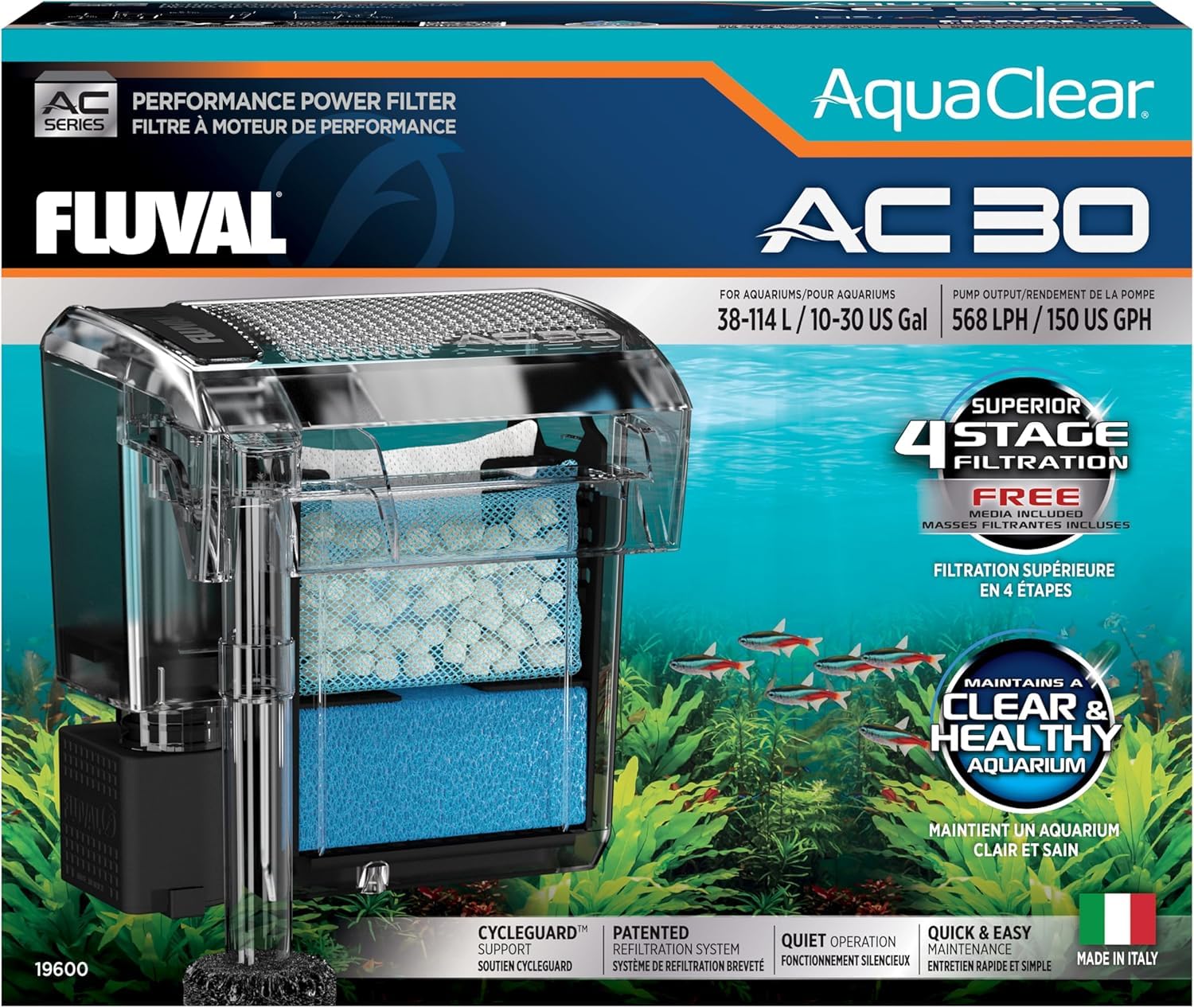
Rating: 4.2 ★ | Price: $$ | Filtration Type: HOB | Flow Rate: 150 GPH adjustable | Media Cost: Reusable foam + carbon | Physical Footprint: Standard
The AquaClear 30 offers a large media basket that fits custom combinations of foam, ceramic rings, or chemical media – a plus for planted tank enthusiasts. Its three-stage filtration is effective, but motor durability varies and noise can be noticeable. For a 10-gallon tank, adjustable flow helps, but these reliability tradeoffs prevent it from being a top pick in this size class.
Pros
- Large media capacity accepts custom filter media beyond standard carbon.
- Three-stage filtration provides effective mechanical, chemical, and biological polishing.
Cons
- Motor durability may vary – some units can stop working within months.
Suited for hobbyists who want to experiment with filter media and can accept the tradeoffs in noise and consistency.
Best for Larger Tanks (20+)
Marineland Penguin 200

Rating: 4.3 ★ | Price: $$ | Filtration Type: HOB Bio-Wheel | Flow Rate: 200 GPH | Media Cost: Disposable Rite-Size | Physical Footprint: Standard
The Penguin 200 offers strong water polishing and a Bio-Wheel for biological filtration at a good value. But its 200 GPH flow is too strong for a 10-gallon tank without baffling, stressing delicate fish. The Bio-Wheel can stop spinning, and the unit’s noise may be intrusive in quiet spaces. This filter works best for 20-40 gallon tanks.
Pros
- Effectively clears cloudy water in 20-40 gallon tanks.
- Bio-Wheel adds biological filtration to mechanical and chemical media.
Cons
- Non-adjustable 200 GPH flow creates strong currents unsuitable for delicate fish in a 10-gallon tank.
This filter is a practical choice for owners of 20-40 gallon tanks who want a budget-friendly HOB with Bio-Wheel, but it’s not recommended for 10-gallon setups.
How to Choose
For a 10-gallon tank, the filter’s flow rate and adjustability matter more than its brand or price, especially if you keep bettas or shrimp.
Filtration Type
Sponge filters provide gentle biological and mechanical filtration without a motor; they rely on an air pump. HOB (hang-on-back) filters draw water up and spill it back, offering more media options but often creating current. Internal submersible filters sit inside the tank, silent but with limited surface area. Canister filters move water through external media baskets, giving the best water clarity but requiring external plumbing. Undergravel filters use the substrate as biological media, but need a power head or strong air pump to drive flow.
The right type depends on your livestock: delicate fish prefer sponge or adjustable HOB; active species tolerate stronger currents from canisters or high-flow HOBs.
Flow Rate and Adjustability
Flow rate is measured in gallons per hour (GPH). A 10-gallon tank should turn over water 4–6 times per hour, so 40–60 GPH is sufficient for low-bioload tanks. However, many HOB filters marketed for 10 gallons push 100–200 GPH, creating a whirlpool that stresses bettas and shrimp.
Adjustable flow is a critical feature for small tanks: a dial or slide lets you reduce current to a gentle trickle. Without adjustability, you may need to baffle the output with a sponge or bottle – an extra step that many buyers overlook.
Media Replacement Cost
Disposable filter cartridges (common in Tetra, Marineland, Aqueon) require replacement every 3–4 weeks at $4–8 per pack. Over a year, that adds $50–100 – often exceeding the initial filter cost. Reusable media (sponges, ceramic rings, foam blocks) last years with only occasional rinsing in tank water.
Sponge filters and canister filters like the AquaClear 30 use reusable foam that saves money long-term, though initial setup may be slightly more involved.
Noise Level
Motor noise from HOB filters is the top complaint in this category. External pump designs (e.g., Marineland Penguin) are louder because the motor vibrates against the tank rim. Internal submersible pumps (Tetra Whisper Internal, Marina S10) are much quieter because water dampens vibration. Sponge filters only produce air pump noise – barely audible with a quality air pump.
For bedroom or office tanks, choose a filter with an internal pump or a sponge filter. Canister filters are virtually silent but cost more.
Physical Footprint and Maintenance
HOB filters hang on the back, taking up no internal space but protruding outward – check your tank’s rim and lid clearance. Internal filters sit inside, reducing swimming area. Sponge filters are tiny and can be hidden behind decor. Canister filters sit under the tank, requiring cabinet space.
Maintenance frequency varies: sponge filters need squeezing every 2–4 weeks; HOB cartridges need swapping; canister filters need media rinsing every 2–3 months. Simpler designs (sponge) are easier to maintain than multi-stage cartridges.
FAQ
Why is my hang-on-back filter so loud on my 10 gallon tank?
HOB filters are often loud because the motor vibrates against the tank rim, and the water splash creates noise. To reduce noise, ensure the water level is high enough to minimize the waterfall drop, and check that the filter is level. If the motor itself is rattling, it may indicate debris or a failing pump. For a permanently quiet setup, switch to a sponge filter or an internal submersible filter like the Tetra Whisper Internal.
Can I use a canister filter on a 10 gallon aquarium?
Yes, you can, but it’s overkill for most 10-gallon tanks. Canister filters like the Fluval 107 provide exceptional water clarity and near-silent operation, but the upfront cost (over $100) and maintenance (media rinsing, seal checks) are hard to justify for a small tank unless you have a high-tech planted setup or very sensitive fish. For most 10-gallon keepers, a sponge or HOB filter is more cost-effective.
Do I need an air pump for a sponge filter to work?
Yes. Sponge filters are air-driven: they require a separate air pump to push air up the lift tube, drawing water through the sponge. The air pump and tubing are not included with most sponge filters (the AQUANEAT Sponge Kit is a notable exception that includes tubing and valves). You can use a standard aquarium air pump rated for your tank size – a small nano pump is sufficient for a 10-gallon tank.
How often should I clean a sponge filter in a 10 gallon tank?
Clean the sponge every 2–4 weeks, or when you notice the flow slowing down. The proper method is to squeeze the sponge in a bucket of old tank water removed during a water change – never use tap water, as chlorine will kill beneficial bacteria. A gentle squeeze is enough to remove debris; aggressive squeezing can damage the sponge. Replace the sponge after about a year if it starts to degrade or lose shape.