This post contains affiliate links. We may earn a small commission when you buy through our links — at no extra cost to you.
Green water doesn’t announce itself. One morning the tank is clear; two days later you can’t see the back glass, and every water change buys you a week at best. A UV sterilizer fixes that by running water past a quartz-sleeved bulb that scrambles the DNA of free-floating algae and the parasites behind ich, so what leaves the unit can’t reproduce. What it won’t do is outrun an overstocked, overfed tank — no bulb fixes water chemistry. Over the past eight months I’ve run nine of these on everything from a nano reef to a 75-gallon community setup, and the good ones separate themselves fast.
Clarity is the payoff everyone talks about, but the differences I cared about were quieter: whether the indicator light tells you the bulb is alive or just that the plug works, whether the housing feels solid and the sleeve reseats without weeping, and whether a year of replacement bulbs costs more than the unit did. A sterilizer is a slow, steady performer, and the wrong one wastes your money quietly. Here’s what earned a permanent spot under my tanks.
Our Top Picks
The Best Aquarium Uv Sterilizers, Reviewed
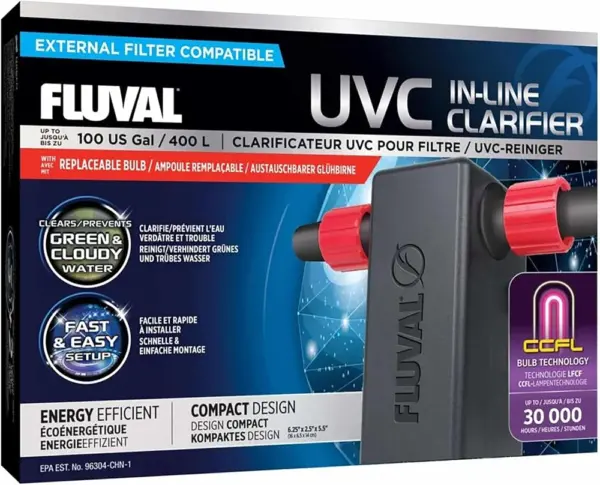
Fluval in-Line UVC Clarifier – Best Overall
Key Features
- Weight: 15.8 oz
- Warranty: 2 years
- Hose size: 5/8 in
- Installation: In-line on filter return hose
- Price: Premium
Before you order, measure the hose on your filter’s return line. This clarifier splices into 5/8-inch tubing, which covers Fluval’s own 207, 307 and 407 canisters and most other canister setups that size, but not the wider hose on the FX6. If yours measures 5/8 inch, everything below applies.
What separates it is where it sits. The lamp lives in a sealed sleeve in the return line, so nothing new goes into the display: no box against the glass, no cord in the water, no current to work around. We have run in-tank units that cleared water just as well and still reached for this one first, because a tank you look at every day should not collect another appliance.
Expect a few days rather than overnight. Green water clears steadily once water is moving past the lamp, and the same UV knocks down the free-floating bacteria behind a milky bloom. Beyond clarity you are paying for build: a two-year warranty is the longest on this page, and the housing and fittings are made for a filter line rather than adapted to one.
The blind spot is the lamp itself. There is no dependable way to look at the unit and know it is still emitting, and UV output fades quietly long before a lamp fails outright. The water will tell you before the housing does.
Pros
- Nothing extra sits in the display tank
- Clears green water over a few days
- Two-year warranty, the longest of our picks
Cons
- Sealed lamp; the whole unit is the replacement
If your filter runs 5/8-inch hose, this is the clarifier we recommend without hesitation: sealed from the tank, quick to clear green water, and backed for two years.
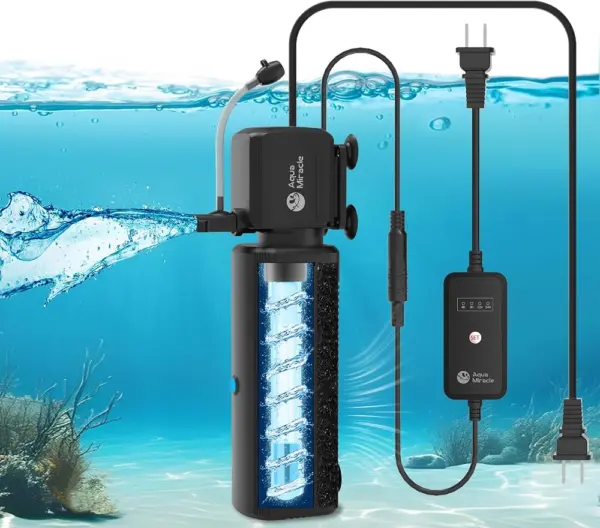
AquaMiracle SV-500 – Best for Small Tanks
Key Features
- Modes: Aeration and rainfall
- UV lamp: 6W
- Max flow: 130 GPH
- Tank range: 10–30 gal
- Price: Midrange
Ten to thirty gallons is the band where an internal UV filter earns its keep, and this is the one we like most in it. A 130 GPH pump, a 6W lamp and a sponge share a single housing that hangs inside the tank, so clearing green water does not mean adding a second appliance to a small setup.
The timer is what sells it. You can run the lamp for a stretch and then switch it off, which matters because a UV lamp has a fixed number of useful hours and a small tank does not need round-the-clock treatment once the water is clear. An observation window in the housing lets you see the lamp glowing without pulling the unit out, and the return can run as an aerating venturi or a rainfall outlet depending on how much surface movement your fish tolerate.
Expect green water to go from soup to clear in about two days if the unit is matched to the tank. The sponge catches what the lamp frees up, so rinse it at every water change — a clogged sponge is the quickest way for one of these to start underperforming.
Pros
- Timer runs the lamp in set stretches
- Filtration and UV in one housing
- Observation window shows the lamp is on
Cons
- 130 GPH is strong current for a 10-gallon
For 10- to 30-gallon tanks this is the unit we reach for: a timed UV lamp and a sponge in one submerged package, so clearer water costs you one piece of equipment, not two.
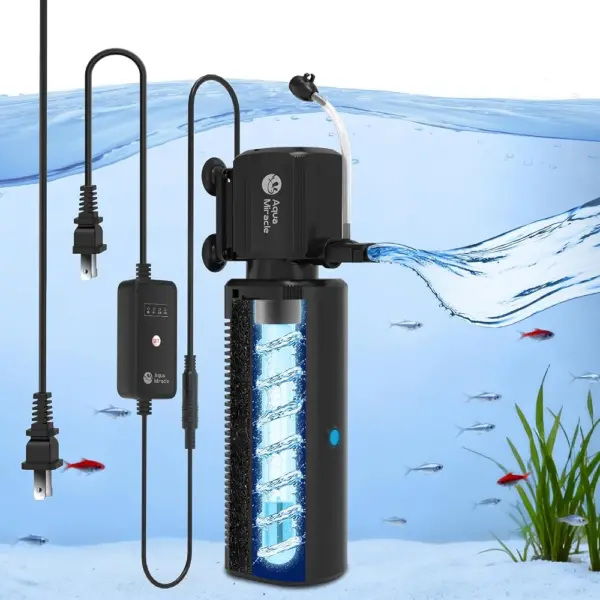
AquaMiracle SV-800 – Best for Mid-Size Tanks
Key Features
- UV lamp: 6W
- Max flow: 225 GPH
- Tank range: 20–70 gal
- Timer settings: 4/8/12/24 hours
- Price: Midrange
The SV-800 is the SV-500 stretched to a bigger tank: 225 GPH instead of 130, a 20- to 70-gallon rating instead of 10 to 30, and the same arrangement of sponge, lamp, window and timer. Above about 40 gallons this is the AquaMiracle we fit, because the smaller unit’s pump cannot turn that much water past the lamp in an hour.
The detail worth knowing is that the lamp does not grow with the tank. Both units use a 6W UV lamp; the SV-800 covers more water by moving it faster, not by burning brighter. That is a sensible trade for green water — more passes per hour at a moderate dose — but it is not the same as a bigger lamp, so a crowded 70-gallon will take longer to clear than a lightly stocked 40.
In use it does what this design does at its best: green water clearing over a few days, strong air through the venturi, and quiet enough that the water movement is louder than the motor. The pump has no flow dial, so the rainfall outlet is how you soften the return in a tank at the low end of its range. Set the timer for a stretch rather than all day and the lamp lasts longer.
Pros
- 225 GPH turns over a 40- to 70-gallon tank
- Four timer settings, up to 24 hours
- Quiet enough for a living room
- Rainfall and aeration outlets in one unit
Cons
- Setup instructions are hard to follow
For 40- to 70-gallon tanks we take the bigger AquaMiracle: 225 GPH past the same 6W lamp clears a bloom in days, and the timer keeps it off when you do not need it.
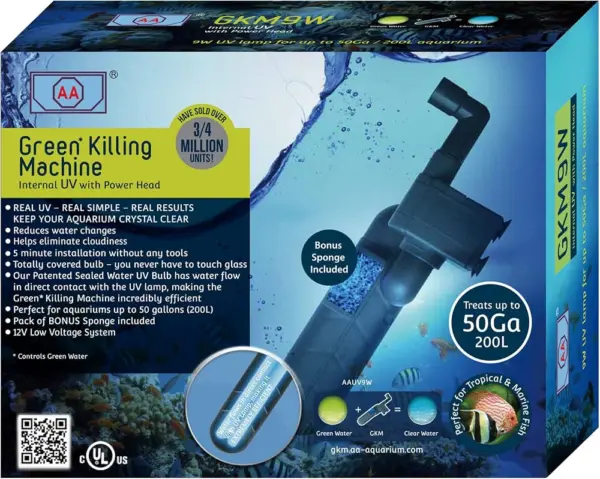
AA GKM9W – Best for Easy Bulb Changes
Key Features
- UV lamp: 9W
- Bulb life: 6–9 months
- Pump flow: 50 GPH
- Tank range: Up to 50 gal
Almost every UV unit here hides the lamp in a sealed housing and gives you no way to check it is still emitting. The GKM9W is the exception: an LED on the control box signals when the bulb is due, and the bulb itself comes out without tools.
That single design decision is why it is on this list. A UV lamp fades gradually, so a unit that hides its bulb can be running at half strength for weeks while you blame the algae. Being able to see the warning light, and to swap the bulb yourself in a couple of minutes, is worth more to us than another hundred gallons of claimed coverage.
The rest is deliberately modest. It is submersible, needs no plumbing, and covers up to 50 gallons with a 9W lamp behind a 50 GPH pump. That flow is slow on purpose — long contact time per pass is how a 9W lamp does useful work — so it complements your filter rather than replacing it. Anyone hoping to add circulation to a still tank is looking at the wrong product.
Bulb life is the number to plan around: six to nine months of constant use, longer if you only run the lamp after dark or once the water has cleared. A spare bulb on the shelf is the sensible way to own one, and it is worth knowing the one-year cover stops at wear parts before you rely on it.
Pros
- LED signals when the bulb needs replacing
- Bulb changes without tools
- No plumbing; drops straight into the tank
Cons
- New bulb every six to nine months
- One-year cover excludes wear parts
The unit we choose when we want to keep a sterilizer running for years: the bulb comes out, an LED tells you when, and it drops in without plumbing.
hygger 3W UV Lamp – Best for Nano Tanks
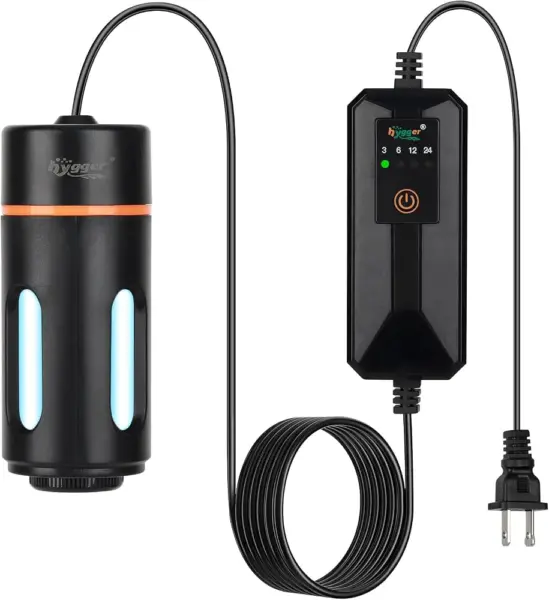
Key Features
- UV lamp: 3W
- Warranty: 2 years
- Tank range: 5–25 gal
- Timer settings: 3/6/12/24 hours
- Price: Budget
A 3W lamp roughly the size of a thermometer, with a plug, a timer and two suction cups: that is the whole product. For a 5- to 25-gallon tank it is the low-cost route into UV, and unlike the pump-driven units here it adds no current and takes up almost no room.
Placement is the whole game. Put it in a filter chamber or behind a sponge and it treats water as it is drawn past; hang it in open water and it works on whatever drifts near it. The timer with memory covers 3, 6, 12 and 24-hour runs, so you can set a nightly schedule once and stop thinking about it.
It earns its place as a supplement rather than a cure: in a small tank with a filter already turning the water over, a shielded 3W lamp on a nightly timer is enough to stop a mild green-water problem taking hold, which is the job we use it for. What it cannot do is rescue a 30-gallon tank in the middle of a bloom — there is neither the power nor the flow.
The shield matters more than the spec sheet lets on. UV-C at 254nm damages fish tissue and plants on direct exposure, so closed-shield is the only mode that belongs in a display tank; the open mode is for a filter compartment with nothing living in the beam. Treat the timer as convenience rather than a safeguard too — if it fails, the lamp can stay lit past its setting, so unplug the unit when you are away.
Pros
- Tiny footprint in a nano tank
- Timer with memory, 3 to 24-hour runs
- Shielded design allows in-tank use
Cons
- Only works where your flow carries water past it
For a nano tank or a filter chamber, this is the low-cost route into UV: a timed 3W lamp that clears green water if you place it where the flow passes.
How We Tested the Best Aquarium UV Sterilizers
Every unit here started with a spec sheet, not a hunch. I pulled sterilizers that fit the plumbing people actually run — half-inch and five-eighths hose barbs, canister and hang-on-back returns, sump feed lines — then narrowed by wattage-to-flow ratio and, just as importantly, by whether replacement bulbs and quartz sleeves were easy to find and sensibly priced. Nine units made the cut, and each ran for eight months across a 20-gallon nano, a 75-gallon community tank, and a 40-gallon breeder I let go green twice on purpose.
Flow came first. I timed a gallon through each unit with a stopwatch and a bucket, then checked that number against the manufacturer’s recommended range, because a sterilizer pushed too fast is just an expensive pipe. Clarity got a photo log: the same white card behind the glass, same lamp, every three days, plus a note on how many days the green tanks took to go from pea soup to readable. I recorded what the indicator light actually reported — power on versus bulb alive — and whether it came back clean after I killed the breaker mid-cycle.
Reliability was boring, unglamorous stuff: whether the seals wept after I reseated a sleeve, how much film collected on the quartz in a month, and how the housing held up to being taken apart and put back together. Near the end I ran bulbs past their rated hours to watch how fast the output fell off, then priced three years of replacements against the purchase price to see what value really looked like. Some units lost their edge long before the bulb died — that’s the kind of thing a spec sheet never tells you.
How to Choose an Aquarium Uv Sterilizer
The first decision is not wattage or price — it is whether the unit goes in your filter line or in the water, and that single choice rules out half the options before you look at anything else.
In-line or in the tank
An in-line clarifier splices into a filter hose and treats water on its way back to the tank; an internal unit sits in the water with its own pump, or with no pump at all. In-line is tidier and puts nothing extra in the display, but it only works if you already run a canister filter with the right hose. The Fluval here takes 5/8-inch tubing, which rules out its own FX6.
If you are on a hang-on-back or a sponge filter, an internal unit is the only practical route. Measure the hose diameter before you order rather than after.
Match the flow to the tank, then the gallon rating
A UV unit only treats water that passes the lamp, so the number on the box is really a statement about pump flow and contact time. A 130 GPH pump on a 10-gallon tank is a lot of current; a 50 GPH pump on 50 gallons is a slow turnover that clears a bloom gradually.
Match the flow to the tank first. The AquaMiracle SV-500 suits 10 to 30 gallons, the SV-800 covers 20 to 70, and the AA unit’s gentle 50 GPH is designed to sit alongside your existing filtration rather than move the tank on its own.
Sealed lamp or replaceable bulb
UV output falls off long before a lamp goes dark, which is why replacement matters. A sealed unit like the Fluval has no bulb to buy, but the clarifier itself becomes the replacement part. A unit like the AA GKM9W takes a new bulb in minutes and warns you with an LED when it is due, at the cost of a bulb every six to nine months.
If you want to know the lamp is working, choose a visible indicator or an observation window. Several units here have one, and it is more useful than another watt of claimed output.
Run it on a schedule, not around the clock
Lamps have a finite number of useful hours, and a clear tank does not need UV all day. Timers on the AquaMiracle units and the hygger lamp let you run a few hours a night and switch off, which stretches bulb life and stops you treating a problem the tank no longer has.
Once the water has stayed clear for a couple of weeks, dropping to a maintenance schedule is normal rather than a compromise.
What UV will not do
It is a water-column treatment, not a cleaning service. UV clears green water and free-floating bacteria, and does nothing about algae on the glass, detritus in the substrate or nitrate building between water changes.
It will not compensate for overstocking or overfeeding either — if anything, a sterilizer makes those problems less visible while they continue. Fix the cause, then let the UV handle the clarity.
Frequently Asked Questions
Will a UV sterilizer kill the beneficial bacteria in my filter?
No. The bacteria that process ammonia and nitrite live on surfaces — filter media, substrate, glass — and a UV unit only affects what passes through its lamp in the water column. A correctly installed sterilizer leaves your biofilter alone.
It will not speed up a cycle either, so do not buy one expecting a new tank to mature faster.
Does an in-line UV clarifier go before or after the filter?
After it, on the return side. Water that has already been through the mechanical and biological stages carries less debris, so cells are not shielded from the lamp and the quartz sleeve stays cleaner for longer.
Plumb it into the return hose between the canister outlet and the tank, and keep the run short so you do not lose flow.
Is it safe to run a UV lamp in a tank with fish?
With a shielded in-tank unit, yes — the housing keeps the light away from livestock. Direct UV-C exposure is a different matter: it damages fish tissue, plants and your own eyes, so open-lamp modes belong in a filter chamber with nothing living in the beam.
Unplug any unit before you reach into the tank.
Final Verdict
The Fluval in-line clarifier is the one we recommend to anyone whose filter runs 5/8-inch hose: sealed away from the tank, quick to clear a bloom, and covered for two years, which is what makes a lamp you cannot replace an acceptable trade.
If your tank runs a hang-on-back or a sponge filter, go internal instead. The AquaMiracle SV-500 is the better buy for 10 to 30 gallons and the SV-800 for 20 to 70, both with a timer that keeps the lamp off once the water is already clear.