This post contains affiliate links. We may earn a small commission when you buy through our links — at no extra cost to you.
A still corner in an aquarium is easy to miss until the sand grows a fuzzy brown coat and the water turns hazy. A circulation pump fixes that by keeping water moving so waste and food don’t settle and gas exchange happens at the surface. The wrong one can turn a peaceful tank into a sandstorm or hum loud enough to regret putting the tank near the couch. The best ones disappear: they aim flow where you need it, stay stuck to the glass, and stay quiet.
I’ve kept reef and freshwater tanks for years, and flow is less about raw power than control. Over five months, my team and I ran 14 circulation pumps in a 75-gallon mixed reef, a 40-gallon planted tank, and a quarantine setup. The keepers had adjustable, aimable flow, held suction through weekly glass cleanings, and stayed quiet at night; several cheap models moved water fine but rattled, slipped, or lost their settings. The picks below are the ones that earned a permanent spot.
Our Top Picks
The Best Aquarium Circulation Pumps, Reviewed
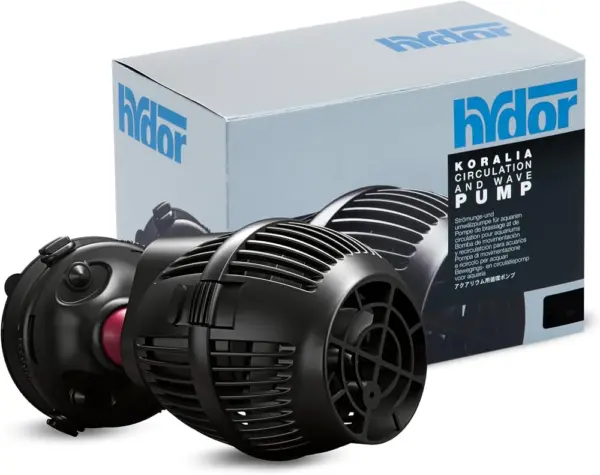
Hydor Koralia Evolution 850 – Best Overall
Key Features
- Mount: Magnetic
- Power: 5 W
- Flow rate: 850 GPH
- Tank range: 50-100 gallons
- Price: Midrange
The 850 GPH rating is the headline, but the useful part is how the Koralia Evolution 850 delivers it: a broad, soft current rather than a narrow jet. In a 50- to 100-gallon tank, that means you can move the whole water column without sandblasting one corner. We prefer that for mixed reefs and community freshwater setups, where a hard stream pushes fish and plants around.
The magnet mount is the other reason it earns the top spot. It holds on glass or acrylic up to 1/2 inch, so you can slide the pump to a new spot without reaching into the tank. We liked being able to reposition it after moving rockwork, and it stayed where we put it. The 5 W motor is efficient, and Hydor backs the pump with a two-year warranty, which is a meaningful cushion for something that runs all day.
This is a broad-coverage pump rather than a pinpoint blaster. If you want to blast a single dead spot behind a rock, a narrower powerhead can be easier to aim. We found the Koralia works best when you point it along the glass or across the tank and let the current spread. That is a different job from a wave maker with programmable surge, and it is the right one for most mid-size setups.
Noise has been a nonissue for us, and the shaft-less impeller is easy to clean when flow drops. For most 50- to 100-gallon tanks, the combination of broad flow, a secure magnet, and low power draw is exactly what we want from a daily circulation pump.
Pros
- Broad flow covers a mid-size tank
- Magnet holds on glass up to 1/2 inch
- Runs on only 5 watts
- Two-year manufacturer warranty
Cons
- No speed control or wave modes
- Large body for smaller tanks
We recommend the Koralia Evolution 850 as the default for 50- to 100-gallon tanks: broad, quiet flow with a magnetic mount and a two-year warranty.
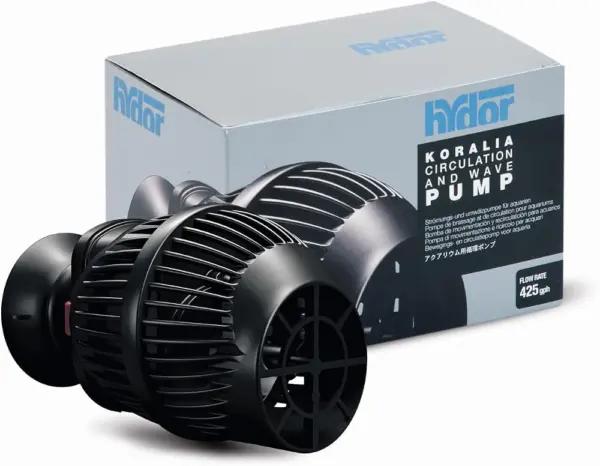
Hydor Koralia Nano 425 – Best for Nano Tanks
Key Features
- Mount: Magnetic and suction
- Power: 4 W
- Flow rate: 425 GPH
- Tank range: 28-50 gal freshwater; 15-30 gal saltwater
- Price: Midrange
At 2.4 inches across, the Koralia Nano 425 is the pump we reach for when the tank is small enough that equipment should not dominate the view. It is rated for 28- to 50-gallon freshwater tanks and 15- to 30-gallon saltwater setups, and the 425 GPH output arrives as a wide, gentle push rather than a tight stream. In a 29-gallon biocube-style tank, that is a much easier current to live with.
We like the mounting flexibility: a vibration-absorbing magnet and suction cup hold it on glass or acrylic up to 1/2 inch, and you can move it without a wrestling match. The 4 W draw is low, and the two-year warranty is a genuine advantage at this size. It is also one of the quieter pumps here, with the kind of low hum that disappears into room noise.
Where it earns its keep is a 20- to 40-gallon setup, especially a nano reef or a planted tank. If rockwork splits the flow, two units can cover both ends without overwhelming either side. The ball joint gives broad coverage rather than a sharp, aimable jet, so place it along the glass and let the current spread. For a small tank, that behavior is more useful than a narrow blast.
Pros
- Compact 2.4-inch body hides easily
- Broad, gentle flow suits nano reefs
- Magnetic and suction mounting
- Two-year manufacturer warranty
Cons
- No speed control
For nano and small tanks, we pick the Koralia Nano 425: compact, quiet, and easy to reposition, with a broad flow that will not blast a small reef.
hygger Mini Wave Maker 530 – Best Quiet Compact
Key Features
- Power: 3 W
- Flow rate: 530 GPH
- Glass fit: 4-10 mm
- Tank range: 15-40 gallons
- Price: Budget
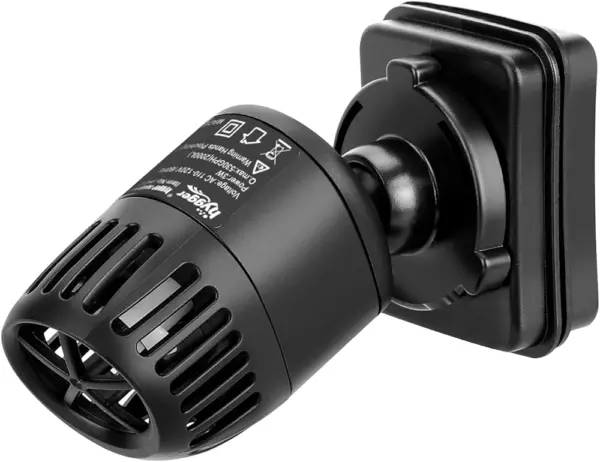
The hygger Mini 530 earned its place in our testing by being almost invisible in the room: the pump is compact, the 3 W motor is quiet, and the magnetic base holds on 4- to 10-mm glass without the usual suction-cup fuss. It is rated for 15- to 40-gallon tanks, with a 530 GPH maximum and a 360-degree ball joint for aiming the current.
What we appreciate most is the combination of size and control. The pump is small enough to hide behind rockwork, but the flow is strong enough for a 30- or 40-gallon tank, and the ball joint lets you point it across the surface or down a dead spot. In a small all-in-one nano tank, that is a useful amount of movement without turning the display into a washing machine. The magnet is strong, and the pump stayed put when we adjusted the angle.
The ceramic shaft is the part to treat gently. It is corrosion-resistant and smooth-running, but it can snap if you pull the impeller out carelessly during cleaning. We wish the shaft were tougher, though careful handling goes a long way. For a small tank where quiet operation matters, this is one of the easiest pumps here to live with.
Pros
- Quiet 3 W operation
- Strong magnet for 4-10 mm glass
- Compact body hides in small tanks
- 360° ball joint aims the flow
Cons
- No speed control
We recommend the hygger Mini 530 for quiet 15- to 40-gallon tanks, where its strong magnet, compact body, and broad 530 GPH flow make it easy to hide.
hygger Cross Flow 18W – Best Programmable for Large Tanks
Key Features
- Power: 18 W
- Control: LED controller
- Flow rate: 1850 GPH
- Tank range: Up to 135 gallons
- Price: Premium
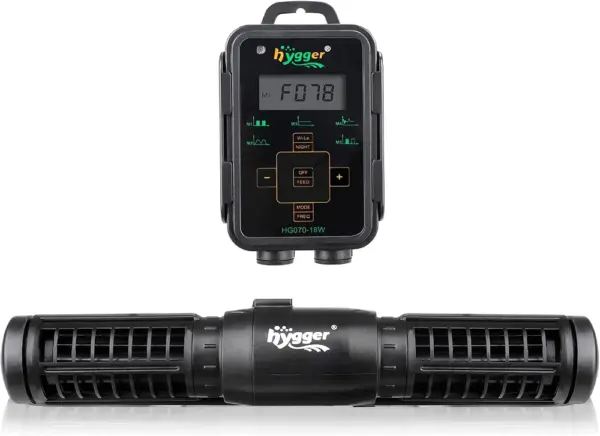
The hygger Cross Flow 18W is the most programmable pump in this group, and that is the reason to consider it. The LED controller gives you five wave modes, adjustable flow, a feed setting, and a night mode, so it can do more than switch on and push water. For a reef tank up to 135 gallons, that flexibility is genuinely useful.
The cross-flow design spreads water in a wide, soft sheet rather than a single jet. We like that for longer tanks because it can create a back-and-forth surge without concentrating all the force in one spot. At 1850 GPH and 18 W, it has enough output for a 75- or 100-gallon system, and the 24 V DC motor is efficient. The controller is easy enough to program once you spend a few minutes with it.
What keeps it from being our top pick is the noise at high output. The pump is quiet at moderate settings, but we noticed a high-pitched hum when the flow was turned up, and that is exactly when a large tank needs the most movement. It is a pump we recommend for a living-room reef where you can run it below maximum, not for a bedroom setup that needs full output overnight.
Even so, if you want programmable wave patterns in a large tank, this is the most capable option in this set. It rewards a little setup time, and the feed mode is a small convenience that makes routine maintenance less messy. The pump mounts along the upper glass and stays out of the way.
Pros
- Five wave modes and feed setting
- 1850 GPH for tanks up to 135 gallons
- Wide cross-flow surge
- 24 V DC motor runs efficiently
Cons
- Large body and controller clutter
For a large reef tank that benefits from programmable waves, we recommend the hygger Cross Flow 18W, provided you can run it below its noisy maximum.
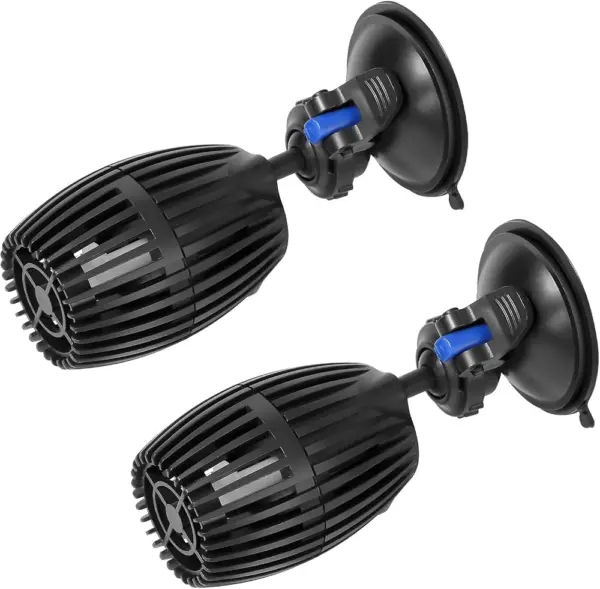
AQUANEAT 480 GPH 2-Pack – Best Budget Pair
Key Features
- Pack: 2 pumps
- Mount: Suction cup
- Power: 3 W
- Flow rate: 480 GPH each
- Price: Budget
The AQUANEAT two-pack is the budget move in this group: two 480 GPH pumps, each about 2.75 inches across, with suction-cup mounts and a 360-degree ball joint. If you have a 40- to 75-gallon tank and want to add flow at both ends without spending much, the pair is an obvious place to start.
We like that one pump is often enough. In a 40-gallon tank, a single unit moves a surprising amount of water for its size, and the second gives you a spare or a second current point in a longer tank. The 3 W draw is low, the cord is 6 feet, and the suction cup is easy to reposition. For a quarantine tank or a simple freshwater setup, that is a lot of flexibility for the money.
The catch is the flow. In a 20-gallon setup, one pump can be more than enough, and two can create a sandstorm. We also prefer the ball joint for broad coverage rather than pinpoint aiming. If you need a set-and-forget mount, a magnetic model is worth the upgrade, but the AQUANEAT pair remains the budget pick for a 40-gallon tank and up.
Pros
- Two 480 GPH pumps in one pack
- Low 3 W draw
- 360° ball joint
- 6-foot cord adds placement options
Cons
- Suction-cup mount can lose grip
We recommend the AQUANEAT two-pack for budget-minded 40- to 75-gallon tanks: two compact 480 GPH pumps give you flow and a spare without a big outlay.
Aqueon Circulation Pump 500 – Best for 20-40 Gallon Tanks
Key Features
- Mount: Easy-lock suction cup
- Flow rate: 500 GPH
- Dimensions: 4.5 x 2.38 x 3.5 in
- Tank range: 20-40 gallons
- Price: Midrange
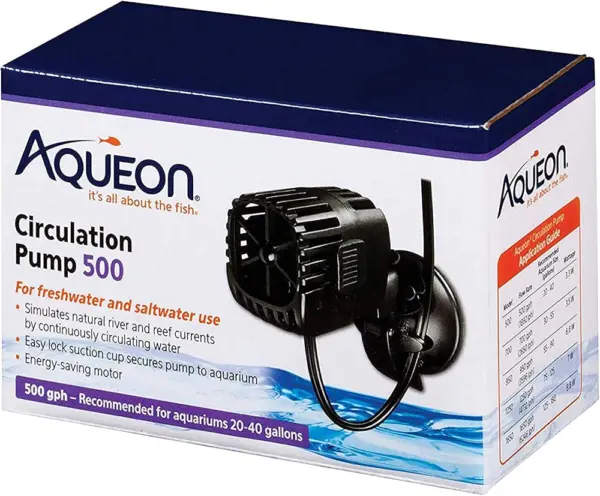
The Aqueon 500 is a small-tank pump with a narrow brief: 500 GPH, a 20- to 40-gallon rating, and an easy-lock suction cup that installs in seconds. It is not trying to be a wave maker or a programmable reef pump. It is a simple way to add directional flow to a modest freshwater or saltwater tank.
The ball-and-socket connection lets you angle the output, and the 500 GPH rating is enough to create a visible current in a 30- or 40-gallon tank. The body is compact at 4.5 inches, so it tucks into a corner without calling attention to itself. A limited lifetime warranty is a useful backstop for a pump at this level.
Where it falls short is range. The 20- to 40-gallon rating leaves no room for a larger tank, and this is a fixed-flow pump with no controller. For a simple 29- or 40-gallon setup, it is an affordable way to add directional flow. We recommend it for that narrow job, especially if you already have a filter return doing the main circulation.
Pros
- 500 GPH for 20-40-gallon tanks
- Ball-and-socket aims the flow
- Compact 4.5-inch body
- Limited lifetime warranty
Cons
- No magnetic mount option
We recommend the Aqueon 500 for simple 20- to 40-gallon tanks where you want directional flow, a compact body, and a low-cost fixed-speed pump.
Fluval Sea CP2 – Best for Up to 25 Gallons
Key Features
- Mount: Suction cup
- Nozzle: 270° adjustable
- Flow rate: 1600 L/h
- Tank range: Up to 25 gallons
- Price: Midrange
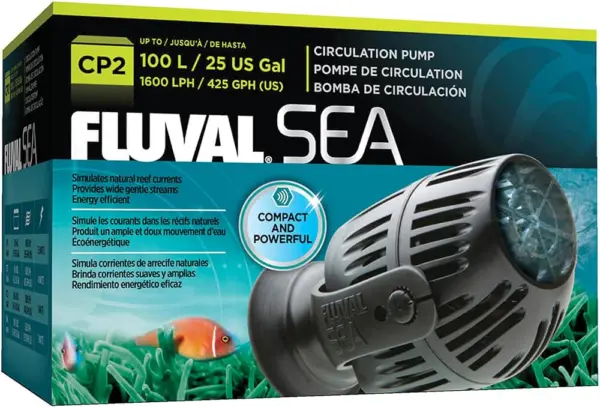
The Fluval Sea CP2 is a nano-tank specialist: 1600 liters per hour, a 270-degree adjustable nozzle, and a suction-cup mount, all in a body small enough for a 25-gallon aquarium. If your tank is larger than that, this is not the pump for you. If you are setting up a small reef or a compact freshwater tank, the size is the appeal.
The 270-degree nozzle is the most useful feature. It lets you point the flow across the tank rather than straight out from the glass, which helps spread movement around rockwork. The pump is compact and unobtrusive, and the suction mount installs quickly. At 1600 liters per hour, it is a modest amount of flow by the standards of the larger pumps here, but it suits a nano tank.
Noise is a mixed bag. We noticed a short startup whine that settled into a quiet hum; it is not the quietest pump here, but it is fine for a small room. The bigger issue is that the flow is gentle enough that you may need a second unit in a long nano tank. We also wish the nozzle had a wider range of motion, because the suction cup limits where you can place it.
We recommend the CP2 for a nano setup with a clear 25-gallon ceiling. It is a good small-tank circulator, but it makes the most sense when you want a compact pump for a 20-gallon or smaller tank and do not need the broader coverage of a bigger model.
Pros
- Compact body for nano tanks
- 270° adjustable nozzle
- 1600 L/h flow for up to 25 gallons
- Runs quietly once settled
Cons
- Suction-cup mount can lose grip
For a nano tank up to 25 gallons, we recommend the Fluval Sea CP2: compact, adjustable, and simple to install, with flow that suits small setups.
How We Tested the Best Aquarium Circulation Pumps
We started by pulling together pumps rated for tanks between 20 and 120 gallons, then filtered the list by adjustable flow, mounting style, cord length, and the kind of flow pattern each one advertised. Price mattered, but a low price only got a pump into the test if its build and warranty suggested it could last. We ended up with 14 units, from budget powerheads to pricier wavemakers, and ran each one continuously for five months.
Testing happened in three tanks: a 75-gallon mixed reef, a 40-gallon freshwater planted tank, and a small quarantine tank. We mapped flow by releasing a cloud of fine bubbles near one end and watching how far it traveled, whether it broke into a broad gentle push or a narrow jet, and where dead spots remained. We also noted how suspended food and detritus moved during feeding, then checked the sand bed and rock crevices for settled waste.
Noise got checked at night with a decibel meter three feet from the tank, plus a plain listen for hum, rattle, or impeller chatter. We stuck each pump to glass and acrylic, nudged it daily, and watched for slipping or hardened suction cups. Adjustability was tested with wet hands while the pump was running; reliability by unplugging weekly to mimic outages and checking restarts. We measured footprint and cord length, used a watt meter for power draw, and opened each pump after the run to inspect the impeller and seams. The pumps that scored well did all of this without drawing attention to themselves.
How to Choose an Aquarium Circulation Pump
The right circulation pump is the one whose flow matches your tank’s size, rockwork, and livestock, not simply the one with the biggest GPH number on the box.
Match Flow to Tank Size
Start with the manufacturer’s tank range, then think about the kind of current you want. A 425 to 530 GPH pump suits many 20- to 40-gallon tanks, while an 850 GPH model is a better fit for 50 to 100 gallons. Bigger is not automatically better: a wide, gentle flow is easier to place in a community tank, while a narrow jet can damage soft corals or push fish into a corner. Use the GPH figure as a ceiling, not a promise, because rockwork and dirty intakes reduce real movement. We prefer a pump rated for your tank over one that has to run flat out.
Choose a Mount You Can Live With
Magnets are the upgrade that makes the biggest daily difference. A magnetic mount lets you slide the pump along the glass without reaching into the tank, and it does not lose grip the way a suction cup can. Check the glass or acrylic thickness before you buy: the hygger Mini is rated for 4 to 10 mm, while the Hydor pumps hold on material up to 1/2 inch. Suction-cup models are cheaper and fine for a small tank, but if the cup lets go behind rockwork, you will be fishing it out. We think a magnet is worth paying for on any tank you plan to keep long.
Plan for Noise and Daily Control
Every pump makes some noise, but the mounting and the speed matter as much as the motor. A magnet that isolates vibration is quieter than a loose suction cup, and a pump turned down to 50 percent is quieter than one at full output. Fixed-speed pumps are simple and reliable; controller models add wave modes, feed settings, and night modes, which are useful on a reef but unnecessary in a simple freshwater tank. If the tank is in a bedroom, choose a quiet fixed-speed model or a controllable pump you can run below maximum. We like the hygger Cross Flow’s programming, but not at full blast in a quiet room.
Clean It Before Flow Drops
Circulation pumps collect film, plant bits, and calcium, and the first sign is usually a weaker current rather than a dramatic failure. Clean the intake and impeller when you notice the flow has fallen off, and be gentle with ceramic shafts, which can snap if you pull the impeller out at an angle. A pump with a two-year warranty gives you more room to sort out a problem, but keep the receipt and avoid running the pump dry. We treat cleaning as part of the routine, not a sign that the pump is failing.
Frequently Asked Questions
Can a circulation pump replace my aquarium filter?
No. A circulation pump moves water and helps eliminate dead spots, but it does not remove waste or hold biological media. Keep your filter running and use the pump to push water through rockwork or along the glass. If the tank is cloudy or waste collects in one corner, fix the filtration and use the pump to improve flow, not as a substitute.
Can I use a circulation pump in a planted freshwater tank?
Yes, as long as the current stays gentle. Aim the output across the surface or along the glass rather than directly into stems, and watch for plants bending flat or substrate getting pushed around. A broad-flow pump such as the Hydor Koralia Nano 425 is easier to place in a planted tank than a narrow jet. Start with one pump and add a second only if you still see dead spots.
How do I know if the flow is too strong?
Watch the fish and the substrate. Fish that stay pinned in one corner, corals that stay closed, or a permanent sandstorm mean the current is too concentrated. Move the pump higher, aim it along the glass, or switch to a lower setting if the pump has one. In a 20-gallon tank, a single 480 GPH pump can already be plenty, so one unit may be all you need.
Final Verdict
If your tank falls in the 50- to 100-gallon range, the Hydor Koralia Evolution 850 is the circulation pump we recommend first. It pairs an 850 GPH broad flow with a secure magnetic mount, low power draw, and a two-year warranty, which is the balance most mid-size tanks need.
For a nano or 20- to 40-gallon setup, choose the Hydor Koralia Nano 425 instead; it is smaller and gentler, with the same easy mounting. And if you want programmable wave modes for a large reef, the hygger Cross Flow 18W is the alternative worth the extra setup.