This post contains affiliate links. We may earn a small commission when you buy through our links — at no extra cost to you.
A wavemaker doesn’t filter a thing. It hangs on the glass and pushes water across the tank in wide, shifting surges, and that movement does two jobs: it keeps waste and leftover food suspended long enough for the overflow to pull it out, and it gives corals the random, changing current they’d get on a reef. Skip it and you get the classic problems — a dead spot behind the rockwork, a sandbed that collects detritus, corals that sulk in a single hard jet.
I’ve kept a mixed reef long enough to have opinions about flow, and honestly, most wavemakers look identical in a product photo. Over the past nine months my team and I have lived with 12 of them, in a 75-gallon mixed reef, a nano cube, and a six-foot softie tank. What separates them isn’t the spec sheet, it’s whether the flow stays wide and unpredictable, whether the mount holds through a cleaning, and whether you can hear the thing from the couch. The ones below earned a permanent spot on the glass.
Our Top Picks
The Best Aquarium Wavemakers, Reviewed
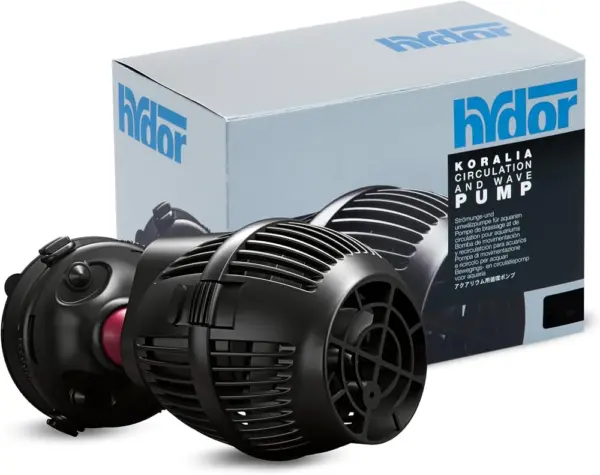
Hydor Koralia Evolution 850 – Best Overall
Key Features
- Flow rate: 850 GPH
- Power draw: 5 W
- Tank range: 50–100 gal
- Max glass thickness: 1/2 in
- Price: Midrange
The current from the Koralia Evolution 850 is wide and soft rather than sharp, and that’s why it’s our top pick. Hydor rates it at 850 GPH for 50- to 100-gallon tanks, and the flow spreads far enough to turn over a four-foot tank without hammering one corner. In a 55 or a 75 that reads as gentle everywhere and dead nowhere, which is what most freshwater community tanks and mixed reefs actually want.
The magnet is the other reason we keep coming back to it. It holds through glass or acrylic up to half an inch thick, so moving the pump is a five-second slide instead of a suction-cup wrestling match, and it stays where you put it. The trade-off is bulk — roughly 7 inches by 4, it’s a visible piece of equipment in a smaller tank — and the impeller wants a clean every couple of weeks or you’ll feel the flow soften.
Our verdict after living with it: this is the pump to buy when you want circulation solved and don’t want to think about it again. The one thing to understand is that it’s a fixed-flow powerhead, not a programmable wavemaker. On an external wave controller it can start in reverse, which is a genuine risk with small fish, so run it on its own outlet. If pulses and surge modes are what you’re after, the hygger cross flow below is the pick.
It’s also among the quietest pumps in this group — a low hum that disappears once the filter is running — and it carries a two-year warranty, matched here only by its smaller sibling. For a mid-size tank that needs steady, broad movement, nothing else on this list does the job more simply.
Pros
- Wide, even flow across a long tank
- Magnet grips through half-inch glass
- Very quiet in normal use
- Two-year manufacturer warranty
Cons
- Large body for smaller tanks
Our default for 50- to 100-gallon tanks: broad, quiet flow, a magnet that stays put, and no controller to fiddle with.
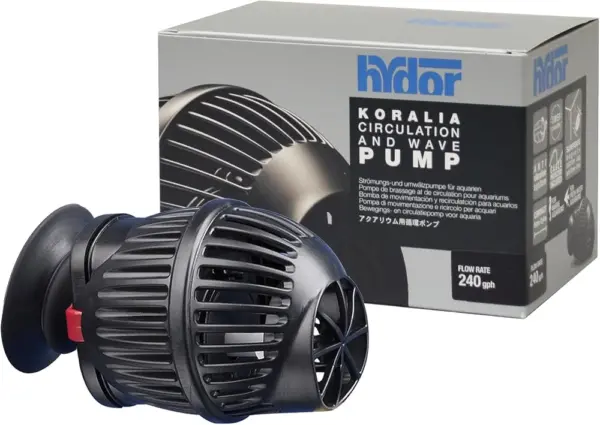
Hydor Koralia Nano 240 – Best for Nano Tanks
Key Features
- Flow rate: 240 GPH
- Power draw: 3.5 W
- Tank range: 16–28 gal fresh, 10–15 gal salt
- Max glass thickness: 1/2 in
- Price: Midrange
At 2.4 inches across, the Koralia Nano 240 is the pump we put in tanks where the equipment shouldn’t be the view. It’s rated at 240 GPH and 3.5 watts for 16- to 28-gallon freshwater tanks and 10- to 15-gallon saltwater ones, and that gentle push suits a nano reef with soft corals or a small planted tank. You’re paying for a small footprint and a low draw rather than gallons per dollar, and for most nano owners that’s the right trade.
Two details we appreciate. The sphere joint lets you swing the outlet to a new direction without unmounting anything, which matters when a coral grows into the flow path. And the cable protector is a genuinely thoughtful touch for anyone keeping urchins, puffers, parrotfish or triggers — the fish that chew through cords for fun. Magnet and suction cup both hold on glass or acrylic up to half an inch.
Noise is where it splits: usually it’s silent, but a unit with a rattle that no amount of repositioning fixes turns up often enough to buy from somewhere with an easy return. And if your tank is nearer 40 gallons, the hygger mini gives you more than twice the flow for less money. You choose this one for the footprint, not the output.
Pros
- Disappears in a nano tank at 2.4 inches
- Cable protector for urchins and puffers
- Sphere joint aims flow without remounting
- Only 3.5 watts
Cons
- Too little flow for tanks past 30 gallons
We choose it when the tank is small and the equipment needs to disappear — just don’t expect it to push a 40-gallon.
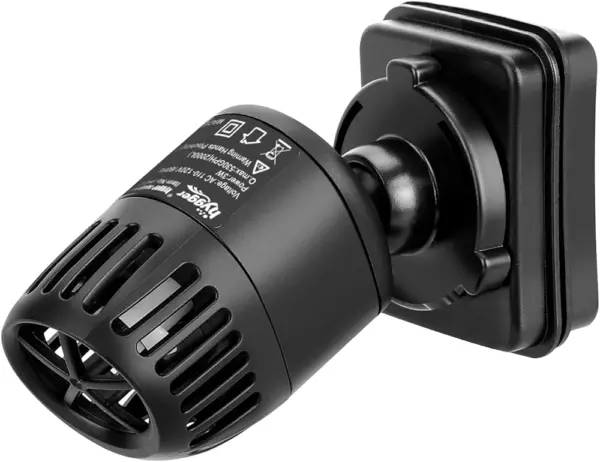
hygger Mini Wave Maker 530 – Best Value for Mid-Size Tanks
Key Features
- Mounting: Magnet, 4–10 mm glass
- Flow rate: 530 GPH
- Power draw: 3 W
- Tank range: 15–40 gal
- Price: Budget
We expected a budget pump to announce itself. The hygger mini doesn’t — at 530 GPH and 3 watts it runs as quietly as the pricier pumps here, and the magnet is strong enough that we stopped worrying about it sliding down the glass. Rated for 15- to 40-gallon tanks, it fills the gap between a nano powerhead and a full-size circulation pump, which is where a lot of aquariums actually sit.
For a 20- to 40-gallon tank this is the value pick of the group. The 360-degree ball joint makes it easy to aim along the surface or across the rockwork, the ceramic shaft and ETL-rated motor suggest something built to more than a price point, and the flow is enough for active fish without turning a small tank into a washing machine. It’s the one we suggest first to anyone who doesn’t want to spend much.
Above 40 gallons it runs out of ideas — a 75 needs the cross flow below, or two of these at opposite ends. In its own range, it’s quiet, cheap to run and easy to live with.
Pros
- Quiet at a budget price
- Strong magnet on 4-10 mm glass
- 360-degree ball joint for aiming
Cons
- Fragile ceramic shaft when cleaned
For 15- to 40-gallon tanks this is the best value here: quiet, magnetic, and cheap to run.
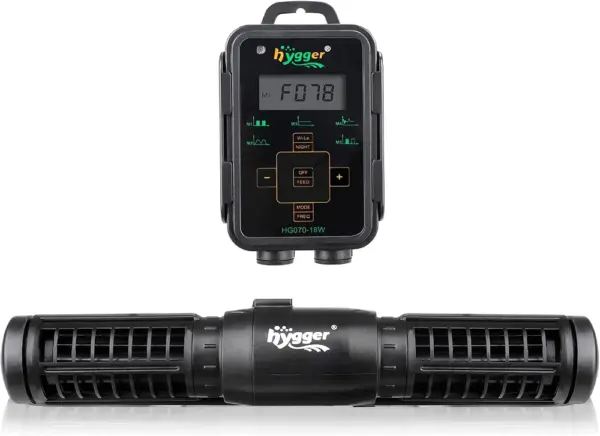
hygger Cross Flow 18W – Best Programmable for Large Tanks
Key Features
- Flow rate: 1850 GPH
- Power draw: 18 W
- Tank range: Up to 135 gal
- Wave modes: 5 via LED controller
- Price: Premium
Cross-flow pumps don’t look like the round powerheads most people picture. This one is a horizontal 8.5-inch barrel, 2 inches across, that pushes a broad sheet of water instead of a jet: mounted high it rolls the surface, mounted low it sweeps the sand. In a four- or six-foot tank that wide blade is far more useful than a narrow blast, and we like the way it reaches the far end without shredding everything near the outlet.
The controller is the reason to pay for it. A small LED panel gives five wave modes, from a steady stream to a pulse and a sine-style surge, plus adjustable strength and a night setting. The pulse modes are what make it interesting — soft corals and gorgonians move in a rhythm rather than bending one way all day — and being able to dial the surge down after lights-out keeps the tank calmer overnight.
Two things to plan for. It’s rated to 1850 GPH, plenty for up to 135 gallons, but on a 75 the flow is better split across two units or backed up at the far end. And reliability is the open question: a few of these stop within weeks, so buy somewhere with an easy return and keep the receipt.
If you want waves rather than just current, this is the pick of the group — the only pump here with real programmability. Buy it for a large tank when the budget stretches to a controller, hide the box, and accept that the occasional strip-down is part of owning a DC pump.
Pros
- Five programmable wave modes
- Broad cross flow reaches tank ends
- Turn the flow down at night
- Magnetic mount, 24 V DC motor
Cons
- Hums near full power
- Controller adds a box and cable
We recommend it when you want real wave programming on a big tank and can live with a hum at full power.
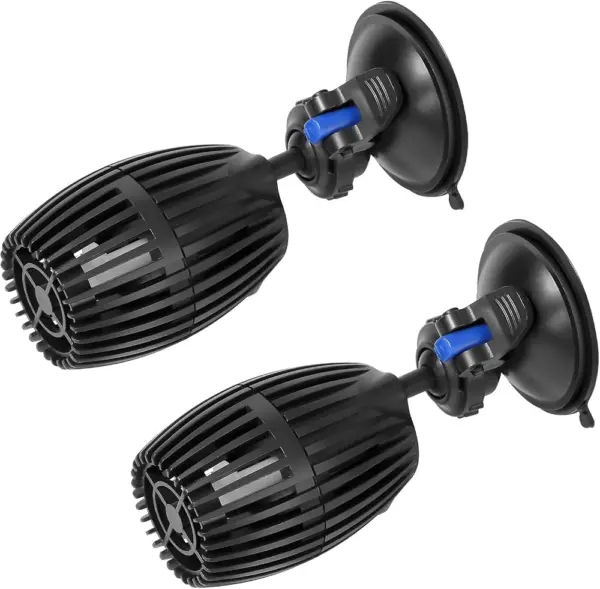
AQUANEAT 2-Pack 480 GPH – Best Budget Pair
Key Features
- Count: 2 pumps
- Mounting: Suction cup, 360 degrees
- Flow rate: 480 GPH each
- Power draw: 3 W
- Price: Budget
Two 480 GPH pumps for roughly the price of one of the budget singles is the whole pitch, and for a first tank it’s a good one. Put one at each end of a 55 or 75 and you get flow across the full length for very little money, or run one and keep the other as a spare. For a first 55-gallon on a tight budget, this is the pair we reach for.
Each pump is small — about 2 by 2.75 inches — with a 360-degree ball joint on the mount, and the six-foot cord is longer than most here, which buys placement options. The catch is the mount: suction cups eventually let go, and a pump that drops onto your corals overnight is a bad night. Clean the glass before sticking it on, and don’t rely on the cups in a tank where a fall would land on coral.
Longevity is the other caveat. The impellers and shafts on pumps at this end of the market wear, and a pair that costs less than a single branded unit is not the pair you keep for a decade. For a quarantine tank, a sump, a mixing bucket or a first freshwater setup, though, they’re hard to argue with.
Pros
- Two 480 GPH pumps for one low price
- Six-foot cords give placement options
- Ideal for quarantine or sump duty
Cons
- Impellers wear faster than pricier pumps
- Not for use with a timer or controller
We like it as a first pair: two pumps, two ends of the tank, very little money.
SunSun JVP-110 – Cheapest Spare Pump
Key Features
- Mounting: Suction cup
- Flow rate: 528 GPH
- Power draw: 2.5 W
- Tank range: 30–60 gal
- Price: Budget
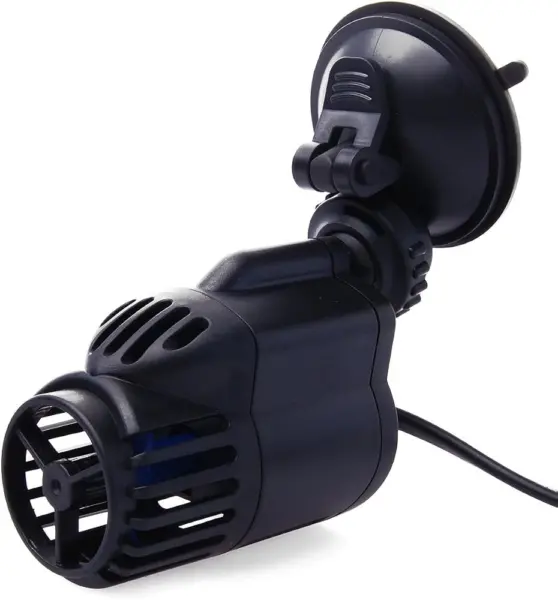
The suction cup is where this one gives ground. There’s no magnet on the JVP-110 — it sticks to the glass with cups and a 360-degree head, and cups are the reason people upgrade. In a quarantine tank, a fry setup or a sump where the pump sits below the waterline and never gets knocked, that’s a non-issue, and the price is remarkable.
At 528 GPH and 2.5 watts it moves close to what the hygger mini does for a fraction of the money, and it does it quietly. Our advice is to buy one as a spare or a temporary fix and expect to replace it in a year or so; at this end of the market that’s a fair deal, and it’s one of the more reliable cheap pumps in this group.
One thing to check before you order: the spec sheet lists 220 volts rather than the 110 to 120 the rest of these use, so confirm the unit you’re buying will run on a US outlet. Beyond that there’s nothing to configure and no controller compatibility — it’s a plug-it-in-and-go pump for jobs where long-term mounting doesn’t matter.
Pros
- Cheapest pump in the group
- 528 GPH from 2.5 watts
- Quiet and compact in small tanks
Cons
- Spec sheet lists 220 V — verify first
- Short 4.5-foot power cord
We treat it as a cheap spare or a sump pump — useful, disposable, and surprisingly strong for the money.
Sicce Voyager Nano – Best for Small Rimless Nanos
Key Features
- Flow rate: 270 GPH
- Power draw: 2.8 W
- Tank range: 5–30 gal
- Max glass thickness: 3/4 in
- Price: Premium
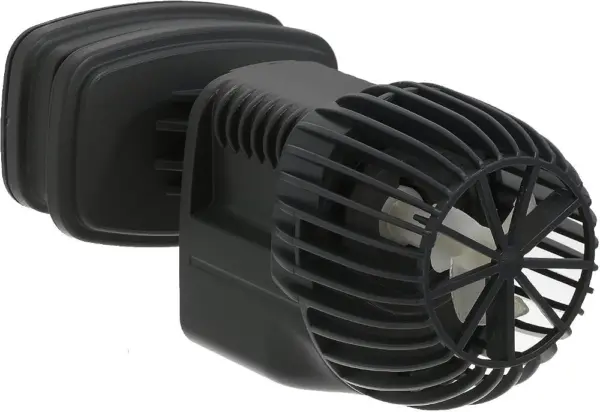
What the extra money buys here is refinement, not output. The Voyager Nano is rated at 270 GPH and 2.8 watts for tanks from 5 to 30 gallons, and it’s the smallest and best-finished pump in this group — a compact body with a 360-degree rotor and a manual flow adjuster you can turn down without reaching for a controller.
The magnet is the strongest of the small pumps here, holding through glass up to three-quarters of an inch, and we like that on a rimless nano with thicker walls. The self-cleaning impeller and stainless steel shaft are the other reason to consider it: fewer strip-downs, and less to snap when you do take it apart.
It’s a considered buy rather than an obvious one. Noise is the compromise — most run silent, but a persistent buzz that changes pitch turns up often enough that the return window matters — and if your tank is 20 gallons or under and you want the neatest possible install, it’s the nicest pump on the list.
Pros
- Best-finished pump of the small ones
- Magnet holds through 3/4-inch glass
- Manual flow adjuster on the body
- Self-cleaning impeller, stainless shaft
Cons
- Costs more than higher-flow rivals
The neatest small pump here — buy it for a nano where build quality matters more than gallons per hour.
How We Tested the Wavemakers
We started with spec sheets: flow ratings, glass-thickness ranges, mounting style, controller type, and price. Anything with a fixed speed, a suction-cup mount, or a footprint that would crowd a narrow tank got cut. That left 12 wavemakers, which we ran for nine months across three tanks — a 75-gallon mixed reef, a nano cube, and a six-foot softie tank — rotating them between systems so no pump got the easy corner.
Flow and current came first. I dropped a pinch of food at the far end of the tank and timed how long it took to cross, watched whether it spread into a wide wandering pattern or shot out as one visible jet, and checked behind the rockwork each week for the detritus piles that signal a dead spot. Every mode got a turn at full and half power, and I noted how far the stream could be aimed before the mount drifted on the glass.
Then the boring stuff. Each pump was unplugged and restarted 30 times to see whether it came back on without a nudge, and I listened from the couch at midnight with the return pump off — a hum you can hear across a quiet room is a dealbreaker in a living room tank. Once a month I pulled every impeller and cage for cleaning, which is where cheap builds show themselves: brittle clips, shafts that won’t reseat, magnets that slide down overnight.
Size and value were the last filters. I measured the wet-side footprint, checked the dry-side magnet against both rimless and braced tanks, and weighed what each pump actually did against what it cost — a mid-priced unit with a controller you can live with beat several pricier ones. The favorites are still running.
How to Choose an Aquarium Wavemaker
The right wavemaker is the one whose flow matches your tank volume and whose mount survives your glass; everything else is preference.
Match the Flow to the Tank, Not the Box
A pump’s flow figure is measured at the outlet with nothing in the way, so rockwork, depth and a dirty impeller all take a bite out of it before the water reaches the far end. As a rule, pick a pump whose stated range tops out at or just above your tank volume: 5 to 30 gallons is Sicce Voyager Nano territory, 15 to 40 suits the hygger mini, and 50 to 100 is where the Koralia Evolution 850 belongs. Going bigger than that doesn’t buy a cleaner tank; it buys current strong enough to make fish seek shelter.
The Mount Decides Where It Can Live
A magnet is worth paying for. It holds through the wall with no cups to peel off, and it lets you slide the pump to a new spot during a water change. Check the glass thickness against the spec first: the Hydor pumps here are rated to a half-inch, the hygger mini to 4 to 10 mm, and the Sicce to three-quarters of an inch. Remember the outside half of the magnet needs clean, flat glass too, which rules out some rimmed and bowed tanks. Suction cups work, but on a dirty pane they let go, so treat them as the temporary option.
Steady Flow or Programmable Waves
Most people want circulation, not a wave machine. A fixed powerhead like the Koralia Evolution runs at one speed, costs less and has nothing to configure, which is right for a freshwater community tank, a planted setup or a mixed reef. A controller unit such as the hygger cross flow adds pulse and surge modes, a night setting and adjustable strength, and on a large reef that variation earns its keep. Two caveats: the controller is another box to hide, and not every fixed powerhead tolerates an external controller, so pair one only with a controller the maker supports.
Noise and Footprint
Noise follows circulation pumps around, and mounting explains more of it than brand does. A magnet decouples the pump from the glass better than a suction cup, a pump run near full power on a DC controller will hum, and a bare pane amplifies everything. Footprint matters just as much: the Koralia Nano is 2.4 inches and vanishes, the Koralia Evolution is closer to 7 inches, and the cross flow is an 8.5-inch barrel. Measure the space before you decide where it goes.
Frequently Asked Questions
Do I need a wavemaker if my filter already moves water?
Often, yes. A filter return pushes water in one direction, and the far end of the tank becomes a dead spot where waste settles and surface film builds. Test it: drop a pinch of food at the opposite end and watch where it ends up. If it drifts into a corner and stays there, a small pump aimed along that wall will fix it.
Can I use one of these in a freshwater tank?
All the pumps here are rated for fresh and salt water. Aim the outlet across the surface rather than down into the rockwork, since that’s where the oxygen exchange happens, and keep the flow low for bettas, gouramis and other slow, long-finned fish. In a planted tank, point it at the front glass so the plants sway instead of bending flat.
How do I keep the flow from blowing sand around?
Raise the pump in the water column and aim it along the surface or across the front glass instead of down at the substrate. A wide cross-flow pattern moves more water with less force than a narrow jet, and most pumps here can be turned down or aimed with a ball joint. If sand still lifts, the pump is oversized for the tank.
Will a wavemaker heat the tank?
Every watt a submerged pump draws ends up as heat in the water. The 2.5- to 5-watt pumps here add almost nothing to a tank’s temperature; an 18-watt unit adds a small but real amount, which matters most in a small, already-warm reef. Check the wattage before you buy — under 5 watts, it isn’t worth worrying about.
Final Verdict
If you want the decision made for you, the Hydor Koralia Evolution 850 is the pump we point most people to. It covers the widest slice of real tanks, 50 to 100 gallons, with flow that spreads rather than blasts, a magnet that holds, and a noise level you forget about. The catch is that it’s a powerhead, not a programmable wavemaker: on its own outlet it simply runs, which is what most freshwater and mixed reefs need.
Spend more only when you want something specific. If you’re chasing a pulsing surge in a big reef, the hygger cross flow’s five modes are worth the step up. If your tank is under 40 gallons, the hygger mini does more of the job for less, and the Koralia Nano 240 is the one to fit when space is the constraint.