This post contains affiliate links. We may earn a small commission when you buy through our links — at no extra cost to you.
Every CO₂ system photo looks nearly identical — a stainless steel cylinder with a gauge. But the part that controls the gas, the needle valve, often determines whether you’ll grow a lush carpet of plants or wake up to a tank of suffocated fish. Budget valves can drift open without warning, and solenoids that leak when powered off are distressingly common.
That’s why the systems in this guide put valve and solenoid reliability first — each pick has real-world feedback proving it can hold a steady bubble count and seal completely when turned off. We also match generator capacity to your tank size, because a 5.5L canister is overkill on a nano desk aquarium, while a tiny disposable cartridge won’t sustain a high-demand 75-gallon scape.
Top Picks
Best for 20–75 Gal Planted
FZONE 5.5L CO2 Generator

Rating: 4.4 ★ | Price: Mid-Range | Capacity & Material: 5.5L SUS304 stainless steel | Integrated Solenoid: Yes, 12V DC | Needle Valve & Bubble Counter: Needle valve, integrated bubble counter/check valve | Included Accessories: Tubing, integrated check valve
The FZONE 5.5L generator uses a citric acid/baking soda reaction in a thick SUS304 stainless steel canister, and the precise needle valve holds bubble rate steady across multi-week refill cycles. The integrated solenoid works with a simple timer to shut off CO₂ at night, while the built-in bubble counter and check valve reduce the number of separate components needed.
This system targets 20–75 gallon planted tanks; the 5.5L capacity would overwhelm nano setups. It suits hobbyists who mix their own citric acid and baking soda refills and want low ongoing costs compared to cylinder swaps. The solenoid may not fully close when powered off, so always monitor with a drop checker and use a timer — this is a generator that rewards consistent attention rather than hands-off automation.
Pros
- Strong plant growth and consistent CO₂ output across tank sizes
- Stainless steel construction resists corrosion and holds up over time
- Low running cost from bulk citric acid and baking soda refills
Cons
- Solenoid may not fully close when off, risking overnight CO₂ leak if not monitored with a drop checker
If you run a 20–75 gallon high-tech planted tank and are comfortable mixing your own CO₂ charges, this 5.5L generator covers the entire injection chain — just keep a drop checker in the aquarium.
Best for Nano <15 Gal
FZONE Nano CO2 System
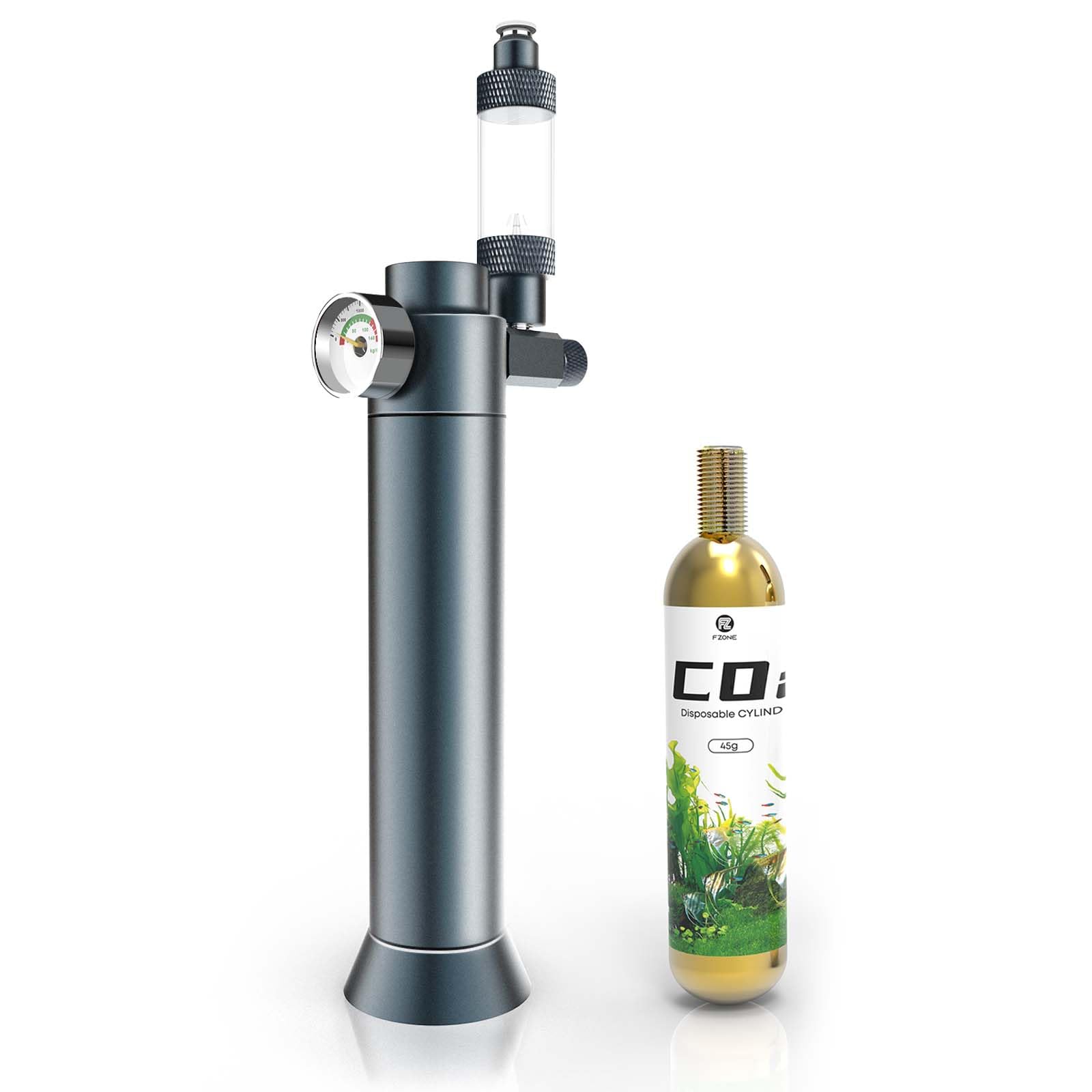
Rating: 4.4 ★ | Price: Budget | Capacity & Material: 45g cartridge, metal regulator | Integrated Solenoid: No | Needle Valve & Bubble Counter: Needle valve, no bubble counter | Included Accessories: None (regulator only)
The FZONE Nano CO₂ System separates itself from bulk generators with a slim all-metal design built for disposable 45g cartridges — no citric acid, no baking soda, no mess. It’s a natural fit for planted nano tanks (under 15 gallons), especially desk-top setups where a full-size CO₂ rig would be overkill. You get plug-and-play cartridge refills at minimal cost, but you do need to pay attention to the gasket: if the clear seal isn’t placed correctly before tightening, the cartridge can empty overnight. Once seated properly, output stays consistent for weeks, making it an easy entry point into pressurized CO₂ without the clutter of a large cylinder.
Pros
- Sleek all-metal build fits desktop aesthetics without bulk
- Consistent CO₂ output helps nano plants thrive with minimal effort
- Quick assembly — even first-timers get bubbles flowing in minutes
Cons
- Cartridge can leak empty if the gasket isn’t positioned correctly — the instructions may not emphasize this step
A tidy cartridge-based solution for nano tanks, provided you take ten seconds to check the seal — otherwise, it’s a low-maintenance upgrade from passive yeast systems.
Best for Budget 10–30 Gal
Hygger 2L CO2 Generator
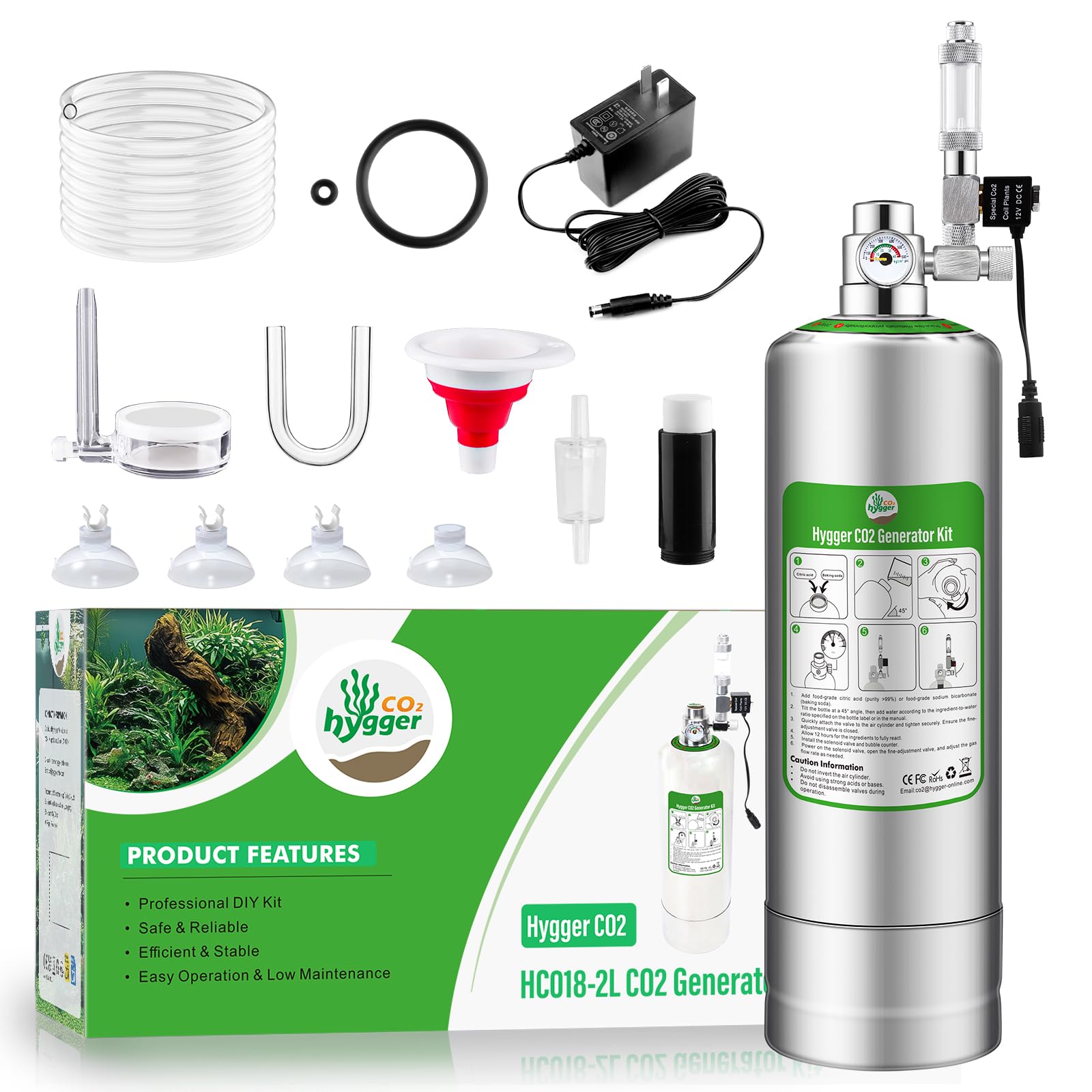
Rating: 4.2 ★ | Price: Budget | Capacity & Material: 2L SUS304 stainless steel | Integrated Solenoid: Yes, 12V waterproof | Needle Valve & Bubble Counter: Needle valve only
This two-liter generator packs a solenoid, regulator, and needle valve into a compact stainless steel body at an entry-level price — a complete starting point for automated CO₂ injection on tanks up to 30 gallons. The system is designed for beginners who want to try pressurized CO₂ without a large upfront investment and are comfortable with the fact that the valves and solenoid may need replacement sooner than on higher-priced units.
Best for owners of 10–30 gallon planted tanks who prioritize affordability and automation over long-term, maintenance-free operation. The smaller 2L capacity means more frequent refills, and the solenoid’s seal quality can vary between units.
Pros
- Compact stainless steel build at a budget-friendly price point.
- Includes solenoid for automated CO₂ injection at a low entry cost.
- Cost-effective way to start with pressurized CO₂ without a large investment.
Cons
- Valves and solenoid may degrade or arrive with connection leaks; some units need early part swaps.
A competent starter system for small planted tanks, provided you’re willing to check seals on arrival and accept that the valves may not last as long as the canister.
Best for Low-Tech Nano
Aquario Neo CO2 Kit

Rating: 4.3 ★ | Price: Budget | Capacity & Material: Yeast/gel bottle, plastic | Integrated Solenoid: No | Needle Valve & Bubble Counter: No needle valve | Included Accessories: Diffuser, bottle, yeast sachets
The Aquario Neo CO2 kit delivers a steady trickle of CO₂ using yeast and gel, which boosts plant growth in small low-tech tanks. Output cannot be adjusted or stopped, and it varies with temperature — this limits its role to gentle supplementation rather than controlled injection. For tanks under 10 gallons where a slight boost is all that’s needed, it sidesteps the complexity of regulators and solenoids entirely.
Pros
- Easy all-in-one solution with included diffuser, yeast, and gel — setup takes minutes.
- Noticeably improves plant growth and color in freshwater tanks up to 10 gallons.
Cons
- CO₂ output is passive and unregulated; production fluctuates with temperature and mixture age, and cannot be paused or adjusted.
This kit suits nano tanks under 10 gallons where a modest CO₂ bump helps, as long as you accept the hands-off, unregulated delivery.
How to Choose
The needle valve — the tiny component that controls CO₂ flow — makes or breaks your planted tank’s safety and consistency.
Generator Capacity & Material
Larger stainless steel cylinders like 5.5L hold 600–800g of raw citric acid and baking soda, providing months of CO₂ for tanks up to 75 gallons. The 2L size suits 10–30 gallon setups but requires more frequent mixing.
Plastic bottle kits are cheap but prone to cracking under pressure and UV exposure, while the stainless steel bodies resist corrosion and won’t fail catastrophically. For nano tanks under 15 gallons, a disposable 45g cartridge system eliminates mixing entirely, though cartridges need replacing every 4–6 weeks with daily use.
Solenoid Automation
A solenoid valve opens when powered, letting CO₂ flow only during the light period. Without it, CO₂ runs 24/7, wasting gas and risking a nighttime pH crash.
The hidden trade-off: many solenoids don’t seal perfectly when off, slowly seeping CO₂. Choose a system with consistent seal feedback, and always use a drop checker with 4 dKH solution inside the tank as a safety net — the solenoid should never be your only shut-off.
Needle Valve & Bubble Counter
The needle valve adjusts bubble rate in fine increments. Budget valves often use coarse threads that let the bubble count jump from 1 to 10 suddenly, making it impossible to dose precisely. Integrated bubble counters visualize flow but don’t measure CO₂ concentration; you still need a drop checker.
Even with a quality valve, temperature changes and aging of the citric acid mixture shift output day to day. Expect to tweak the valve every couple of days to maintain the target bubble rate.
Safety Features
An automatic pressure relief valve vents gas if the container exceeds a set limit (typically 30–80 kg/cm²), preventing explosive failure. A separate manual shut-off valve adds a physical barrier and is essential if the solenoid leaks.
Cheap kits often skip these or use low-spec plastic relief valves that stick. For cartridge systems, pressure is inherently lower, but you lose the ability to stop flow without a solenoid. In any system, never run CO₂ without a properly installed drop checker in the aquarium.
Included Accessories
Kits may bundle a diffuser, check valve, and tubing, but the included diffuser is frequently a ceramic disc that produces large bubbles or clogs within weeks. Plan on upgrading to a fine-pore in-tank or inline diffuser for a mist of micro-bubbles that dissolves efficiently.
A check valve prevents aquarium water from siphoning back into the generator and ruining the mixture. Some generators integrate one into the bubble counter; others include a separate inline check valve. Make sure yours has one in the line.
FAQ
Why does my CO₂ generator leak when the solenoid is turned off?
Debris, wear, or design flaws can prevent the solenoid plunger from seating fully. Clean the valve and test with a drop checker. If the leak persists, manually close the shut-off valve at night until you can replace the solenoid or upgrade the regulator.
How can I prevent my DIY CO₂ system from killing my fish?
Use a drop checker filled with 4 dKH indicator solution inside the tank to monitor CO₂ concentration in real time. Set a timer so CO₂ turns on 1–2 hours before lights and off 1 hour before lights out. Never rely entirely on the needle valve or solenoid; always have a manual shut-off valve as a backup.
Why isn’t my bubble counter producing bubbles after a few days?
The most common causes are a leak in the tubing or a stalled chemical reaction. Check all connections and caps for tightness, and ensure the check valve isn’t stuck. If using citric acid/baking soda, the mixture may have depleted or deactivated; a fresh charge usually restores flow immediately.
Can I use a different diffuser with my CO₂ generator kit?
Yes, you can swap the included diffuser for any ceramic or inline diffuser that matches your tubing size. An in-tank diffuser with fine pores creates a mist of micro-bubbles that dissolves far more efficiently than large-bubble diffusers. Always install a check valve between the generator and diffuser to prevent water back-flow.